In my editor’s note in the fifth issue of the Graduate Journal of Food Studies, which launched online today, I considered how to define food studies, inspired by definitions put forth by Carole Counihan and Penny Van Esterik in Food and Culture: A Reader and by Jeff Miller and Jonathan Deutsch in Food Studies: An Introduction to Research Methods. What follows is a selection from that piece. You can read the entire essay here, and we hope you’ll enjoy the complete issue, here.
When tasked this semester to define food studies for my students, I proposed the following:
Food studies is a burgeoning, interdisciplinary, inherently politicized field of scholarship, practice, and art that examines the relationship between food and all aspects of the human experience, including culture and biology, individuals and society, global pathways and local contexts.
I explained that our discipline is young, pointing to the emergence in the 1980s of texts now considered nearly canonical, such as Sidney Mintz’s Sweetness and Power and Warren Belasco’s Appetite for Change, as well as the pioneering work of Mary Douglas and Carole Counihan. I declared food studies an interdisciplinary pursuit, one that is thrilling and innovative, if sometimes nebulous. I further clarified food studies’ scope as an academic field of research, writing, and teaching, but just as importantly, a field dedicated to building bridges between scholarship, practice, and art. Food studies is a field built on the connections between researchers and communities, addressing resources, assets, dilemmas, and solutions. I attempted to summarize the vast inclusiveness of our object of study, pointing to dynamics between culture and biology, individuals and society, global and local processes.
And I felt called to emphasize that our field is inherently politicized. Food studies scholars often assert that food—food culture, food access, and food sovereignty—is a human right. Food studies examines how food constructs identities. And food studies analyzes how governments shape and control food through food systems regulation, food labor policies, food and feeding programs, and support (or lack thereof) for food-related research and artistic expression.
As a result, food studies matters, now more than ever. I hope that this issue of the Graduate Journal of Food Studies incites critical thought, inclusiveness, and hope as we define and enact food studies in our current political climate.
I’m delighted to share that my article, “Healthy Food Blogs: Creating New Nutrition Knowledge at the Crossroads of Science, Foodie Lifestyle, and Gender Identities,”* was recently published in the thirty-sixth edition of Yearbook of Women’s History, a special issue titled, “Gendered Food Practices from Seed to Waste,” edited by Bettina Bock and Jessica Duncan, available for purchase here.
My article explores the intersection of nutritional and foodie discourses within a selection of popular “healthy food blogs” in the United States. This subgenre of food blogs combines health-conscious recipes, nutrition education, and the theme of “clean living” with the stylized preparation, plating, photography, personal narrative, and consumptive lifestyle that typically characterize food blogs.
Through content analysis and close reading, I analyzed twelve blogs that were featured in Shape Magazine’s online list, “Our Favorite Healthy Food Blogs,” published in summer 2014. Google searches for “healthy food blogs” confirmed these blogs’ relative popularity among readers, and several blog authors have published cookbooks based on their blogs, placing them among a select group of well-known and financially successful food bloggers. This list of blogs also makes a useful sample because the Shape feature included interviews with the bloggers, which provide additional pertinent data of a nearly ethnographic quality. For example, these interviews summarize how each blogger conceptualizes “healthy food” and “good nutrition,” as well as how they position their own food blogging in relation to nutrition science.
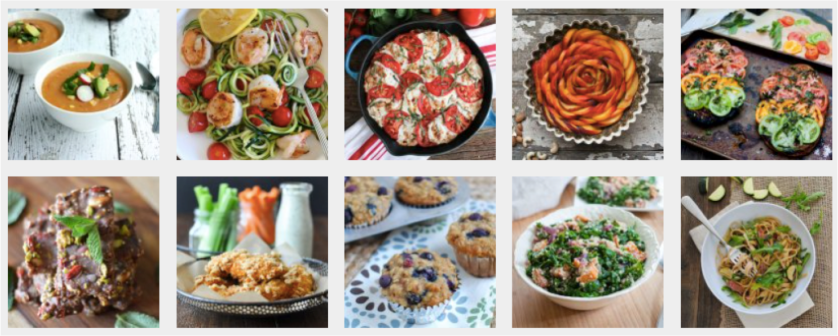
Thumbnail images from the healthy food blogs Shape featured.
These blogs create new knowledge about food, eating, and health. Principally engaging Gyorgy Scrinis’ concept of “nutritionism,” I examine how nutrition knowledge on these blogs—positioned at the crossroads of competing paradigms—is constructed, disseminated, and consumed, as well as how it might be renegotiated. I demonstrate how these healthy food bloggers construct authority and expertise through variable combinations of professional credentialing (for example, as registered dietitians or certified health coaches) and life experience growing, cooking, and eating food, as well as experience following a particular diet, losing a significant amount of weight, or mothering. I also explore how blog content aligns, contradicts, and/or renegotiates conventional dietary advice, such as government dietary guidelines that until recently promoted lower fat diets. This comparative analysis reveals the ongoing contest for the authority to speak for our bodies and to define a “healthy” diet and identities.
In the case of healthy food blogs, this authority is intertwined with the construction of a hyper-feminine domesticity that is distinctly white, middle class, and heteronormative, which potentially limits the transgressive potential of these media forms. I build upon past analyses of “food porn” to apply the concept of food pornography to the representation of bloggers themselves.
I investigate the role food porn plays in producing and sustaining food inequalities and the social politics of inclusion and exclusion. I thus consider not only spectacular representations of food, but also the highly curated aesthetics of food bloggers’ appearances, bodies, and social relationships. Just as food blogs display food porn through photography and presentations of unrealistic and remarkable food lives, these blogs also depict fantasies of hyper-femininity through Hollywood-esque friendships and courtships, dream weddings, blissful marriages, slim and “healthy” bodies, and perfect motherhood. Just as food porn renders food and cooking seemingly out of reach for many consumers, these representations of healthy food bloggers similarly limit “successful” performances of femininity, containing it within hyper-feminine, heterosexual, white, and relatively affluent bounds.
Thumbnail images from the healthy food blogs that Shape featured.
Although these healthy food bloggers resist, negotiate, and transform conventional nutrition education and dietary advice, these representations of hyper-feminine domesticity are inherently part of the food, nutrition, and health knowledge that they produce. It remains to be seen if the highly curated pages of food blogs may also be a space for postfeminist action. This sample of food blogs reveals significant tensions between progressive and regressive representations of femininities, which curtail the socially transformative potential of these new food knowledges, even as they effectively decenter nutrition science’s dietary hegemony.
This fascinating issue dedicated to the topic of food and gender contains ten articles and one showcase interview with Johanna Maria Van Winter, author of Food and Nourishment in Medieval Europe and Spices and Comfits: Collected Papers on Medieval Food, among many others. As mentioned in the special issue’s title—from seed to waste—editors organized the articles within the structure of the everyday food cycle starting with food growing before processing, selling, and serving; buying and cooking; and eating; then concluding with cleaning and disposing.
Cover image of Yearbook of Women’s History 36.
The editors write, “The collection of papers contained in this Yearbook showcase that food practices have important implications for gender identities, social norms, socio-economic positions, relations of power, and bodies” and form “a curious, complex, and compelling picture.” It is available for purchase here.
* Yes, I’ve learned my lesson about giving articles titles that are way too long. I’ll never do it again. Learn from my mistake.
Food studies can learn from a similarly burgeoning and interdisciplinary field: food design. Last week, I had the opportunity to attend and present at the 3rd International Conference on Food Design, organized and led at every step by Francesca Zampollo. The conference consisted of ten research and practice presentations and four keynote addresses, which were all shared online in a virtual environment. As my first virtual conference and my first food design event, I’m now reflecting on seven key things.
1. The ongoing definition of a field is a good thing.
Just as food studies continually immerses itself in processes of interdisciplinary self-definition, so too does food design. In an editorial in the first issue of the International Journal of Food Design, Francesca summarized multiple definitions for the field, excerpted here. And Francesca further clarified the field of food design, identifying key categories:
food product design
design for food
design with food
food space design
eating design
food service design
critical food design
food system design
In their conference presentation, Ludovico Pensato and Alessandra Ivul of Panem et Circenses conceded their discomfort with having their work categorized as food design, which in Italy refers nearly exclusively to industrial design, invoking commerce and architecture more so than art and performance. In the end, such wrestling with a field’s definition, boundaries, and meaning ensures innovation and invention, commitment and care.
2. Play possesses enduring value.
Food designers incorporate a sense of play, which illuminates their work and passion for food. Even when discussing food dilemmas—like the tension between health and indulgence—Deger Ozkaramanli, of the Delft Institute of Positive Design, asserted that food solutions can be inspired, creative, and playful, like chocolate to-do lists to maximize motivation, productivity, and pleasure, all at once. In their CHIL-DISH project, Kristos Mavrostomos and Anna van der Lei capitalized upon children’s sense of play and fun, as they created fully functional, kid-designed tableware with items like a house-shaped teapot and a bolt-shaped mug. And Léa Bougeault and Aude Laznowski of Miit Studios endorsed playfulness as a business strategy, arguing that positive childhood food memories make for natural points of connection, communication, and conviviality between people and companies. Somewhat similarly, Júlia Nasa argued that creativity is as important to consider as nutrition, sustainability, or safety, as a sense of curious creativity can enliven these other aspects of food and food systems.
3. Food and the senses remain central.
Food design foregrounds sensory experiences. Beatrice Lerma, Doriana Dal Palu’, and Eleonora Bugatti shared how the sounds made by food packaging—for example glass, clay, and plastic containers for yogurt—shaped how consumers perceived flavor, as well as characteristics like quality, craftsmanship, and genuineness. In her presentation, Slow Tofu, Weiwei Wang highlighted tofu not as a high-protein meat substitute with mutable flavor, as it is so often characterized in the West, but as a delicious and complex food unto itself, eaten in various ways and possible to prepare on one’s own with simple tools: a plate, a handmade basket, and a bowl. Ivana Carmen Mottle further explored how sensory tasting events can merge the experiences of eating and tasting, performance and art, entertainment and learning, conviviality and identity.
4. Food space can be transformative.
Food design often engages a strong sense of place and space. In her presentation on the rise of solo dining in urban areas, Emily Cheng posited ways for restauranteurs to spatially consider the needs of diners who eat alone in public, an activity that often carries social stigma. And Alexandra dos Santos presented the results of her work with a local market opening its doors after hours in an effort to engage customers and create a greater sense of community. Centered around the market’s space and building, the evening event incorporated not only locally produced goods and sellers, but also conversation, music, photography, drawing, and design.
5. Food experiences traverse the life course.
Projects shared at the conference engaged food at moments across the life course, from childhood to adulthood and into older age. In their CHIL-DISH project, Kristos Mavrostomos and Anna van der Lei engaged children as young as five in the processes of food design, cooking, and reflecting on food culture. Liza Murphy from The Big Picture research firm shared results from a study of one hundred Millennial and “Generation Z” consumers, revealing how young eaters are shaping the future of eating, snacking, and thinking about health. Additional projects at the conference navigated food in later stages of life. Annet Hoek shared the results of her study which incorporated the principles of molecular gastronomy to improve the culinary experience and nutritional status of elderly patients with swallowing difficulties. Jonas Pariente shared Grandma’s Project, a collaborative web series of recipes and stories, featuring grandmas from around the world.
6. Virtual conferences can be effective, fun, and meaningful.
I was very pleasantly surprised by how this virtual conference promoted the exchange of ideas and provided opportunities for social networking, collaboration, debate, and intellectual growth. All of the presentations were streamed with Google Hangouts, live on air, and then immediately available on YouTube for further viewing and sharing. Presenters shared their interests and contact information with digital business cards:
Throughout the conference, presenters and attendees interacted in the chat rooms, through direct messaging, and on Twitter. And even now that the conference is over, its entire structure still exists online with presentation abstracts, the conference proceedings, and recordings of all the presentations and Q&A ready and waiting, forever, to be further discovered and explored.
7. Aesthetics make an impact.
Lastly and perhaps unsurprisingly, designers produce beautiful things—including their presentation slides, videos, and materials. (Check out Emily Cheng’s lovely slides here.) Food studies academics could certainly learn a trick or two from the visually stunning ways that designers present, represent, and summarize their ideas!
As for my presentation at the conference, I shared “Designing Gender: Masculinity and Food Packaging.” You can read the abstract here and watch the presentation below, starting at approximately 4:00.
Our current political moment has incited numerous protests and with them a new cohort of protest posters, including ones that engage food as resistance in ways literal and metaphorical, scathing and humorous. Megan Elias has begun a public history project to archive these political ephemera—Dishing it Out: Food-Themed Protest Posters. Megan is a historian who writes about food in the US. Her new book, Food on the Page: Cookbooks and American Culture (Penn Press) will be out in June 2017. She was kind enough to answer a few questions about Dishing It Out:
Emily: What inspired you to start gathering these images of food-themed protest posters?
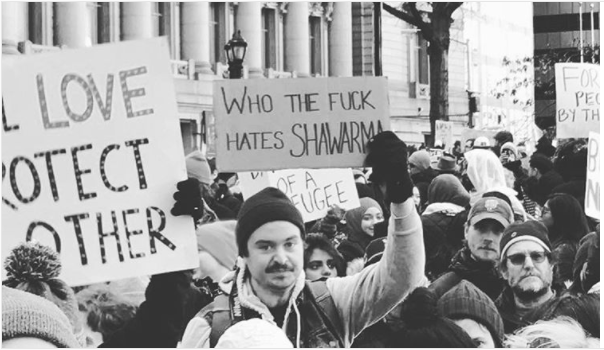
Megan: I noticed the shawarma poster at a protest that I went to in NYC and then a friend in Boston posted a picture of a sign about coffee. The connection jumped out at me because I’m always thinking about food’s roles outside the kitchen. I thought that if this was a trend it would be one worth thinking about.
What do you think these images tell us about food history—and about food politics?
I’m hoping to get other people to work this out with me. I think there are lots of different things going on. One thing that is fascinating for me is that some signs foreground the tendency to embrace the foods of another culture while keeping the people associated with those foods at arms length. Another thing I see is that this contemporary collection of protest movements incorporates humor really openly and that food can help people make their jokes. The use of cheetos to identify the president is a great example of this. It’s not just because they’re orange and he wears tanner—no one calls him Mr. Carrot. Cheetos carry some other code that people find useful for mocking Trump.
Which poster resonates with you the most?
The first poster I saw, “Who the Fuck Hates Shawarma,” still interests me most and is what made me want to start this collection. It’s so insouciant but also a great question: to what extent does our own self identification within the American political system shape what we will and won’t eat? You can take the sign literally: are there people who hate shawarma because it comes from the Middle East?
Travel Ban Protest, Battery Park NYC, January 29, 2017.
If you would like to add an image of a food-themed protest poster to this project, provide an update to any of the image captions, or contribute an interpretive piece based on the image collection, please use the contact form on the Dishing It Out website.
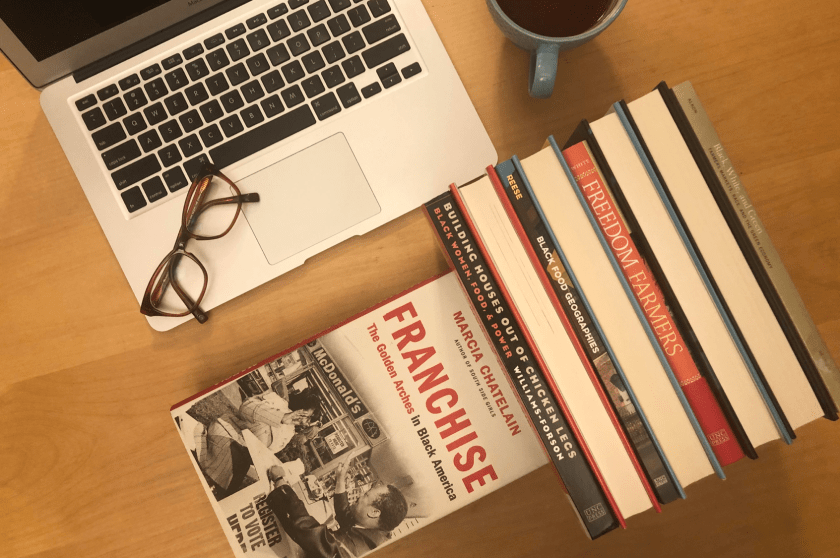
In 2017 with friend and colleague, KC Hysmith, I started this list, dedicated to academic books on African American food and culture. I’ve updated the list every February since, adding books chronologically by their year of publication. But these are books for reading far beyond Black History Month alone. As the list indicates, this is a rich, important, and growing area of food studies research that is gaining momentum.
These books matter as they address many themes, including: the significant contributions of African and African American foodways to “American” food culture; the knowledge, expertise, and agency of enslaved people, expressed through agriculture, cooking and domestic labor, botanical medical traditions, and food commerce; the meaning and historical trajectory of Soul Food; and the intersections of food and race with embodiment, health, medicine, agriculture, and power.
If you have suggestions for books to add, please send me a note or let me know in the comments! And find even more academic works, as well as historic and contemporary cookbooks from Black chefs and restauranteurs, on Black Culinary History’s fantastic website.
Doris Witt, Black Hunger: Food and the Politics of U.S. Identity (Oxford University Press, 1999)—reissued as Black Hunger: Soul Food and America (University of Minnesota Press, 2004).
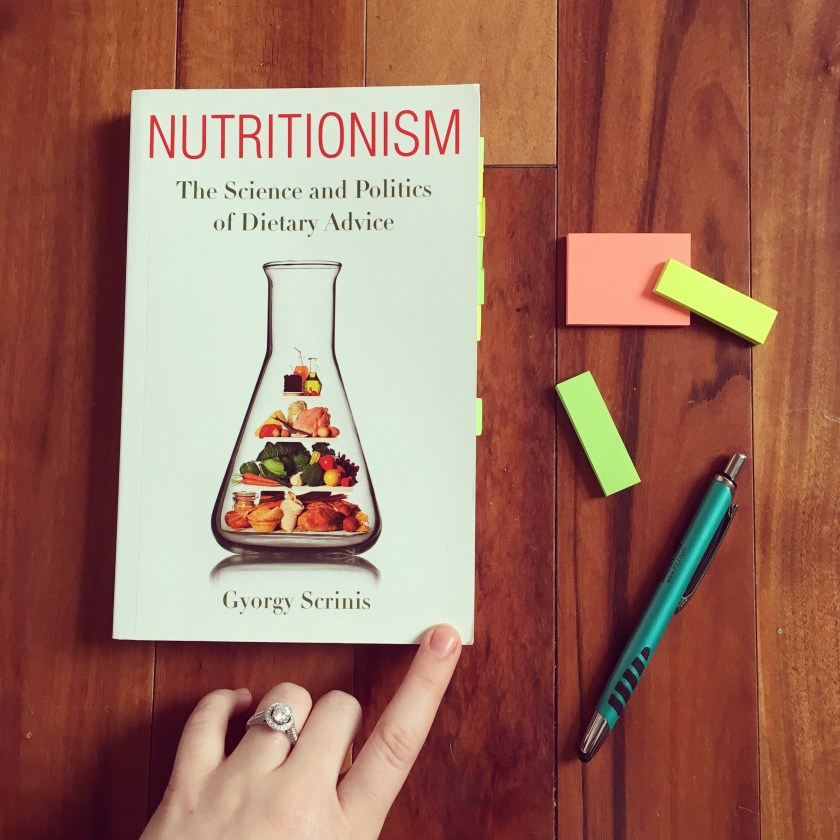
Gyorgy Scrinis of University of Melbourne presented “Nutritionism, Big Food, and the Corporate Capture of Nutrition” at Harvard University on December 7. The talk provided a fascinatingly concise summary of Scrinis’ work on nutritionism to date and previews his new work, which directly engages how the corporate food industry has captured, appropriated, and co-opted the discourse of nutritionism in food product development and marketing.
The event was sponsored by Harvard-based working groups on the History of Medicine and Modern Science and organized by my friend and colleague, Lisa Haushofer, a PhD candidate in History of Science at Harvard.
I live tweeted during the event and have curated the talk’s main points below. Learn more about Gyorgy Scrinis and Nutritionism here.
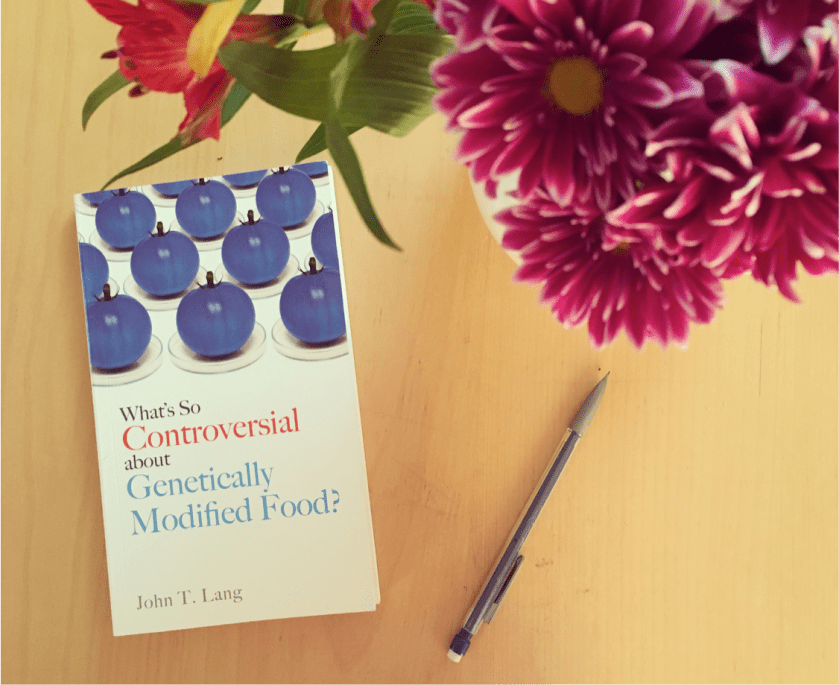
As a sociologist of food who explores the intersection of consumption, culture, and trust, Lang could not have found a more compelling case study. Lang places the debate around genetically modified (GM) food and our current “menu of choice” in social context. He demonstrates how controversies about GM food are but “a proxy debate” that articulates larger issues of social and political power, cultural values, corporate responsibility, intellectual property, democratic practices, science, and technology through concerns regrading risks and benefits, expertise and knowledge, fear and trust.
Lang novelly argues that genetic modification is not only a complex issue, but perhaps one that has misguided our attention and political activism. Going so far as to describe GM food controversies as “largely symbolic in content,” Lang points us to the heart of the issue as he writes:
Time, energy and money have been dedicated to debates about whether GM food has more potential for good or evil, yet these resources might be better spent seeking solutions to known problems in agricultural practices and systems, like contaminated and inadequate water supplies, degraded soil quality, stresses of climate change and persistent distribution problems. That we have become so focused on genetic modification controversies is the biggest problem of all. The scientific tool of genetic modification is not the ultimate problem, but rather a distraction from the persistent problems that plague our international food system.
After spending more than a decade researching this topic, Lang shares, “I hold a relatively neutral position on GM food.” He asserts that rather than narrowly focusing on genetically modified foods or issues like GM labeling, we will be better served by broadly advocating for increased social responsibility and local adaptability throughout the food system. Such a focus seeks to dismantle the links between profit, industry-wide consolidation, scientific hegemony, and intellectual property law—which form the current foundations of genetically modified technology.
In the end, Lang finds inspiration in Hunter S. Thompson’s The Rum Diary: The Long Lost Novel; that we can make good use of “the continuing tension between restless idealism and an impending sense of doom” to fuel our search and activism for more just and culturally appropriate solutions within our global food system.
Please Join Food Studies at Brown for:
The Tension Between Idealism and Doom: Our Future with Genetically Modified Food
John Lang | Associate Professor of Sociology, Occidental College
December 2, 2016 | 3:30 pm | Smith-Buonanno 106, 95 Cushing Street (Map)
Warmly open to the public
Co-Sponsored by Brown University American Studies, Science and Society, the Institute at Brown for Environment and Society, Anthropology, and BIOL 0190U: Plant Development, Structure and Function
About Food Studies at Brown
Food Studies at Brown began in spring 2016 and currently involves dozens of faculty members across disciplines such as American Studies, Anthropology, Biology, English, Environmental Studies, Medicine, and Public Health. Courses offered by Food Studies at Brown affiliated faculty explore food, culture, and identity; food systems, agriculture, and sustainability; food policy and issues; nutrition, health, disease, and medicine; and food writing and media; among other topics as well.
Food Studies at Brown approaches food from a broad and interdisciplinary perspective. We examine the relationship between food and all aspects of the human experience, including culture and biology, individuals and society, global pathways and local contexts. Across our campus, faculty, students, and staff engage with food in myriad meaningful ways. Food Studies at Brown endeavors to bring food-related research, teaching, projects, activities, and events together in one place so that we can synthesize our efforts across campus and the community.
For more information regarding Food Studies at Brown, contact Emily Contois at emily_contois [AT] brown.edu.
Diners, Dudes & Diets: How Gender & Power Collide in Food Media & Culture will be published in fall 2020 by the University of North Carolina Press.
Analyzing pop culture like dude food and the dadbod, Diners, Dudes & Diets tells an insightful and contemporary story about food, health, media, and the contest for our identities. During and after the Recession, gender norms shifted in American culture, resulting in a moment of gender crisis that opened the door for industry to target men in new ways. I reveal how the food, media, and advertising industries used the concept of “the dude” to sell feminized products to men. The dude celebrates the average (or even below average) guy. He interacts with food, but with such detached coolness and insincerity that it does not infringe upon his sense of masculinity. Brands deployed the dude to sell everything from men’s cookbooks and Guy Fieri to diet sodas, yogurts, and weight loss programs. I demonstrate how twenty-first-century gender crisis played out through food—and how understanding that process might help all of us to find more joy and justice in our media lives.
Get a taste of what I’ve already published on these topics:
My own article examined a particular product: Vegemite. Chocolate-like in appearance but with a flavor like nothing else on earth, Vegemite is a yeast extract spread that is essentially synonymous with Australia. I’ve written about Vegemite before here, here, and here.
In this most recent publication, I examine how Vegemite was not an instant success when first marketed to Australian consumers in the 1920s. It was culturally resonant advertising campaigns in the 1930s, 1940s, and 1950s, designed by the US ad giant J. Walter Thompson, that played a key role in securing Vegemite’s place in a significant share of Australia’s kitchens. These efforts included the now iconic “Happy Little Vegemites” campaign, developed for radio in 1954 and television in 1956. In rotation ever since, it is a campaign that comprises what Douglas B. Holt calls a brand’s “masterful, breakthrough performance”—an advertisement so extraordinary that it is incorporated into the culture itself.
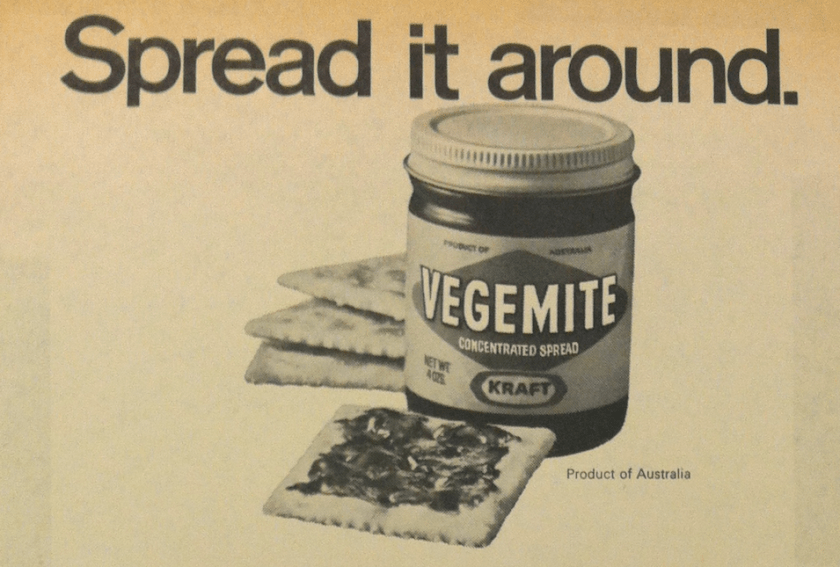
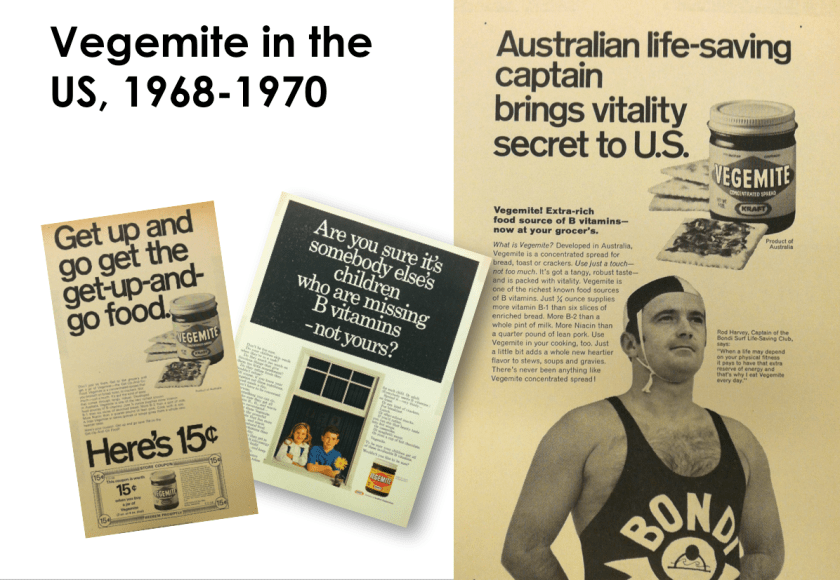
Given Vegemite’s sales success and burgeoning cultural icon status in Australia, Kraft attempted a transnational feat in the late 1960s—to create a US market for the salty spread. J. Walter Thompson developed at least three distinct campaigns, which ran in newspapers and magazines across the USA between 1968 and 1970. Introduced to a nation only peripherally aware of Australia itself, these campaigns failed. Despite this, Vegemite and its US advertising tell us an intriguing story.
Sample advertisements from the U.S. Vegemite campaigns. J. Walter Thompson (1968-1970), “Kraft, 1968-1970, Vegemite”, Domestic Advertisements Collection, Box KR36, David M. Rubenstein Rare Book & Manuscript Library, Duke University, Durham.
Combining the approaches of advertising history, food studies, and transnational studies of popular culture, this article presents Vegemite —as both a food and cultural product—as a case study through which three interrelated themes can be explored.
First, Vegemite in the USA demonstrates the progression of American perceptions of Australia during the latter half of the twentieth century. Despite failing to capture the American market in the late 1960s, Vegemite—and Australia—captured American interest in the 1980s when a pop culture wave of Australian films, music, and sport triggered several years of success stateside.
Most notable among these was Men at Work’s 1982 hit song, “Down Under.”
The song’s second verse ignited an American fascination with Vegemite and all things Australiana:
Buying bread from a man in Brussels He was six foot four and full of muscle I said, “Do you speak-a my language?” He just smiled and gave me a Vegemite sandwich
(Hay and Strykert, 1981)
Second, Vegemite’s failures and successes in the USA articulate the complexity of the transnational flow, adoption, and rejection of ideas, people, and products. Appadurai (1990, 1996, 2010) has theorized extensively on the politics of ever shifting, but always connected transcultural flows and exchanges, as they challenge traditional notions of the nation-state. Indeed, scholars debate whether transnationalism represents cultural imperialism and homogenization or processes of localization and generative hybridity.
Globalization’s effects upon local food cultures and “national cuisines” are also central to these debates (Inglis and Gimlin, 2010). While scholars have explored the hegemonic potential of global food brands, such as McDonald’s (Ritzer, 2004; Watson, 1997), Coca-Cola (Foster, 2008), and Starbucks (Harrison et al., 2005; Plog, 2005), I ask what is to be made of Vegemite, as a failed cultural exchange between two nations, both former English colonies.
While efforts to tap an American taste for Vegemite ultimately failed, my analysis of US newspaper articles mentioning Vegemite between 1982 and 1988 finds that American perceptions of Vegemite fall into three main categories: excited exoticism, pleasantly bemused derision, and elitist disdain. No matter the reaction, Vegemite press coverage throughout the decade demonstrated the ambivalent and non-linear progression of American perceptions of Australia, as Americans’ at times derisive views of Australian culture comingled with enthusiastic mania for Australiana.
Third and finally, these transnational exchanges provide the opportunity to examine the cultural contexts in which advertising fails and triumphs, as well as the marketing process by which brands become icons, or not. Although J. Walter Thompson was able to transform Vegemite in Australia from an unpopular spread to a national symbol, the agency was unable to create even a modest market in the USA. Lacking significant points of cultural connection or relevance, advertising alone failed to make Vegemite meaningful to American consumers. Conversely, an influx of Australia-made popular culture in the 1980s successfully captured American appetites for the salty spread, notably without a national advertising campaign. Comparing these two moments and using Holt’s (2004) principles of cultural branding as a framework, this case study demonstrates the pivotal role of culture and environment in advertising’s functionality and effectiveness.
If you have access to the Journal, I hope you’ll read the entire piece, as well as the other fascinating articles working to chronicle the history of marketing in Australia.
Works Cited
Appadurai, A. (1990), “Disjuncture and difference in the global cultural economy”, Theory, Culture & Society Vol. 7 No. 2, pp. 295-310, doi: 10.1177/026327690007002017.
Appadurai, A. (1996), Modernity At Large: Cultural Dimensions of Globalization, University of Minnesota Press, Minneapolis.
Appadurai, A. (2010), “How histories make geographies”, Transcultural Studies, Vol. 1 No. 1, pp. 4-13.
Foster, R.J. (2008), Coca-Globalization: Following Soft Drinks from New York to New Guinea, Palgrave Macmillan, New York, NY.
Harrison, J.S., Chang, E.Y., Gauthier, C., Joerchel, T., Nevarez, J. and Wang, M. (2005), “Exporting a North American concept to Asia: starbucks in China”, Cornell Hotel and Restaurant Administration Quarterly, Vol. 46 No. 2, pp. 275-283, doi: 10.1177/0010880404273893.
Holt, D.B. (2004), How Brands Become Icons: The Principles of Cultural Branding, Harvard Business Review Press, Boston, MA.
Inglis, D. and Gimlin, D. (2010), The Globalization of Food, Bloomsbury Academic, New York, NY.
Plog, S.C. (2005), “Starbucks more than a cup of coffee”, Cornell Hotel and Restaurant Administration Quarterly, Vol. 46 No. 2, pp. 284-287, doi: 10.1177/0010880405275535.
Ritzer, G. (2004), The McDonaldization of Society, Revised New Century Edition, Pine Forge Press (Sage), Thousand Oaks.
Watson, J.L. (Ed.) (1997), Golden Arches East: McDonald’s in East Asia, Stanford University Press, Stanford, CA.
October is National Cookbook Month. I’ve written about cookbooks with some regularity, thinking through their many roles and meanings as: texts, technical guides, objects, ephemera, historical evidence, collector’s items, keepsakes, family heirlooms, art, and symbols. I’m celebrating this month with a round up of some of my past posts, which examine cookbooks from these various perspectives.
Teaching Food Studies, Cookbooks & Writing
How do cookbooks speak? What stories do they tell—and whose? What do cookbooks reveal about power and how it operates? How do cookbooks communicate and construct gender? These are some of the questions my students and I pondered in our course “Food and Gender in U.S. Popular Culture” at Brown University during a cookbook workshop.
The Woman Suffrage Cookbook of 1886: Culinary Evidence of Women Finding a New Voice
The Woman Suffrage Cookbook (1886),edited by Mrs. Hattie A. Burr, was created as a fundraising tool for Massachusetts suffragists, but it also provided a powerful new voice. It communicated with women of all classes in the common language of the cookbook about not only food and domesticity, but also the radical cause of women’s right to vote.
The author of thirty cookbooks and innumerable articles on food for major newspapers and magazines, Nika Hazelton had little patience for those who purchased cookbooks as “escapist literature.” Instead, in a 1963 article in the New York Times, she laid out in black and white exactly how one ought to judge if a cookbook was up to snuff.
Ann Seranne: America’s #1 Expert on Blender Cookery
The author of dozens of cookbooks, Ann Seranne published with Eileen Gaden The Blender Cookbookin 1961 to rave reviews. Not at all gimmicky, the cookbook was heralded by Craig Claiborne as an inspired, functional, and welcome resource, penned by “probably the world’s leading authorities on what a blender will and will not do.”
Chicken Fricasee Face-Off: 18th Century Haute Cuisine versus 1950s Can-Opener Cooking
This essay compares two recipes for Chicken Fricassee: Francois Massialot’s recipe, “Poulets en Fricasée au Vin de Champagn” from Le Nouveau Cuisinier Royal et Bourgeois (1748) and Poppy Cannon’s “Chicken with White Wine and White Grapes” from The Can-Opener Cookbook (1953). While it may appear at first glance that Massialot pens a culinarily superior recipe, I argue Cannon’s is just as intriguing, as it reveals the struggles and desires of the 1950s American housewife.
Defining American Food in ‘The Saturday Evening Post All-American Cookbook’
This post considers the contentious question, “What is American food?” as it analyzes the answers provided by the Saturday Evening Post All-Amerian Cookbook, published in 1976. The cookbook features five hundred recipes, considerable discussion of “American” ingredients, dishes, values, and freedoms—as well as reproductions of Norman Rockwell’s covers and food advertisements included in the Post over the years.
Cooking Up a Storm at the 2013 Cookbook Conference
This post summarizes the various panels I attended at the 2013 Roger Smith Cookbook Conference, including presentations on cookbooks as status symbols, wartime cookbooks, cookbooks and social class, children’s cookbooks, exoticism in cookbooks, and White House cooking.
Artisanal coffee, sometimes called “third wave,” continues to rock the coffee scene across the country. Rhode Island is no exception. But here at Cooper’s Cask Coffee you can find carefully selected single-origin beans paired with the subtle, sweet notes of award winning whiskeys from Sons of Liberty Spirits, another Rhode Island specialty.
Named for coopers—the craftsmen who for centuries have built wooden, barrel-shaped casks—Cooper’s Cask Coffee ages unroasted beans in barrels previously used for producing whiskey and rum. Master roasters, Jason Maranhao and John Speights, then roast the beans in small, boutique batches, packaging them in pouches specially designed to exude the alluring aromas.
You can learn more about Cooper’s Cask Coffee and the men behind it in my most recent story for Zester. And no matter where you are, you can have Cooper’s shipped to your door with Amazon Prime.
Credit: Cooper’s Cask Coffee
Credit: Cooper’s Cask Coffee
Credit: Sons of Liberty
As you sip, you might find yourself wanting to learn more about “third wave” coffee. At least that’s what happened to me.
Trish Rothgeb of the Coffee Quality Institute and Wrecking Ball Coffee Roasters christened artisan brews “third wave” coffee in 2002 in an article in The Flamekeeper, the newsletter of the Roaster’s Guild. Food writers and coffee connoisseurs alike have adopted the category, but often in reductive terms. They typically equate first wave coffee to Folgers, second wave to Starbucks, and third wave coffee to something like Portland’s Stumptown Coffee Roasters.
But this linear evolution and set of characteristics are not what Rothgeb (formerly Speie) described. Like any good scholar of culture would, she argued, “The waves overlap; and one inevitably spills over to influence the next.” The “waves” are both additive and reactionary. For example, Rothegeb asserts that artisanal coffee is beholden to first wave coffee’s innovations in packaging and marketing, as well as the considerable coffee-consuming population they ensured. At the same time, “The Third Wave is a reaction to those who want to automate and homogenize Specialty Coffee.” These developments in production, packaging, distribution, marketing, and consumption all define each wave and its philosophy, rather than just a coffee “type.”
Rothgeb was inspired to codify coffee waves based on innovations in the early 2000s coffee scene in Oslo, Norway, where she was living at the time. Her readings in third wave feminism also shaped her thinking, what she called “the concept … that you could be whatever you want to be—that we can build on what we had learned from feminism of the past few decades, and then shed some of the ideas that no longer worked.” It’s from such a revolutionary foundation that Rothgeb defines “third wave.” It’s coffee that eschews hierarchy. It’s coffee that rigorously resists the standards set by mass production methods. It’s coffee that aspires to quality, expertise, service, sustainability, individuality, and a complex, even quirky taste experience.
While the debate rages on whether coffee waves are useful for thinking about cups of joe (like here, here, and here), there should be no debate about Cooper’s Cask Coffee. I hope you’ll enjoy reading the full story and will try a taste sometime soon.
We at the Graduate Journal of Food Studies are delighted to present our fourth issue (volume 3, no. 1), which features five original research articles that were first presented at the GAFS Future of Food Studies Conference in October 2015 at Harvard University. Our next conference will be hosted at Washington University in St. Louis in October 2017. Till then, savor the fruits of our first conference with articles from Darcy Mullen, Meaghan Elliott, John Jones, Samantha Desroches, and Francesca Grazioli.
This new issue also includes five must-read book reviews from Anastasia Day, Ruth Dike, Julieta Flores Jurado, Jesse Dart, and Hailey Grohman—and Leah LaFera’s penetrating photo essay of ten unforgettable images.
This is my first issue as managing editor alongside Editor-in-Chief, Carla Cevasco, who has fearlessly and fiercely led these last three issues of the Journal. Though I’ll have big shoes to fill, I’m thrilled to be starting my term as Editor-in-Chief and can’t wait to share our next issue with you in the spring.
How do we experience taste when we eat a Michelin-starred dinner, an all-star diner breakfast, or a can of chicken and stars soup? Nicola Perullo nimbly endeavors to answer this question in Taste as Experience: The Philosophy and Aesthetics of Food, published in April 2016 by Columbia University Press. Presenting not a philosophy of food, but rather a philosophy with food, Perullo examines food from the inside out, privileging the eater’s perceptions over the critic’s observations as he dismantles the hierarchy of the senses.
While his text flows smoothly as a single essay over 135 pages, Perullo also willingly condenses his thesis into a “short and somewhat arcane formula:”
As I read Taste as Experience, these are ten points that I highlighted and stopped to ponder:
1.“A philosophy of food, to the extent that it is a philosophy with food, depends on a transformational interrogation and not only on a descriptive one” (p. viii). Throughout his analysis of taste, Perullo emphasizes the phenomenological experiences of those doing the tasting over observers. This move destabilizes the hierarchy of the senses, which traditionally subordinates all senses to intellect and marginalizes taste as an inferior sense.
2.“Because the specifics of our daily relationship with food happen through processes, ordinary gestures, and incorporated memories, identifying ‘experts,’ in the most complete sense of the word, becomes extremely problematic.” (p. x). Perullo defends the study of food as far more than a quotidian material required for sustenance and survival. At the same time, he purposefully studies taste from below and emphasizes what he calls “naked pleasure”—a nearly instantaneous sensation that is distinct from the trained palate of the expert and the esteemed context of haute cuisine. In this way, a fine dining restaurant and a roadside diner both provide pleasure. Even a sandwich that doesn’t taste particularly delicious is pleasurable if it assuages one’s hunger.
3.“One needs to understand taste as an ecological system” (p. xi). Perullo asserts that taste—as a concept that depends upon an individual’s perception, pleasure, and knowledge—emerged within the specific historical context of modernity. He seeks to place taste within a context that is wider, perhaps older, and “systematically holistic,” which he calls an ecological relationship.
4.“Taste as an experience of pleasure, knowledge, and indifference espouses a dynamic conception of aesthetics” (p. 8). Perullo organizes his text into sections that address these three modes of experience, each an approach to understand and theorize taste. Interpreting and experiencing how pleasure, knowledge, and indifference “intertwine, overlap, and reshape themselves” sets the path toward gustatory wisdom.
5.“In the present age, technology can also allow for a fulfilling and intense quality in the aesthetic relationship between human beings and food” (p. 23). Arguing that industrial food is “neither good nor bad in itself,” Perullo asserts that a deeper and more systemic understanding of taste provides a path forward for thinking about the connections between production and consumption, perhaps alluding to potentially more beneficial relationships within the food system. This is an underdeveloped but quite intriguing proposition.
6.“Changing the signs on the marginality of taste perception means accepting its paradoxically parasitic nature; taste is the paradigm of embodied knowledge, which originates and develops in and through the body, and which is not conceivable otherwise” (p. 25). Perullo both accepts and refutes the binaries and hierarchies that typically organize taste. He examines how gastronomy and taste are always at once intellectual and corporeal, serious and light, high and low, exceptional and mundane, memorable and perishable, cultural and natural.
7.“The pleasure of food is always ambivalent” (p. 40). Throughout history, food has been considered laudable and suspect—even dangerous or pathological—for its ability to incite desire. While classist constructions of “good taste” attenuate this ambivalence and render it acceptable in particular contexts, Perullo argues instead for a democratization of taste. This strategy still endorses taste cultivation, but also emphasizes an instinctual and intuitive response to pleasure.
8.“Taste is a multimodal device, embedded, relational, flexible, and potentially skilled at sorting out very different and even opposite situations” (p. 74). Again proposing a more populist understanding of gastronomy, Perullo says taste reflects “both a deeper and more open, amateur, inclusive, and aware look.” He summarizes the fluid dynamic between pleasure and knowledge with a visual metaphor: “nude pleasure gets dressed.”
9.“The mindful comprehension of eating experiences comes by way of understanding their entire ranges and processes” (p. 89). While Perullo analyzes pleasure and knowledge as unsurprisingly intertwined concepts within perceptions of taste, he concedes that indifference may seem a bizarre addition. This is perhaps his most novel contribution, however, as he analyzes indifference as an essential component of the “experiential blueprint” that constructs taste. Perullo writes that indifference is not emblematic of lack, whether lack of thoughtfulness, attention, or ability. Instead, indifference is required for creating gustatory wisdom.
10.“Conviviality can therefore represent a gym for refining the wisdom of taste” (p. 131). The wisdom of taste, as Perullo defines it, is not static or rigid; not guided by rules, canon, or standardized expertise alone. Hospitable exchange is what creates the situations and circumstances in which taste can thrive and transform. The openness of these interactions ensures the dynamism of the system and the connectedness of its ecology.
* * * * *
Perullo concludes that the wisdom of taste requires a specific attitude and set of behaviors. We would all do well to embrace Perullo’s advice from the end of his first chapter to “start observing and perceiving our daily food with open-mindedness, patience, and confidence” (p. 26).
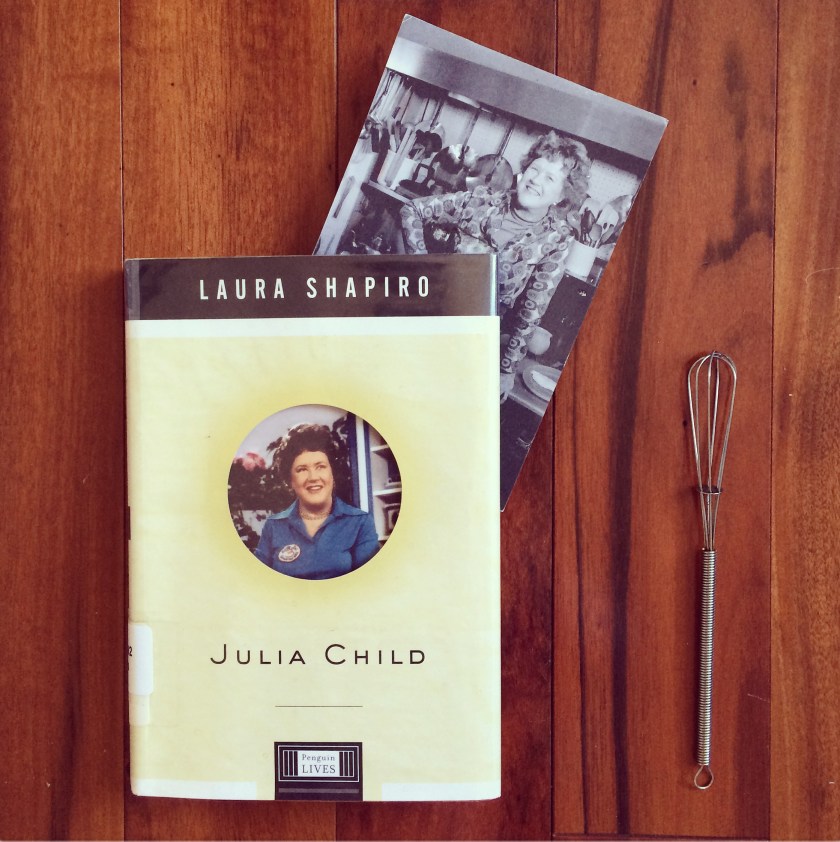
Born in 1912, Julia Child would have celebrated her 104th birthday today. I never got to meet Julia; she died in 2004, just two days shy of her 92nd birthday. But I’ve felt her spirit.
With Jacques Pépin, Julia co-founded the MLA in Gastronomy Program at Boston University, which began offering courses as early as 1991. It was one of the first graduate programs for the study of food, which Julia and Jacques adamantly believed in. In those early years, Julia defended the burgeoning course of study in the the New York Times, saying:
There’s a lot more to the field than cooks piddling in the kitchen. It’s high time that it’s recognized as a serious discipline.
Every matriculating BU Gastronomy student feels a connection to Julia’s legacy, her lineage. I started my degree in Gastronomy in 2011, but Julia was still there. For instance, the demonstration kitchen was built for Julia’s estimable height, making the counter and cooktop higher than standard, and a bit of a stretch for we shorter folk. Her sturdy metal stool resides in the room as well, a memento of her, and a special spot for both established and rising food studies scholars to feel her presence.
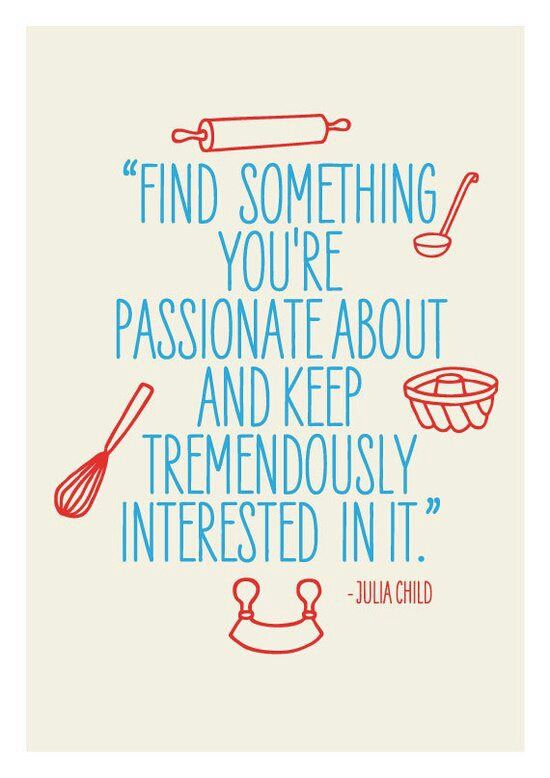
The internet also abounds with Julia quotes: witty, inspirational, empowering, funny. I’ve borrowed a few below:
The one that inspires me the most as I continue on this journey to the PhD and (hopefully) a life in academia is:
On this blog, these words are always in the footer below—a constant, supportive reminder of the passion and joy, tenacity and resolve that any worthwhile endeavor requires. On the days when progress feels stagnated or the future uncertain, I also take a second to take a deep breath and remember that Julia, our goddess of food in every possible way, didn’t find her life’s calling until her late 30s. I still have time. To all the late Millennials worried about the world we’ve inherited, we have time.
And for so many of us, the BU Gastronomy program provided and provides not only a site for rigorous academic pursuits, but also a journey, a jumping off point, a path that leads to a passionate life. It’s a place where Julia lives on.
To celebrate her birthday further, I’ve rounded up four of my previous articles on Julia Child and hope they satisfy your craving for a little piece of Julia on her special day. Though truly, her spirit, her lessons, her joy are all around us.
In this Zester Daily article, I compare Julia’s advice on wine to that offered by other cookbooks published around the same time. As she did with French cuisine, Julia expects, encourages, and supports readers to rise to the challenge of perfectly pairing wines. Like any good teacher, her own love for learning gushes out, as she provides the environment and tools that her students will need to succeed. Then she gives them a little push to get started, to jump in, to really and truly discover it for themselves.
Written as part of Gastronomy at BU’s celebration of what would have been Julia Child’s 100th birthday in 2012, this piece is an interview with Julia’s full-time assistant of nearly 16 years—and the BU Gastronomy program’s first graduate—Stephanie Hersh.
This post is a round up of the many multi-media pieces that were produced to celebrate Julia, her work, and her life on her centenary. This compilation of 15 articles to read, videos to watch, segments to listen to, and ways to cook, eat, and enjoy her food can also be the perfect way to celebrate her at 104.
The new website features our now fully digital Graduate Journal of Food Studies. While the Journal has always been open access and available as a beautifully designed PDF, we are excited to move the journal into its next stage, where we endeavor to lead the way in online publishing with food studies scholarship that is peer-reviewed, rigorous, engaging, and decidedly interdisciplinary, as well as gorgeous, flexible, and sharable.
With these goals in mind, we’re also launching a new section of the Journal called Food-Stuff, which invites a variety of food studies scholarship outside of the traditional academic article. Food-Stuff pieces may take the form of field notes, archival reports, commentaries, interviews, and photo essays. We also welcome proposals for additional creative formats.
On the new website, you’ll also continue to find information about GAFS, our membership benefits, and how to join the premiere international graduate student association for the study of food.
Take a click around. We can’t wait to hear what you think—and if you’re a graduate student and would like to submit your work or get involved, we’d love to hear from you.










 1.
1. 


 Emily Contois