All posts tagged: food studies

Publishing in Food Studies Journals: An Index

Food studies is an ever-expanding field with an increasing number of discipline specific and related peer-reviewed journals. As you seek out the right “home” for your food studies scholarship, consider this list of peer-reviewed publications, organized alphabetically. Please note that this list was originally compiled in June 2016 and all links were updated in September 2019. The last update was made in June 2021. I endeavor to keep the list up-to-date, adding journals as folks alert me to them, but if you find something amiss, please feel free to comment or send me a note!  Agriculture and Food Security is an open-access journal that addresses global food security with a particular focus on research that may inform more sustainable agriculture and food systems that better address local, regional, national and/or global food and nutritional insecurity. The journal considers contributions across academic disciplines, including agricultural, ecological, environmental, nutritional, and socio-economic sciences, public health, and policy. Agriculture and Human Values is the journal of the Agriculture, Food, and Human Values Society. The journal publishes interdisciplinary research that critically examines the values, relationships, conflicts, and …

Why I Support Render, Feminist Food Writing & Activism

As its website states, Render: Feminist Food & Culture Quarterly works in every issue “to spotlight all the badass women who are making waves within the persistently male-dominated food industry.” These efforts “to smash the patriarchy in the food industry” are important for all of us, as readers, thinkers, and eaters. It’s why I renewed my subscription and contributed to Render’s Kickstarter, which ends on May 4. I’m not part of the Render team, but as pledges currently fall short of their goal, I wanted to offer these few words of support, because these issues have been top of mind for me lately. In our course, “Food and Gender in U.S. Popular Culture,” my students and I have discussed and pondered, sighed and screamed about not only the continual under-representation of women in the food industry and the media that covers it, but also about how the icon of the celebrity chef — constructed as white, male, and straight — is a cultural figure that by its very nature subordinates every other identity within the industry. This particular construction of the celebrity …

Teaching Food Studies, Cookbooks & Writing

How do cookbooks speak? What stories do they tell—and whose? What do cookbooks reveal about power and how it operates? How do cookbooks communicate and construct gender? These are some of the questions my students and I have pondered lately in our course “Food and Gender in U.S. Popular Culture” at Brown University. For our first assignment, students analyzed how cookbooks prescribe and transgress conventional gender roles. A uniquely interdisciplinary field, food studies scholarship often employs various methods, but the close reading of cookbooks is one method that approaches universality. I’m working with a thoughtful and engaged group of 20 mostly first- and second-year students. While most had read and used cookbooks for cooking, few had previously considered them as elements of popular culture, as valuable historical evidence, as prescriptive literature that shape notions of gender, or as sources in which the so-often-silenced voices of women and people of color can be heard. In an effort to fully scaffold and support our work with cookbooks, we first did some reading. While there are many incredible texts I could have assigned, we read from: Jessamyn Neuhaus. …

CFP: Critical Nutrition Studies Panel at ASFS 2016

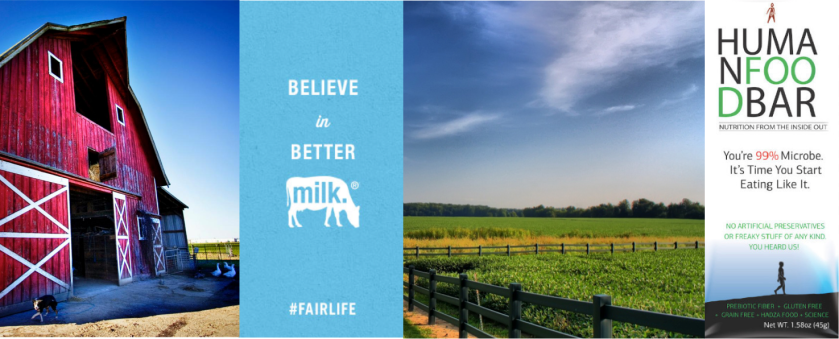
If you engage critical nutrition studies in your work, my colleague Stephanie Maroney (PhD Candidate, Cultural Studies, UC Davis) and I welcome your submissions to join our panel submission to the ASFS/AFHVS/CAFS conference to be held June 22-26, 2016 in Toronto. The panel, “Interrogating Nutritionism and Dietary Science in Novel Food Products,” examines the discursive effects of the marketing for two novel food products: FairLife Milk (Emily) and the Human Food Bar (Stephanie). The panel explores the relationship between the cultural values that animate these advertising messages and the scientific research that supports these products.   Drawing from the field of Science and Technology Studies, critical studies of nutrition recognize and reveal the ways that scientific knowledge is not neutral, natural, or objective – rather, it is co-constituted alongside sociocultural values and beliefs. By looking at the history and politics of dietary advice, we can better explain and account for the assumptions that structure contemporary nutrition science and the marketing claims used to differentiate products in our health-centric culture. We seek additional papers that critically examine …

6 New Food Studies Books That I Can Stomach Reading

When I was preparing for my preliminary exams, I had a friend warn me that after reading 300-or-so texts, the thought of picking up another book would make me feel physically ill. While there were certainly moments when I literally couldn’t stand reading another word, I’m pleased to share that I not only passed my exams in November, but am still hungry for more. I’ve been browsing the food studies titles that have come out recently, and here are six that I’m looking forward to reading: 1. Kate Cairns and Josée Johnston. Food and Femininity. New York: Bloomsbury Academic (September 2015). 2. Kima Cargill. The Psychology of Overeating: Food and the Culture of Consumerism. New York: Bloomsbury Academic (October 2015). 3. Deborah A. Harris and Patti Giuffre. Taking the Heat: Women Chefs and Gender Inequality in the Professional Kitchen. New Brunswick, New Jersey: Rutgers University Press (May 2015). 4. Julie Parsons. Gender, Class, Food: Families, Bodies, Health. Palsgrave Macmillan. (September 2015). 5. Toni Tipton-Martin. The Jemima Code: Two Centuries of African American Cookbooks. Austin: University of Texas Press. …

Announcing the Graduate Journal of Food Studies 2.2 & the End of Food Puns

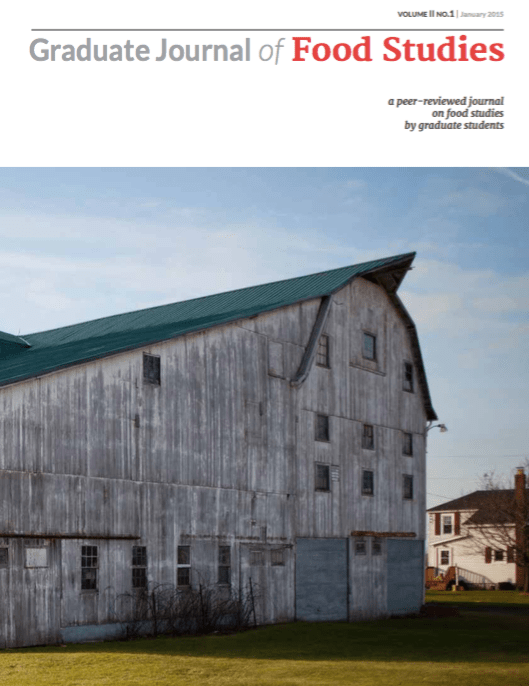
Look no further for groundbreaking scholarship, throught-provking book reviews, and stirring art from emerging scholars. The third issue of the Graduate Journal of Food Studies (volume 2, no. 2) is now live online. The issue starts with editor-in-chief Carla Cevasco’s insightful letter, “I hate food puns,” which urges us all to refrain from foodie figurative language in an effort to bolster the intellectual foundations and popular perceptions of our field. Gone be the “food fights,” “seats at the table,” and, sigh, “food for thought.” I especially love her assertion that these phrases make food studies appear “fun” and approachable, but in the end, “Food studies should not be easy.” Our topics may be quotidian. That’s what makes them powerful and meaningful. Our conferences and events may consider eating and drinking primary. That’s experiential learning and intellectual embodiment, purposeful commensality and mindful consumption. Our work speaks to students and the public. That’s how our field will continue to expand and survive. Food studies is not a passing fad nor a field of inquiry with soft edges. As Carla argues so well, its acuity …

Conference Save the Date: Graduate Association for Food Studies, October ’15

Mark those calendars people! The Future of Food Studies, the first conference of the Graduate Association for Food Studies, will be held 23-25 October 2015, at Harvard University in Cambridge, Massachusetts. The conference will include a keynote talk by Fabio Parasecoli, food studies scholar and coordinator of the Food Studies program at the New School, as well as graduate student panels that you won’t want to miss. The conference theme directly engages the complexity of food studies’ status as a “burgeoning” field, as so many characterize it. With roots in the late 1980s, food studies has consistently gathered steam—as well as a critical mass of articles, dedicated monographs, professional organizations, journals, and university programs—with more opportunities surfacing each year. The conference will engage these changes, actively pondering what the future of the discipline holds, conceptually, methodologically, and publicly. Graduate students are encouraged to submit paper and panel proposals by the CFP deadline of 31 May 2015. And I welcome everyone interested in the future of food studies to mark your calendars and plan to join us at Harvard in October. Please share widely—including this snazzy save …

Announcing the Graduate Journal of Food Studies 2.1

In case you haven’t heard, the second issue of the Graduate Journal of Food Studies came out last week online and will soon make its way to the mailboxes of subscribing members! I was thrilled to have my research on trophy kitchens included in the first issue and the second issue is just as thoughtful and beautifully designed, featuring four original research articles, multiple reviews on some of the most recent food studies publications, and stellar photography. So with this news, what should you do next? Read the Graduate Journal of Food Studies winter 2015 issue (2.1). Join the Graduate Association for Food Studies, an organization that connects graduate students with an interest in food studies, promotes their work, and provides myriad resources for publishing, networking, presenting at conferences, and more. It’ll be the best $20 you ever spend. Submit a proposal for the first edition of the biennial Graduate Food Studies Conference to be held in Boston, 23-25 October 2015. The submission deadline is 31 May 2015. Submit an article, book review, or photography/art for consideration for the Journal’s third edition. The …

The Food Heritage, Hybridity & Locality Conference

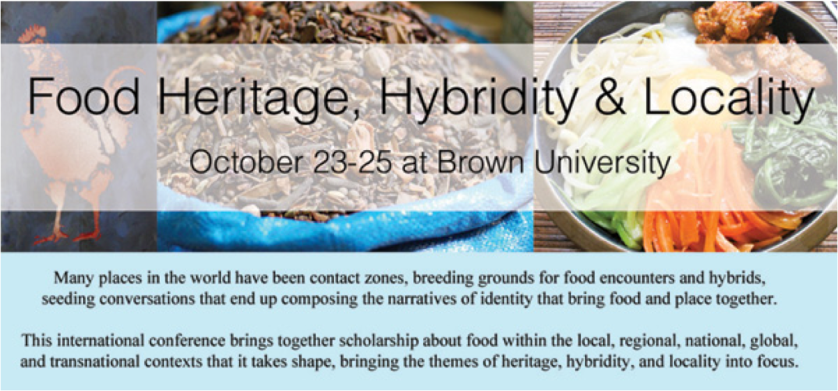
The Food Heritage, Hybridity, and Locality Conference, which was held here at Brown University, October 23-25, 2014. This exciting event brought together presenters from throughout the United States and across the globe, whose work explores the intersection of tradition, place, and the dynamic processes of fusion, melding, and hybridization that create new food phenomena. Providence, Rhode Island proved a unique host for this conference—and not just because it has earned top rankings among Travel and Leisure’s America’s favorite food cities. As the conference call for papers states so well, waves of immigration have fashioned Rhode Island food culture into a unique hybrid, marked by such gastronomic wonders as Rhode Island chowder, whose clear broth defies both cream and tomato-based conventions, and Johnnycakes, cornmeal cakes whose origins are a complex combination of worlds both old and new. Even local, homegrown favorites fuse the conference’s themes of heritage, hybridity, and locality, like Del’s lemonade, a lemon flavored Italian ice sold from distinctive mobile units that first set up shop in Cranston, Rhode Island in 1948, and coffee milk, a beverage very deservedly Rhode Island’s state drink. Rhode Island provides additional examples, including the chow …

3 Posts to Toast Julia Child’s 102nd Birthday

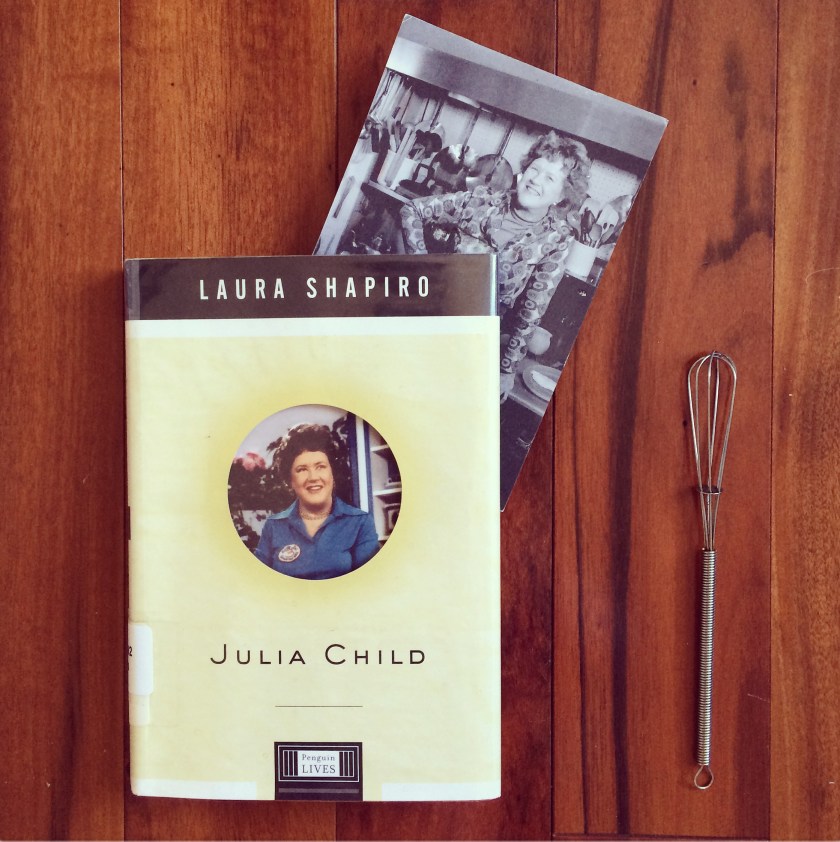
Today would have been Julia Child’s 102nd birthday and with her towering height, booming voice, vivacious personality, and insatiable appetite for food, eating, cooking, and learning new things, we can be sure she would have celebrated in style. As a graduate of the MLA in Gastronomy Program at Boston University—the program co-founded by Julia Child with Jacques Pépin to secure a place in higher education for the serious study of food—I share with my BU colleagues a borderline-cult-like love for all things Julia. I celebrated this week by finally reading Laura Shapiro’s biography of Julia Child, which is a petite book that perfectly captures the stages of Julia Child’s life, love, and career. I also spent some time writing an article for Zester Daily, comparing Julia’s advice on wine to that offered by other cookbooks published around the same time. One of the things I most love about Julia is how she expects, encourages, and supports readers to rise to the challenge, whether it be mastering French cuisine or perfectly pairing wines. Like any good teacher, her own love for learning …

Academe Amuse-Bouche: Expanding the Menu of Academic Publishing

I had the opportunity to attend the Essay in Public conference here at Brown University earlier this week at which speakers and participants discussed a full host of topics related to how we can best bring longform writing and dense content (such as the bulk of work created by academics) to the public. [Update: I summarized all of my live tweeting here. And yes, Storify really is as neat as they say.] At one point in the day, we discussed and re-articulated the very meaning of “the public,” as not only an audience with whom many of us as public intellectuals hope to engage, but also a grouping of individuals that contains the fantasy of accessibility and embodies the breaking down of hierarchies, limits, and borders. Part of my own aspiration with this blog is to connect with just such a public of readers, near and far, through my work, which I strive to communicate in jargon-free and hopefully-at-least-minorly-entertaining prose. A truly satiating day, this conference explored far more than audience, connectivity, and content. In this particular post, however, I’m chewing on the idea that …

How to Write a Statement of Purpose

When I applied to PhD programs, I didn’t really find the advice I was seeking for how to write a statement of purpose, so I wrote this post in the hope that it might help someone in a similar position.  Folks will tell you that your statement of purpose is the most important part of your PhD application and they’re right. While your transcripts might demonstrate your past academic success and your letters of recommendation can speak volumes, especially if written by significant scholars in your field, no piece of your application package can make more of an impact than your statement. It is your opportunity to clearly and succinctly discuss your past and future research goals in an interesting way. From this document (as well as the rest of your application package), an admissions committee will decide if you are the right “fit” for their program. While you’re determining which programs are the right fit for you, you can simultaneously put pen to paper (or fingers to keyboard) and start the first of many drafts …

4 Steps to Find the Right PhD Program for You, Food Studies or Otherwise

So, you’ve decided to pursue a PhD. You’ve heard the advice, “If there’s anything else you want to do, seriously, do that instead” and pondered it thoroughly. You’ve searched your soul, talked it over with those important to you in your life, and have confirmed beyond a shadow of a doubt that an academic life is the career that will fulfill you. Congratulations on getting to this point. Now, you have to apply to programs and get accepted, which in this academic and economic climate, isn’t easy. While there’s no magic number for how many programs you ought to apply to, somewhere in the 6 to 12 range works well. You might have already gone through some of these steps, but here is a four-step plan to finding the right PhD program for you and increasing your chance of acceptance—with some special advice thrown in for food studies students. Step 1: Choose the right field of study. For some, this first step will be a no brainer. You might get a PhD in the same …

Graduate Food Studies Programs: A List

I began keeping this list of graduate food studies program after a fascinating roundtable discussion titled, “Masters Programs in Food Studies, Food Systems, and Food Policy,” at the 2013 joint meeting of the Association for the Study of Food and Society and the Agriculture, Food & Human Values Society at Michigan State University in East Lansing. During this discussion, the directors of seven graduate food programs debated the key issues emerging in graduate food education. They were also asked by a session attendee to summarize each program’s distinguishing features, which I’ve summarized here in the hopes it might prove useful for any students currently weighing their options for graduate study in food. Note: I’ve been keeping this list as current as possible. Last update: January 25, 2019 Boston University, MLA in Gastronomy  Location: Boston, MA Program Director: Megan Elias, Ph.D. Program History: Co-founded in the 1990s by Julia Child & Jacques Pépin Strengths / Specialities: Focus on the liberal arts; can include culinary arts & wine study; online, blended and in-person courses; in large, research university Follow: Twitter (@GastronomyatBU); …

Talk to Me Baby! Encouraging Dialogue between Nutrition Science and Food Studies

I’m very excited to be heading to UC Santa Cruz for Friday’s Critical Nutrition Symposium, an event that will address questions that I’ve also been pondering for a while, such as:  What’s wrong or missing in conventional nutritional practice? What are its effects in terms of human health and social justice? What other approaches might work better? What follows are some thoughts I have at this point on the current connections and future opportunities between nutrition and food studies, which I’m sure will be greatly expanded by the end of Friday’s discussions. Unlike other disciplines that inform food studies, generally heralding from the liberal arts and social sciences, nutrition science is just that – a science, thus coming from a divergent academic tradition that tends to favor statistics over narrative detail and quantitative methods over qualitative (Faltermaier 1997). In addition, nutrition and food studies contribute to one another’s fields in a more complex way because their area of focus overlaps — they both study food. Up to our current point in history, each discipline has tended …