Latest Posts

CHAViC 2015: An Insane Asylum, on a Dinner Plate?

Five glorious days musing over fascinating eighteenth and nineteenth-century objects and texts, multiple delectable meals (including one cooked over the hearth at Old Sturbridge Village!), stimulating conversation, and umpteen new friendships and professional food studies connections. All this was the result of my incredible experience at the American Antiquarian Society in the Center for Historic American Visual Culture (CHAViC) seminar, “Culinary Culture: The Politics of American Foodways, 1765-1900,” which was organized and orchestrated by Nan Wolverton, CHAViC Director, and led by Nancy Siegel, Professor of Art History, Towson University.

The week’s lectures, material, and discussions were oriented around a case study assignment, in which each student chose one of seven artifacts/objects/ephemera (pictured below) to discuss in greater detail.

With such exciting options, we all agonized over which object to choose and spent the week working through questions grounded in the lives of the objects themselves, like:

  • Where did it come from?
  • Who held it, used it, or owned it?
  • Where did it live? Was it meant to be private or public?
  • Why was it made? What is its message?
  • What does it tell us about the time period in which it was produced?
  • Who would buy it?

After much flip-flopping, I finally settled my attentions on the Ridgway plate depicting the Insane Hospital, Boston, c. 1825. Drawn to the question: “Why does an image of a hospital for the mentally ill grace the bottom of this plate?”—I organized my thoughts around the plate’s production, consumption, and representation, an exercise that merged my interests in food studies, the history of medicine and public health, and everyday objects and popular culture.

John & William Ridgway, Insane Hospital, Boston, c1825, Staffordshire ceramic, 7

John & William Ridgway, Insane Hospital, Boston, c. 1825, Beauties of America series, Staffordshire ceramic, 7″ plate

To begin with the producers, John and William Ridgway were third-generation potters, who joined and later inherited their father’s business. They both visited the United States numerous times, including a trip in 1822 on which John Ridgway kept a diary of the sites he visited, many of which made their way onto Staffordshire ceramics as part of the Beauties of America series.

Items in the series would have been collectable as individual pieces that would form a culinarily rendered guidebook to notable American sites. The hospital on this plate was opened as the “Asylum for the Insane,” a division of the Massachusetts General Hospital, in October 1818, so it’s likely Ridgway saw it in person on his trip and decided to include it in the Beauties of America series. (See below several pieces from the American Antiquarian Society’s collection of the series. Make sure to check out their gorgeous online exhibition too!)

A businessman of means, Ridgway wrote of the impressive architectural achievements he toured, describing the buildings as “fine,” “large and handsome,” “beautiful,” “magnificent,” “elegant,” and “splendid,” comments indicative of his own class status and cultivated tastes. Such observations were also fitting for the Boston hospital featured on this plate. It began as Joseph Barrell’s home, which was heralded as:

The most outstanding private residence built in America during the last decade of the [eighteenth] century.

The building was also a technological and industrial feat for its heating and ventilation systems, attributes that Ridgway commented on at similar sites. Ventilation in particular was considered a central component of disease treatment and wellbeing, in part due to medical paradigms of the time and understandings of disease transmission before the acceptance of germ theory.

But as a devout Methodist, Ridgway was also particularly interested in (and critical of) the institutions he visited that traded in Benevolence: churches, hospitals, asylums for the deaf and dumb, and as we see on this plate, asylums for “lunatics.” As such institutions combined or shifted their funding mechanisms from charity to fee-based services, Ridgway was unimpressed. For example, after touring the Pennsylvania Hospital in Philadelphia, he remarked,

So far as I could see, the thing wants the inspection of regular Benevolence; the people here are too much alive to getting money and these public institutions are neglected.

And so I argue that perhaps this plate’s design, and ones like it, were selected not only to feed an American market need to gaze upon and collect itself, but also because it aligned with the values and worldview of the leadership involved in its production. As an architectural achievement and a benevolent institution, this Boston hospital for the insane was deemed socially, morally, and economically valuable by John Ridgway.

For consumers, on the other hand, this plate and its design produced value for other reasons. At the time, it wasn’t unusual for citizens to visit and tour institutions like asylums for entertainment, enlightenment, and community engagement. A consumer good, the acquisition of the plate itself also placed the buyer within the trans-Atlantic consumer culture. Forged in British clay and donned with an American scene, this plate and items like it were transnational objects, located in an identity narrative connected to the old country and to the building of a new national identity.

As such, its design might have evoked place-based pride at multiple levels. For starters, the aesthetic and moral achievement of the hospital was a decidedly American beauty, one inviting a celebration of the national. It also stands as a beacon of local and regional innovation, embraced within the context of increasing sectionalism. Notably, this hospital was the first in New England and only the fourth institution for the mentally ill in all of the United States. Furthermore, the architectural significance of the estate, designed and later greatly added to by Charles Bulfinch, also stands as a local and regional achievement.

Furthermore, in the early decades when institutions like asylums were first being constructed, removing the “insane” from prisons and placing them in more comfortable and kind surroundings might have been a socio-medical innovation that more generally symbolized generous and goodly values within broader structures of the family, the community, and the state.

The rise of institutions for the insane can also be painted with a darker hue, however. Plans for this hospital recommended patient payments rather than straightforward charity. In addition, removing the “insane” from prisons and placing them in asylums likely freed individuals from sites of discipline, but not from strict surveillance.

Close up

Note the fence in the foreground of “Insane Hospital, Boston,” c. 1825

To consider representation, the plate’s design depicts these interpretations of both benevolence and control. For example, the plate’s design features a fence running through the foreground, a physical boundary to keep patients contained. Indeed, viewed through a Foucauldian lens, the plate takes on a different character, one in which the “repetitive rose and leaf medallion border” can be considered not only an embellishment and the design most visible when the plate is filled with food, but also a circular cuff that restricts and retains the plate’s central image.

The plate’s aesthetics are meaningful in other ways as well, particularly as evidence of the multistage design process. The plate’s design is noticeably modified from the artist, Abel Bowen’s (1790-1850), original drawing and then line engraving, commissioned by Ridgway (see below). The original drawing includes two additional buildings, while the plate’s illustration features only the central house of the estate. The changes to the scene allow closer detail of the center building and make it stand more majestically in the frame, as the height and space of the flanking buildings would have somewhat diminished the central figure.

And while the plate’s design features only a fence running through the foreground, the drawing includes rich foliage, as well as the banks, flowing waters, and human activities of the Charles River.

Abel Bowen's drawing of The Asylum in 1825 as depicted in Caleb Snow's History of Boston, 1825

Abel Bowen’s drawing of The Asylum in 1825 as depicted in Caleb Snow’s History of Boston, 1825

And yet, the translation between drawing and plate design is not the only interrupted conversation, as Bowen’s drawing does not include details captured in the historical record. For example, the grounds’ terraced gardens, imported, rare, fruit trees, and ornamental fish pond, which could be viewed from the house when looking toward the Charles River, which cuts through the foreground, are not captured in Bowen’s account.

Such edits, additions, and cropping reveal the dynamics between reality and representation and the multiple moments of translation that occur as landscapes make their way from the viewer’s eye to the artist’s pen to the engraving plate for mass production to the transfer process, where the hands of female workers fixed the image to a plate in Staffordshire county that would then make its way back to the land where the image itself originated.

As immortalized on the plate in 1825, the “Boston Insane Hospital” stands as a transnational icon. Within the plate’s design, the estate’s central building is situated within a tranquil landscape believed to be restorative not only for the “insane,” but for all people. In this way, perhaps yet another reason that this plate was produced, purchased, cherished, and put to use at the dinner table was the therapeutic value it provided. When not being used to actually serve food, if the owner even desired to do so, this plate might have been prominently displayed as a colorful diversion and a daily dose of refined culture and natural restoration.

These are but some of the questions and potential answers one can explore when starting with the life of the object itself, a method I practiced at this CHAViC seminar and look forward to incorporating into my scholarship—to look more closely, deeply, and thoughtfully at my evidence, so that it can speak its own story.

In closing, I cannot more highly recommend my experience at the American Antiquarian  Society. I encourage scholars to visit their astonishingly beautiful space (see below), correspond with their knowledgable and approachable curators, to visit their gorgeous reading room and engage with their incredible collections, and to apply for their seminars and short and long term fellowships.

Bibliography

Eating for Muscle: What This Foodie Has Learned From Her Powerlifter Husband

I don’t usually identify myself as a foodie, but compared to my husband—who trains hard and subsists upon protein shakes and loads of lean meat—you might as well consider me one.

The diets of strength athletes, bodybuilders, powerlifters, and the like are a gustatory world away from what most people eat, what the USDA would recommend, or what any food enthusiast would sanction. In my most recent Zester post, I pondered the nearly twelve years I’ve spent cooking and eating alongside this man I love, as he’s worked toward his athletic goals, boiling it down to six food rules that muscle building folks follow:

    1. Protein is king.
    2. Food is fuel.
    3. Taste is secondary.
    4. Cheating is part of the plan.
    5. Bulk is good.
    6. Meal prep is not cooking.

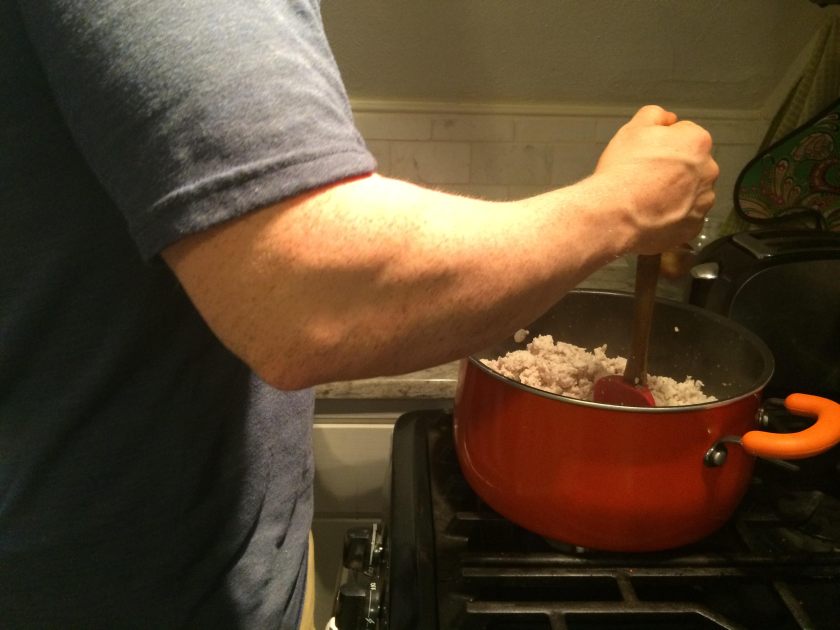
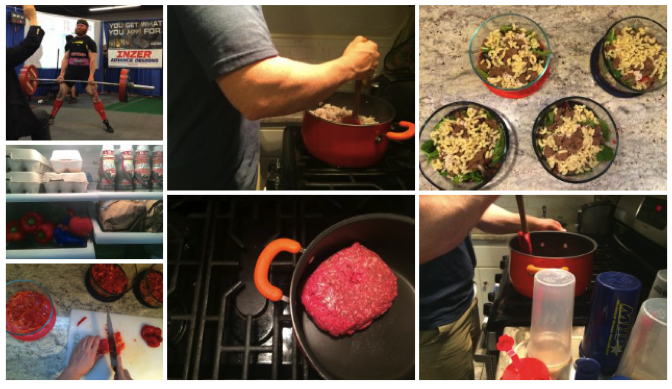
I’d love to hear your thoughts on this dearly dedicated, but distinctly anti-foodie subculture. And as a silly supplement, here are some shots of my husband’s weekly meal prep (and his lifting).

PowerFood

Photo credits: Emily Contois, 2015

#phdlife: On Adopting a Dog & How Instagram Makes Academic Life Easier

We adopted an adorable pit bull rescue on Valentine’s Day and it was only a matter of time before she somehow made her way onto the blog. And believe it or not, bringing her into our family has helped my academic life in myriad ways, from minimizing study-induced back pain and loneliness to off-time full of unlimited cuddles and kisses.

Adopting a pup also means I’ve discovered the world of pet-friendly Instagram (if you’re the sort that follows doggies, she’s @raven_puppie), which is one of the most supportive communities I have ever been part of and one that makes the copious use of emojis that I’ve been desiring from everyone in my normal life. (Seriously. Why aren’t you guys texting me multi-colored hearts and snoozy faces all the time?) These doggie mamas and papas are ever present to tell my girl that she’s cute and special and that she’s part of a caring community of dogs and owners committed to animal kindness for all breeds and types, especially hers, one so often maligned.

And so, as I’ve engaged for the first time with an online community of amazing strangers, I want to find (or create!) such a place for those of us flying and slogging, skipping and trudging through the day-to-day life that is getting a doctorate or other graduate degree. Call it a waste of time, but taking a pretty photo of the day’s reading for my field exams and sharing it on Instagram makes the effort a bit easier, a tad lighter, and a modicum more fun, especially when the going gets tough. (I have to make it through five books today? What??) It transforms this scholarly labor from the world of work to the land of aesthetics, amateur art, and gentle hobby-making. It curates the words, pages, and books that I consume on a daily basis. It creates an object of inspiration and commemoration of my own design. It makes my intellectual effort material, legible, translatable and worthy of a stranger’s gaze, if not their understanding. A mental trick? Decidedly millennial silliness? Perhaps. But if it works, why not go with it?

Below is some of what I’ve started. We’re talking #shelfie, #mydesk, #phdlife, and #gradlife with overwrought arrangements (usually with the delightfully lightening Valencia filter) of books, papers, pens, laptops, coffee, and tea—and in my case, one adorable pup.

Won’t you join me?

Don’t forget the emojis!

Photo credits: Emily Contois, 2015

Conference Save the Date: Graduate Association for Food Studies, October ’15

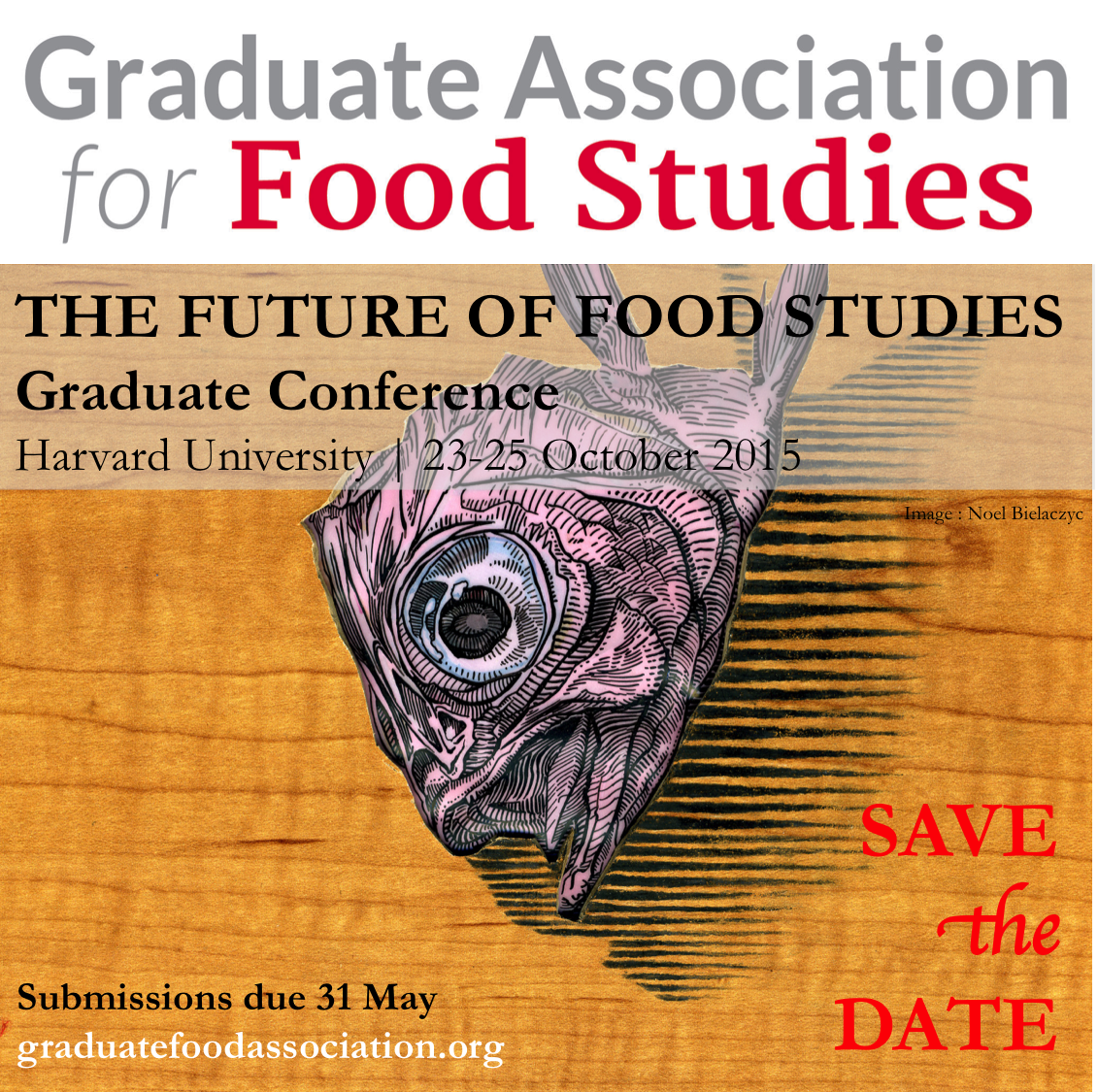
Mark those calendars people! The Future of Food Studies, the first conference of the Graduate Association for Food Studies, will be held 23-25 October 2015, at Harvard University in Cambridge, Massachusetts.

The conference will include a keynote talk by Fabio Parasecoli, food studies scholar and coordinator of the Food Studies program at the New School, as well as graduate student panels that you won’t want to miss.

The conference theme directly engages the complexity of food studies’ status as a “burgeoning” field, as so many characterize it. With roots in the late 1980s, food studies has consistently gathered steam—as well as a critical mass of articles, dedicated monographs, professional organizations, journals, and university programs—with more opportunities surfacing each year. The conference will engage these changes, actively pondering what the future of the discipline holds, conceptually, methodologically, and publicly.

Graduate students are encouraged to submit paper and panel proposals by the CFP deadline of 31 May 2015. And I welcome everyone interested in the future of food studies to mark your calendars and plan to join us at Harvard in October. Please share widely—including this snazzy save the date with art by Noel Bielaczyc that I had so much fun designing!

GAFS Conference Save the Date


Ann Seranne: America’s #1 Expert on Blender Cookery

In 1961, Ann Seranne and Eileen Gaden, both former Gourmet Magazine editors, published The Blender Cookbook to rave reviews. Not at all gimmicky, the cookbook was heralded by Craig Claiborne as an inspired, functional, and welcome resource, penned by “probably the world’s leading authorities on what a blender will and will not do.”

Not only the nation’s top blender cookery expert, Seranne wrote more than two dozen cookbooks, published mostly in the 1960s and 1970s. A woman with dual passions, she also bred champion Yorkshire terriers—who ate very well and loved garlic. Her name also buzzed among foodies a few years ago, when Amanda Hesser revived Seranne’s 1966 rib roast of beef recipe in a “recipe redux” in the New York Times.

Read more about this lesser known cookbook author in my most recent Zester piece, “How the Blender Was Elevated to a Kitchen Staple,” and enjoy this image gallery, an ode to the humble blender.


Nika Hazelton’s 1963 Rules for Judging Cookbooks

People buy cookbooks for a variety of reasons. They look pretty on the bookshelf. Even better on the coffee table, depending on the book, a topic of culinary conspicuous consumption I discussed in a round table at the 2013 Cookbook Conference. Cookbooks can be fun to collect. Cookbooks represent skills we hope to learn or wish to have, meals we desire to eat, people we aspire to be.

For well known cookbook author and writer Nika (Standen) Hazelton, however, there was only one reason to buy a cookbook: to cook from it, damn it. [I’m not sure if she would approve of such phrasing, but one of her cookbooks was titled, I Cook As I Please, so I might not be too far off.] The author of thirty cookbooks and innumerable articles for major food newspapers and magazines, Hazelton had little patience for those who purchased cookbooks as “escapist literature.” Instead, in a 1963 article in the New York Times, she laid out in black and white exactly how one ought to judge if a cookbook was up to snuff.

Check out my article on Hazelton’s cookbook advice on Zester Daily and browse the gallery below for a mere sampling of her many cookbooks.

Announcing the Graduate Journal of Food Studies 2.1

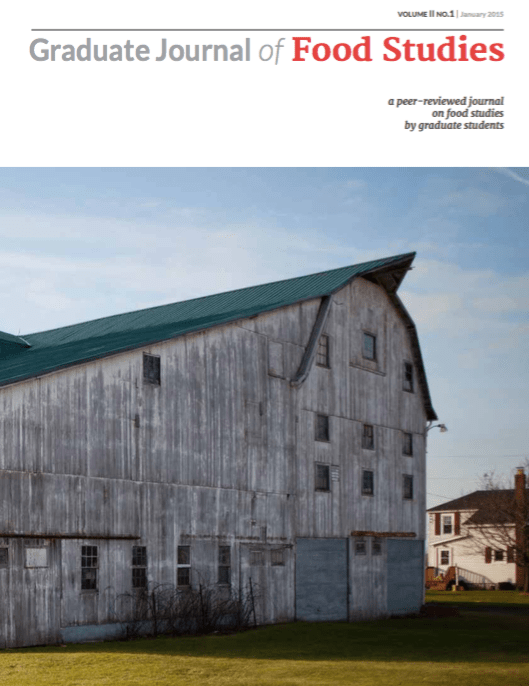
In case you haven’t heard, the second issue of the Graduate Journal of Food Studies came out last week online and will soon make its way to the mailboxes of subscribing members! I was thrilled to have my research on trophy kitchens included in the first issue and the second issue is just as thoughtful and beautifully designed, featuring four original research articles, multiple reviews on some of the most recent food studies publications, and stellar photography.

So with this news, what should you do next?

  1. Read the Graduate Journal of Food Studies winter 2015 issue (2.1).
  2. Join the Graduate Association for Food Studies, an organization that connects graduate students with an interest in food studies, promotes their work, and provides myriad resources for publishing, networking, presenting at conferences, and more. It’ll be the best $20 you ever spend.
  3. Submit a proposal for the first edition of the biennial Graduate Food Studies Conference to be held in Boston, 23-25 October 2015. The submission deadline is 31 May 2015.
  4. Submit an article, book review, or photography/art for consideration for the Journal’s third edition. The submission deadline is 31 March 2015.
  5. Follow the Graduate Association for Food Studies on social media: Twitter, Facebook, and Instagram.

The featured image above dons the cover of the Graduate Journal of Food Studies winter 2015 issue. Photo credit: Brett Culbert.

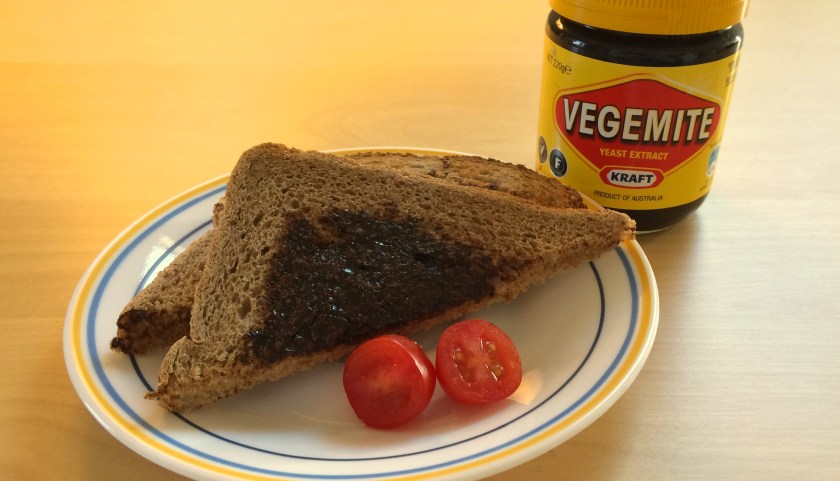
Post #100: Advice for Vegemite Virgins on Australia Day

My latest Zester piece encourages Americans to try Vegemite today, on Australia Day,  the country’s national holiday celebrating the day in 1788 when Captain Arthur Phillip and the First Fleet of eleven convict ships from Great Britain arrived at Sydney Cove.

If you try it, you’ll be joining a venerated group of non-Aussies who have taken the challenge:

  • Oprah tried it during her shows in Sydney, on the steps of the Opera House, no less, and claimed to like it.
  • Brad Pitt also tried it, sticking his finger boldly into the jar and tasting it from his fingertip, with diplomatic consideration for its flavor.
  •  President Barack Obama confessed in 2011 to then-Australian Prime Minister Julia Gillard that he found the spread “horrible,” disappointing Vegemite lovers—including me.
  • Niall Horan of One Direction echoed this sentiment in 2012 when he tasted Vegemite toast live on Australian television only to spit it out and later share on Twitter, ”Can clearly say vegemite is horrible!”
  • Ten American children tasted Vegemite for the first time in a popular video that circulated last year. Vegemite failed to gain a single follower: no tears, but lots of squealing. Suffice it to say, none of them gave Vegemite their kid seal of approval.
  • Thirteen people in this GIF roundup tried Vegemite, also yielding dismal results.

To learn more about this salty spread (it’s yummy, I swear!), check out my article.

And thank you for reading this post, my one hundredth! I’ve been blogging for two and a bit years and I continue to think (and think some more) that it is an important thing for academics to do.

Photo credit: Emily Contois, 2015

To Eat, Or Not To Eat, Kangaroo

Inspired by my recent travels to Australia, my most recent Zester Daily piece explores kangaroo meat and its consumption in Australia and abroad. Low fat, high protein, eco-friendly, affordable, and served at top Aussie restaurants, kangaroo meat consumption appears to be on the rise, but not in Australia. For the most part, Australians are wary to eat kangaroo, as the animal has figured prominently in the nation’s history, identity, and popular culture.

For more, please take a sec to read the article—and here’s an impromptu gallery of kangaroo imagery as thanks.

Trader Vic: The Man, The Legend, The Gastronomic Enigma

When I first acquired a copy of Trader Vic’s Book of Food and Drink (1946), I knew it wouldn’t be long before I wrote something about it. There’s a tangible excitement to owning a first edition of something, anything. In an age of inescapable planned obsolescence, it’s mildly thrilling to own something, anything from before 1950.

As I flipped through the book’s pages, I couldn’t help but be interested in its recipes for mai tais and mojitos—drinks now so unquestionably commonplace that it’s hard to imagine a time when they once cast an allure of intriguing exoticism. Drinks aside, however, it was Trader Vic himself—San Francisco native, Victor Bergeron Jr.—who enthralled and beguiled me.

My most recent piece for Zester Daily, “Trader Vic: The Apostle of Rum and Ready-Prepared Foods,” explores the fact and myth, truth and legend of the man who purportedly invented the mai tai, popularized the margarita and nachos, and introduced American diners to morel mushrooms, sunflower seeds and green peppercorns before most restaurants included them on the menu. Adored by diners and well-respected by food writers and restaurant critics, Bergeron did all this while believing that “American” food, and convenience cuisine in particular, was destined to become the culinary center of the world.

While his predictions may have failed to materialize, he’s left us a fascinating tale and a persona to match.

Top Image Credit: “The History of Trader Vics,” tradervics.com  


5 Posts to Celebrate National Coffee Day

It’s National Coffee Day, which means you can pick up freebies to sip that will pair perfectly with these coffee themed posts:

1. American Coffee Culture in 1872: So Different from Today? Start off with a taste of coffee history and ponder how coffee transformed into the United States’ national beverage and a potent patriotic symbol.

2. Dunkin’ Donuts Coffee: A Site and Source of Bostonian Identity Even During a Lockdown. During the manhunt and city-wide lockdown following the Boston Marathon bombing, Dunkin’ Donuts remained open to serve police officers and first responders. This piece, published in The Inquisitive Eater, considers the deep meaning of the coffee chain in New England.

3. The Dunkin’ Donuts Origin Story: A Meaningful Beginning. This piece covers a brief history of one of New England’s favorite chains.

4. When Theory Actually Applies: Starbucks is to Bourdieu as Dunkin’ Donuts is to Foucault. This post conducts a comparative cultural analysis of the two chains, which are I argue align with opposing theoretical frameworks.

5. Imagining the Dunkin’ Donuts Identity Outside of New England. Considering coffee consumption as an expression of identity, this post explores Dunkin’ Donuts outside of its native New England in settings across the U.S. and around the globe. 

Photo credits: Emily Contois, 2015, Muddy’s Bake Shop, Memphis, TN

Vegemite: Advertising and the Making of an Australian Icon

Chocolate-like in appearance but with a flavor like nothing else on earth, the yeast extract spread Vegemite is essentially synonymous with Australia. Hired by the ambitious Fred Walker to create a copy of the British spread, Marmite (which coincidentally has an adorable Twitter feed), food scientist Cyril Callister developed Vegemite in 1923. Based on a mutual interest in developing a processed cheese with a longer shelf life, Walker joined forces with James Kraft, forming the Kraft Walker Cheese Company in 1926, whose Melbourne factory and head offices are pictured below (image 1).

The Kraft Walker Cheese Company, Melbourne, Australia (1928-1956) Image Credit: Australian Academy of Science

Image 1. Credit: Vegemite Heritage Website

High in B vitamins during an historical moment when vitamins themselves were a new scientific phenomenon, Vegemite was from the beginning marketed by the Fred Walker Company as nutritious, particularly for children. For example, a Vegemite advertisement from the 1920s assured consumers that “there is no food richer in vitamins than Vegemite” and a point of sale advertisement from the 1930s emphasized the spread’s nutritional content and the themes of vitality, health, and childhood (image 2).

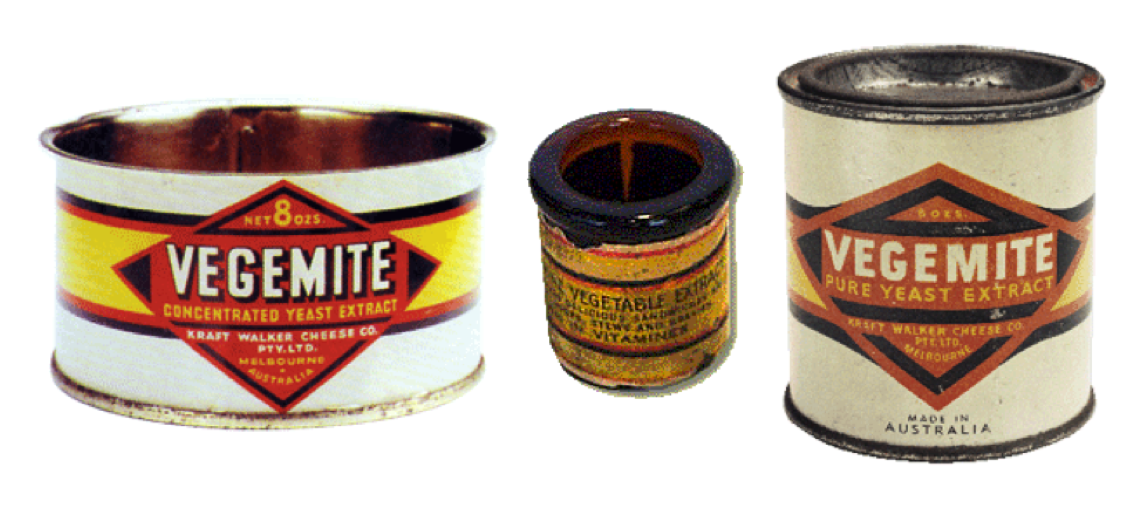
Despite its vitamin content, consumers were initially slow to embrace Vegemite, but ads by American advertising giant, J. Walter Thompson, who commenced its Australian operations in 1930, began to turn the tide. The agency’s campaigns in 1937 and 1938 included a limerick competition, Pontiac giveaways, and cash prizes. Employing a different tactic, advertisements in 1939 included health endorsements by the British Medical Association. Collectively, these efforts resulted in jars and tins of Vegemite (image 3) becoming a “staple food in every Australian home and in every Australian pantry,” at least according to “The Vegemite Story” as presented on the Vegemite website.

During World War II, Vegemite was rationed domestically so that it could be included in Australian soldiers’ field rations. Even when it was not available on store shelves, J. Walter Thompson ensured that Vegemite remained on the public’s mind with a deluge of ads, linking Vegemite to patriotism and national identity. One WWII Vegemite ad featured a cherubic child who’s “doing his bit for his Dad” and the war effort, while others showed Australian citizens giving their Vegemite to the fighting forces (image 4).

Image x

Image 4. Credits: The Mercury, 1942; Vegemite Heritage Advertising Timeline; The West Australian, 1943

By the post-war period, Vegemite had risen to icon status, embodying Australian nationalism, independence, identity, health, prosperity, and the future. Of all the post-war advertising, scholars credit the “Happy Little Vegemites” campaign, which maintained a media presence for sixty years, for securing and sustaining Vegemite’s national status. Developed by J. Walter Thompson, the catchy jingle first ran on radio in 1954 and was adapted to television in 1956, along with a print campaign that ran throughout the decade and into the 1960s. Perhaps feeding off of the post-war baby boom and the figurative capacity of children to communicate the birth of a new Australian identity, the campaign featured Australian children, growing up, healthy and happy by eating Vegemite. The campaign was revived with splashes of color in the 1980s and again in 2007, making its imagery and unforgettable tune relevant to generations of Australians.

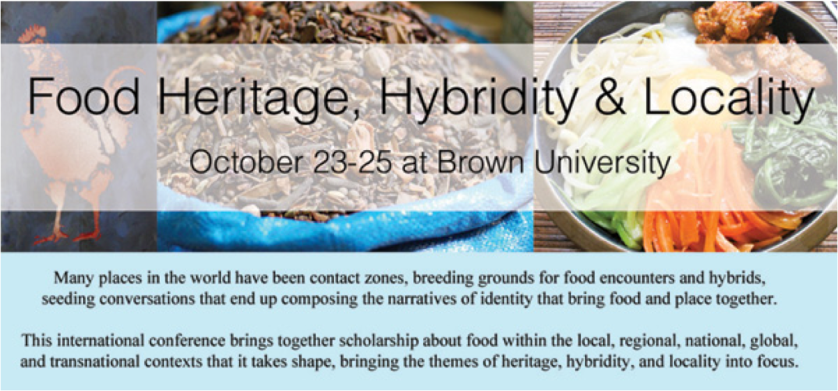
The Food Heritage, Hybridity & Locality Conference

The Food Heritage, Hybridity, and Locality Conference, which was held here at Brown University, October 23-25, 2014. This exciting event brought together presenters from throughout the United States and across the globe, whose work explores the intersection of tradition, place, and the dynamic processes of fusion, melding, and hybridization that create new food phenomena.

Providence, Rhode Island proved a unique host for this conference—and not just because it has earned top rankings among Travel and Leisure’s America’s favorite food cities. As the conference call for papers states so well, waves of immigration have fashioned Rhode Island food culture into a unique hybrid, marked by such gastronomic wonders as Rhode Island chowder, whose clear broth defies both cream and tomato-based conventions, and Johnnycakes, cornmeal cakes whose origins are a complex combination of worlds both old and new. Even local, homegrown favorites fuse the conference’s themes of heritage, hybridity, and locality, like Del’s lemonade, a lemon flavored Italian ice sold from distinctive mobile units that first set up shop in Cranston, Rhode Island in 1948, and coffee milk, a beverage very deservedly Rhode Island’s state drink. Rhode Island provides additional examples, including the chow mein sandwich, the wimpy skimpy (a stuffed spinach pie served at Caserta Pizzeria in Federal Hill), and the grilled pizza made famous at Al Forno in Providence.

The conference was free and open to the public. View the conference program for more information.

webHHL-email


Food History Roundup: 6 Posts on 1950s Convenience Cuisine

Titled, “Beef Fizz and Other Strange Recipes from the ’50s-’60s,” my most recent Zester Daily article was published last week, a short piece dedicated to my fascination with mid-century cuisine.

Over the summer, I have indulged my mid-century penchant by picking up dozens of vintage cookbooks, including six more just last night! These cookbooks are mostly from the 1950s and 1960s, but some earlier in the twentieth century (I can’t wait to write about The Sunny Side of Life Book, published by the Kellogg Company in 1934) and some later (like Betty Crocker’s Family Dinners In a Hurry, whose fourteenth printing ran in 1980). It’s a borderline reckless hobby, adding more books to an already large collection of literature, public health texts, and food studies books, but I’m sure it’ll provide inspiration for many a blog post.

I’ve already written a bit on convenience food, packaged-food cuisine, my love of Laura Shapiro’s Something from the Oven, and what food and cooking meant mid-century. Here’s a quick roundup in roughly chronologically historical order:

1. Wartime, Memorial Day … & Kraft American Cheese? Focusing on a 1947 ad for Kraft cheeses, this post considers the postwar food environment and includes four nostalgia worthy images of dainty American housewives and the idealized domesticity that their figures embody.

2. The Oh-So-Glamorous World of Velveeta & Cheez Whiz. Drawing on material I collected while in the archives at the Hartman Center at Duke University, these Kraft ads from the 1950s and 1960s perfectly reveal how the convenience food industry sought to glamorize their products in order to win over housewives, who were initially leery of their products.

3. The Dunkin’ Donuts Origin Story: A Meaningful Beginning. Chronicling the origins of the coffee chain on which American runs (and at whose altar New Englanders worship), this post tells the tale of how the first Dunkin’ Donuts opened its doors in Quincy, Massachusetts in 1950.

4. Curating the History of American Convenience Cuisine. Through five images, this post explores the intersections of foodways, the postwar military industrial complex, women’s issues, and class-consciousness within the socio-cultural context of the 1950s.

5. Chicken Fricasee Face-Off: 18th Century Haute Cuisine versus 1950s Can-Opener Cooking. Inspired by the greatest essay exam question ever, designed by Dr. Ken Albala (who blogs at Ken Albala’s Food Rant), this post compares Francois Massialot’s recipe, “Poulets en Fricasée au Vin de Champagn” from Le Nouveau Cuisinier Royal et Bourgeois (1748) with Poppy Cannon’s “Chicken with White Wine and White Grapes” from The Can-Opener Cookbook (1953), revealing what this processed-food-dependent recipe can tell us about the desires and trials of the 1950s American housewife.

6. What’s Your Food Culture Type: June Cleaver or Hippie? In this post, I compare and contrast the food values embodied by June Cleaver and the 1950s’ trend of convenience foods with the countercuisine of 1970s hippies, exploring how elements of both decades influence today’s mainstream food culture.

Photo credits: Emily Contois, 2014

3 Posts to Toast Julia Child’s 102nd Birthday

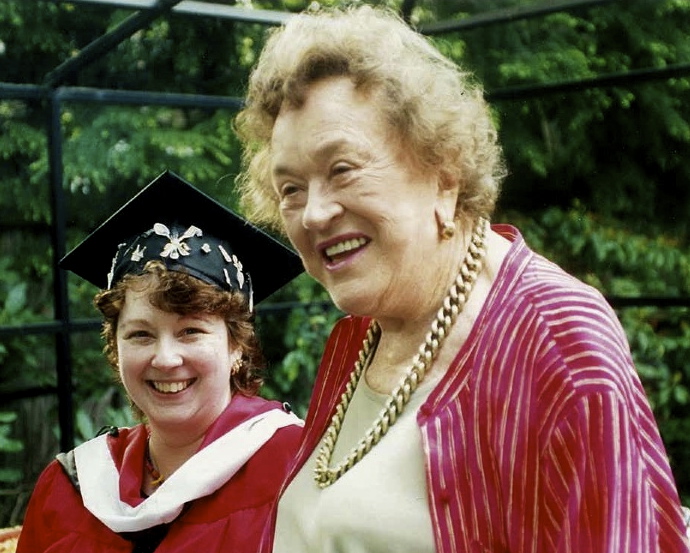
Today would have been Julia Child’s 102nd birthday and with her towering height, booming voice, vivacious personality, and insatiable appetite for food, eating, cooking, and learning new things, we can be sure she would have celebrated in style. As a graduate of the MLA in Gastronomy Program at Boston University—the program co-founded by Julia Child with Jacques Pépin to secure a place in higher education for the serious study of food—I share with my BU colleagues a borderline-cult-like love for all things Julia.

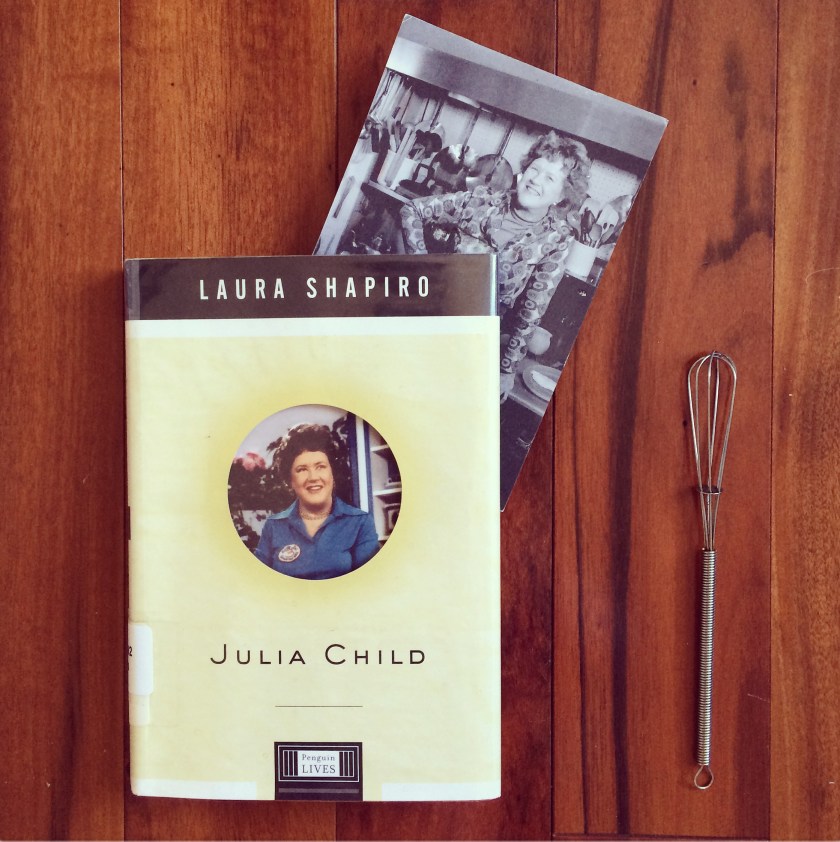
I celebrated this week by finally reading Laura Shapiro’s biography of Julia Child, which is a petite book that perfectly captures the stages of Julia Child’s life, love, and career. I also spent some time writing an article for Zester Daily, comparing Julia’s advice on wine to that offered by other cookbooks published around the same time. One of the things I most love about Julia is how she expects, encourages, and supports readers to rise to the challenge, whether it be mastering French cuisine or perfectly pairing wines. Like any good teacher, her own love for learning gushes out, as she provides the environment and tools that her students will need to succeed. Then she gives them a little push to get started, to jump in, to really and truly discover it for themselves.

To celebrate her birthday further, I’ve rounded up three of my previous articles on Julia Child and hope they satisfy your craving for a little piece of Julia on her special day:

Stephanie+Julia1. An Interview with Stephanie Hersh, Julia Child’s Long-time Assistant
August 15, 2012

Written as part of Gastronomy at BU’s celebration of what would have been Julia Child’s 100th birthday in 2012, this piece is an interview with Julia’s full-time assistant of nearly 16 years—and the Gastronomy program’s first graduate—Stephanie Hersh.

JC100_Logo_highres2. 15 Delightful Ways to Celebrate Julia Child’s 100th Birthday Today
August 15, 2012

This post is a round up of the many multi-media pieces that were produced to celebrate Julia, her work, and her life on her centenary. This compilation of 15 articles to read, videos to watch, segments to listen to, and ways to cook, eat, and enjoy her food can also be the perfect way to celebrate her at 102.

Image from: http://www.radcliffe.harvard.edu/event/2012-siting-julia-symposium

3. These Are a Few of My Favorite Things…About Julia Child
September 24, 2012

Inspired by the Siting Julia symposium, a day long Julia-fest hosted by Harvard’s Schlesinger Library at the Radcliffe Institute for Advanced Study, this piece covers the four most wonderful things about Julia that I took from the day’s events.

Top photo credit: Emily Contois, 2016