Latest Posts

15 Delightful Ways to Celebrate Julia Child’s 100th Birthday Today

Food lovers the world over adore Julia Child — and as a current student in the Master of Liberal Arts in Gastronomy program at Boston University, which Julia co-founded with Jacques Pépin, I can’t help but feel more intimately connected to her now than ever before.

I also recently had the opportunity to learn more about Julia from her personal assistant of nearly 16 years, Stephanie Hersh, a food legend in her own right. You can read the Stephanie Hersh profile (hot off the press today!) on the Gastronomy at BU Blog.

And while you’re at it, check out these fifteen (Get it? Her birthday is August 15!) delightful ways to engage all of the senses in celebrating Julia Child’s 100th Birthday today — and everything about her that lives on.

Read

Look, Watch, Scroll

Listen

Participate

Cook and Eat

  • Whether you can book a reservation for Julia Child Restaurant Week, cook one of her recipes, or simply honor her legacy by cooking a delicious meal from scratch, celebrate Julia by cooking and eating something delicious.

A ‘Public Health Nutritionist’ Attempts Food Writing

I was jump-up-and-down and grinning-ear-to-ear-excited to be quoted recently on NPR’s Food Blog, The Salt, in the post, “Long Before Social Networking, Community Cookbooks Ruled the Stove.” I did a a bit of a double take, though, when I was identified as a “public health nutritionist and food blogger.” While I have an MPH with a concentration in Public Health Nutrition and I blog on food-related topics, I’d never before identified myself that way. But hey, I’ll run with it, especially in this post where I dive into something new.

In the BU Gastronomy program, I study alongside many talented, aspiring food writers. While my work tends to focus more on the social, political, and historical context of eating, here, I’m going to attempt to try my hand at actually writing about food…

– – – – – – – – – – – – –

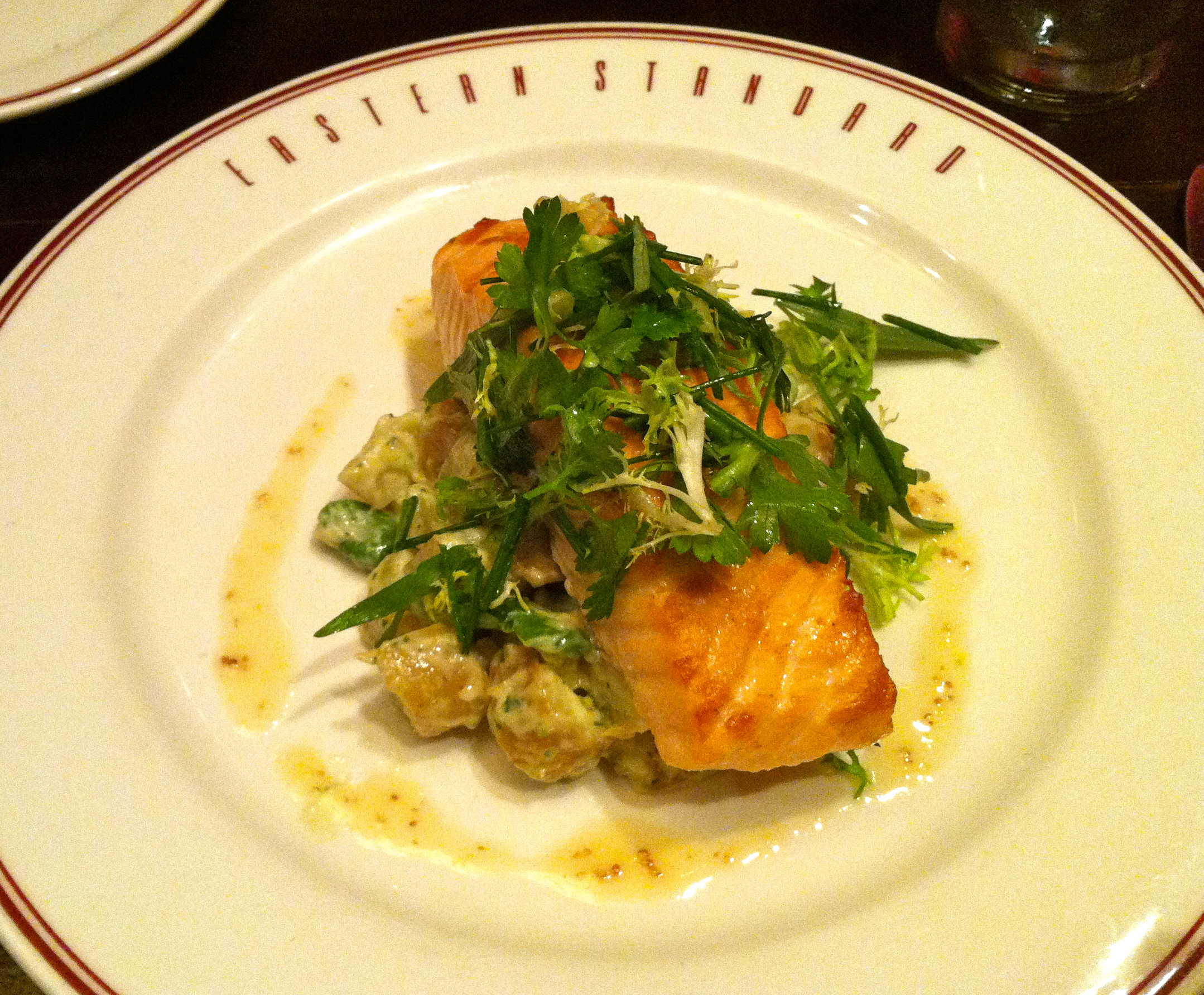
Photo: Emily ContoisAfter wading through streets clogged with rowdy Red Sox fans, I take a quick right turn through a break in the crowd and walk beneath a vibrant red awning into Eastern Standard. Upon entering the softly lit, but energetic, dining room, a hostess gestures for me and my fellow classmates from Boston University’s Food and Art course to follow her, saying with a knowing nod and quiet professionalism, “We have your table all ready for you.” She leads us, a group equal parts hungry and excited, through the buzzing restaurant, animated conversations and upbeat Elton John tunes embracing us. We reach our destination at the back right corner of the restaurant, near the kitchen and the gleaming oyster bar.

In the center of our private dining room stands an uncovered dark wood table, simply dressed with two sets of tall, curvaceous salt- and peppershakers. Alongside each of the seven place settings sits an ivory plate marked with two concentric burgundy rings and the Eastern Standard moniker at the edge. A knife and fork of heavy weight, a water glass, and a white napkin, folded around the menu card featuring the evening’s special fare, complete the setting with a restrained simplicity.

Photo: Emily ContoisLike the dark table, the walls of the private dining space are also a rich, dark brown, bordered near the ceiling with large squares of deep red paneling, adorned with gold nailheads. Radiance from the single light fixture above creates orb-like reflections on the red surface, creating a warm, inviting environment. Carpet of a brownish burgundy hue covers the floor. We are completely enveloped in dark, rich colors, masculine textures, and simple, clean lines. Opposite the double doors, a dark wood sideboard hugs the wall. On top of it rests a mostly green arrangement with several round, lavender-headed flowers at the top, reaching as high as the red border. On either side of the vase perch two wooden pig sculptures, as if standing guard.

Photo: Emily ContoisAfter soft bread with a gentle brown crust, even softer butter, and crisp, pickled vegetables quieted the initial pangs of our hunger, two female servers process round the table, pouring glasses of chilled white wine. With the arrival of the first course, plates begin to populate the expansive and empty city that is our dining table. Each place receives a shallow dome of mixed greens topped with thinly sliced cucumber and radish, lightly tossed with sherry vinaigrette that makes the varying lettuces glisten. Three settings of charcuterie balance the bright colors on our plates. Geometric arrangements of meat line up like little soldiers on the wooden serving boards, placed at intervals down the center of the table. The round slices of meat are well paired with shallow cups of condiments and a small mound of tiny pickles. Slices of crusty baguette and dark brown bread rest near the wooden serving boards, ready to enter into gustatory matrimony with the meats and mustards.

Photo: Emily ContoisFollowing on the heels of the first course comes the main. Large oblong plates of simply arranged steak, accompanied by small cups of béarnaise sauce and piles of thin cut herb fries are placed before some of us. The rest of us feast our eyes on a large fillet of Faroe Island salmon, soft and pink inside, slightly crispy and auburn outside, topped with an herb salad. In a vertically stacked presentation, the fillet rests atop a salad of chopped fingerling potatoes and fava beans, very near raw, with a creamy-tasting bacon Dijon vinaigrette. The circular arrangement of the potato salad, as well as the ring of vinaigrette that encloses it, mirror the concentric burgundy lines that encircle the plate itself, softening the straight form of the salmon fillet that stretches across nearly the entire diameter of the plate. As we begin to eat, three votives of medium height are brought in to dress the center of the table, like breadcrumbs to lead us the way home once our meal is complete. As I create delicious bites of salmon coupled with the haute potato salad, I may indeed forget my path.

After the entrée plates are cleared and our wine glasses house only a final sip, two medium sized plates of fresh baked cookies arrive. In three gentle lines of three cookies each, oatmeal, chocolate chip, and macaroon varieties lie ready to be enjoyed. The oatmeal cookie in particular elicits a surprised gasp of pleasure, as an unexpected hit of spicy molasses merges with the soft currants and raisins, creating a harmonious mouthful.

Beyond the delight of magically appearing food, the most memorable component of the meal proves to be the feeling of conviviality, the pleasure of my classmates’ and professor’s company, our dancing conversation, and our, at times, uproarious laughter. It is a long-standing cultural custom to break bread together to cement relationships. As a food studies student, I often partake in end-of-the-semester potlucks. But to gather as a small group in a delightful restaurant, unchallenged to pay the bill, I am able to effortlessly soak in every element of the meal. After completing study in art history, I am also able to bring a new visually analytical eye to the table, which further enhances the pleasures of the palate.

Seven Simply Smashing Food Exhibits: No Tickets, Shoes, or Shirts Required

One of my favorite things on a weekend afternoon, a weekday evening—well, we can go ahead and say just about anytime—is to spend a few glorious hours of levity and escape at a museum. I’m lucky to live in Boston where world-class museums abound as plentifully as colleges and universities, but sometimes, I hear you, we get busy and don’t make it out the door to enjoy the many intriguing exhibits on display.

Here you’ll find seven excellent online food museum exhibits that you can visit anytime you like from your computer—and in your pajamas if you so desire. There are likely many more delightful virtual expos, but these seven, listed in no particular order, can be a very filling place to start…

1. Julia Child’s Kitchen

Even if you aren’t in Washington D.C. you can peek in the drawers and cupboards of Julia Child’s kitchen, view selected culinary objects, and peruse an interactive timeline that chronicles her love of cooking.

Exhibit by the Smithsonian, National Museum of American History

2. War-Era Food Posters

Check out dozens of posters from during and between the World Wars with food-focused messages, such as “Eat more cottage cheese,” “Every garden a munition plant,” and “Have you eaten your pound of potatoes today?”

Exhibit by Cory Bernat from the Collection of the National Agricultural Library

3. What’s Cooking Uncle Sam?

Trace the Government’s effect on how Americans eat, exploring the farm, factory, kitchen, and table. This exhibit ran at the National Archives from June 2011 to January 2012, but you can still experience much of it through the online exhibit preview. I highly recommend purchasing the exhibit catalog.

Exhibit by the National Archives

4. counter space: design + the modern kitchen

Explore the twentieth-century kitchen as a nexus of technology, design, culture, and aesthetics through items in the MOMA collection, including a recently acquired, and  unusually complete, example of the iconic “Frankfurt Kitchen,” designed in 1926–27 by the architect Grete Schütte-Lihotzky.

Exhibit by the Museum of Modern Art

5. Key Ingredients: America by Food

Emphasizing regional traditions and international influences, this exhibit takes you coast to coast through 500 years of food in America. Through a selection of artifacts, photographs, and illustrations, you’ll explore within the home, as well as restaurants, diners, and communities.

Exhibit by the Smithsonian Institute

6. Chosen Food

Click through this beautifully done online exhibit dedicated to American Jewish identity, cuisine, and culture. You’ll find tantalizing stories and facts, from Chinese food on Christmas to the Gefilte Fish Line to latke mix in a box.

Exhibit by the Jewish Museum of Maryland

7. A Visual Feast

The National Association for the Specialty Food Trade celebrates the organization’s 60th anniversary with a beautiful (though slightly self-serving) online exhibit of 60 features, including products (from pickles to chocolate), pioneers (such as Julia Child and Martin Yan), organization events throughout the twentieth century, and trends that have transformed the culinary landscape, such as fast food, consumer food movements, and kitchen appliances.

Exhibit by the National Association for the Specialty Food Trade 

This post was originally published on the Gastronomy at BU blog

Food Journals in Popular Culture: Confessing Diet Sins or Legit Rehabilitation?

At times, diet literature offers the same recommendations that dietitians and eating disorder specialists proffer, but accompanied by an underlying message of guilt—in this case of biblical proportion.

Diet Confessions Image | Photo by David Harry Stewart

In the article, “Diet Confessions” from the June 2006 issue of O, The Oprah Magazine, Jim Karas (Chicago-based trainer to the stars and the common man alike) discusses keeping a food journal as a weight loss strategy.

The article is accompanied by a disturbing image of a thin young woman kneeling as if at worship itself with her hands pressed together in fervent prayer. A scale lurks forebodingly in the background, a menacing crucifix. Upon her face shines the light of whichever god one confesses dieting sins.

Karas discusses food journals utilizing religious descriptive language, including:

  •  coming clean
  •  every bite you take, every vow you break
  •  confessing what you’ve eaten

The article portrays an extra cookie as a sin that must be confessed to the food journal. Susan Estrich also refers to food journals in her diet book, Making the Case for Yourself: A DIET Book for SMART Women (1997), saying, “You won’t want to write down two potato chips, so you won’t eat them. Forced to confront what you’re doing, you won’t do it” (56).

Ironically, food journals are used in bulimia treatment “to provide the foundation for effective [therapy]” by identifying disordered behaviors and providing a forum for the therapist to offer suggestions and encouragement (Riess and Dockray-Miller 2002: 17). Dietitians often use a food journal as a diagnostic tool to help clients recognize nutritional deficiencies or excesses as a means to create more balanced meal plans. Food journals are not proof of an individual’s mistakes or a deterrent to eating, but a simple way to assess eating patterns so that positive changes can be made if necessary (Hollis 2008), which, as a 2008 study confirmed, effectively aids weight loss. (In this study, it doubled the weight loss.)

The improper use of food journals is yet another example of how the diet industry employs faulty psychology in its products and marketing practices. In fact, Oprah reader and recovering anorexic, Sarah Cole-Hamilton, critiques Jim Karas’ “Dieting Confessions” article (2006: 26) saying,

I could have written that article on my worst day as an anorexic.

The same damaging ideas about food and weight, which comprise the psychology of an eating disorder, are inserted into articles, advertisements, and books on dieting. This psychology renders dieters unable to relate normally to food or weight, and consequently, perpetuates dieting in the United States at the expense of the health of millions of Americans.

References

  • Cole-Hamilton, Sarah. 2006. “We Hear You!” [Reader’s Comments]. O, The Oprah Magazine August. 26.
  • Estrich, Susan. 1997. Making the Case for Yourself: A DIET Book for SMART Women. New York: Riverhead Books.
  • Hollis, J.  2008. “Want to Lose Weight? Keep a Food Diary.” Am.Journal of Preventive Medicine, Aug; vol 35.
  • Kaiser Permanente Center for Health Research News. 2008. “CHR Study Finds Keeping Food Diary Doubles Weight Loss.” July 8.
  • Karas, Jim. “Diet Confessions.” O, The Oprah Magazine June 2006:143-144.
  • Riess, Helen and Mary Dockray-Miller. 2002. Integrative Group Treatment for Bulimia Nervosa. New York: Columbia University Press.

Phallic Produce and Over-Sexed Peasants in 16th and 17th Century Italian Art

In the sixteenth and early seventeenth centuries, the comedic produce paintings of papal Rome and the naturalistic peasant paintings of northern Italy both presented erotic situations that at surface level appear as juvenile examples of low humor. Analyzing these paintings within the large social and political context of the time, however, reveals tensions, transitions, and insecurities within the Church, class relations, and art itself.

Varriano cites the popularity of witty puns in the sixteenth century, contending that they embody the instability of politics and the Church (2009: 118). He argues that lusty fruit and vegetable paintings proved to be:

The perfect metaphor for the culture of post-Reformation Rome, in which the quest for religious and political orthodoxy may have increased uncertainties and humor was the only acceptable outlet for transgressive desire (Varriano 2009: 125).

In fact, erotic pun paintings were most popular in Rome, where these suggestive works may have provided sexual release from the repression required by Catholicism, especially for the clergy.

Caravaggio’s Still Life with Fruit on a Stone Ledge is a particularly strong example of these erotic paintings, as it portrays a veritable produce orgy. A ray of light beams down from the upper left and the heads of two brightly lit, erect gourds emerge from the upper right. These diagonal lines bring the eye to the center of the painting, where one gourd appears ready to take a perfectly round melon from behind. Bursting melons and figs fill the foreground, while a basket of yet to be deflowered fruit looks on from the upper left.

Caravaggio’s “Still Life with Fruit on a Stone Ledge”

Read More

American Coffee Culture in 1872: So Different from Today?

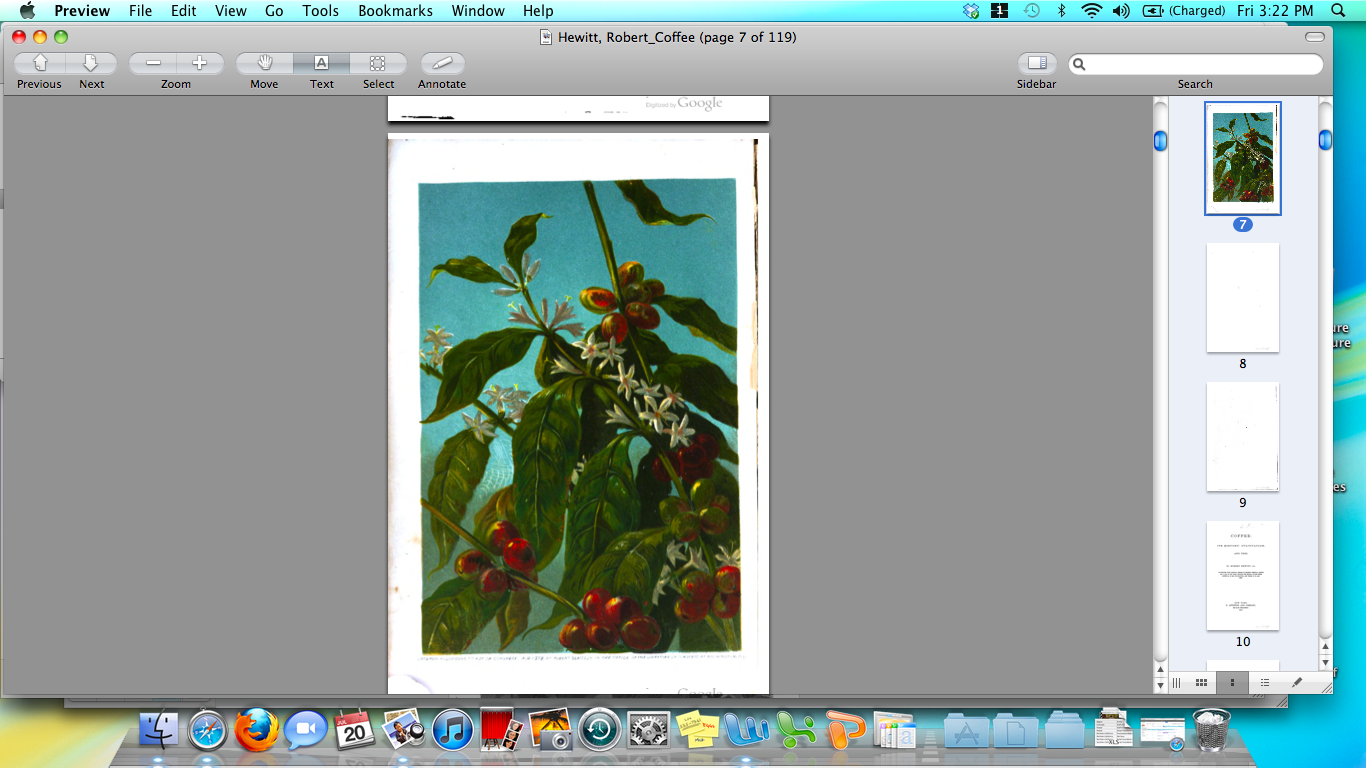
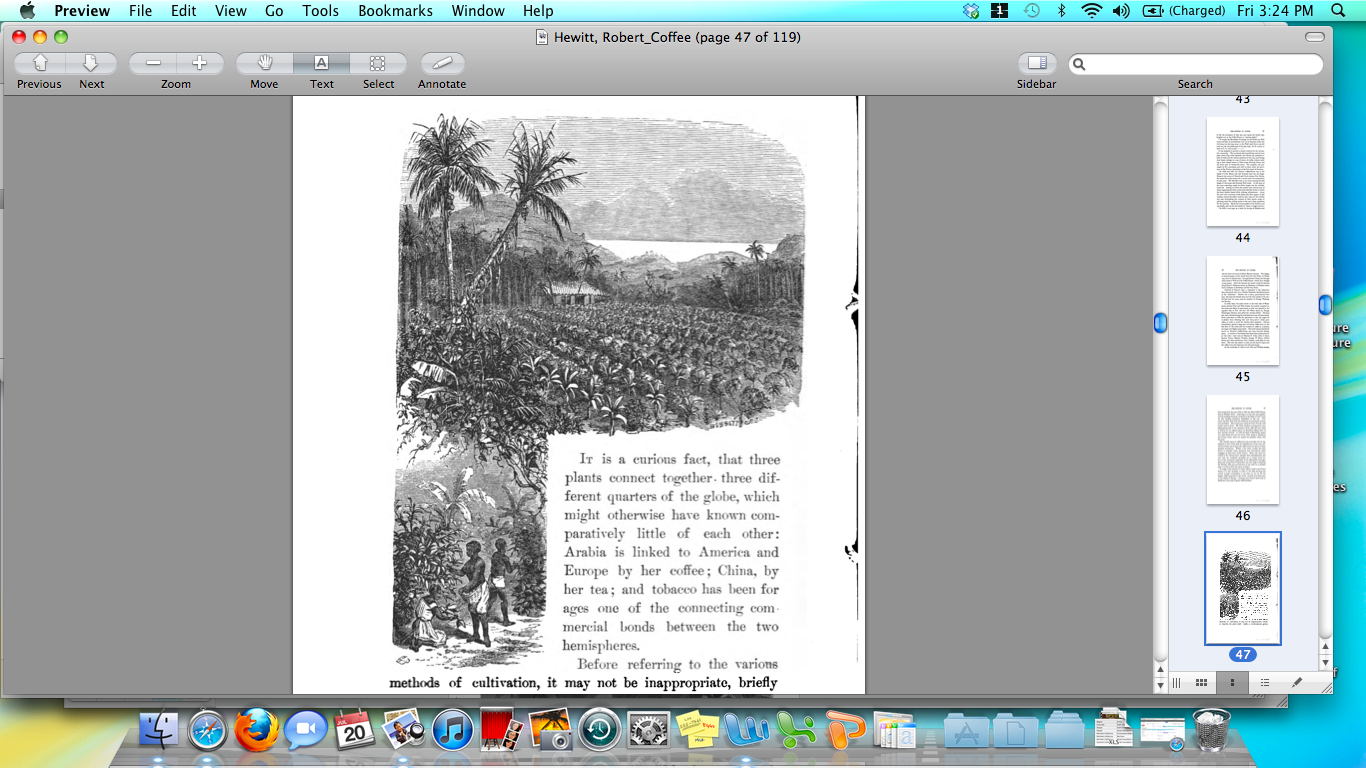
Coffee plant: Image from introductory pages of Robert Hewitt Jr.’s “Coffee: Its History, Cultivation, and Uses”

Since the seventeenth century, Americans have roasted, steamed, and boiled coffee, causing its gradual transformation into our national beverage and a potent patriotic symbol. In his 1872 text, Coffee: Its History, Cultivation, and Use, (read it for free on Google Books) Robert Hewitt Jr. captured the historical prominence of coffee in the United States, saying, “Since cotton has been proclaimed ‘king’ in the realm of commerce, coffee should be styled ‘queen’ among the beverages of domestic life” (Hewitt 1872: 11).

Coffee has since risen from its status of queen of the domestic realm and emerged as a leading global commodity, second only to petroleum oil (Pendergrast 1999: 1). Coffee thus exerts considerable political and economic power. The United States has led world coffee consumption for the past two hundred years (Tucker 2011:18). Coffee plays multiple social and cultural roles within American daily life as a beverage consumed upon waking, shared in social settings, enjoyed at the end of a meal, savored during the workday coffee break, and so on. In his historical text, Hewitt depicts coffee as a socially accepted stimulant that fuels and enlivens the mind, body, and spirit.

A Short Coffee History

Hewitt traced coffee’s origins to Ethiopia where it had been consumed “from time immemorial” (1872: 16). He then dated coffee consumption in Persia to the fifteenth century. Sr. Henry Blount, who visited Turkey in 1634, described coffee as,

Made of a berry as big as a small bean, dried in a furnace, and beat to a powder of a sooty color, in taste a little bitterish, that they seethe and drink, hot as may be endured. It is good at all hours of the day, but especially at morning and evening, when to the purpose they entertain themselves two or three hours in cauphé-houses, which, in Turkey, abound more than Inns and ale-houses with us (quoted in Hewitt 1872: 23).

Hewitt cited coffee consumption as fashionable in both Paris and England around the mid-seventeenth century with coffee introduced in the United States a short while later (1872: 23; also Ellis 2008). For example, a Bostonian woman received the first license to sell coffee in 1670, and by 1690 there were at least two operating coffeehouses in Boston (Stavely and Fitzgerald 2004: 270).

Four Reasons Coffee Became the American National Beverage

Several converging factors influenced the transformation of coffee into American “necessity of life” (Hewitt 1872: 30) in the eighteenth and nineteenth centuries, the first of which had roots in New England.

  1. Patriotism. Following the Boston Tea Party of 1773, avoiding tea was considered “an American patriotic duty” (Stavely and Fitzgerald 2004:270; Pendergrast 1997:15) and coffee proved a perfect substitute.
  2. Affordability. The declining cost of coffee made it an affordable choice for an increasing proportion of society (Stavely and Fitzgerald 2004:270; Pendergrast 1997:15).
  3. Tastier technology. Advancing technologies for grinding, roasting, and brewing coffee resulted in a tastier product with broader appeal (Tucker 2011:19).
  4. Productivity. Some scholars contend that the Industrial Revolution dramatically altered eating and working patterns and created even greater need for stimulating beverages that promoted worker productivity (Pendergrast 1997: 16-17).

Coffee’s Socially Acceptable Stimulating Power

Hewitt praised coffee’s caffeine kick, referring to coffee as “the magic drink” that “achieved an incalculable amount of good, in rendering people more happy… as well as more thoroughly equipped for encountering the battle of life” (1872:11). Hewitt even used poetic prose to describe one man’s early morning coffee experience at an outdoor stand in New Orleans:

Look at the recipient, who with blanched face, dull eyes, and depressed mien, reaches out his hand and seizes upon the nectar. The moment the fragrance reaches his nostrils a transformation for the better commences, the eyes grow bright, a healthful color and natural fullness returns to the cheeks, smiles wreath the mouth, the mind becomes active, the fogs, the dark air, effluvia of all sorts are exorcised like ghosts fleeing before the penetrating rays of the unobstructed sun (1872: 30).

Here Hewitt portrays coffee as a savior that awakens the consumer, bestowing energy and clarity. Hewitt likens the awakening power of coffee to the sun, making coffee the center of the universe, a source of life and power like the sunrays required for photosynthesis and the survival of all plant life on earth.

Hewitt also posited coffee as an acceptable stimulant, unlike alcohol and tobacco. He argued that coffee ought to be considered “an auxiliary to temperance” (1872: 41), as coffee was “an exhilarating drink, possessing the good qualities of wine without any of its bad consequences” (1872: 75).

The Historically Laborious Coffee-Making Process 

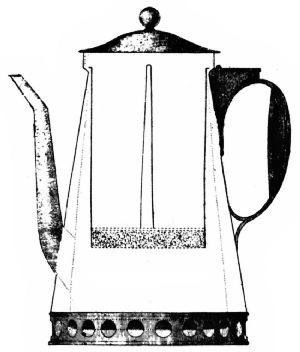
Count Rumford’s Percolator

Preparing coffee was a laborious and complex process until the twentieth century (Stavely and Fitzgerald 2004: 272). In Coffee Culture, Tucker quips that if coffee had not promised the enlivening effects of caffeine, it is unlikely that people would have pursued the multistep process of preparing it (2011: 6). Indeed, Hewitt admitted that making good coffee was considered a problem that “Yankee ingenuity has not been idle in trying to solve,” noting that the United States Patent Office had issued 175 patents for coffeepots alone (1872: 78). Hewitt recommended using Count Rumford’s percolator.

Making fresh coffee in nineteenth-century New England required a fair amount of work and number of kitchen gadgets; one had to:

  1. Procure whole coffee beans, often from a local grocer or supplier; then wash and dry them.
  2. Roast the beans in a pan set near a fire or cool oven, constantly stirring the beans to achieve even brownness. Hewitt referenced a superior method of coffee roasting where one used a hollow cylinder made of perforated iron, consistently turning it over the fire until the beans turned a deep cinnamon color. Whatever the roasting method, early techniques required near constant attention to avoid burning the beans.
  3. Grind the beans using an iron coffee mill, although Hewitt argued that the Turkish method of pounding the coffee with a mortar was superior to grinding (1872: 70).
  4. Pour boiled water over the grounds. Hewitt admonished the reader to never perform the reverse and add grounds to boiling water.

The Fragrant Coffee Berry: A Political Commodity 

Illustration (p. 38) from Robert Hewitt Jr.’s “Coffee: Its History, Cultivation, and Uses”

The main ingredient in a cup of coffee is the bean itself. Coffee berries grow best in warm climates at high elevations. Then and now, coffee is a tropical commodity that is grown in a variety of locations near the equator. Very often in high demand, coffee’s production was and is similar to that of sugar, rum, and other tropical commodities, each rife with political and economic conflict, as well as affronts to social and environmental justice. Although such issues were not a key focus in Hewitt’s text, he did express concern that coffee bean production was supported by forced labor conditions that were worse than those of American slavery (1872: 58).

Notable, however, is Hewitt’s repeated reference to coffee as “the fragrant berry,” revealing a more intimate knowledge of the bean’s origin. Typically commodity fetishism manifests in dissociation between the commodity and the consumer’s knowledge of its production. From Hewitt’s descriptions however, it appears that this knowledge remains intact, at least among those interested in coffee.

Conclusion

Although its health effects have been contested within the medical community for hundreds of years, coffee in the United States began as and remains a socially acceptable drug that fuels labor, intellectual thought, and creativity.

Catherine Tucker pondered the role of coffee as fuel in her work, Coffee Culture. She described a frantic morning when she was running late to teach one of her classes at Indiana University, but needed to stop for a quick cup of coffee. Her search for a coffee shop without long lines proved difficult and in considering the situation, she mused, “Going by the number of busy coffee shops, someone might think that the campus runs on coffee. Maybe it’s true” (2011: 18). Dunkin’ Donuts’ most recent marketing slogan, “America Runs on Dunkin,’” also builds upon this construct of coffee as a potent fuel that runs humans like machines, just as gasoline runs automobiles. Robert Hewitt Jr.’s nineteenth-century text reveals not only historical evidence for the concept of coffee as fuel, but also demonstrates the command coffee has had over Americans for centuries.

References

  • Ellis, Markman, 2008. “An Introduction to the Coffee-House: A Discursive Model.” Language & Communication 28: 156-164.
  • Hewitt, Robert, Jr, 1872. Coffee: Its History, Cultivation, and Uses. New York: D. Appleton and Company. Accessed November 1, 2011.
  • Pendergrast, Mark, 1999. Uncommon Grounds: The History of Coffee and How it Transformed Our World. New York: Basic Books.
  • Stavely, Keith, and Kathleen Fitzgerald, 2004. America’s Founding Food: The Story of New England Cooking. Chapel Hill: The University of North Carolina Press.
  • Thurber, Francis, 1889. Coffee: From Plantation to Cup. A Brief History of Coffee Production and Consumption. 15th Edition. New York: American Grocer Publishing Association. Accessed November 1, 2011.
  • Tucker, Catherine, 2011. Coffee Culture, Local Experiences, and Global Connections. New York: Routledge.

Food News Round Up: Celebrate and Assess the Half

We recently passed the approximate half-way point of summer, a fact worth celebrating in a half-glass-full kind of way — and a reason to perform a mid-point status check. Are you making it through that reading list? Have you spent enough time at the beach? Have you tried at least half of those recipes you’ve been marking, saving, and creating?

If not, you have approximately another half to go; plenty of time to fit in everything you planned for your summer. Regardless, you can enjoy these “half and half” edition of Food News Round Up.

Research: 1/2 Science + 1/2 News Reporting

Media coverage on eating behavior research abounds, but the relationship between science and science news is often tenuous. These three studies were reported in the media this week and are presented here with the study or abstract to ensure research integrity.

Food Policy: 1/2 Foreign and 1/2 Domestic 

Food policy news this week spans both international and US concerns:

Food and Culture: 1/2 the Arts + 1/2 Cuisine

This week provides a veritable smorgasbord of interesting tidbits involving food and culture, divided between the visual and linguistic arts and culinary trends:

This post was originally published as part of a recurring feature called ‘Food News Round Up’ on the Gastronomy at BU blog

Chicken Fricassee Face-Off: 18th Century Haute Cuisine versus 1950s Can-Opener Cooking

When I was a graduate student in the Boston University Gastronomy program, Ken Albala assigned an intriguing final exam question in the course “A Survey of Food History:” to compare and contrast two Chicken Fricassée recipes.
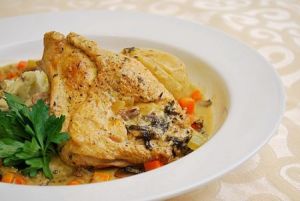
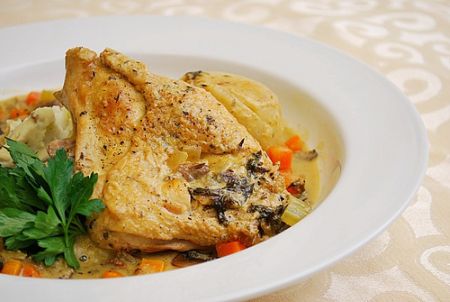
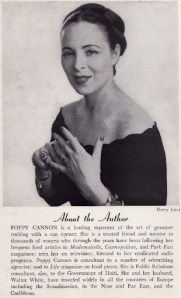
While it may appear at first glance that Francois Massialot’s recipe, “Poulets en Fricasée au Vin de Champagn” from Le Nouveau Cuisinier Royal et Bourgeois (1748), is the culinary superior of Poppy Cannon’s “Chicken with White Wine and White Grapes” from The Can-Opener Cookbook (1953), such an assumption ignores the complexity of each recipe as a unique product of a particular time and place. As Anne Bower contends, a cookbook can be read as a “fragmented autobiography” (Bower 1997: 32) that reveals unique details not only of the author’s experience, but also those of his or her time. Cannon’s recipe in particular fulfills Bower’s assertion that the main theme of cookbooks is the “breaking of silence” (1997: 46-47), as it reveals the struggles and desires of the 1950s American housewife.

Examples of Period Food Trends

First published in 1691 and in revised additions throughout the early eighteenth century, Le Nouveau Cuisinier Royal et Bourgeois featured haute cuisine, a new culinary tradition first articulated in seventeenth century France. Rather than the strong, heavily spiced flavors that had previously characterized European court cuisinehaute cuisine featured harmonious flavors, derived from the foods themselves. For example, the “Poulets en Fricasée” recipe does not include exotic spices or sugar, but instead showcases the flavors of the new cuisine with a sauce based on butter, aromatics, such as the onion and mushrooms that accompany the chicken, and sparse use of salt and parsley.

American cuisine of the 1950s also emphasized simplicity, though in a different way. Following World War II, manufacturers sought domestic markets for products, such as ready-made foods, that had been developed for military use during the war. Home economics texts, women’s magazines, product-sponsored recipe booklets, and advertising alike aggressively promoted processed “convenience foods” as time and energy saving wonders, suited to simplify the busy housewife’s labors.

Specific Types of Food Systems

Massialot’s recipe depends upon a food system that is more intimately connected to nature and Cannon’s one that is more industrialized. While Cannon simply instructs the reader to “open and empty a can of chicken fricassee,” Massialot’s recipe requires far greater investment of time and intimacy with the dish’s main ingredient. His recipe calls for one to work from whole chickens and connects the reader to the animals in a possessive, familiar way, calling them “your chickens.” Like a senior surgeon gently guiding one through a new procedure, Massialot instructs the reader to gut the chickens, remove their skin, and states exactly where and how to cut.
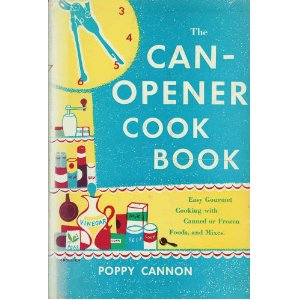
Conversely, The Can-Opener Cookbook places distance between the cook and the chicken. It instead depends upon the technology of mass produced canned goods, which were, and are, a legacy of the Second Industrial Revolution. Canned foods first provisioned Napoleon’s troops in the early nineteenth century. By the end of the century, however, canning had been industrialized on an international scale. Coupled with nineteenth century advances in transcontinental transportation, canning played an increasing role in changing the way Americans ate. And, processed foods were strongly promoted following World War II. Cannon’s twentieth century recipe embodies these converging effects with the first ingredient, “canned chicken fricassee.”

Unique Ways of Communicating

Massialot’s recipe builds upon the legacy of haute cuisine and the Apollonian codification of French cuisine, cooking methods, kitchen organization, and recipes. American recipes also experienced a codification of sorts at the turn of the century. Fanny Farmer of the Boston Cooking School aggressively promoted cooking with scientific accuracy, down to the fraction of a teaspoon, the legacy of which is clear in Cannon’s recipe. Massialot offers no specific amounts for ingredients, using phrases such as “some,” “a little,” and “a bit,” which depend upon a chef’s intuition, sensory involvement, and experience. Cannon, on the other hand, spells out for the reader at the beginning of the recipe exactly what ingredients are needed. Throughout the recipe, she qualifies specific amounts, such as “4 tablespoons” and “½ teaspoon,” ensuring that even the novice housewife with minimal cooking experience could make the recipe with ease.
The Intended Audience

Massialot worked extensively in court kitchens and this popular cookbook packaged that knowledge for the upper middle class of seventeenth century France. Cannon, however, provided recipes for middle-class housewives of mid-twentieth century America. Cookbooks for busy American housewives were not new, however. For example, Hannah Glasse’s The Art and Ease of Cooking (1747) was one of the first cookbooks printed in the American colonies, instructing housewives on how to feed their families in accordance with English tradition.

Poppy Cannon’s The Can-Opener Cookbook is unique, however, in that it acknowledges the challenges of the housewife who also works outside of the home. In the 1950s, increasing numbers of middle class women remained in, or joined, the workforce, which affected cooking and eating practices, as well as American society more generally. In her chapter on Poppy Cannon in Something from the Oven: Reinventing Dinner in the 1950s America, Laura Shapiro reveals that it was these women who Cannon sought to serve, stating, “At the center of Poppy Cannon’s culinary life was an American housewife, and she just got home from work” (2004: 89).

The Authors

As a thoroughly experienced chef, Massialot’s recipe exudes a calm confidence as it communicates culinary insight, gained from courtly kitchen experience. Cannon speaks with a straightforward confidence as well, as she endeavors to bring busy housewives into the fold of quick and easy gourmet cooking. Shapiro states that Cannon, “Had always considered herself far above the marshmallow-salad school of quick cooking, because her business was imitating great cuisine” (2004: 107). This is evident as her recipe offers a quick version of a gourmet dish. Indeed, Cannon was proud to be called “the original gourmet in a hurry” (quoted in Shapiro 2004: 111).

National Identity in Recipes

Massialot provided a French recipe for a French audience at a time when French cuisine was becoming more democratized and increasingly viewed as a unifying element of French culture. Alternatively, Cannon’s recipe is an example of an “ethnic” dish portrayed as part of American cuisine, which is largely the product of immigrant cuisines. Some contend that this resulted in “Americans lack[ing] a sense of having a national cuisine that unites them across ethnic and regional boundaries” (Gvion 2009: 56). With regard to French cuisine, Americans have considered it both something to be emulated, as well as something to avoid at different times throughout the twentieth century. Cannon’s recipe both elevates French cooking as the height of elegance, but also devalues it by Americanizing it. For example, while the ingredients include canned chicken fricassee, the recipe title has been thoroughly Americanized to the simple (and rather boring) “Chicken with White Wine and White Grapes.”
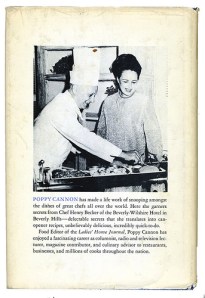
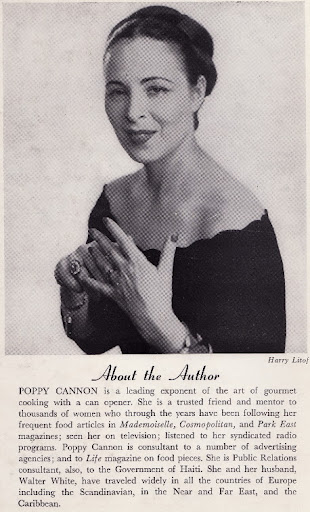
While she Americanized the dish for her readers, Cannon was fully literate in the world of fine dining and French cuisine. Like other epicures of the day, Cannon had traveled extensively in Europe, publishing Eating European at Home and Abroad in 1961. As wife to both Claude Philippe, a culinary powerhouse of the Waldorf-Astoria, and Walter White, a prominent civil rights leader, Cannon had considerable gastronomic experience. Thus, her statement, “Much of the difference between just cooking and epicurean cooking is the difference in the way the food is served” (quoted in Shapiro 2004: 125), was based upon a wealth of knowledge. This recipe demonstrates Cannon’s faith in presentation, as the “serving time” instructions dictate, “For the utmost in elegance serve with wild rice or saffron rice,” but she is also quick to assure the reader that such an effort can be simple and quick, since wild rice “can be bought canned and ready for heating.”

Conclusion

Massialot provides clear instructions for crafting a culinary masterpiece that builds upon what many consider to be the preeminent haute cuisine of the world, for all time. But Cannon’s French-inspired meal from a can is one that endeavors not only to make cooking dinner easier for the workingwoman, but also assists her in crafting the ideal of the gourmet meal for two. Cannon valued romance in both her personal life and career, which is evident in her recipes.

This recipe also serves as a “breaking of silence” (Bower 1997: 46-47) as it expresses the inner conflict and hopes of many housewives in the 1950s. For many women at that time, cooking dinner may have been a daily act of not only wifely and maternal love, but an act to erase the pain and suffering of the war. As films like The Man in the Gray Flannel Suit (1956) tell the story of men coping and adjusting in post-World War II America, Poppy Cannon’s recipes tell part of the women’s side of the same story. Even when newly burdened with the stress of working outside the home, a speedy (but gourmet) meal from a can ensured that a woman could still serve a dinner that would nourish her family. She could feed them physically and emotionally, with nutrients, epicurean presentation, and genuine love — easing the memory of a painful past and looking to the future with hope.

References

  • Bower, Anne. 1997. “Cooking Up Stories: Narrative Elements in Community Cookbooks” in Recipes for Reading, edited by Anne Bower. Boston: University of Massachusetts Press. 29-50.
  • Cannon, Poppy. 1953. ““Chicken with White Wine and White Grapes” in The Can-Opener Cookbook New York: Thomas Y. Crowell Company. 131.
  • Gvion, Liora. 2009. “What’s Cooking in America? Cookbooks Narrate Ethnicity: 1850-1990.” Food, Culture & Society. 12(1): 53-76.
  • Massialot, Francois. 1748. Le Nouveau Cuisinier Royal et Bourgeois. vol. II Paris: Joseph Saugrain. 246.
  • Shapiro, Laura. 2004. “Chapter 3: Don’t Check Your Brains at the Kitchen Door” in Something from the Oven: Reinventing Dinner in the 1950s America. New York: Penguin Books. 85-127.

This post originally appeared on the Gastronomy at BU Blog

Chain Restaurant “Diet” Menus: Serving Up Guilt with a Side of Sin

Guilt is frequently linked to food in a dysfunctional way and is founded in a belief system that gives food and eating a moral value. Notably, Paul Rozin et al.’s (1999) landmark food psychology study found that compared to Japanese and European subjects, Americans restricted their diets the most, feeling the most guilt and dissatisfaction. The moral construct of food consumption is an important part of American food culture and is what Paul Campos refers to as “orthodox diet theology” (2004: 75). Using this theology, some foods are deemed good, while others are bad, and thus guilt-inducing.

The themes of guilt and morality are often used to sell entrees at chain restaurants, usually dishes that are considered “healthy” or low-calorie options. Patrons are encouraged to order from “diet” menus, which claim to offer dishes that make eating out a guilt-free experience.

Among 200 menu options (some of which contain more than 1,000 calories), The Cheesecake Factory launched the “SkinnyLicious® Menu” in 2011, which Bruce Horowitz in USA Today argues was a result of “pressure from calorie counters, advocacy groups and party poopers” (Horovitz).

At Applebee’s (a chain currently refreshing their image and at least on surface level improving their food—and did you know Applebee’s sells the most steak of all chains in the bar and grill category?), eating out and dieting explicitly coexist, as diners can watch their “points” by ordering from the Weight Watchers® menu. Applebee’s promotes these diet options with the tagline, “Eating right never tasted so good,” insinuating that eating healthfully does not taste good.

Screenshot of Applebee’s Weight Watcher’s Menu

While Chili’s used to offer “Guiltless Grill” options that “give you more choices for your healthy lifestyle,” the chain now serves “Lighter Choices” that are featured on Healthy Dining Finder (a pretty decent tool if you do eat out frequently and are working to maintain or lose weight), containing not more than 750 calories, 25 grams fat, and 8 grams saturated fat. Chili’s is one of several chains to utilize the concept of lightness in diet menu marketing, as consumers seek lighter bodies through dieting.

Red Lobster Lighthouse Menu

Red Lobster also endorses lightness, offering the “Lighthouse Menu,” a title alluding to not only the pursuit of physical lightness, but also the promise that ordering diet foods is “safe” and can guide a dieter safely into port. Similar to Applebee’s, Red Lobster promotes these “Lighthouse” options with the tagline, “Smart choices never tasted so good,” again reinforcing the belief that healthy eating is inherently not a tasty experience. Ironically, Red Lobster also exploits health concerns to the chain’s advantage, such as a section titled, Seafood and Health, which promotes seafood as a low-fat, high-protein option, rich in omega-3 fatty acids, a type of fat that has garnered significant fame. (In the perfectly titled BBC News Magazine article, “The Cult of Omega-3,” Brendan O’Neill explores whether they are as magical as the media have led us to believe.)

Some restaurants take another approach, marketing indulgence as sinful, but enjoyable. For example, at Outback Steakhouse, one can order Sydney’s Sinful Sundae®. By offering diet menus and using language that makes eating out seem like a guilt-ridden activity, patrons begin to feel guilty about eating in general.

In fact, restaurant diet menus prey upon the psychological insecurities of dieters and those with eating disorders, as revealed in a study by psychologists Vivian M.M. Gonzalez and Kelly M. Vitousek of the University of Hawaii. The researchers found that categorizing food as good or bad leads to guilt and fear with eating. The study found that:

Restrained individuals, [those who diet or have an eating disorder] categorize foods according to whether they are ‘guilt inducing’ versus ‘guilt free’ (2003: 156).

When participants were asked to rate foods, the results for restrained individuals showed a positive correlation between increased guilt and fear and “each perceived level of fatteningness” (2003: 160).

These results inform the discussion of “diet” options on chain restaurant menus. If an item is not preceded by the words lean or healthy or light, consumers fear a food must be a “bad” food, making the consumer who eats it bad as well. Ironically, while these diet menus exist to provide “healthy choices” to diners, they may actually complicate consumers’ ability to discern quality food choices or to “indulge” without emotional ramifications, such as guilt.

References

Not Just for Cooking Anymore: Deconstructing the Twenty-First-Century Trophy Kitchen

This post contains an expanded abstract for “Not Just for Cooking Anymore: Deconstructing the Twenty-First-Century Trophy Kitchen,” which I presented in April 2012 at the Language of Food Conference at Cornell University, a thought-provoking event, directed by my now wonderful friend, Diana Garvin. This paper was then published in the Graduate Journal of Food Studies, Winter 2014. Download the PDF here

Presenting my paper at the Language of Food Conference | Photo by: Julia Hastings-Black

More than ever before, the American kitchen is center stage. A variety of converging factors explain its ascent within the home and the American consciousness. With the inception of the Food Network (1993), Home and Garden Television (1994), shows such as MTV Cribs (2000), and a deluge of magazines and websites, images of the dream kitchens used by famous chefs, owned by celebrities, and purchased by aspiring homebuyers bombard American viewers. The near constant barrage of ideal kitchen images is one factor that has contributed to the redefinition of the American kitchen.

Drawing from kitchen design history, popular culture, and current kitchen renewal trends, this paper shows that today’s ideal kitchen breaks the mold that defines the kitchen itself. In opposition to how the kitchen has been historically positioned and understood within the home—and despite predictions that technological innovations would render the kitchen obsolete—the ideal twenty-first-century kitchen is now considered the central hub of the home. While previously defined as a room for cooking, the ideal of the trophy kitchen takes on a new meaning that is often disassociated from cooking and food preparation.

This paper explores several themes that triumph over function in the twenty-first-century kitchen.

1. Kitchen as Status Symbol

As function has become secondary, status has become primary. Scholars have examined the emergence of the kitchen as a potent status symbol, often using the work of Pierre Bourdieu (Southerton 2001, Gram-Hanssen and Bech-Danielsen 2004, Shove and Hand 2005, Gdula 2008). With the rise of “foodie” culture, which has been growing steadily in the United States since at least the 1960s, dining and cooking have become leisure activities of the bourgeoisie, thus making the kitchen a site of their consumption.

One of 50 Cent’s six ktichens as featured on MTV Cribs

This section includes analysis of the 50 Cent Special Episode of MTV Cribs and the HGTV program, House Hunters.

2. Kitchen as Social Space

In her ethnographic research of home decoration in London, Alison Clarke (2001) concluded that “the house objectifies the vision the occupants have of themselves in the eyes of others and as such it becomes an entity and process to live up to, give time to, show off to” (quoted in Shove and Hand 2005). Thus, as the kitchen becomes a more public space meant for socializing, rather than cooking, status plays a larger role. The kitchen is thus elevated to a social space for entertaining that merges the public and private spheres, complete with professional appliances heretofore reserved for restaurant kitchens.

HGTV Dream Kitchen Giveaway 2012: “Continues from the great room…an 8-by-4-foot…island accommodates both food prep and entertaining.”

3. Kitchen as Site of Fantasy 

Shove and Hand’s research on kitchen consumption found that people made kitchen design decisions for a desired future state “in order to foster habits to which they aspire” (Shove and Hand 2005), revealing an orientation toward a future self, rather than the present. The kitchen is also a site for hopes, dreams, and fantasies with appliances and equipment representing a better future self promised by the kitchen consumer industry.

4. Kitchen as Performance Space…Especially for Men

As the focal point of the home, the kitchen also provides a performance center where culinary theater and leisure are played out in kitchen design, décor, and use. In addition, the trophy kitchen promotes male culinary performance specifically, fantastically termed the “dudification of cooking” by Helen Rosner, the online editor for Saveur (McArdle 2011)While a woman who cooks for her family is viewed as unexceptional, a man who cooks is viewed as a celebrity within his own home. Thus, men are theorized to be a key contributor to the growing trend of trophy kitchens (Koppel in Guzman 2002).

By exploring these themes, this paper elucidates the evolution, role, and meaning of the twenty-first-century trophy kitchen, especially in scenarios where it is not meant for cooking.

References

Featured Image Credit: Peter Rymwid & Peter Salerno

Sacred Feasts: Food in Art as Literal History and Spiritual Metaphor

A variety of food centered sacred narratives have artistic appeal, from parables and miracles that involve food to sacred meals. Varriano (2009) discusses at length two sacred meals in particular, the Last Supper and the Dinner at Emmaus, which were depicted repeatedly by a number of Renaissance artists. Given the sparse details of the actual foods served at the meals and the oft-competing roles of literal and symbolic depictions, however, artistic purpose and intention can be difficult to discern, even in works portraying well-known sacred narratives.

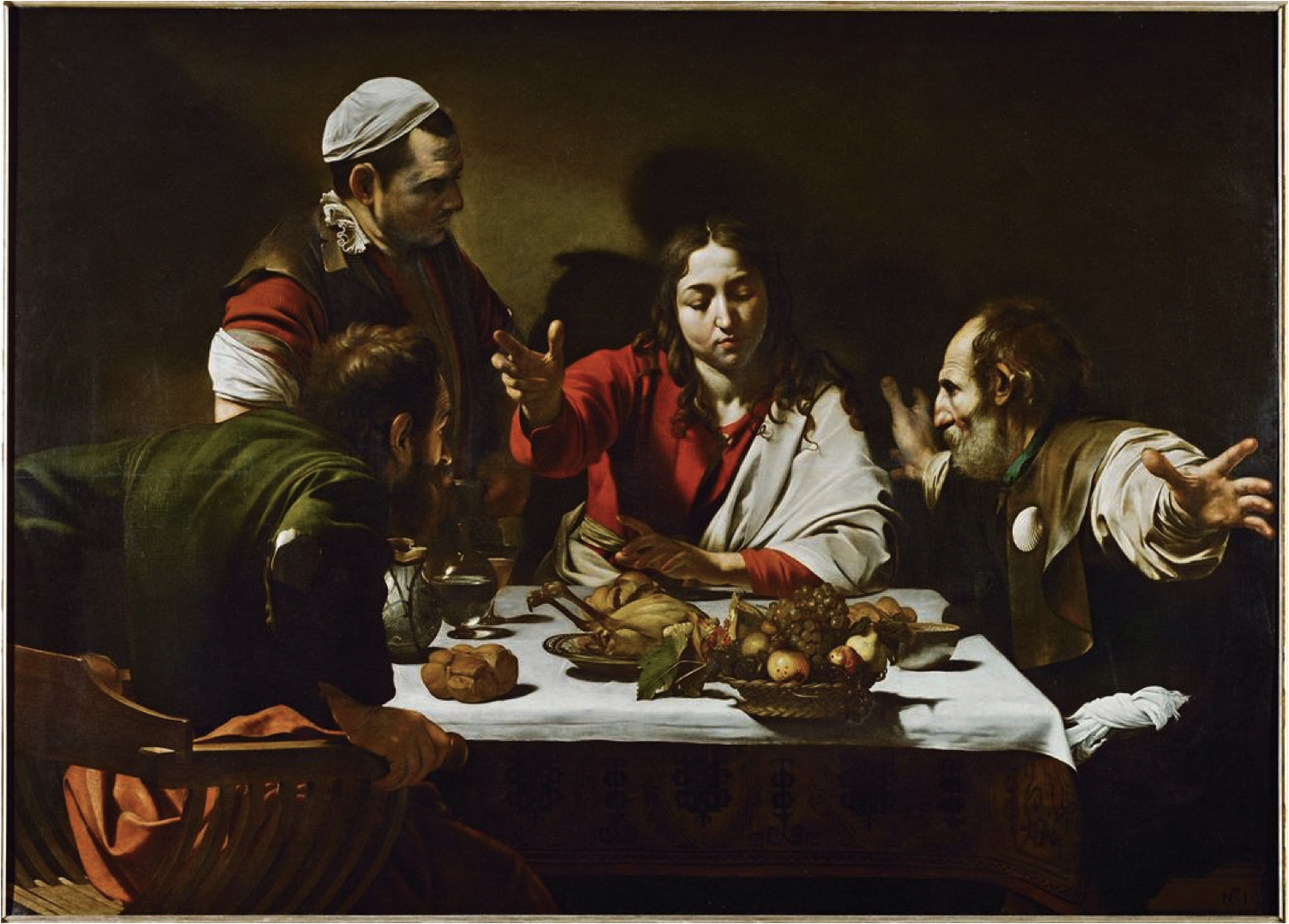
Caravaggio’s “Dinner at Emmaus”

Biblical Meanings of Food

Many of Christ’s parables utilized food as metaphors, symbols, and narrative devices to create commonality with his followers. Humble fishermen and farmers could thus relate to the subjects of his stories—such as the Parable of the Mustard Seed, the miracle of feeding the multitude with five loaves and two fish, the miracle of turning water into wine, and the story of Jesus and the fishers of men—because they are told using the common language of food. Meals, specifically, provide powerful subject matter. As Elsen states “the table…[serves] as a compositional and social catalyst” (174), thus imbuing sacred feasts with intriguingly layered and dramatic meaning. For example, the breaking of bread together was a shared experience with established cultural meaning, such as sustenance, community custom, and pleasure, prior to its elevation as a Christian sacrament. From an artistic perspective, meals also provide ample source material for portraying both food still life and narrative action.

Interpreting Sacred Feasts in Art

At least two problems arise in interpreting artistic works portraying sacred feasts, however, such as the Last Supper, the Dinner at Emmaus, and the Wedding at Cana. First, the Bible does not describe the foods served in detail. For example, the story of the Last Supper mentions only wine and bread. Varriano states, however, that artistic exploration beyond literal Biblical text is a hallmark of the Renaissance, stating, “the secularism and antiquarianism of the Renaissance were the forces necessary to bring this about” (2009: 95). With little narrative detail to work from, artists employed varying degrees of creative license, crafting meals suitable for a Biblical time and setting, feasts featuring foodstuffs of the artist’s own time, or meals simply drawn from the artist’s imagination.

Veronese’s “Feast in the House of Levi”

While each of these interpretations is well within the explorative purpose of art, they were not equally well received by those commissioning the paintings, often the Church itself. For example, in Paolo Veronese’s depiction of the Last Supper, Feast in the House of Levi, he imagined a main dish of poultry and gave significant attention to glittering serving ware and cutlery (Varriano 2009: 112). While the Holy Office of the Inquisition was most distressed by the artist’s inclusion of extra unorthodox guests at the table, we see that Veronese’s imaginative touches to the dinner table reflect the artistic and intellectual climate of the Renaissance that embraced creativity beyond recorded details.

A second problem of interpreting sacred feasts in art lies in that the foods featured often embody both literal and symbolic meaning, making their deconstruction complex and layered. For example, the fact that the Gospels only mention wine and bread at the Last Supper might refer more to their roles in the sacrament than as the actual foodstuffs served. Fish, as well, has both a literal role as a period dish, and a symbolic one, serving as a Christian symbol.

Ravenna Mosaic, “The Last Supper”

For example, Varriano describes the Ravenna mosaic of the Last Supper, arguing that the six small loaves of bread and platter featuring two large fish, “emphasizes the symbolic over the literal aspects of the meal” (2009: 95). An artist’s intention to portray a literal feast, one with symbolic potential, or both can be difficult to discern from the works alone.

Regardless of the artist’s intention, the powerful meaning and visual appeal of food and meals ensure that works featuring sacred feasts possess lasting resonance for viewers.

References

  • Elsen, Albert. Purposes of Art. Fort Worth: Harcourt College Publishing, 1997.
  • Varriano, John. Tastes and Temptations: Food and Art in Renaissance Italy. Berkeley: University of California Press, 2009.

The Woman Suffrage Cookbook of 1886: Culinary Evidence of Women Finding a New Voice

The Woman Suffrage Cookbook (1886), edited by Mrs. Hattie A. Burr, was created as a fundraising tool for Massachusetts suffragists, but it also provided a powerful new voice. It communicated with women of all classes in the common language of the cookbook about not only food and domesticity, but also the radical cause of women’s right to vote. The Woman Suffrage Cookbook also tracks changing cooking practices in the United States in the late nineteenth century, changes that mirrored larger transitions in society. The growing forces of industrialization, urbanization, and a variety of social movements—among them women’s suffrage—swept the nation, forever molding her into a new shape. This cookbook demonstrates the changes impacting women’s domestic and civic life at the time by documenting the transformation taking place within her kitchen.

The Cookbook

The cookbook begins: “This little volume is sent out with an important mission,” which we can assume has scope beyond “cookery, housekeeping, and the care of the sick” given when and why it was published.

The Woman Suffrage Cookbook is the oldest fundraising cookbook in support of women’s suffrage. It was developed for and sold at events in Boston, Massachusetts in 1886 and 1890, which were held to raise much-needed funds for the municipal suffrage campaign. In the cookbook’s introduction, Burr refers to the cookbook as “our messenger,” believing that it “will go forth a blessing to housekeepers, and an advocate for the elevation and enfranchisement of woman” (emphasis added). This cookbook served as a unique, subversive, and intelligent messenger. Its success is marked in that it was followed by suffrage cookbooks in other states, although The Woman Suffrage Cookbook features contributions by iconic leaders of the suffrage movement.

The Authors

The contributors to The Woman Suffrage Cookbook are prominently introduced as “eminent in their professions as teachers, lecturers, physicians, ministers, and authors, — whose names are household words in the land.” Among the authors are the organizer of the Boston Festival and Bazaar, President Mary A. Livermore, and leading suffragists Lucy Stone, Julia Ward Howe, and Frances Willard. These authors are not only experts in domestic issues, as is typical of cookbooks, but also women of significant social standing and education, often in positions that until recently had been held exclusively by men. This preface alerts readers to the fact that this cookbook is unlike any other. Even if the recipes are similar or familiar, the way in which they are presented—and the presenters themselves—are of specific and vital importance, as they now embody women’s suffrage.

The Recipes

Within the context of this cookbook, particular recipes take on a new meaning. If published within any other compilation, Mrs. Mary F. Curtiss’ Rebel Soup would be less rebellious. While election cakes were common, Miss M.A. Hill’s Mother’s Election Cake has more potency within this cookbook, marking an opportunity for women’s involvement in elections to expand beyond the kitchen.

While I know not the consistency of “popped robbins,” my mind’s eye conjures something akin to this little fellow.

These embodied recipes were intended for a broad female audience with varying cooking expertise, just as the vote was intended for all womankind. An assumed familiarity with cooking is present in many recipes that are written in the “old style” of a short narrative devoid of significant description or instruction. Assumed familiarity is also apparent in recipes that compare one dish to another and, specifically, in the instruction to “stir with a spoon until of the consistency of what our grandmothers called ‘popped robbins,’” revealing the assumed knowledge of generations of cooking techniques. A few recipes are more instructive, such as To Broil Whitefish or To Fry Spring Chicken and Make Gravy as Mother Did It.

A Time of Social and Culinary Change

As a time of great transition and change, the climate of the late nineteenth century is clearly visible in three recipe characteristics.

1. Recipes employ both old and new equipment and measurements.

Some recipes refer to older, traditional technology, such as the kitchen fire lit in the morning, while many others refer to the “quick oven” and at least one recipe refers to the Dover egg beater. Several recipes state a preference for porcelain cookware. In addition, disinfectant “recipes” are included for both water-closets and outhouses, perhaps revealing not only the progress of technology, but also the broad audience of the cookbook, which included women of all social classes.
The recipes also feature both standardized and non-standardized measurements. References to both cups and teacupfuls appear throughout the cookbook and even within the same recipe. For example, Mrs. Mary J. Buchanan’s Cake recipe refers to both “butter size of a small egg” and to the standard measures of “cupful” and “teaspoonful,” again revealing the state of transition in not only food and cooking, but in American life more broadly.
2. Recipes include both traditional and modern foodways.

The cookbook includes historically “native” ingredients and recipes, as it features “Indian meal” several times, as well as pone. Matilda Joslyn Gage acknowledges American Indian foodways in her recipe To Broil White Fish, saying “Upon the shores of this great inland sea I learned – a Chippewa Indian’s receipt – that, to have this fish in perfection, it must be covered while boiling.” Traditional and historic recipes are also included, such as Centennial Pepper Hash, Old-Time Baked Indian Pudding, Last Century Blackberry Pudding, and Washington Cake, St. Louis, 1780.

Recipes also feature “modern” ingredients. Mrs. Emma P. Ewing’s bread recipe calls for Fleischmann’s yeast, indicating a full departure from making one’s own yeast at home. A disinfectant recipe and Mrs. H.R. Shattuck’s recipe for Cocoanut Cookies also reveal a growing trend of purchasing ingredients at markets, shops, and drugstores.

3. Recipe language appears in both old and new formats.

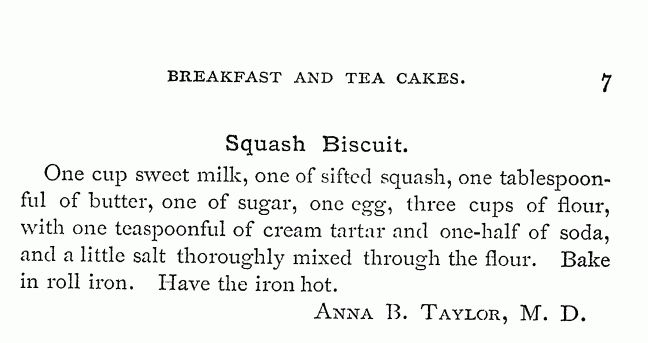
Most recipes are written in the “old fashioned” model and do not list ingredients separately or use imperative verbs as signposts throughout the recipes. Rather the recipes read as a list of ingredients, sometimes including instructions, woven together in short narrative paragraphs. An exception to this style of recipe is that for Iowa Brown Bread submitted by Mrs. Emma P. Ewing. One of the few submissions from outside of New England, Ewing’s recipe reads in the “modern” fashion that would soon become conventionalized, providing the ingredients in a list at the beginning of the recipe, followed by process steps marked with imperative verb instructions that are absent from most other recipes.

Page 7 Woman Suffrage Cookbook | Image from: http://digital.lib.msu.edu/projects/cookbooks/coldfusion/display.cfm?ID=wosu&PageNum=27

Example of a recipe written in the “old style”

Recipe Codas

While the old style of recipe writing is often brief and direct, many of the recipes include what is referred to as a “coda.” The recipe codas not only function to end the recipe, but also provide us with snippets of the author’s views on cooking and domesticity in her own words and voice. For example, Catherine H. Birney’s recipe for Home-made Macaroni explicitly promotes home cooking and frugality, saying, “If the paste is stiff enough and rolled thin enough, it will be found superior to the bought macaroni, and far cheaper.” Some recipes include a coda with a strict tone emphasizing precision and quality, such as “If this recipe is strictly followed, and the yeast and flour are of good quality, it will invariably produce sweet, nutty-flavored delicious bread and roles.”

The coda may also include advice applicable both in the home and the public sphere. For example, Abigail Scott Duniway’s Pure Salt Rising Bread recipe warns and encourages us “…it takes time, patience and thought to make it. Try it, and be convinced.” Matilda Joslyn Gage tells us in her Baked Tomatoes recipe, “If you do not succeed the first time, try again; they are worth the trouble,” lessons that perhaps apply not only to cooking, but to the quest for the vote, which will not come to all women for another thirty-four years.

Conclusion

Filled with new meaning and revealing a historic transition in cooking and society as a whole, The Woman Suffrage Cookbook provides a powerful example of the inner workings and purpose of cookbooks. This cookbook in particular reads as a “fragmented autobiography” and fulfills Anne Bower’s assertion that the main theme of cookbooks is the “breaking of silence,” as this cookbook features a generation of women on the verge of possessing a political voice.

Its publication also represents a use of the cookbook as an opportunity to express “an inner drive towards the assertion of selfhood in resistance to the overt and violating male plots of ambition,” as can be seen in the professions of the contributors and the explicit mission of the cookbook itself to promote political equality. The Woman Suffrage Cookbook also provides fruitful evidence of the changing times, offering a window into a new era of food and cooking and the expansion of women’s roles in American society.

Bibliography 

Cooking a Sixteenth Century Meal Brings Food History to Life

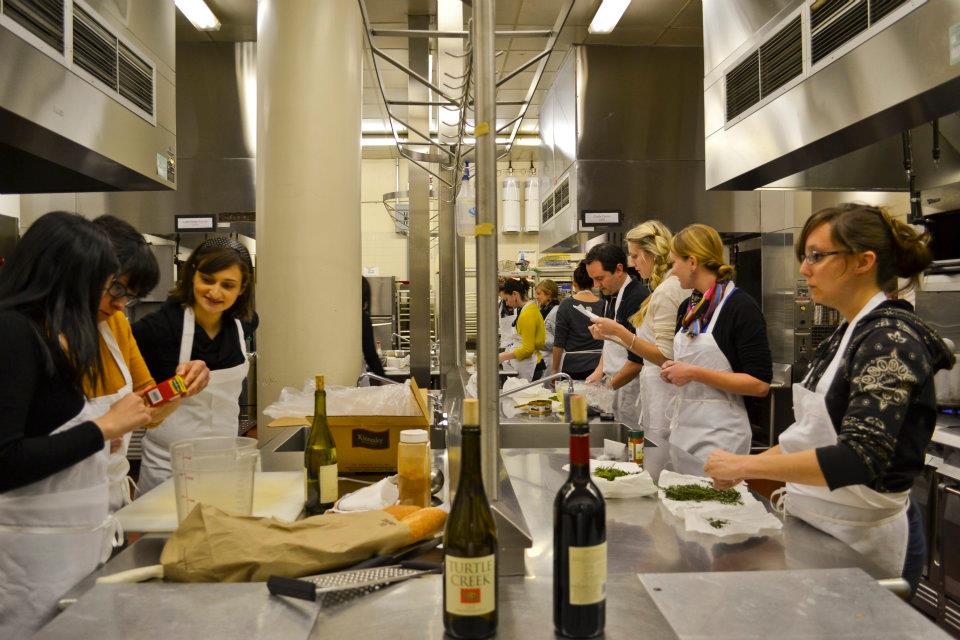
As students in Dr. Ken Albala’s Survey of Food History class, we were overjoyed that the Food and the City Conference brought him to Boston not only to deliver the conference keynote, but to allow us the opportunity to meet him in person and cook together a sixteenth century meal.

From our course lectures, we had learned that throughout history, specific ingredients have served as markers of social class that exude distinction. The most prestigious ingredients were often rare, expensive, and fashionable among the upper class at a certain time in a particular place. Rarity, cost, and fashion were unstable factors, however, meaning that the symbolic potential of ingredients evolved over time. The existence and expansion of trade networks, and globalization more generally, also played a significant role in specific ingredients securing elite status, while others did not.

Trends and fashion made certain ingredients signs of social distinction. The variables of rarity and cost influenced trends, which tended to occur in cyclical and reactionary patterns. Culinary fashions changed for a variety of reasons, among them political, economic, cultural, and even due to changes in weather and climate. Culinary fashion often changed as ingredients became more commonplace and inexpensive, thus increasing their accessibility for the middle and lower classes and diminishing their symbolic potential and power for the nobility. For instance, medieval cuisine was heavily spiced as a demonstration of wealth because spices were expensive at that time. By the sixteenth century, however, spices had become more affordable, and upper class cuisine used less spices, instead emphasizing simplicity. Baroque fashion in particular emphasized elegant simplicity, rather than ostentatious cuisine, which had been popular when spices were expensive.This was in contrast to middle class cooking in the sixteenth century, which was heavily spiced due to the new affordability and accessibility of spices.

Stewe Mutton

In our cooking class with Ken, the recipe for Stewe Mutton from Proper Newe Book of Cookery exhibits this transition well, as it not only calls for several herbs, but also a variety of spices: “cloves, mace, peper, saffron, and lyte salt.” As we discussed, a recipe from the sixteenth century featuring such an amalgamation of spices was one meant for the middle class for whom these ingredients were newly affordable, rather than for the nobility among which this style of seasoning had fallen out of favor.

Gathering together in the kitchen to cook, and then taste, sixteenth century recipes brought what we had learned from lectures and readings to life. The upwardly mobile aspirations of the sixteenth century middle class danced on our tongues as we contemplated the evolving meaning of specific ingredients throughout history.

This post was originally published on the Gastronomy at BU blog. Photos courtesy of Katherine “KC” Hysmith and Rudolf Manabat.

Food News Round Up: Wrangling Action

Welcome, gastronomes and cowboys alike, to this action-oriented (and alluringly alliterative) edition of Food News Round Up. Part of the news process is indeed passive — the pleasant and oft solitary experience of soaking up the news via paper or screen. But what is so key with food, is the desire to take the next step beyond the passive processes of perusing, reading, and contemplating to the impassioned action of politicking, organizing, and converging. So stick a fork in these delicious bites of news — and then wrangle some food action.

Peruse – and Politick – the Politics of Provisions

Read – and Reason – Rousing Research Results

Ogle – and Organize! – Organic Oddities

Contemplate – and Critique – if Calories Count

Digest – and Dive into – Food Desert Discussions

Curl Up to – and Converge – Food Culture Conversations

This post was originally published as part of a recurring feature called ‘Food News Round Up’ on the Gastronomy at BU blog