Latest Posts

Cheers & Tears: 5 More Reasons for Academics to Blog

This summer marks my second year of blogging, so I thought I’d celebrate by adding to the five lessons I learned in my first year.

1. Blogging connects you to lay readers and fellow scholars. 

While having my post, “Tofu & Tapenade? The Unspoken Rules of Football,” Freshly Pressed in January brought 600 new followers my way, blogging has also connected me more closely with just a handful of folks in a meaningful way. Jan Whitaker (who blogs at Restraunt-ing Through History) and I routinely read and comment on one another’s work, which made finally meeting her in person at this summer’s ASFS conference all the more enjoyable. Blogging is also one of the ways I connected with Rachel Lauden, famed food historian, who also blogs and tweets up a storm. If you put your work out there, not only does someone other than your mom and prof read it, people who you cite, admire, and would like to work with can read it too—and that’s when the magic happens.

2. Blogging provides a publication platform that’s always accepting submissions. 

I (mostly) love writing papers from scratch to fulfill specific CFPs that inspire me to start a new project. I (sort of) enjoy editing papers to suit the scope of a particular journal. And I really like writing articles for Zester Daily’s informed, but general foodie audience. That said, sometimes I want to write and share a piece that doesn’t fit any of those venues. Blogging gives you a platform to share your work and the ability to set free whatever thoughts and ideas you have, whenever you’re ready to put them out into the universe.

3. Blogging cures writer’s block—and the horrible thing that happens before writer’s block. 

I unexpectedly had a rather rough first semester in my PhD program; no one’s fault, just the way the cookie happened to crumble. As I devolved into fits of crying and prolonged stints of binge watching television, I blogged less and less. And as I more rarely put words together, my writing process froze up. Words were hard to come by. Sentences became a painful effort. Full research papers seemed unsurmountable. Usually bursting with ideas to write about, I suffered from the horrible thing that happens before you can even be blessed with writer’s block—I couldn’t even come up with topics. Sob story aside [and don’t worry, it all got done, it just hurt], the lesson here is that blogging (if you keep up with it on a regular basis) is an exercise that keeps your academic writing muscles in top form. Don’t let them get out of practice.

4. Blogging establishes your writing track record and builds a portfolio. 

Blogging regularly demonstrates that you can routinely take in information and churn out interesting pieces at a decent pace, a skill valued by editors of websites, magazines, non-academic journals, you name it. If you’re interested in writing for the world outside of the academy (and getting paid for it), blogging is part proof, part portfolio, and it all works in your favor.

5. Blogging means that you’re always the master of your own domain.

When you’re reading something new and difficult, writing a piece that refuses to cooperate, or teaching a course where the class vibe just won’t jive, blogging can provide a small, but meaningful, space where you are always on top and always know what you’re doing. This can help you to remember why you love doing all of this incredibly frustrating and difficult stuff in the first place. We all need opportunities where we get to feel masterful, especially when things aren’t going so well elsewhere, and blogging can do just that, keeping you excited, motivated, and moving forward.

Top Photo Credit: Emily Contois, 2016 

24 Conference Tips

You wrote an abstract, submitted it, got accepted (!), and now you’re attending the big event. Conferences are exhilarating, inspiring, and fun, but they can also be exhausting, overwhelming, and anxiety producing, especially for graduate students and junior scholars. The balance between these positive and negative experiences can also depend upon what conference you’re attending. It’s one thing to attend your favorite conference year after year, surrounded by friends and colleagues. It’s another to attend an organization’s conference for the first time—especially if it’s gigantic, a new field for you, or a space where you might know next to no one.

Here are a series of tips for ensuring the most satisfying, productive, and engaging conference experience no matter what conference you’re attending.

Before the Conference

1. Study the program. Depending on the conference, there can be dozens upon dozens of panels to choose from. If you scramble to choose what session to attend the day of (or just follow your friends from session to session or, erm, just see the panels scheduled in the same room all day), you won’t have the best experience. Choose panels based upon presenters you’d like to meet, topics that align with your own research interests, or topics that fill in gaps in your own knowledge. It can also be great fun to attend panels on wholly unfamiliar topics to learn something new. If you have time, google presenters beforehand so you can make the most informed panel selections possible. You can also ask a colleague or mentor for “must see” presenter or panel recommendations.

2. Schedule out your conference. To determine what sessions you’ll attend, you can peruse the online program and/or after you’ve check-in at the conference, mark up the printed program with a highlighter. Or, if available, create a custom schedule in the conference app. Also note breaks in the program where you can schedule meetings with new colleagues, friends, and editors. For folks who you know will be particularly busy, it can be a good idea to reach out weeks ahead of the conference to schedule a meeting.

3. Prep your presentation. If you’re presenting, make sure you are prepared. It’s sometimes unavoidable that you’ll need to prepare your presentation while traveling to the conference (or even while at the conference), but doing so ahead of time can reduce stress at the event and make it possible to get the most out of the sessions. Practice your presentation to ensure that you stick to your allotted time, which is pretty much always less time than you’d like. Still, don’t be that person who goes way over time. In most cases, visuals help, so standbys like PowerPoint presentations can complement and supplement your paper. Make sure you have access to your presentation a couple different ways (e.g. a USB drive, email attachment, Dropbox link, etc.) in case things go awry. I also find it helpful to include a running footer at the bottom of each slide with my name and contact/social media information. People may come into sessions late, so if they miss your introduction, they can still know who you are. If you’re unsure of the norms for reading papers versus speaking presentations, ask a colleague who’s attended the conference previously.

4. Prep to share beyond your presentation. There’s only so much you can say in a short presentation, so consider ways to provide more for attendees who might want to continue the conversation. If your presentation is part of a larger project (or a forthcoming publication) specifically mention that for context and for promotion. If the conference doesn’t publish proceedings or link to full papers, you can share printed copies or a QR code or short link to the full paper, which can also be helpful for making presentations accessible to all attendees.

5. Prep your panel. Whether you’re on a pre-organized panel or one created from individual paper submissions, email your fellow presenters to introduce yourself, share the content of your talk, organize your presentation order, and set your time allotments. Decide who will serve as time keeper to keep presentations running on time. It’s also a best practice to gather your panel’s slides together in a single slide deck before your session, which can be easy to do in Google slides. This reduces the chance of technical difficulties and ensures a smoother panel experience for both presenters and attendees—one without awkward moments between papers switching laptops or USB flash drives. Those saved minutes can also allow for more discussion time. If you have a discussant for your panel, make sure to distribute papers/presentations ahead of time to assist them in devising comments and remarks.

6. Pre-network. Connect before the conference with people who you want to make sure you meet for the first time, talk to, or catch up with. Depending upon how you know and have communicated with each person beforehand, you may seek them out with an informal tweet or direct message (“I’m so glad you’ll be at x conference and look forward to meeting you/catching up!”) or a more formal email. If you’re attending a conference in an entirely new field and not sure who to meet up with, ask a colleague or mentor for recommendations and, if they’re willing, to send introductory emails/messages on your behalf.

7. Pack your business cards. We may live in a digital age, but a business card is still one of the greatest networking tools available. Whether you choose a custom design or something simple with your institution’s logo, make sure to include your name, credentials, department, and institution, as well as the ways folks can get in touch with you: phone, email, Twitter, Facebook, blog, etc. You can print on the back of cards too, which can be a good place to list the fields of your research or other pertinent info.

8. Choose your outfits. Even if you’re not a fashionista, thoughtfully select your conference attire, adhering to the formality of the specific conference. (If you’re not sure, ask a colleague who’s attended before, or ask on Twitter using the conference hashtag.) No matter what, you’ll feel more confident presenting and networking if you know your clothes fit, are clean, and make you look as great as your ideas are. Wear comfortable shoes, especially if the conference events involve a lot of walking. Also pack for fluctuating temperatures, as some conference spaces can be very chilly, others too hot, and you want to be as comfortable as possible. If you’re endeavoring to not check a bag, check out my post on packing light for academic conferences.

9. Pack snacks. If you know you’re a person who needs regular snacks (this is 1 million percent me), pack snacks and take them with you to sessions throughout the conference. My favorites are granola or protein bars, dried fruit like apricots or figs, and nut/seed mixes. If you’re attending a conference that offers meal and snack breaks, don’t be afraid to “squirrel away” a small snack for later.

During the Conference

10. Engage with content. Just like when you attend classes, lectures, or seminars, don’t just sit and listen. Take notes or live tweet (with permission from the panelists) each presentation’s main ideas or interesting findings. Live tweeting conferences is also a service to the broader community, as it makes the conference content available to anyone unable to attend the event in person, which could lead to great online connections for you as well. Check out this guide for live-tweeting tips.

11. Connect with presenters. For any presenter who you haven’t formally scheduled time to meet, find other ways to connect. Ask questions during the Q&A and/or speak with presenters after their session. If you’re shy or feeling nervous, send the presenter an email, tweet, or direct message instead. It can also be great to attend those early morning panels. Presenters dread being assigned those spots and often worry about drawing a tiny crowd, so there’s more opportunity for discussion with a small group of dedicated folks.

12. Promote your presentation. Share the details for your talk or panel (topic, day/time, and location) on social media using the conference hashtag. You can even create an eye-catching visual to catch a bit more attention. If you’re on a panel, encourage all members to share and promote it to ensure a nice-sized crowd.

13. Rock your presentation. If you’re presenting, here’s where your preparation hours pay off. I like to visit the room where I’ll be presenting ahead of time to check out the tech set up, seating, and so on. Sometimes I’ll attend the session in that same room right before mine is scheduled, so I don’t have to worry about finding the room or being late. Either way, arrive as early as you can to get tech set up, check in with your panelists, and get settled, so you feel comfortable and confident to begin. As you present, connect with your fellow presenters. Speak confidently, clearly, and at an appropriate volume. Make as much eye contact as possible, even if you’re reading your paper. Pay attention and respect your panel’s time keeper. Welcome questions from the audience. Answer them succinctly and directly. If the audience doesn’t ask questions of all panelists, find ways to connect your answers to fellow panelists’ work to draw them into the conversation. If possible, follow up with the people who ask you questions after the talk to continue the conversation.

14. Shop for projects. As you meet with other scholars, ask about their current projects. Everyone loves the opportunity to talk about their own work—and who knows, there could be an opportunity for you to collaborate or contribute.

15. Read name tags. Pay attention to who folks are: in the audience, sitting next to you at lunch, or standing in the hall. If you’ve read a person’s book or paper, but have never met them before, it’s easy to start a conversation just by saying that you’ve read their work, sharing how and why you enjoyed it and found it meaningful to your own research. At the same time, don’t be the jerk who loses interest in someone when you don’t recognize their name or are always looking for someone “better” to chat with.

16. Network old school style. To be honest, events created to promote networking, like mixers, make me feel like a door-to-door salesman and I get all awkward and Willy Loman all over myself. If this is you too, set small achievable goals, like, “I will make two meaningful connections at this event,” meaning you have a conversation or exchange business cards with just two people. After you get started, you might gain some momentum and meet many more people.

17. Don’t skip out, too much. Conferences can be exhausting and everyone gets to a point when they want to (or start to) ditch sessions and events, maybe to sightsee around the conference city. Find the right balance for you, but the more sessions, workshops, field trips, ceremonies, and meals you attend, the more opportunities to meet people. A conference is not about your presentation, which could be just a handful of minutes long. It’s about all the other moments when you’re meeting people and building your network. If the conference is in a city you’d like to explore, try to arrive a day or two early or stay late, since trying to sightsee and conference at the same time can be tricky.

18. Quietly skip around. As long as you aren’t disruptive to the presenters and the conference doesn’t have strict rules against it, you can skip around during panel sessions. If you want to see the first talk in one session and the last in another, seat yourself near an exit so you can head out without disturbing the presenters and attendees. Similarly, if you end up in a session that you’re not enjoying, skim the program or check out the conference hashtag to see if there’s a more engaging panel to skip to so you can make the most of your conference experience.

19. Make new friends. Conferences are a great opportunity to meet well-established scholars in your field, but they’re also the perfect place to make new friends from institutions across the country and around the world, who can relate to your current joys and challenges as new faculty, graduate students, parents, etc. Try to branch out from your current group of friends and seek out new, likeminded colleagues.

20. Make introductions. If you’re more senior in the field or well-known at a particular conference, consider sharing your connections with graduate students or folks newly attending the conference. If your conference offers a mentoring program, volunteer a few minutes of your time to meet a new attendee, learn about their interests, and help introduce them to folks in your network.

21. Rest up (and responsibly caffeinate). Some folks can conference for 12+ hours, but know yourself and your limits. Try to get enough rest to be alert and engaged throughout the conference. During the day, conferences are essentially sitting and listening for hours on end, which can be exhausting both mentally and physically. If you’re dozing off during a session, you’re missing the action. Plan for caffeine and physical activity breaks. Some folks schedule short naps. If the conference offers a morning exercise session, consider attending. And during sessions, don’t be afraid to get up from your seat and stand in the back of the room to rejuvenate yourself.

After the Conference

22. Post-network. For any business card you secured or meeting/chat you had, send a follow up communication, whether by email or social media to keep the relationship growing.

23. Don’t be a missed connection. If there was someone you wish you had met or spoken to at the conference, but somehow didn’t, it’s not too late! In the days immediately following the conference, reach out to those folks. Tell them how much you enjoyed their presentation, loved their book, or regretted that you weren’t able to meet in person. See if there might be opportunities for you to meet on their home turf or on yours if they’re traveling near you for another conference or event.

24. Plan for next year. It’s never too early to start planning for next year’s conference. While it might be too early to approach presenters you don’t know well, make notes of people who do work that complements your own and brainstorm potential panel topics so that when next year’s proposal deadline comes around, you’re not scrambling.

What are your favorite tips for having a great conference experience? Please share them in the comments!

Top Photo Credit: Emily Contois, 2017

Archive Adventures #2: Wartime, Memorial Day … & Kraft American Cheese?

With the tagline, “Hanker No More!” this advertisement from my archive adventures at the Hartman Center for Sales, Advertising & Marketing History at Duke University celebrates the return of not only America’s World War II heros, but of Kraft cheese products, like Kraft American cheese, Velveeta, and “Old English” Pasteurized Process Cheese, which were rationed on the home front.

"Hanker no more!" Kraft Cheese advertisement, 1947

This “Hanker no more!” Kraft cheese advertisement ran 67 years ago this week in The Saturday Evening Post on May 24, 1947 and in Life Magazine on May 26, 1947.

Ad copy commiserates with America’s housewives: “For a long time during the war, you couldn’t get an ounce of this mellow, smooth-melting cheese; since then a single package has been ‘a find.'” Now, however, the “cheddar goodness you’ve missed so long” has not only returned to supermarket shelves, but “is plentiful.” Furthermore, while an ounce was once impossible to procure, Kraft American cheese could now be purchased in a five-pound loaf or by the half pound (packaged in blue) if preferred. Such linguistic comparisons of weights and measures reveal some evidence of the food industry’s post-war aim to not only find domestic markets for wartime goods, but to increase consumption more generally.

Finally, nearly all of the other advertisements that I collected for Kraft cheeses during the 1940s and 1950s simply depict the cheese products themselves, perhaps with a bodiless hand positioning foods on a plate. This particular ad includes four images of women altering their domestic activities due to the return of Kraft cheese.

One (image 1 below) depicts a housewife at home in her apron, reaching up to the top shelf of her china cabinet to “get down the chaffing dish,” because “smooth-meling Kraft American is back!” Another (image 2) pictures a woman outdoors, returning from grocery shopping, bidding a happy good-bye to cheese substitutes and a welcome hello to “the real thing.” A third illustration (image 3) portrays a woman before her open refrigerator, stocked full of food, including “a whole Kraft shelf.” A final vignette (image 4) shows a woman serving a man, most likely her husband, a piping hot souffle, a dish made possible by the return of “sharp Old English” cheese.

With the end of the war and the return of these products, Americans were free to make the sandwiches depicted in this advertisement, perhaps even for a Memorial Day meal. Whip them up to thank, celebrate, and remember the men and women who serve our country—or whenever you have a hankering:

For each sandwich, toast a slice of bread (crusts trimmed) on one side. Spread un-toasted side with Kraft Mayonnaise, cover with a slice of peeled tomato, then a slice of Kraft American. Top with two strips of partially broiled bacon. Place sandwiches under low broiler heat or in a moderate oven, 350 degrees, until cheese is melted and bacon is crisp.

Kraft Image

Image 1

Image

Image 2

Image 3

Image 3

Image 4

Image 4

Publication Update! Toned Tummies & Bloated Bellies: Activia Yogurt & Gendered Digestion

I’m thrilled to share that my article, “Toned Tummies and Bloated Bellies: Activia Yogurt and Gendered Digestion,” was recently published in CuiZine: The Journal of Canadian Food Cultures. I blogged about this project when I first completed it about a year ago and could not be more honored that it was selected as CuiZine‘s best graduate student paper in 2013 by a committee featuring the food writers, scholars, and researchers Maeve Haldane, Ian Mosby, and David Szanto.

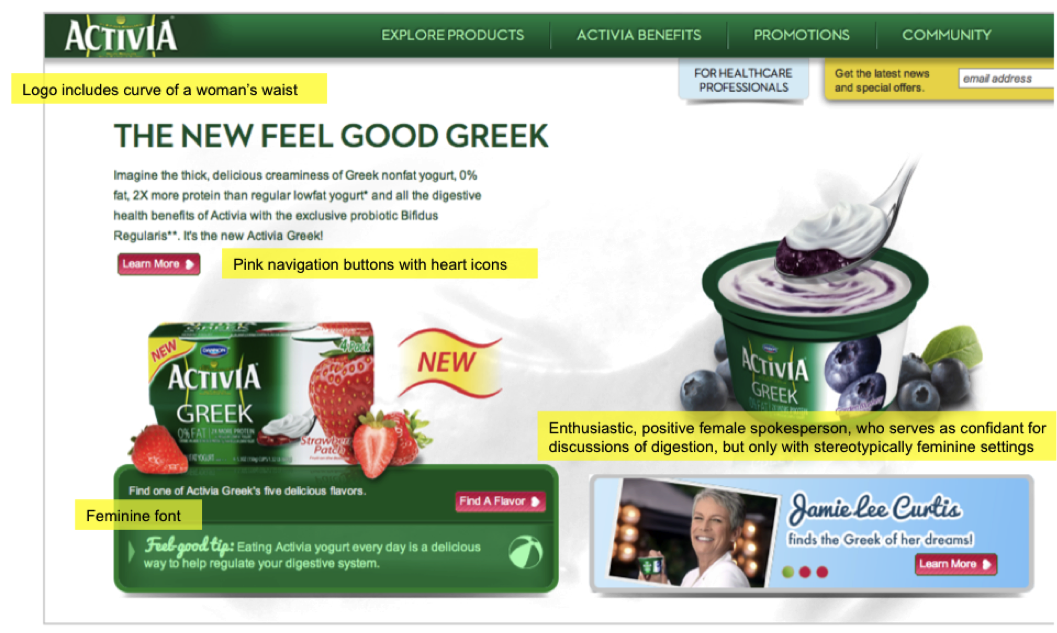
As I analzyed this probiotic yogurt that continues to populate the dairy case with its iconic green containers, I drew from print and online advertisements, product packaging, press coverage, and industry reports, as well as a variety of secondary sources that analyze digestion as a cultural act. When I first began this study, Jamie Lee Curtis served as a spokeswoman so enthusiastic that her commercials had become the stuff of Saturday Night Live parody. Most all Activia advertisements targeted women, many featuring feminine touches, from the product’s waist-like logo to commercials’ girly jingle—“Ac-tiv-i-aaaah!” Furthermore, whether a print ad or TV commercial, nearly every marketing effort featured a slim, toned, and at least partially naked stomach, most often light skinned, providing a taste of “gastrointestinal pornography.”

U.S. Activia website homepage, 2013

The 2013 U.S. Activia website homepage featured spokeswoman, Jame Lee Curtis, as well as feminine touches, such as pink navigation buttons, heart icons, and distinctly “girly” fonts.

In 2014, however, Activia redesigned its approach, swapping Jamie Lee Curtis for a trio of spokespeople—Laila Ali, daughter of Muhammad Ali and now a retired boxer herself; country singer and actress, Reba McEntire; and Dr. Travis Stork, a former “Bachelor” who is now a host on the daytime medical talk show The Doctors—who promote the probiotic yogurt as part of the new advertising campaign, “Activia Tummies. Happy People,” which aims to target a broader audience.

Although this campaign makes clear Activia’s intension to gain market share by bringing men into the probiotic yogurt fold—similar in some ways to the efforts of commercial weight loss programs to secure male clients—Activia’s 2014 marketing efforts also continue to emphasize digestion in a sexualized and gendered fashion. For example, new 2014 advertisements feature Columbian pop superstar Shakira.

U.S. Activia Website 2014

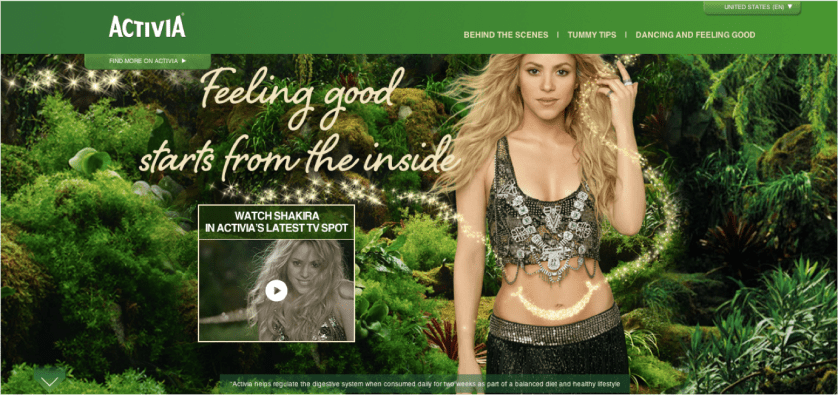
The 2014 U.S. Activia website homepage prominently features popstar Shakira.

Through Shakira—and her long famous belly baring and sensual dancing—Activia’s “Dare to Feel Good” campaign may attract new clients of both genders, albeit for potentially different reasons. Despite the conceivably increasing gender neutrality of Activia’s advertising, Shakira’s endorsement also continues to align digestive health with images of idealized feminine beauty, focusing directly upon an eroticized toned tummy.

Thanks to CuiZine’s fabulous online format and commitment to open access, you can read the full text of “Toned Tummies and Bloated Bellies: Activia Yogurt and Gendered Digestion” in the journal’s most recent issue, which features eight new pieces dedicated to the theme “Sustaining Foods and Food Traditions” and three book reviews—all ready now for your reading pleasure! 

Archive Adventures #1: The Oh-So-Glamorous World of Velveeta & Cheez Whiz

Laura Shapiro's Something from the Oven (2004)

Laura Shapiro’s Something from the Oven (2004)

Telling the story of how the food industry won over (albeit not immediately) the hearts and kitchens of America’s housewives, Laura Shapiro‘s Something from the Oven: Reinventing Dinner in 1950s America (2004) is hands down one of my favorite food history texts. I very truly geeked out when she signed my copy at the Siting Julia symposium in 2012. As “deliciously readable” as The New York Times Book Review claims it to be, this delightful book demonstrates how in the years following World War II, the food industry, women’s magazines, and the press alike attempted to sell housewives on convenience food products, emphasizing the technological wonderment and time saving attributes of frozen vegetables, canned meats, and complete frozen meals. I got a taste of this myself when I was researching the marketing of Kraft food products in the archives at the Hartman Center at Duke University last month. But first, let’s talk a little history.

Despite the industry’s best efforts, food technology at first failed to capture housewives’ hearts or stomachs. Women who had utilized processed foods during wartime rationing did not desire to do so when fresh foods were available and affordable. Furthermore, women were “deeply suspicious” of convenience foods (44). Even more problematic for the food industry, convenience foods lacked prestige (20), were not viewed as food, and serving them was even considered cause for shame (55). While children may be fed on occasion that icon of American culture, the TV dinner, packaged foods were not considered an appropriate substitute for a family meal and certainly not suitable for guests. This negative view of convenience food was also a direct result of women’s sense of moral, emotional, and societal responsibility to cook, a deep-seated responsibility that was not fulfilled by shortcut cooking (52).

Women’s desire and responsibility to cook was particularly powerful during the 1950s. Following the strains of the Depression and World War II, decades of struggle and want, the 1950s ushered in a time of relative prosperity that Shapiro terms “a genuine good-food era in American life” (26-7). Food, meaningful in any time, became the glue that reattached families, helping them to grow, to forget a painful past and move forward into a new, prosperous future. Women were not only responsible for cooking tasks as they had been in the past, but were also charged with the weighted mission to do their part to usher in a new American life. While much of Europe lay in ruin—so the postwar American narrative goes—the US economy boomed and hopes for a prosperous future materialized for many American families. Increasing incomes and a growing middle class resulted in increasing car and home ownership, often in suburbs, which reshaped the American landscape and consciousness, strongly influenced by consumerist and materialist aims. As affluence increased, however, so did class anxiety. Food, cooking, kitchens, and dining rooms became powerful markers of social status.

It was in this climate that the convenience food industry was able to reinvent itself from suspicious and shameful to aspirational, conspicuous consumption. Following the food industry’s lead—or the advice of Poppy Cannon and her Can-Opener Cookbook (1953)—housewives added to and “doctored up” packaged foods, making them acceptable to the palette and for the dinner table. This evolved into “glamorizing” (65), framed by the industry as easy haute cuisine. The industry gained a foothold, however, when it stopped selling individual convenience products and instead marketed a new cuisine—“packaged-food cuisine” (56)—and a lifestyle to go along with it. Packaged-food cuisine elevated the status of convenience foods, transforming them into “party foods” (65), meaningful to families competing for social status in a society of increasing abundance. An amalgamation of the somewhat manufactured values of fun, effortless labor, and sophisticated luxury, packaged-food cuisine represented a triumph for the food industry.

I had this history in my head when I went into the advertising archives last month, but nothing prepared me for how thrilling, vexing, hilarious, and intriguing it would be to run across a slew of domestic Kraft advertisements for products like Velveeta and Cheez Whiz, which brought Shapiro’s text to life in full color. I hope you enjoy this little snack as much as I did.

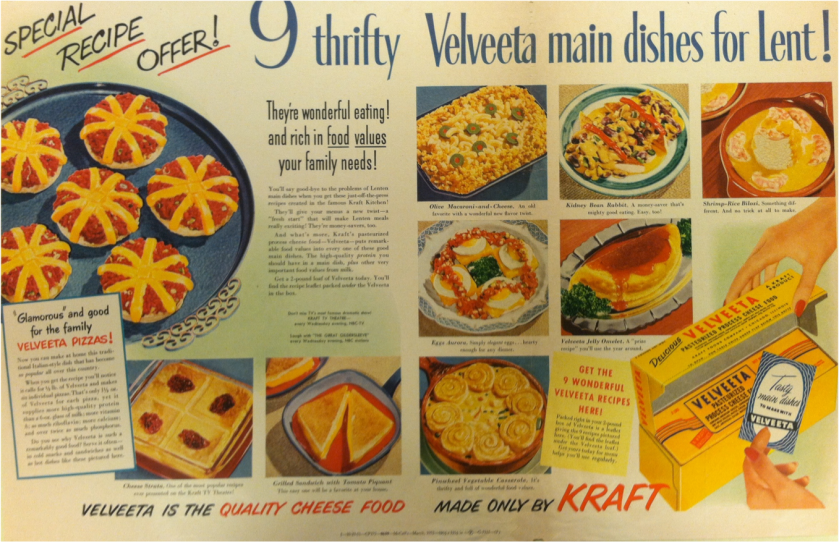
This 1962 advertisement for Velveeta features recipes for “everything from thrifty main dish sandwiches to gala party ideas!” May I interest you in a “Hawaiian sandwich:” a toasted bun slathered with peanut butter, then covered with a well-drained slice of pineapple, only to be topped with a slice of Velveeta, and punctuated with a maraschino cherry.

This 1962 advertisement for Velveeta features recipes for "everything from thrifty main dish sandwiches to gala party ideas!"

Velveeta advertisement, McCall’s 1962.

Among these nine thrifty Velveeta main dishes perfect for Lent are “‘glamorous’ and good for the family Velveeta pizzas,” marketed as a “traditional Italian-style dish that has become so popular all over the country.” [An aside to children of the ’90s: Are these not the precursor for Bagel Bites, the infamous snack of latchkey kids? “When pizza’s on a bagel, you can eat pizza anytime!!“]

Among these nine thrifty Velveeta main dishes for Lent are "'glamorous' and good for the family Velveeta pizzas.

Velveeta advertisement, McCall’s 1960s, n.d.

This 1953 advertisement for Kraft’s Cheez Whiz markets the cheese-esque product as “elegant,” “perfect for party dishes,” and “grand for glamorizing vegetables,” like the cauliflower pictured below, encircled by a bevy of sliced tomato beauties. Or perhaps you’d prefer the “Rice Timbales,” prepared by packing hot cooked rice into greased custard cups, unmolding the rice, and serving with “rich, hot Cheez Whiz.”

This 1953 advertisement for Kraf

Cheez Whiz advertisement, Ladies’ Home Journal, 1953

Celebrating Earth Day with Andrew Ross’ Parable of a Sustainable Phoenix

Andrew Ross' Bird on Fire

Andrew Ross’ Bird on Fire

This year’s Earth Day theme is green cities, a topic that could not relate more directly to today’s post on Phoenix, a city arguably deserving of the title “World’s Least Sustainable City.” A desert vision of unrestrained growth, the history of Phoenix and the surrounding Sunbelt region provides a nationally instructive case study on sustainability. Invited by Future Arts Research, an Arizona State University institute, to “come and do research of [his] choosing in Phoenix” (19), Andrew Ross, Professor of Social and Cultural Analysis at New York University, spent two years in the Valley of the Sun. The result of extensive historical research and 200 interviews with the region’s “more thoughtful, influential, and active citizens” (17), Ross’ recent book, Bird on Fire: Lessons from the World’s Least Sustainable City (2011), makes manifest his aim “to take the social and political temperature of Metro Phoenix” (17).

From its early days of Anglo settlement to today, the Sunbelt proves a feverish place, whose post-war metropolitan growth tells a uniquely American story. In the Valley of the Sun, an ideology of excess reigns, one which delights in the risk and promise of westward expansion, the spirit of Manifest Destiny, the ideal of the Agrarian Myth, the self-reliance of the frontier mentality, a faith in God’s ability to provide, and a deep-seated desire for limitless growth. While the Sunbelt couples this ideology run amuck with a political culture resistant to the science of climate change, Ross both challenges and empowers the region, saying, “If Phoenix could become sustainable, then it could be done anywhere” (14).

Tracing the region’s development, Ross demonstrates how growth in the Sunbelt transpired as if following a blueprint for un-sustainability, dependent in turn and in sum upon “mineral extraction and ranching, irrigation farming, military provisioning, suburbanization, high-tech industry transfers, and absorption of retiree and other migrant populations” (106). In contrast, Ross organizes his text around the topics central to current sustainability efforts: water management, urban growth, downtown revitalization, pollution distribution, the solar power industry, immigration policy, and urban farming. Through chapters dedicated to each theme, he interrogates and rearticulates what sustainability itself means, especially when mapped onto the landscape of the Sunbelt.

Broadly, some activists define sustainable growth as that which bequeaths “an equivalent stock of nonrenewable resources to the next generation” (244). On a local level, city officials manipulate sustainability as a desirable public relations instrument. Superseding the cache of the Creative City, Ross argues, “Mayors, especially, have found that green is a useful color to attach to their electoral profiles” (8-9). From the local level to the global, sustainability endeavors often take form as a “bettering of the balance sheet,” which reconciles quantifiable positive and negative metrics, such as weighing increases in the number of solar roofs and transit riders with decreases in water use per capita and golf courses (245). These sorts of sustainable actions depend upon a slew of eco-technological fixes, such as recycling programs, water conservation, LEED-certified buildings, enhanced public transportation run on clean fuels, solar energy, urban farming, and local food systems.

Ross argues, however, that the path to sustainability lies not in eco-technological fixes, but in changes in “social relationships, cultural beliefs, and political customs” (16). Otherwise, no matter how innovative a technological solution, it is at nearly certain risk of being inequitably applied over social and geographical landscapes, creating and reinforcing what has been termed “eco-apartheid” (17). While he phrases it as a question, Ross rather definitively concludes that, “The key to sustainability lies in innovating healthy pathways out of poverty for populations at risk, rather than marketing green gizmos to those who already have many options to choose from” (239). In this line of thinking, sustainability is not an effort taken on for the good of the Earth or even for future generations of children and grandchildren. It is an endeavor of the current moment that ought to be invested in for the good of “today’s most vulnerable and affected populations” (250), who inequitably suffer environmental injustices, from poor air quality to toxic exposures.

While in the end a hopeful story, Ross demonstrates throughout his text how race, ethnicity, and class profoundly shape ideas about sustainability. He not only maps racial geographies over environmental injustices—revealing the connections between pollution and privilege, toxic exposure and poverty—but also elucidates what Arizona politics reveal about conservatism and conservation on the national stage. Although Arizona politicians present “faux-green reasoning” to support anti-immigration efforts (201)—like the claim that immigrants emit more CO2 in the U.S. than in their home countries—Ross demonstrates how these politics and policies actually reveal the desire of the affluent to retain the power to pollute.

Considered the civil rights struggle of the twenty-first century by activists, Ross argues that immigration encapsulates conservative political fears about changing voter demographics. State immigration policy and anti-immigration sentiment in Arizona thus communicate a complex climate-based story, which Ross’ interviewees contend has been simmering since the mid-1980s and has reached a boil recently due to the burgeoning voting block and political potentiality of the “Latino” population (200-201). It is immigration reform not greenwashing that emerges as one key step toward thwarting climate change and promoting sustainability in the Sunbelt.

In response to his initial claim that there is hope for us all if Phoenix could become sustainable, Ross concludes, “Time after time, Phoenix turned out to be a textbook illustration of the need to adapt the tenets of environmental justice as the lead principle of green conduct” (246). Phoenix can defeat “the dogma of growth” (53) and its deleterious effects upon the environment, if the actors profiled in Ross’ text—city government, state legislators, university researchers, private citizens, developers, and industry—work together to realign social priorities and profit motives to ensure the wellbeing of the populations most affected by a warming planet.

Top Photo Credit: Emily Contois, 2017 

Academe Amuse-Bouche: Expanding the Menu of Academic Publishing

Essay in Public took place at Brown University on April 8, 2014.

Essay in Public took place at Brown University on April 8, 2014.

I had the opportunity to attend the Essay in Public conference here at Brown University earlier this week at which speakers and participants discussed a full host of topics related to how we can best bring longform writing and dense content (such as the bulk of work created by academics) to the public. [Update: I summarized all of my live tweeting hereAnd yes, Storify really is as neat as they say.] At one point in the day, we discussed and re-articulated the very meaning of “the public,” as not only an audience with whom many of us as public intellectuals hope to engage, but also a grouping of individuals that contains the fantasy of accessibility and embodies the breaking down of hierarchies, limits, and borders. Part of my own aspiration with this blog is to connect with just such a public of readers, near and far, through my work, which I strive to communicate in jargon-free and hopefully-at-least-minorly-entertaining prose.

A truly satiating day, this conference explored far more than audience, connectivity, and content. In this particular post, however, I’m chewing on the idea that successfully accessible publications balance the rhythm of their content, fostering a textual commingling of shortform and longform writing, alongside other types of contributions and more visual components.

Marcial Godoy-Anativia, a sociocultural anthropologist and the Associate Director of the Hemispheric Institute of Performance and Politics at New York University discussed how the journal that he co-edits, e-misférica, publishes not only the more normative scholarly essays and book reviews, but also multimedia artist presentations and performance reviews. All of these contributions are imbued with new dynamism, reach, and potential readability by the editorial team’s commitment to translation, publishing materials in English, Spanish, and Portuguese.

This discussion made me reflect upon food studies, a field in which the metaphor of the buffet takes fecund root as publishers frequently present multi-form content. While Food, Culture and Society and Food and Foodways serve up articles and reviews with rigor and tradition, a few journals offer complementary content as well.

Gastronomica

Gastronomica, newly christened “The Journal of Critical Food Studies,” has an established history of bridging the divide between academic publishing, foodie-friendly journalism, and high-art aesthetics. Specializing in “translational” work that speaks to multiple audiences, the quarterly-published journal features refereed original research, as well as research briefs, critical commentaries and discussions, reviews of books and films, creative reflections, photo-essays, interviews with key figures in the field (like the Spring 2014 interview with Seth Holmes, whose book Fresh Fruit Broken Bodies I adored), and aesthetic pieces pertaining to food.

Digest

Digest: A Journal of Foodways & Culture, the online journal of the Foodways section of the American Folklore Society, publishes peer-reviewed articles, as well as research notes: folklore food-related fieldwork projects or reports that are part of a larger project and not subject to peer review. Digest also serves up an “Amuse-Bouche” section, which includes a variety of shorter pieces, such as creative writing, pieces of fiction, poetry, photographs and photographic essays, recipes, and historical materials, such as prints and menus. For example, the spring 2014 issue includes a series of vintage food ads and original photography of Coca-Cola bottles.

CuiZine

CuiZine: The Journal of Canadian Food Cultures is a peer-reviewed e-journal published by McGill Library in English and French. With a core audience of “readers interested in Canada’s diverse food culture,” research articles precede a veritable feast of food-themed original poetry, animations, cartoons, image-based essays, reminiscences, short studies on iconic Canadian dishes or products, short opinion-editorial pieces, food-related exhibit reviews, and interviews.

Such a mix of content makes perfect sense for oscillating personal tastes, though one is *always* in the mood for Gastronomica’s “Just Desserts” section. While participants at Essay in Public worried that we live in a society threatened by a crisis of attention, it is typical rather than exceptional for eaters to come to the table with vastly varying cravings from day to day. Would it be so strange to offer up a similar buffet to readers, whose tastes, desires, and limitations of time, mental energy, and attitude guide what they seek to read, listen to, or watch at any particular moment?

As other changes sweep academic publishing from open access to digital humanities projects, perhaps academics and academic journals might be well served to similarly expand the menu.

Interdisciplinarity & Health: 10 Posts to Celebrate National Public Health Week

NPHW 2014 runs April 7-11, but the work of public health continues far beyond that.

NPHW 2014 runs April 7-11, but the work of public health continues far beyond that.

During April’s first full week each year, the American Public Health Association celebrates National Public Health Week, a time to bring together communities from sea to shining sea to focus on the contributions and aspirations of public health. National Public Health Week 2014 focuses on the following themes:

  • Be healthy from the start. From maternal health and school nutrition to emergency preparedness, public health starts at home.
  • Don’t panic. Disaster preparedness starts with community-wide commitment and action.
  • Get out ahead. Prevention is now a nationwide priority. Let us show you where you fit in.
  • Eat well. The system that keeps our nation’s food safe and healthy is complex.
  • Be the healthiest nation in one generation. Best practices for community health come from around the globe.

In celebration of all that public health is, does, and can do, I offer up these ten previously published posts on the theme of health:

Featured in a 1909 spread, this image created a villainous image of "Typhoid Mary," cracking skulls into a skillet.

1. Typhoid Mary: Public Health Menace or Plucky Bad Ass?

Commonly known as “Typhoid Mary,” Mary Mallon was incarcerated for a total of 26 years in isolation on North Brother Island for unknowingly spreading typhoid through her cooking. Her story reveals the ways in which society and medicine shape one another and how we each, as public health citizens, view and respond to disease.


Studious_Featured2. “Graduate School Will Kill You” and Other 18th Century Health Advice for the Studious

William Buchan’s 18th century domestic medicine manual includes a host of recommendations for “the studious,” which ring as true today as they did 250 years ago, at least to those who spend the majority of the work day sitting…


Hippie Eating3. Before You Set a New Year’s Resolution, Read Eating Right in America

Revealing how the dietary advice of four 20th century dietary reform movements promotes more than nutrients alone, Charlotte Biltekoff’s Eating Right in America: The Cultural Politics of Food and Health is an important resource for those in public health and dietetics to consider the broader cultural and social influence of nutrition science.


Fresh Fruit Broken Bodies Image4. Review: Fresh Fruit, Broken Bodies Astutely Addresses Structural Solutions

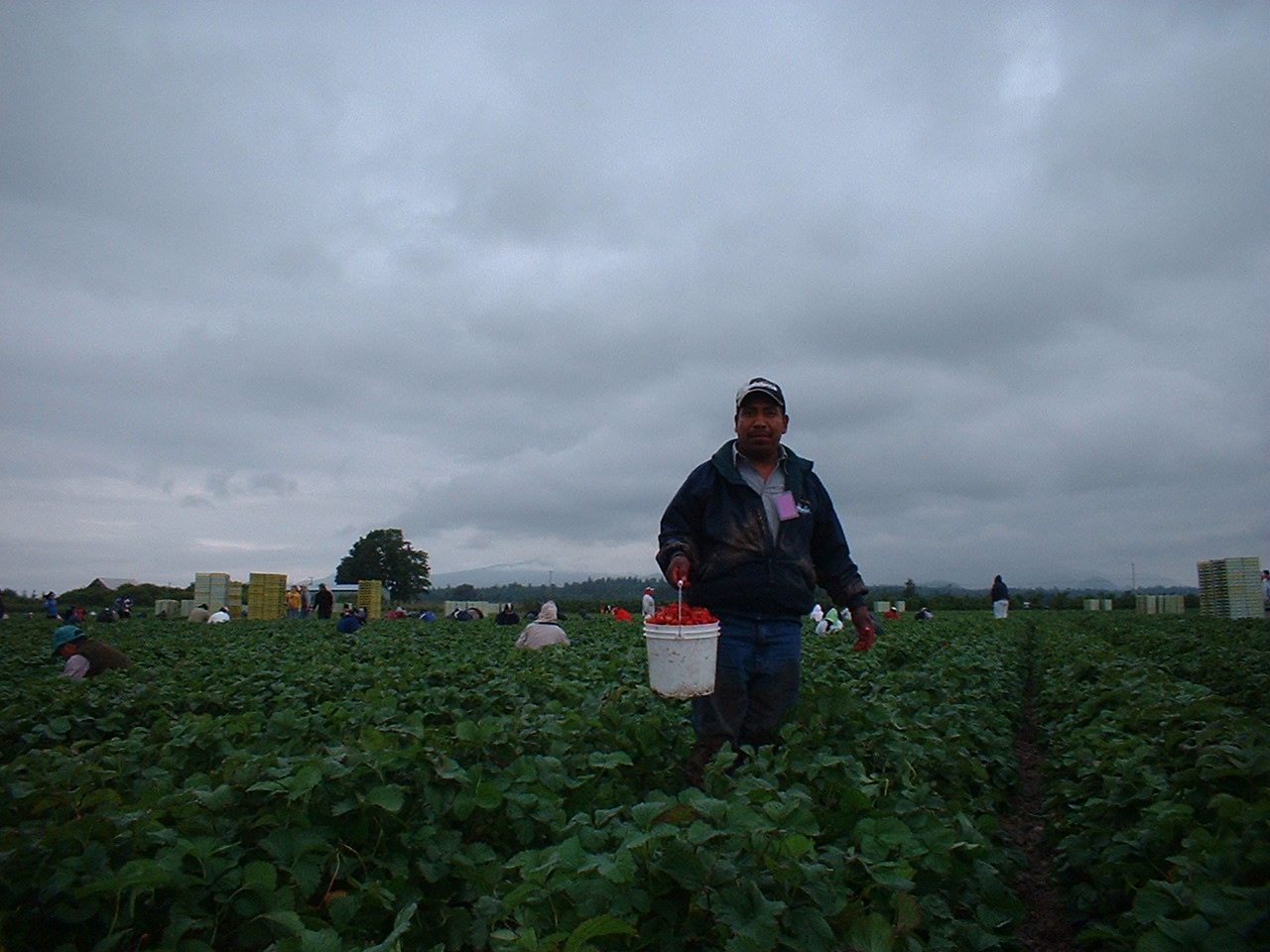
In this engrossing ethnography, medical anthropologist and physician, Seth M. Holmes (who is Assistant Professor at my alma mater, UC Berkeley’s School of Public Health) reveals through poignant thick description the life experiences, structural inputs, and health outcomes of Triqui migrant farmworkers.


Taft Horse5. Presidential Obesity: Taft, Bathtubs, and the Medicalization of Corpulence

In the article, “Corpulence and Correspondence: President William H. Taft and the Medical Management of Obesity,” Providence College’s Deborah Levine analyzes letters in which the 27th president of the United States corresponded with Dr. Nathaniel E. Yorke-Davies, an English diet expert, chronicling Taft’s efforts to lose weight while in the harsh spotlight of American politics and popular culture.


Emily Public Health6. The Ins & Outs, Highs & Lows of Public Health Nutrition

This post summarizes reflections on my own public health education and professional experience in worksite wellness.


Books and Apples7. Talk to Me Baby! Encouraging Dialogue between Nutrition Science and Food Studies

Now is an exciting time for all things food, a time when much change is afoot. One such development is an open door for translational, interdisciplinary, and cooperative research between food studies and nutrition science.


Vegetables8. Meat is Bad and The World is Flat: Thoughts from the Critical Nutrition Symposium

The 2013 Critical Nutrition Symposium critically examined what is missing from conventional nutrition science research and practice, discussed why it matters, and brainstormed how to move forward in an informed and balanced way.


Food Blog9. No Room for Debate: The World of Food is Full of Women

Written after the final presidential debate in October 2012, this post examines how women have made (and are making) their mark in the world of food, as food producers, consumers, and change-makers.


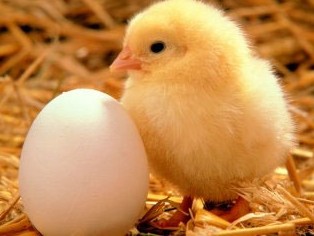
Image from: http://www.thereformedbroker.com/2012/08/06/chicken-or-the-egg-the-actively-managed-etf-problem/10. Which Came First: The Fear of Cholesterol or the Egg?

While the health-related reputation of eggs has oscillated over the course of the 20th century, moderation is a long-lasting and resilient recommendation for good health and a delicious diet.


Beyond reading these ten posts, you can participate in National Public Health Week from anywhere by:

Sink Your Teeth into the First Edition of the ‘Graduate Journal of Food Studies’

I could not be more thrilled to have my paper, “Not Just for Cooking Anymore: Exploring the Twenty-First-Century Trophy Kitchen” published in the first edition of the Graduate Journal of Food Studies, which came out today.

In case you’re new to the journal, the Graduate Journal of Food Studies is “an international student-run and refereed journal dedicated to encouraging and promoting interdisciplinary food scholarship at the graduate level. Published bi-yearly in digital form, the journal is a space for promising scholars to showcase their exceptional academic research. The journal hopes to foster dialogue and engender debate among students across the academic community. It features food-focused articles from diverse disciplines including, but not limited to: anthropology, history, sociology, cultural studies, gender studies, economics, art, politics, pedagogy, nutrition, philosophy, and religion.” The Graduate Journal of Food Studies also includes a Book Reviews section. Graduate students interested in being part of the journal’s second edition may submit an original food-related essay by May 31, 2014.

Now, get ready to sink your teeth into the fabulous first edition of the Graduate Journal of Food Studies!

Typhoid Mary: Public Health Menace or Plucky Bad Ass?

While many may have heard of “Typhoid Mary” (I’m speaking here of the public health historical figure not either of the hard rock bands that bear her name nor the mutant Marvel villain inspired by her plight), fewer know the complete story of Mary Mallon, the immigrant cook incarcerated in isolation for a quarter century for unknowingly spreading typhoid through her cooking.

When one hears the name “Typhoid Mary,” the mind often conjures images of some untamable shrew dishing out ladles full of infected slop, a mental picture not unlike the one that the press created in 1909, in which Mallon is depicted cracking skulls into a skillet, while venomous vapors drift downward from her mouth.

Caption

Cracking skulls and taking names, Mary Mallon was villainously recreated in the popular press as “Typhoid Mary.” From New York American, June 20, 1909. 

Often told with a reductionist focus in science textbooks, Judith Walzer Leavitt’s social history, Typhoid Mary: Captive to the Public Health (1997), sets Mallon’s story straight. While viewed as a menace by the New York public health department, the legal system, media, and general public, Mary Mallon was also a powerfully plucky bad ass, who despite institutional entities against her, little education, and limited support, fought her detainment till her death in 1938.

Mallon’s story transpires in the early twentieth century, a time characterized by a scientific enthusiasm, rooted in germ theory and bacteriology, that sought a new level of empirical certainty. This new knowledge emboldened public health policies, which sought to protect population health through assertive action. When civil engineer, George Soper, identified Mallon as the cause of a small typhoid outbreak in 1906, she was seized and incarcerated in 1907. She was released in 1909 with the caveat that she never again work as a cook. With no job retraining and limited options to support herself, Mallon did return to cooking, an action that was misunderstood as a determined intent to spread disease. As a consequence, Mallon was re-incarcerated in 1915 and would live a total of twenty-six years in isolation on North Brother Island.

North Brother Island where Mary Mallon was held in isolated quarantine for 26 years.

North Brother Island where Mary Mallon was held in isolated quarantine for 26 years.

Beyond new scientific principles and expansive public health authority, social expectations and prejudices also influenced how Mallon—an unmarried, Irish, domestic worker of low social class, whose comportment and resistance deviated from gendered behavior norms—was treated. As a healthy carrier of typhoid who showed no symptoms of disease, Mallon vehemently (and all things considered, rightfully) resisted testing and fought her sentencing. Observe her defiant gaze from her hospital bed in 1909.

Mary Mallon in bed in Willard Parker Hospital, 1909.

Mary Mallon in bed in Willard Parker Hospital. From New York American, June 20, 1909. 

While other healthy carriers roamed free, Mallon was demonized and isolated, an injustice that she fought fiercely, proving courageous and clever enough to have the lab tests that sought to document her typhoid carrier status replicated at a reputable laboratory and presented as evidence during her legal battle.

The media played a starring role in spreading the medical construct of “Typhoid Mary,” which dehumanized Mallon in the eyes of both health officials and the public through sensationalized reporting, such as the spread pictured below, in which she was deemed the “most harmless and yet the most dangerous woman in America.”

Part of the June 20, 1909 New York American article that first identified Mary Mallon as "Typhoid Mary."

Part of the June 20, 1909 New York American article that first identified Mary Mallon as “Typhoid Mary.”

Defiant until the end, Mallon contended that she had not spread disease and had been a victim, wrongly incarcerated and reduced to “Typhoid Mary,” a derisive moniker that she abhorred. Notably, while many no longer know the details of Mallon’s case, the name possesses a continuing cultural legacy and lasting symbolism.

In her concluding pages of Typhoid Mary, Leavitt productively employs hindsight, positing that if Mallon had not been stigmatized by public health officials and the media for her class, heritage, and resistant nature; if the default solution to her healthy carrier status had not been an unexplained and unregulated isolation; if the public health system had seemed more trustworthy and approachable to Mallon; and if her need for job retraining had been taken into account—her life and the legacy of her experience could have been radically different. Leavitt’s Typhoid Mary tells more than the story of one unjustly treated woman, however, as it addresses the conflict that lies within the charge to both protect the public’s health and uphold the rights and liberties of individuals. A story from more than one hundred years ago, these lessons remain relevant, as contemporary crises, such as the prevalence of AIDS and drug-resistant tuberculosis, sustain these concerns.

While the name “Typhoid Mary” may be doomed to live in infamy, Leavitt clears the path to public health progress with lessons learned from Mary Mallon’s tragic case. She concludes with pointed recommendations for the future of public health to “diminish the use of labels that stigmatize and separate” (237), to create a “benevolent and non-discriminatory” health care system in which citizens have confidence that individual liberties will be upheld in the pursuit of good health for all (245), and to encourage understanding of a disease and its carrier, acknowledging social conditions, cultural bias, and structures of power when assigning blame and responsibility. As such, Mary Mallon and “Typhoid Mary” ought to live on in public memory not as a demonic carrier of death, but a reminder of the ways in which society and medicine shape one another and how we each as public health citizens view and respond to disease.

‘Graduate School Will Kill You’ and Other 18th Century Health Advice for the Studious

Before I began my doctoral studies, I worked for five years in the field of worksite wellness, an experience that made me painfully aware of the growing evidence that sedentarism—spending too many hours sitting on one’s glorious behind—has deleterious health effects. Unfortunately, as a striving academic, I often find myself seated squarely on my rear for what sometimes feels like endless amounts of time.

While many a modern day inforgraphic can summarize how sitting may be killing us, William Buchan, MD’s domestic medicine manual, Domestic Medicine Or, a Treatise on the Prevention and Cure of Diseases By Regimen and Simple Medicines (1772, second edition) provides period recommendations for the studious, which I found entertaining, enlightening, affirming, and worrisome in equal measure.[1] Many of Buchan’s recommendations ring as true today as they did nearly 250 years ago.

Buchan writes:

Intense thinking is so destructive to health, that few instances can be produced of studious persons who are strong and healthy, or live to an extremely old age. Hard study always implies a sedentary life; and, when intense thinking is joined to the want of exercise, the consequences must be bad…Man is evidently not formed for continual thought more than perpetual action, and would be as soon worn out by one as by the other.

Now that it’s sunk in that nothing is worse for your health—or less beneficial to society—than studying all day [dejected sigh], consider Buchan’s recommendations for promoting health among the studious:

Don’t sit all day. He warns that sitting “from morning till night” impairs digestion, the discharge of urine, liver and lung function, and causes gout. Unrelated to sitting, studying also causes sore eyes, especially when reading by candle light, which “ought to be practiced as seldom as possible.”

Practice good posture. As if foreseeing the rise of standing and walking desks, Buchan urges studious people to pay attention to their posture, alternating between sitting and standing positions. He also promotes proper ergonomic positioning while sitting as he warns, “Those who read or write too much are ready to contract a habit of bending forward and often press with their breast upon a table or bench. This posture cannot fail to hurt the lungs.” [My husband, who’s a physical therapist, read this recommendation and asked, “When did [Buchan] write this? This dude’s totally on point.” So there’s that.]

Focus on your digestion. The food studies scholar is doubly damned in that, “No person can enjoy health who does not properly digest his food. But intense thinking and inactivity never fail to weaken the powers of digestion.” Lest we get caught in a never ending cycle of studying and poor digestion, Buchan encourages us to “never study too long at a time” and eat regularly.

William Buchan's Domestic Medicine contained a plethora of medical information, including a section on the health of the studious.

William Buchan’s Domestic Medicine contained much medical information, written for public consumption and application, including a section on the health of the studious.

Strive for work-life balance. Buchan warns that our nerves are vulnerable to the effects of study, as “a delirium, melancholy, and even madness, are often the effect of close application to study.” [Ain’t that the truth?] Thus, we must strive for work-life balance and fulfilling non-academic hobbies, because “[h]ardly any thing can be more preposterous than for a person to make study his sole business. A mere student is seldom an useful member of society.” [Even deeper dejected sigh.] Buchan recommends that the studious “engage in some employment or diversion,” [horseback] rides, or walks.

Socialize with non-academic friends. Buchan frowns upon intellectual elitism, stating that while “learned men often contract a contempt for what they call trifling company,” it is imperative that those who consider themselves philosophers associate with “the cheerful and gay.”

Enjoy the great outdoors. While our studying often keeps us indoors in dark quarters, we must seek fresh air and sunshine at every opportunity, which refresh both mind and body. Florence Nightingale reinforces the power of the sun as she writes nearly 100 years later in Notes On Nursing: What It Is, and What It Is Not (1859), “The sun is not only a painter but a sculptor” (p. 48).

Exercise regularly, and in the morning. While the morning is the best time to study, Buchan argues that we must first exercise, on an empty stomach no less. Notably, “It is not sufficient to take diversion only when we can think no longer.”

Listen to music. We ought to listen to music for it “has a very happy effect in relieving the mind when fatigued with study.” [So go ahead and link those grant funds up to your iTunes account.]

Avoid strong liquor. While borderline alcoholism and caffeine addiction are often hallmarks of academic careers, Buchan warns, “This indeed a remedy; but it is a desperate one, and always proves destructive.” He assures that we shall undoubtedly be better served by recreational horseback riding than strong drink. But don’t lose heart; a suitable diet includes “fine malt liquor, not too strong, good cyder [sic], wine and water, or if troubled with acidities, water mixed with a little brandy.”

Eat in moderation. Consume “any kind of food that is wholesome,” but avoid “sour, windy [read gassy], and rancid foods.” We also ought to eat a light supper early in the evening.

So there you have it: 250-year-old health recommendations for the studious that while reasonably on point for the twenty-first-century graduate school experience, will do nothing to assuage the hundreds of pages of reading you have to complete. With that, I leave you to complement your scholarly endeavors by listening to music, socializing with folks outside of the academic bubble, drinking weakly-alcoholic beverages, strolling in the sunshine, and, of course, riding horses.


[1] Here, in the NIH National Library of Medicine Digital Collections, you can read a beautifully uploaded copy of the eleventh edition of Domestic Medicine from 1789. Recommendations for the studious begin on page 61.

Top Photo Credit: Emily Contois, 2016 

Hippo: It’s What’s For Dinner

Jon Mooallem's 'American Hippopotamus' (2013)

Jon Mooallem’s ‘American Hippopotamus’ (2013)

While the global food news often tells of meat shortages in China and India, as middle class demand for meat increases in these extremely populated countries, the United States faced its own meat crisis in the early twentieth century—and believe it or not, hippopotamus ranching emerged as a proposed solution. This is the remarkable story told in American Hippopotamus (2013) by Jon Mooallem, a product of significant archival research, which you can purchase at Atavist or on Kindle for your own reading pleasure.

Mooallem’s account orients itself around 1910, when a combination of increasing immigrant populations, growing cities, and overgrazed rangeland caused meat prices to soar, as producers struggled to keep up with domestic meat demands. Christened “the Meat Question” in the newspapers, Louisiana Congressman Robert Broussard proposed importing hippopotamuses from Africa and settling them in the bayous of Florida, Mississippi, and Louisiana to assuage America’s carnivorous ills, as well as to tackle the invasive water hyacinth plants, which clog southern waterways and impact fish populations to this day.

The bulk of the American Hippopotamus narrative presents dueling biographies of the two fascinating characters deployed to support the hippo ranching scheme. Frederick Russell Burnham was a humble frontiersman and “freelance adventurer” who inspired both the Boy Scouts and Indiana Jones. He was once described by an acquaintance as “most complete human being who ever lived.” Fritz Duquesne, on the other hand, was a darkly ambitious con man who sported multiple aliases with such ease that he reads like the combination of a less murderous H. H. Holmes and a more sinister Frank Abagnale Jr. (the inspiration for Spielberg’s Catch Me If You Can). Interwoven within these men’s stories, however, American Hippopotamus also tells a tale of interest to food historians and Americanists.

Just imagine, thriving hippo ranches in the bayous of the American south providing alternative meat sources, such as "lake cow bacon." [Image Mark Summer from Wired, Dec 20, 2013]

Just imagine, thriving hippo ranches in the bayous of the American south providing alternative meat sources, such as “lake cow bacon.” [Image: Mark Summer from Wired, Dec 20, 2013]

While Americans were somewhat appalled by last year’s horse meat scandal, the optimistic players behind hippopotamus consumption believed that the animal could be successfully incorporated into American foodways. One such individual was William Newton Irwin, a seasoned USDA researcher described at the time by The Washington Post as “one of the foremost fruit experts in the country.” Mooallem further characterizes Irwin as having “spent his career championing ideas that were simultaneously perfectly logical and extravagantly bizarre.” In this vein, Irwin claimed the only reason that Americans did not chow down on hippo was “because nobody ever told them it was the proper thing to do.” Mooallem contends that for both Irwin and Burnham:

the Meat Question [w]as a test of American ingenuity and resolve: To defend our freedom and way of life, some generations of Americans are called to go to war; this generation was being called to import hippopotamuses and eat them…It was only the passage of time that had made a pork chop or a bowl of chicken soup feel American—not their actual origins. Time would make hippo roasts just as familiar.

The taste of food-based cultural innovation also flavored the name of the lobbying firm, the New Food Supply Society, which promoted the hippo cause. Unfortunately, though perhaps an eventuality from the start, the Department of Agriculture dismissed the idea of importing hippopotamuses, instead investing resources to expand not the diversity of America’s meat supply, but developing new ways to increase the production of acceptably palatable animals.

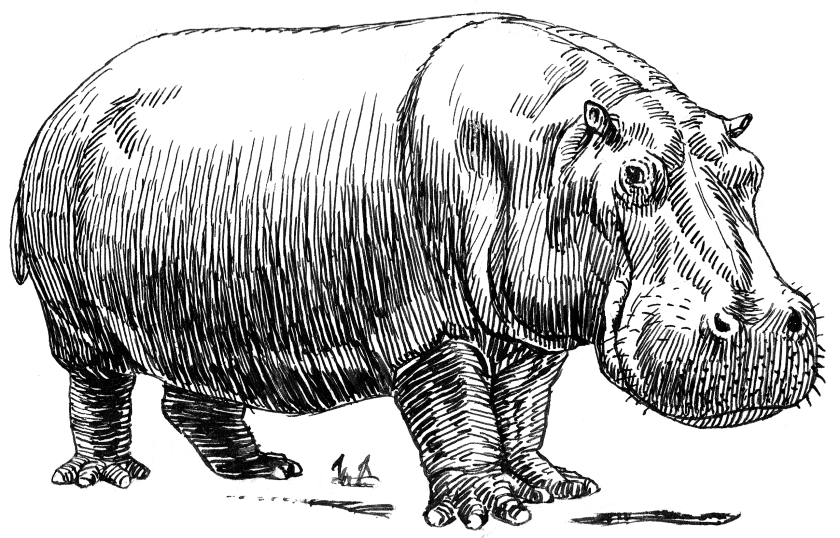
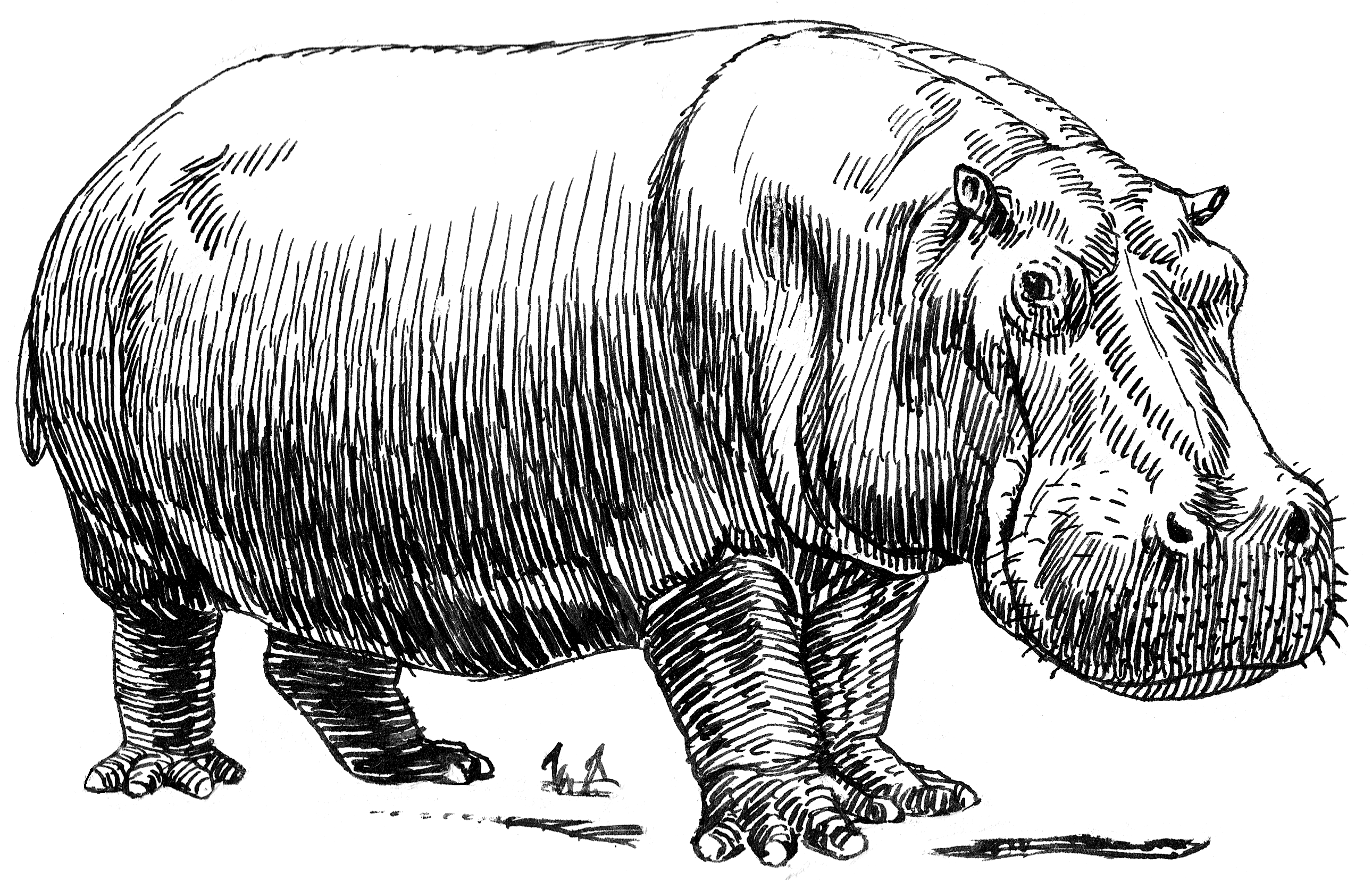
Hippopotamus, not as something to want for Christmas, but for dinner.

Hippopotamus, not as something to want for Christmas, but for dinner. Image: Archives of Pearson Scott Foresman, donated to the Wikimedia Foundation.

Mooallem contends that choosing beef and eschewing hippo formed one link in the chain that led to today’s factory farming practices that define industrial agriculture; practices related to “all kinds of dystopian mayhem,” including an antibiotics nightmare and issues of animal welfare, as well as contributing to global warming.

Not only does Mooallem connect this historical meat moment to present day meat production methods, but to a seemingly by-gone American political ethos. He argues:

[T]here is something beautiful about the America that considered importing [hippopotamuses]—an America so intent on facing down its problems, and solving them, that even an idea like this could get a fair hearing; where the political system and the culture felt so alive with possibility, and so confident in its own virtue and ingenuity, that elected officials could sit around and contemplate the merits of hippo ranching without worrying too much about how it sounded; where people felt free and bold enough to imagine putting hippopotamuses in places were there were no hippopotamuses.

Published just a few months ago, American Hippopotamus proves a timely piece, not only within the story of a “broken” food system, in which meat production and consumption are a much invoked component, but as commentary on America’s political, economic, and cultural perspective. On this note, Mooallem’s conclusion reminds me of the point of view that Amy Chua and Jed Rubenfeld endorsed in a recent New York Times article promoting their Triple Package research: “Those who talk of America’s “decline” miss this crucial point. America has always been at its best when it has had to overcome adversity and prove its mettle on the world stage. For better and worse, it has that opportunity again today.” Now is exactly the time for bold and creative solutions.

While the American public may never willingly consider hippopotamus farming or “lake cow bacon” consumption, Mooallem may be on to something that we would do well to view our present and our future with more open mindedness; to recapture a national spirit that is fearlessly open to innovation in all its forms—even hippopotamuses.

What Does the Fridge Say? A Historical Photo Essay

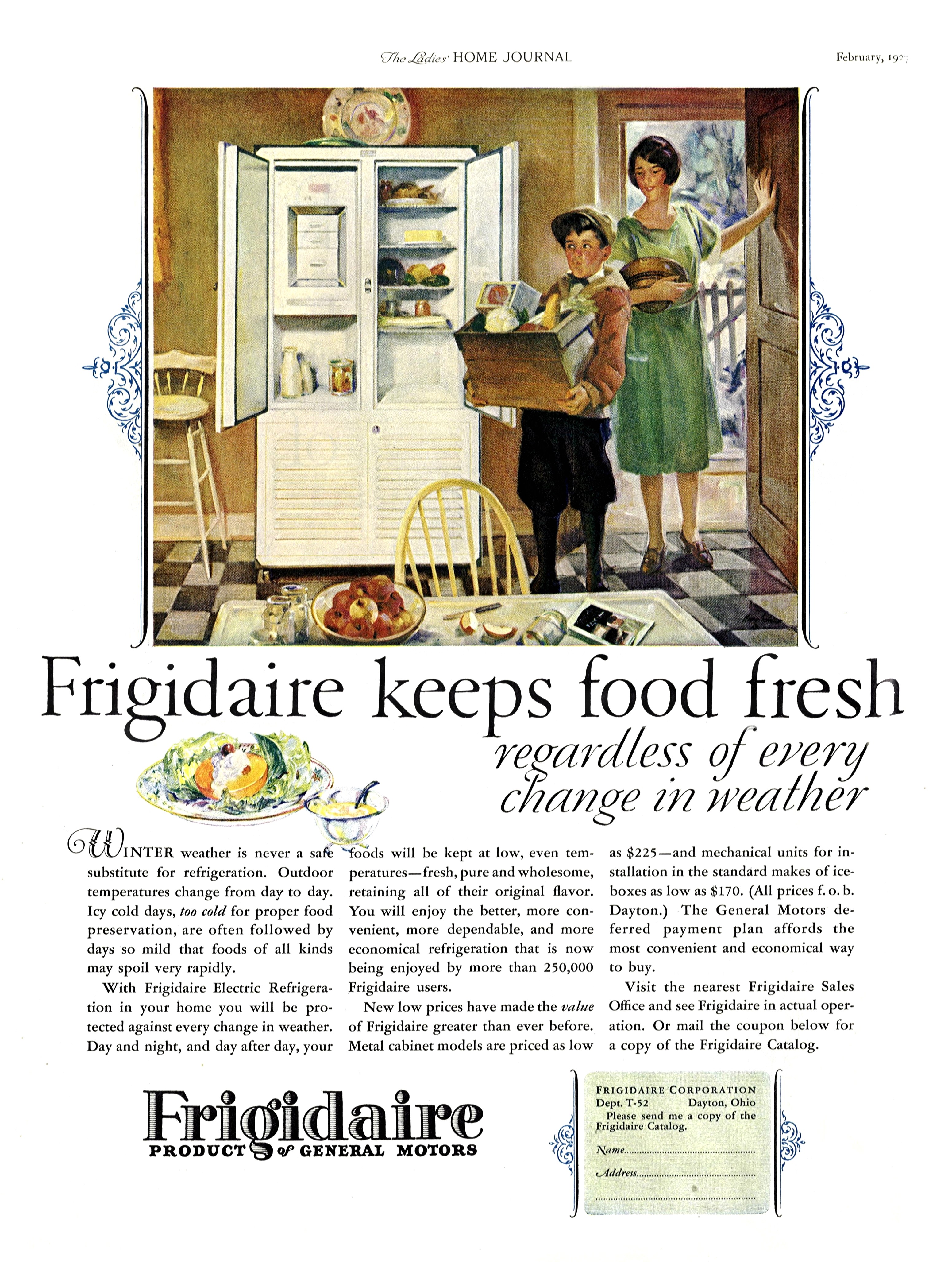
While we may now know less about what the fox says than we did before the autumn months of last year, the fridge has been saying quite a lot ever since it found its place within the home kitchen in the first quarter of the twentieth century.

Electric and gas refrigerators became available for domestic use in the United States following World War I, but were at first a luxury item owned by only upper class Americans. Refrigerator ownership was truly scant; in 1923, for example, it’s estimated that only 20,000 households in the United States owned a mechanical refrigerator. As late as 1927, 60 percent of households had no form of refrigeration at all, mechanical or ice-based. This was largely a result of refrigerator cost, which throughout the 1920s would have totaled close to $3,500 today.

The exclusivity of refrigerator ownership is evident in period advertising. Take for example Frigidaire Frozen Delights: Frozen Desserts and Salads Made in Frigidaire (1927)—a resource developed by Jessie M. DeBoth of the DeBoth Home Makers’ Schools of Chicago, Illinois. While some messaging focuses on the more middle class concerns of practicality, reliability, and food safety, this guide also promotes more affluent topics, as it demonstrates the high style entertaining made possible by this chilly appliance. On one page, sandwiched between pages of recipes, the pamphlet features a woman in sparkling eveningwear, welcoming a well-dressed couple into her home.

Image from Frigidaire Frozen Delights: Frozen Desserts and Salads Made in Frigidaire (1927)

Image from Frigidaire Frozen Delights: Frozen Desserts and Salads Made in Frigidaire (1927)

The accompanying text reads, “The hostess in whose kitchen Frigidaire is an assistant, greets her guests unworried and with an air of perfect assurance.”

As a result of technological advances, standardization, mass production, and market competition, refrigerator cost declined in the late 1920s and 1930s, and manufacturers began to target the middle class in an effort to increase sales beyond the small market segment of wealthy households. An audience more likely to be focused on the practical concerns of food safety than elegant frozen desserts, advertisements of the time reflect this perspective, casting the refrigerator in a less glittery role.

Prior to home refrigerators, housewives preserved food in a variety of ways. This 1927 ad works to re-educate housewives, promoting the regulated temps of technology as superior to nature.

Prior to home refrigerators, housewives preserved food in a variety of ways. This 1927 ad works to re-educate housewives, promoting the regulated temps of technology as superior to nature.

In the 1950s and 1960s, refrigerators were promoted less for their practical ability to keep food cold and safe, but for the agricultural abundance they so effortlessly provided—as well as their fashionable role within the kitchen as a design space. Take for example these individualized Kelvinator Originals:

Kelvinator 1965 advertisement; which one is your style?

Kelvinator Originals advertisement from the 1960s; which one is your style?

Starting around the 1980s, however, the refrigerator emerges in a staring role within the burgeoning trend of the trophy kitchen. While fashionable at times to be hidden within custom cabinetry…

Cabinet Fridge

Are those wall-to-wall cupboards? No! It’s a fridge—and a truly massive one at that.

…the leading trend in today’s kitchen continues to be the stainless steel fridge, proudly put on display.

A stylish kitchen featured on the Sub-Zero and Wolf website.

A stylish kitchen featured on the Sub-Zero and Wolf website.

In luxury homes across the nation, high-end refrigerators continue to serve as significant status symbols, as well as intriguing economic indicators. In a New York Times article this week on the erosion of the middle class, G.E. shares how sales of their Café line of refrigerators—which boast features like hot water dispensers to the tune of a $1,700 to $3,000 price tag—outpace mass-market fridge sales.

Whether a reflection of one’s style and taste, a status symbol, or an appliance simply beloved for its frigid capabilities, the fridge certainly has something to say.

References

  • Cowan, Ruth Schwartz. “Chapter 15: How the Refrigerator Got Its Hum,” in The Social Shaping of Technology,” eds. Donald MacKenzie and Judy Majcman (Philadelphia: Open University Press, 1985), 202-218.
  • Grahame, Peter R. “Objects, texts, and practices: The refrigerator in consumer discourses between the wars,” in The Socialness of Things: Essays on the Socio-Semiotics of Objects, (ed.) Stephen Harold Riggin. (Berlin: Mouton de Gruyter, 1994).
  • Isenstadt, Sandy. “Visions of Plenty: Refrigerators in America around 1950.” Journal of Design History 11, 4 (1998): 311-321.
  • Nickles, Shelley. “’Preserving Women’: Refrigerator Design as Social Process in the 1930s.” Technology and Culture 43, 4 (2002): 693-727.
  • Young, William H. and Nancy K. Young. American Popular Culture Through History: The 1930s. Westport: Greenwood Publishing Group, 2002.

Top Image: New Freedom Gas Refrigerator, Print Advertisement, circa 1946

Review: ‘Fresh Fruit, Broken Bodies’ Astutely Addresses Structural Solutions

I must recommend Fresh Fruit, Broken Bodies: Migrant Farmworkers in the United States (written by medical anthropologist and physician, Seth M. Holmes, and published this past June by UC Press), a text so marvelous that it deserves this post title’s quadruped alliteration. In this powerfully moving and hopefully significantly influential book, Holmes reveals through poignant thick description the life experiences, structural inputs, and health outcomes of Triqui migrant farmworkers.

Fresh Fruit Broken Bodies Cover

Seth M. Holmes’ Fresh Fruit, Broken Bodies: Migrant Farmworkers in the United States (2013)

Best described by his fellow fruit picker, Samuel, as a project in which “he wants to experience for himself how the poor suffer” (33), Holmes chronicles Triqui experiences as they live in Oaxaca, risk their lives crossing the U.S.-Mexico border, and labor in the fields of California, Oregon, and Washington. Holmes vividly depicts personal experiences of suffering, defined as “not only physical sickness, but also mental, existential, and inter-personal anguish” (89). Furthermore, while various scholars and researchers describe, list out, and point to structural inequalities and the fundamental causes of disease, Holmes’ combination of ethnography, theory, and medicine elucidates these causes and structural forces with refreshing complexity, dexterity, clarity, and empathy.

With an assertively activist aim, Holmes seeks to encourage acknowledgement, engagement, reform, and transformation of the social, economic, and political structures that have created the plight of the migrant farmworker. He points most specifically to NAFTA trade policies that benefited the United States, while decimating the Mexican corn industry and the jobs it provided (25). Without these employment opportunities available, Holmes argues that the migration of farmworkers is anything but voluntary. Rather, migration for agricultural work in the United States is a forced necessity for workers to support their families. As his Triqui companion, Macario, says, “There is no other option left for us” (18).

Beyond the economic politics of global neoliberal capitalism, Holmes depicts the causal pathways by which structural forces affect the wellbeing of migrant farmworkers. He sketches hierarchies, relationships, feedback and feed-forward loops with compassion and balance.

For example, Holmes reveals the different structural inputs that affect workers at every level of the social structure at Tanaka farm where he worked and observed. Within the “ethnic-labor hierarchy” of the United States, which places white and Asian American U.S. citizens at the top and undocumented indigenous Mexicans at the bottom (84), Holmes exposes “the primary fault lines of power” within the Tanaka farm hierarchy, which is segregated by race, class, and citizenship (50). At the same time, he reveals the way market pressures and concerns for the fate of family farming shape the actions of farm executives and how the work demands and perceptions of those in the middle of the hierarchy (administrative assistants, crop managers, supervisors, and checkers) influence how they treat the field workers paid hourly and by weight.

Similarly, Holmes acknowledges the structural factors (health system bureaucracy, positivist biomedical training, and lack of funding, supplies, medicines, and equipment) and challenges (language barriers, time constraints, incomplete health records, and lack of continuity of care) that affect clinicians and shape how they perceive, diagnose, and treat migrant patients (128-130).

By delineating the challenges and structural inputs at each level of these imposed hierarchies, Holmes is able to propose structural solutions that both remove the clinical gaze upon individual migrant workers as responsible for their fate and moderate the pointed blaming of healthcare workers and farm executives and managers.

While the theoretical concepts employed in the text seem disjointed and cherry-picked at times, Holmes’ use of structural violence (43) and Bourdieu’s symbolic violence (44) are a common thread throughout the text. In this way, Holmes reveals how social inequalities and hierarchies not only fall along “social categories of class, race, gender, and sexuality,” but also how they come to be internalized and legitimated (89). He forcefully argues that due to this violence the suffering of migrant workers has been “taken for granted, normalized, [and] naturalized” (156).

Depicting physical experiences that are powerfully shaped by perceptions of race and class, Holmes’ work also provides a contemporary view of the biological racism that others have depicted in historical perspective, such as Natalia Molina’s compelling 2006 study, “Medicalizing the Mexican: Immigration, Race, and Disability in the Early-Twentieth-Century United States” and very shortly forthcoming book, How Race is Made in America: Immigration, Citizenship, and the Historical Power of Racial Scripts also from UC Press.

The audience for Holmes’ message is wide, taking in the lay public, policy makers, and health care workers, all of whom he seeks to make aware of the structural violence exerted by global neoliberal capitalism and the labor hierarchies within American agriculture (109). He calls for reforming economic, immigration, and labor policy, including social structural analysis in the training of medical and public health professionals so that they can see more than the “biological and behavioral determinants of sickness” (153), and working toward a universal health care system (195).

Arguing that the inequalities faced by migrant farmworkers are not naturally but socially constructed, Holmes voices an impassioned call to acknowledge that these structures can, should, and must be changed (156); a call that most any reader would be hard pressed not to answer after reading of the broken bodies that provide our fresh fruit.

Top Image Credit: Seth Holmes

Presidential Obesity: Taft, Bathtubs, and the Medicalization of Corpulence

Ask your average citizen what he or she knows about President William Howard Taft and you’ll most likely hear recanted the rumor that due to his girth, Taft once became stuck in the White House bathtub. In the article, “Corpulence and Correspondence: President William H. Taft and the Medical Management of Obesity,” Providence College’s Deborah Levine analyzes fascinating primary sources from the Library of Congress—letters in which the 27th president of the United States corresponded with Dr. Nathaniel E. Yorke-Davies, an English diet expert—that chronicle Taft’s efforts to lose weight while in the harsh spotlight of American politics and popular culture. [If you haven’t read Monday’s New York Times coverage or the original article in the most recent issue of Annals of Internal Medicine, they’re marvelous. Go read them now!]

As Levine demonstrates, this correspondence reveals Taft’s own views of the relationship between obesity and personal character, as he aspired to lose weight not only “to combat uncomfortable symptoms” (565), but also to “become a better civil servant” (565), revealing the assumption that one’s weight informs both objectives. This perspective is reinforced by Taft’s repeated assertion that “No real gentleman weighs more than 300 pounds” (565). Standing 6 feet and 2 inches tall, Taft weighed 354 pounds on his inauguration day, 255 pounds after dieting with Yorke-Davies, and 280 pounds at his death.

Notably, this framing of Taft’s weight and his attempts to reduce it are in stark contrast to the story presented by many sources, including the Taft biography featured on the University of Virginia’s Miller Center website. In this instance, nearly half of a page devoted to Taft’s family life focuses on his “enormous size,” and claims, “At ease with his uncontrolled appetite and his need for sleep after eating or after exerting himself, Taft simply refused to be embarrassed by his weight or his behavior. He accepted his size and so did most of the American public in time.” Levine’s research calls such assertions into question.

Beyond his personal beliefs regarding obesity, Taft’s weight also affected his political career. Levine shows, “By the time that Taft, the nation’s heaviest president, was inaugurated in 1909, his appearance was a point of intense public concern and one that Taft had worked to address for years” (569). This concern often took the form of jokes, such as the aforementioned and long-lasting rumor that Taft became stuck in the White House bathtub, as well as editorial cartoons (such as the one to the left, published prior to the 1908 Republican National Convention) and newspaper articles. Levine argues that Taft pursued weight loss in order to counteract this view of his presidency, “plainly seeking relief from these tribulations” (569) by dieting with Yorke-Davies, perhaps most importantly because popular opinion of his weight “affected journalists’ opinion of his leadership ability” (569).

President Taft, as depicted by JC Leyendecker in the Saturday Evening Post, 6 March 1909

President Taft, as depicted by JC Leyendecker in the Saturday Evening Post, 6 March 1909

Levine asserts, “In choosing Yorke-Davies, a credentialed physician, over the many other sectarian or faddist sources of diet advice available at the time, Taft was exercising agency over how he wanted his obesity to be treated” (566). He wanted his obesity to be viewed and treated as a medical issue, a desire mirrored powerfully today, especially given the AMA’s recent recognition of obesity as a disease. In doing so, Levine argues, “Taft became symbolic of the medical management and struggles associated with sustaining long-term weight loss,” a symbolic role that “shap[ed] American relationships to obesity in the early 20th century” in which “a person’s weight and approach to diet was explicitly recast as an outward indicator of the health, vitality, self-control, and discipline, required to succeed and lead in the modern United States of America” (569).

Taft’s weight loss attempts provide historical roots to the current meaning of obesity in the United States, especially within the Oval Office. For example, New Jersey Governor Chris Christie, who weighed about the same amount as Taft prior to recent gastric-band surgery, is rumored to be trying to lose weight in order to run for president. At this point, Taft remains the only obese person to lead the nation. Levine’s important archival work and fascinating article provide historical evidence as to why this remains so.