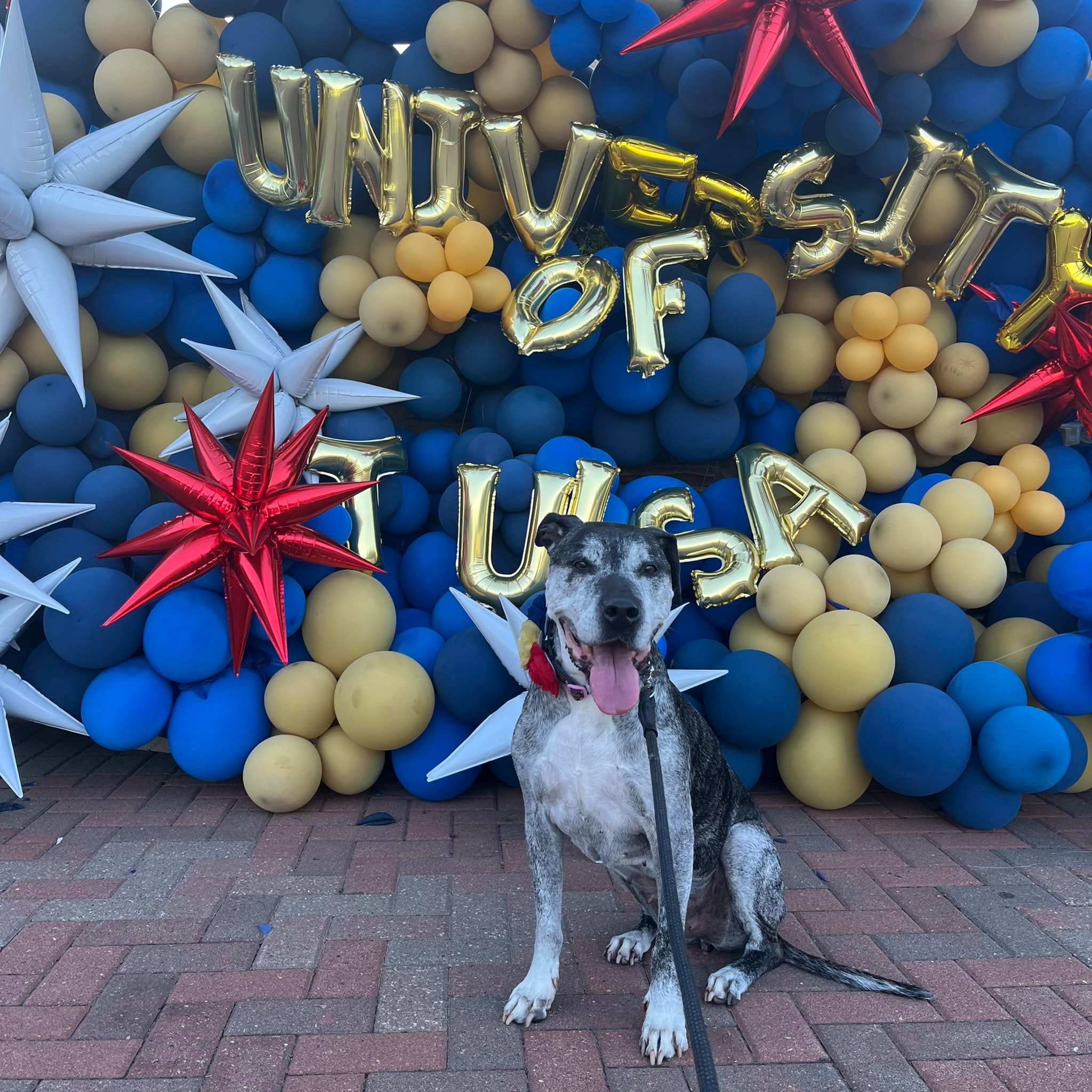
Latest Posts

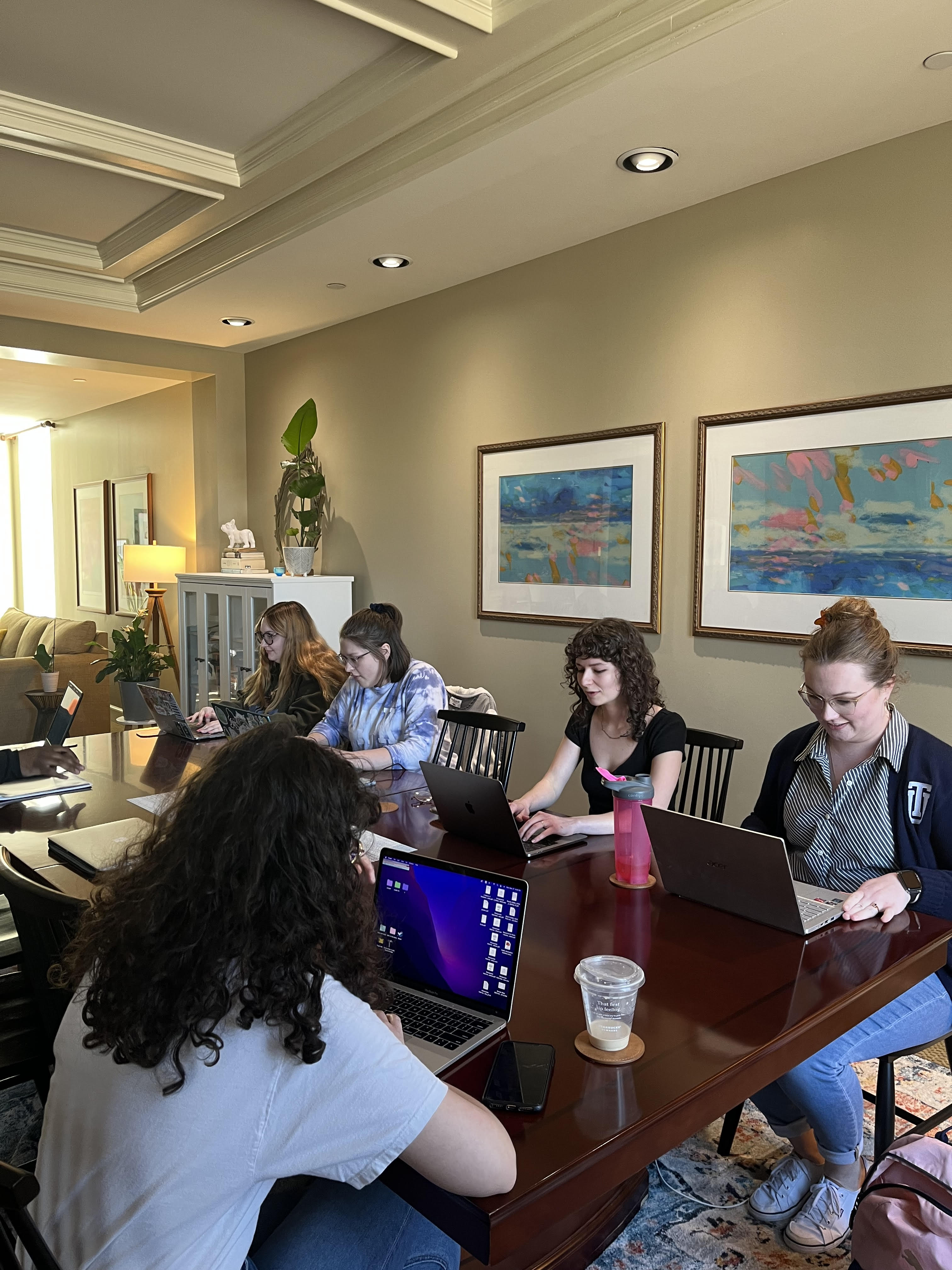
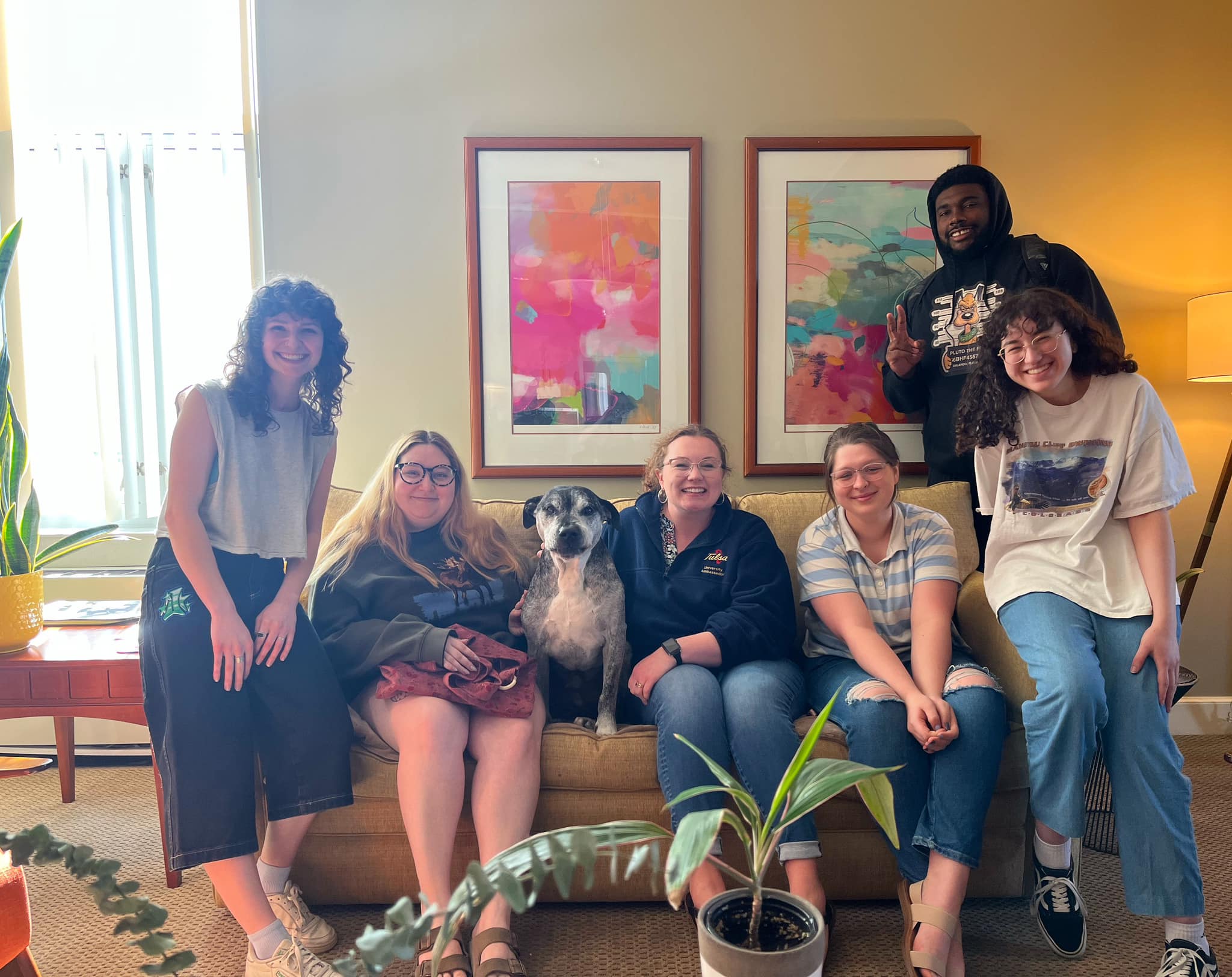
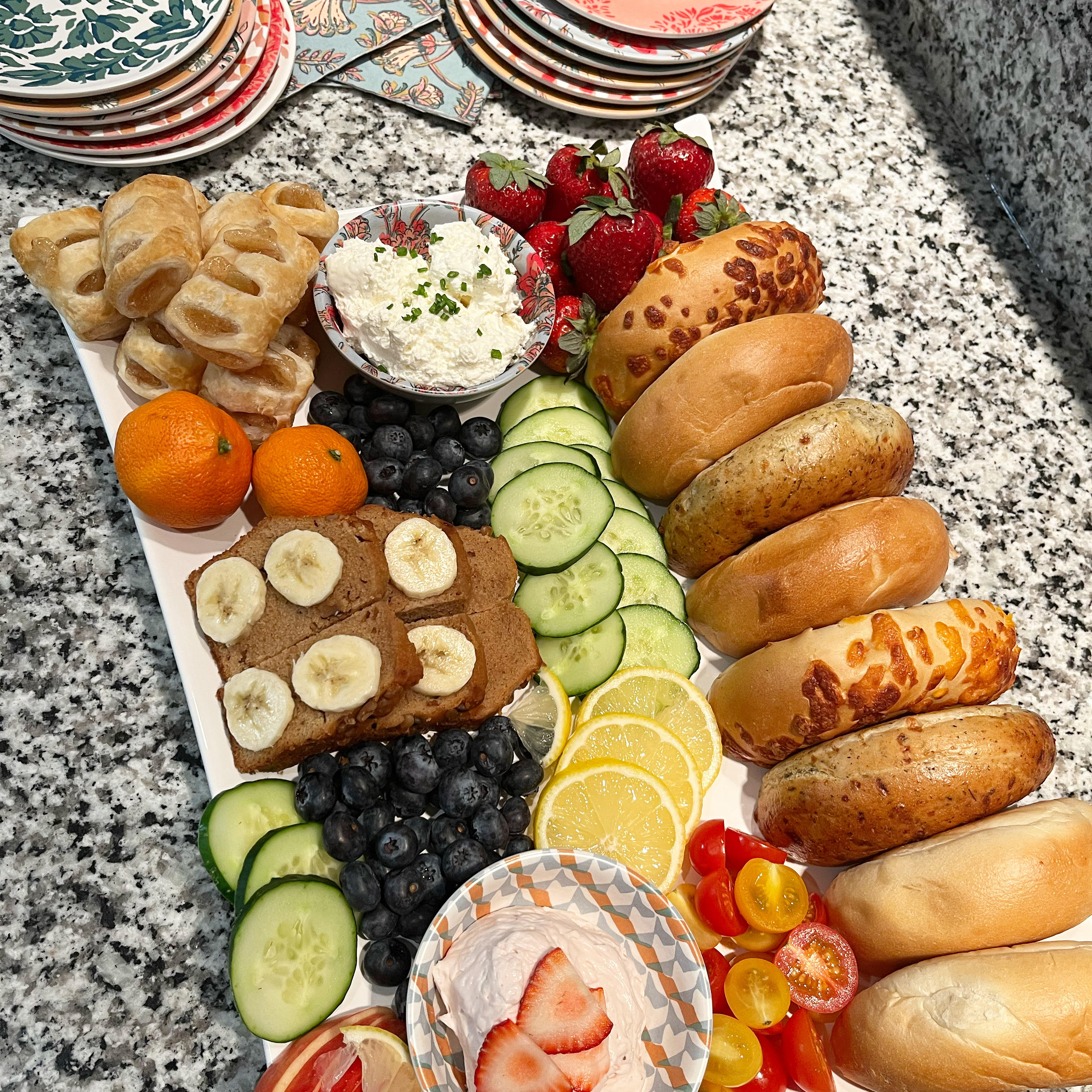
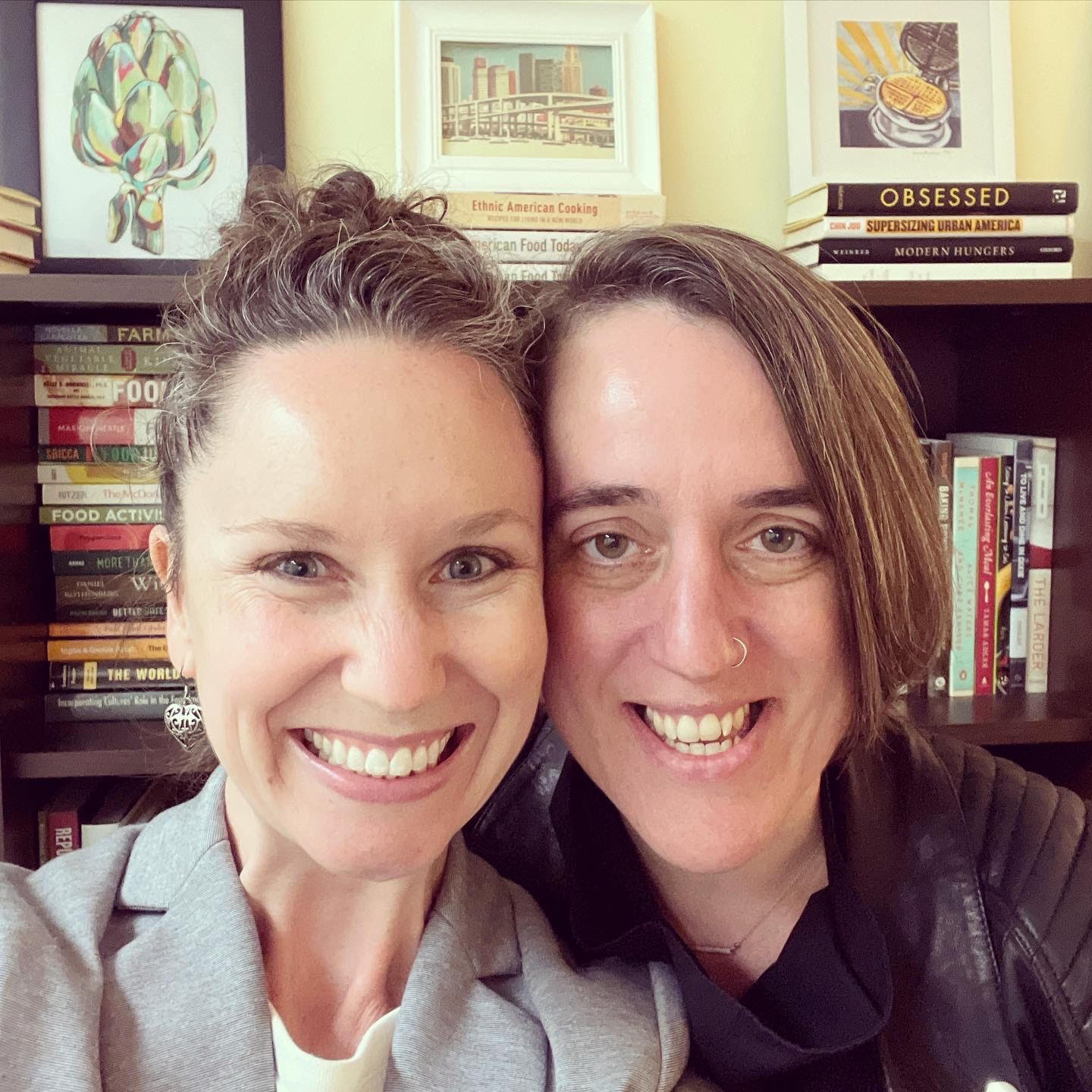
2024-2025 UTulsa Faculty in Residence Annual Report

Executive Summary

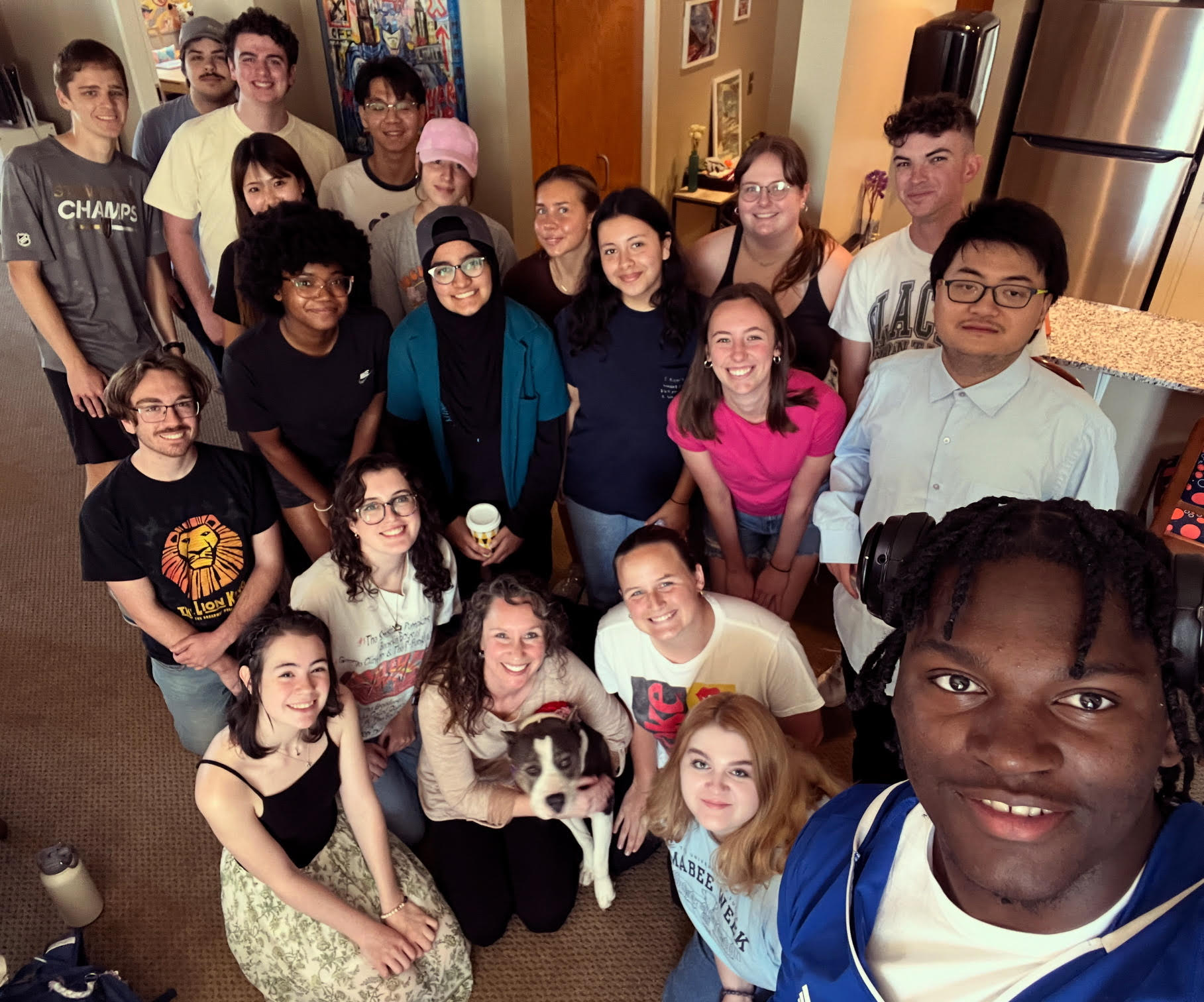
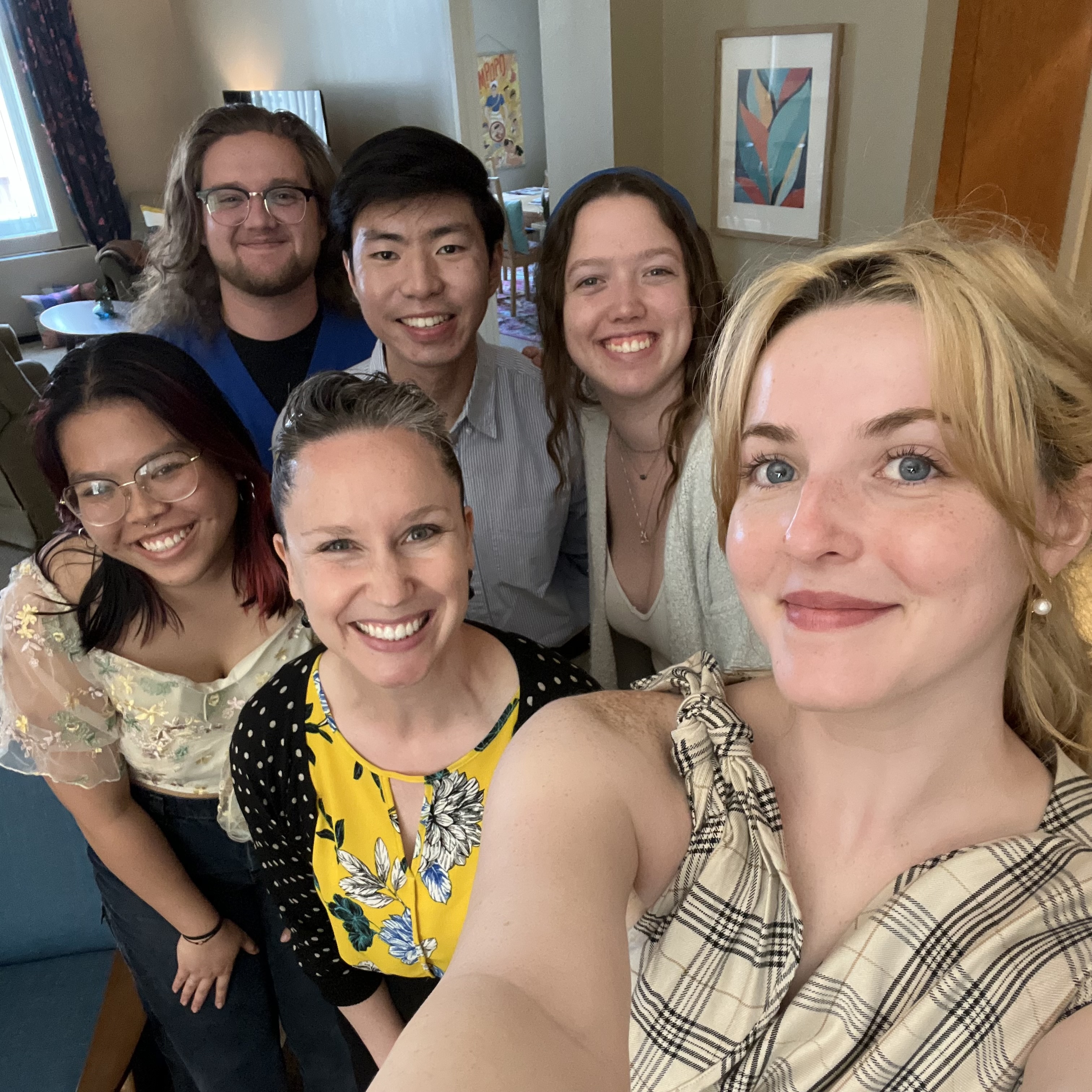
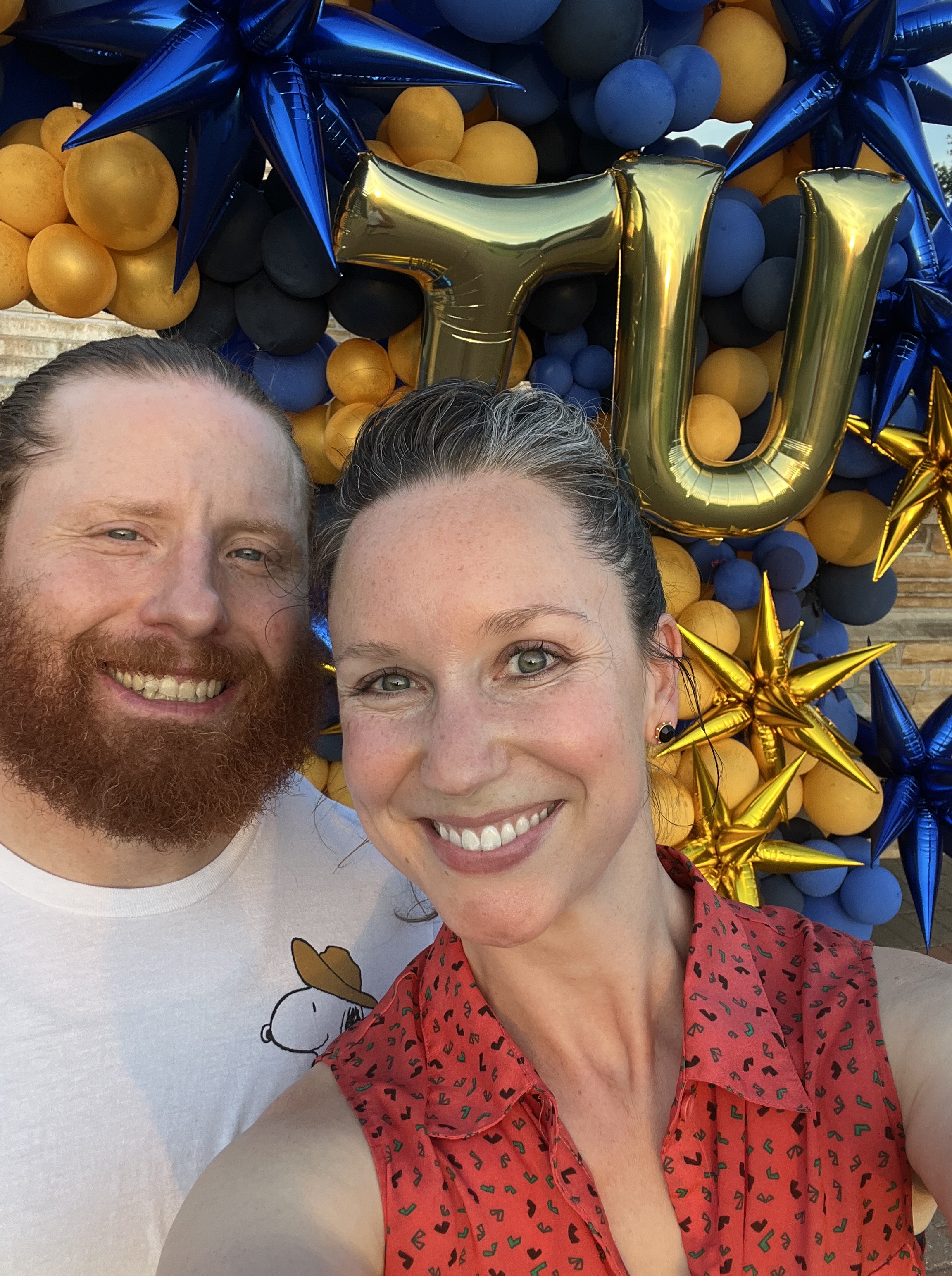
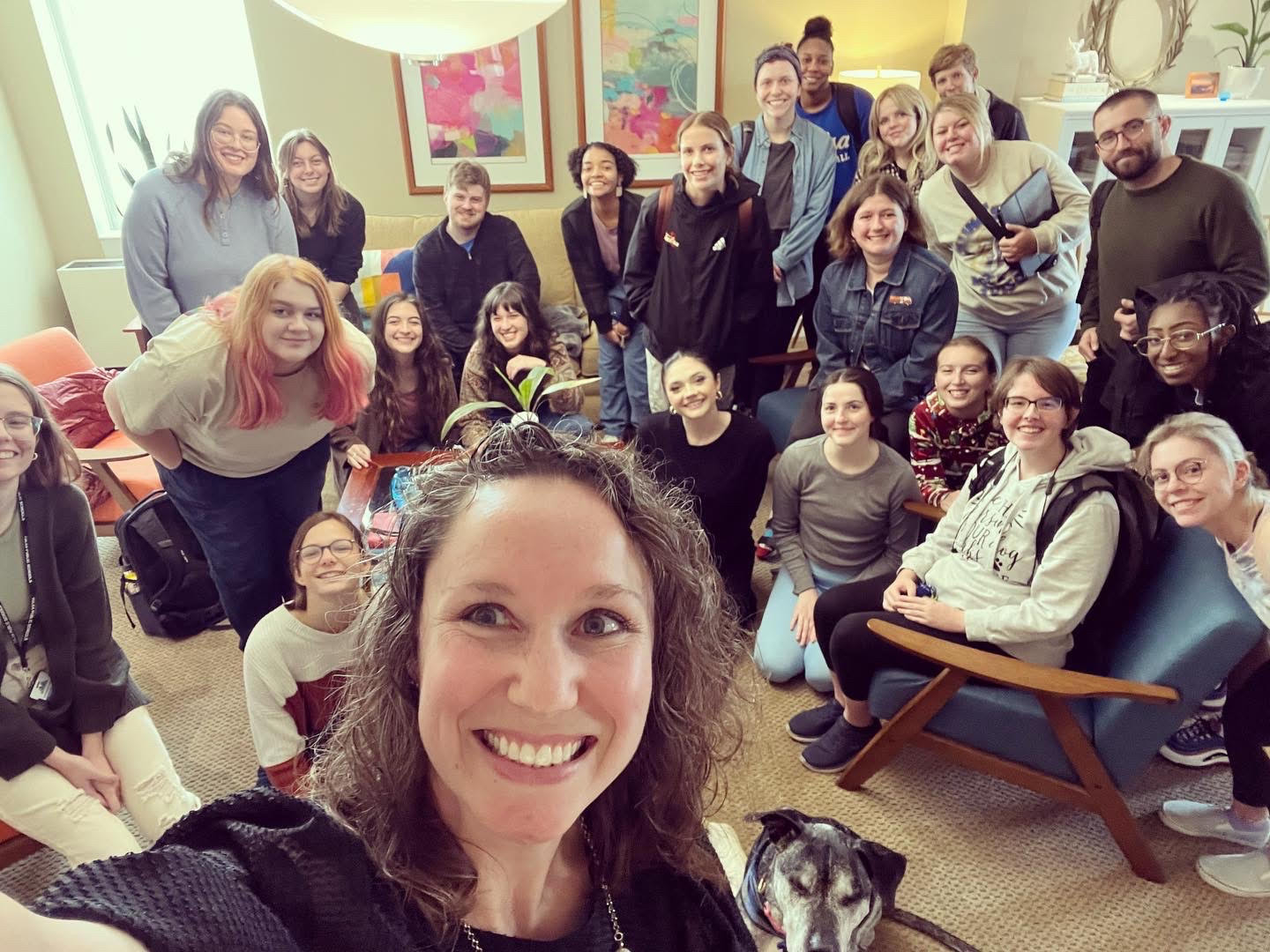
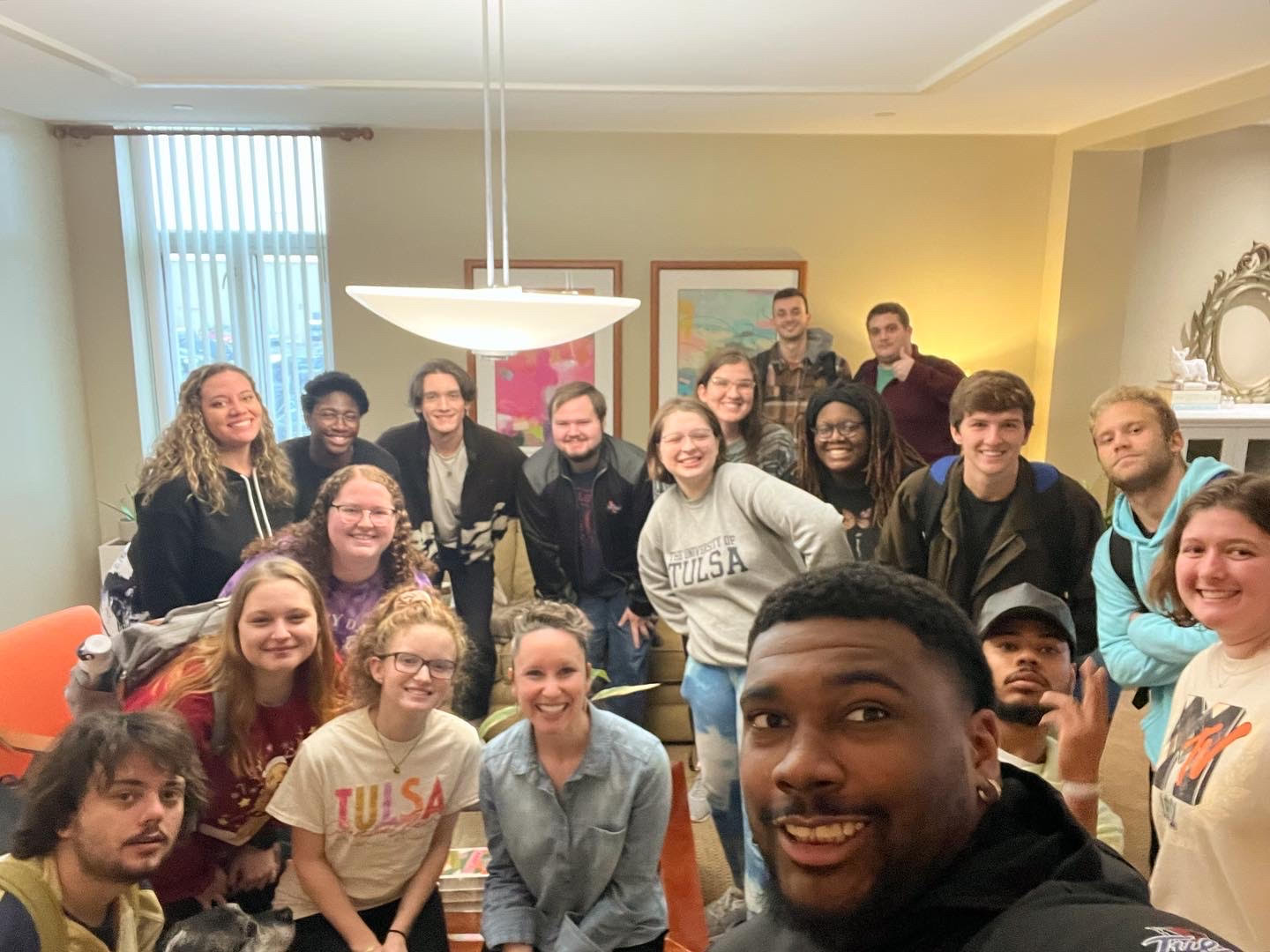
The 2024-2025 academic year marked the third in my (Emily Contois, Associate Professor of Media Studies) Faculty in Residence (FiR) journey at The University of Tulsa, along with my husband, Chris, and our dog, Ruby. Over these three years, we’ve hosted 115 events in our home and participated in many more across campus. We’ve continued successful FiR programming from our first year—including weekly office hours, Pup & PJs evening events, and monthly dinners at our home—and built upon successes from our second-year—including academic skills workshops and social events that merged my teaching and FiR work.

In addition to summaries and photos from this year’s program, this annual report also includes 12 testimonials from students who’ve participated in it. Zoe Smithey, a first year Sociology major with a minor in Women’s and Gender Studies, says of the FiR Program:

To live three doors down from an academic who is well established in her field, you would think she would just keep to herself. However, her door is often open, and she is ready to hear about your day, feed you good food, or help you excel in her field. She is a great addition to LaFortune.

And Hal Clowers, a junior Biology major (pre-med) with minors in Chemistry and History, writes:

I absolutely love the Faculty in Residence program. I have been going to Professor Contois’s events since her first semester in the role. I have loved getting to know one of my favorite professors in a more personal way that allowed me to see her as more than just a faculty member. I have attended many of her events including dinners, finals study preparations, and my personal favorite: Pup n’ PJs. Faculty in Residence has been my favorite program TU offers and I hope to see it continue. 

FiR Program Elements

UTulsa’s FiR program is a living-learning community that provides both formal and informal interactions between students and professors. We aim to form a bridge between the classroom and student life with the goal of enriching students’ daily lives and overall college experience.

Building from the higher ed literature on effective FiR programs, we seek to facilitate sustained interactions with students that combine academic and social elements, as well as providing opportunities for “deeper life” conversations once solid professor-student relationships have been cultivated.

FiR Student Welcome Efforts

I endeavor to welcome LaFortune residents (and all UTulsa students) to campus with intention and care, so I:

  • Updated our UTulsa Faculty in Residence webpage
  • Posted a welcome photo and message on my Instagram in fall 2024
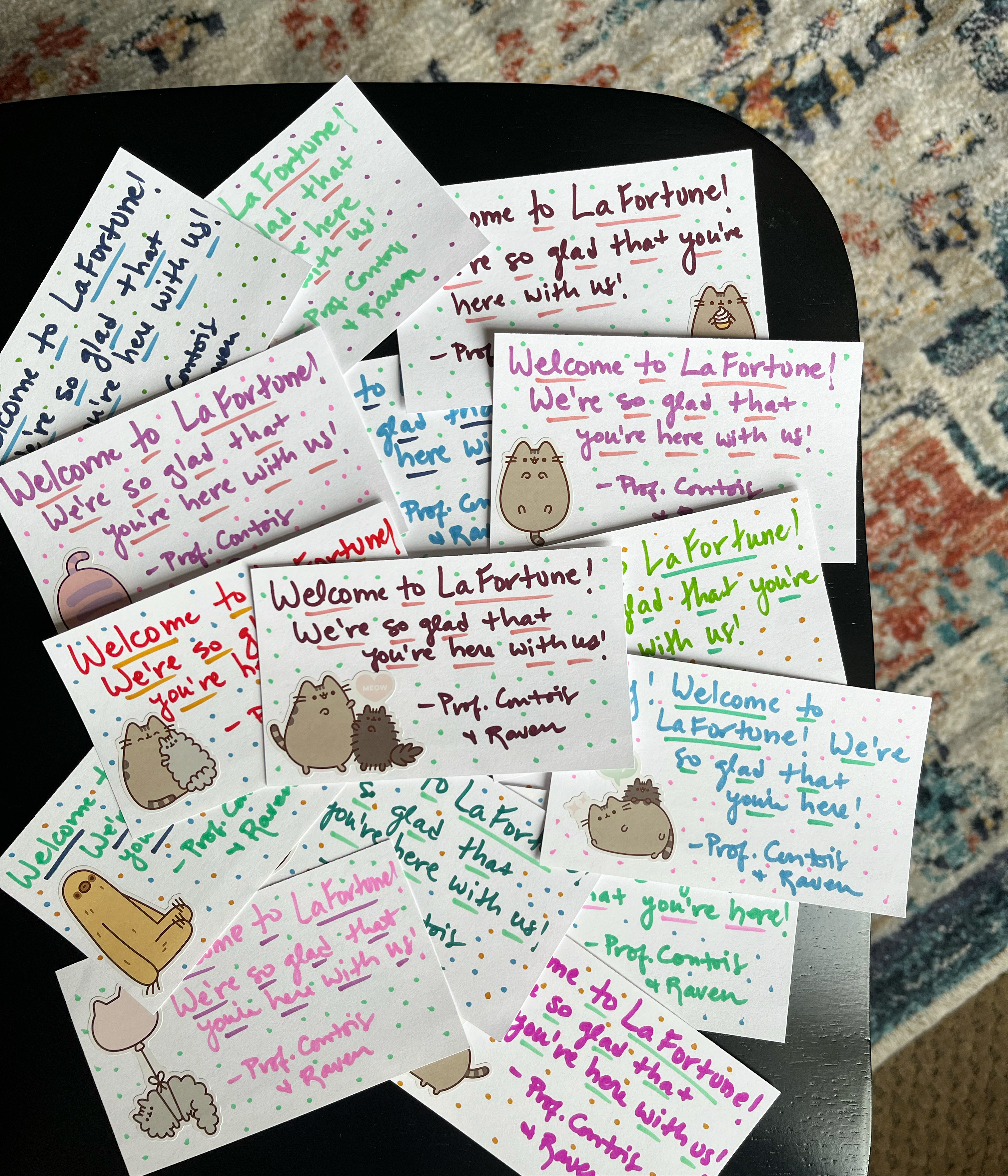
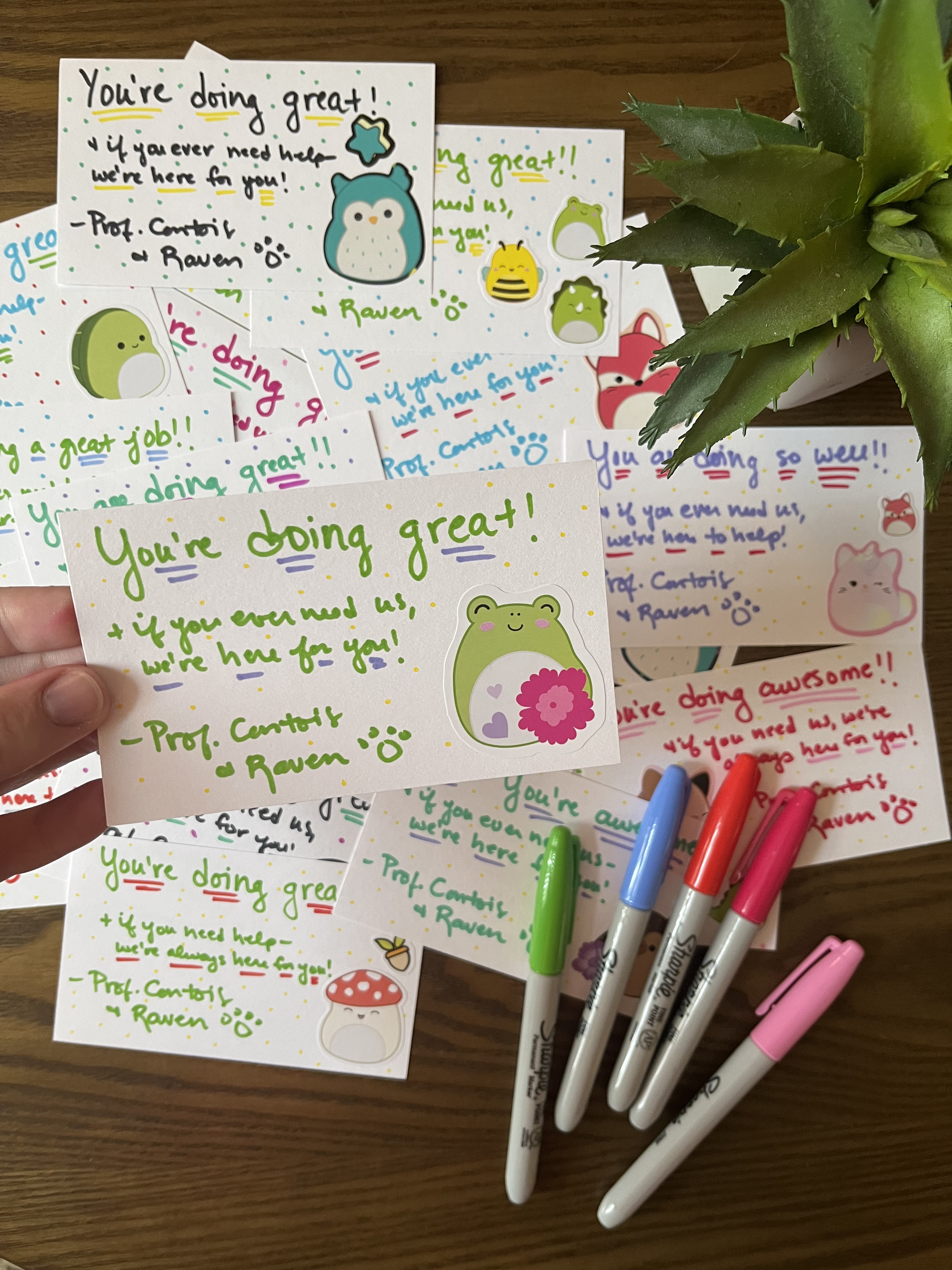
  • Hand-wrote welcome notes for every LaFortune suite door, as well as encouragement notes for fall 2024 finals
  • Worked LaFortune move-in day alongside student and staff volunteers
  • Attended LaFortune’s first hall meeting to introduce myself and Ruby to all residents
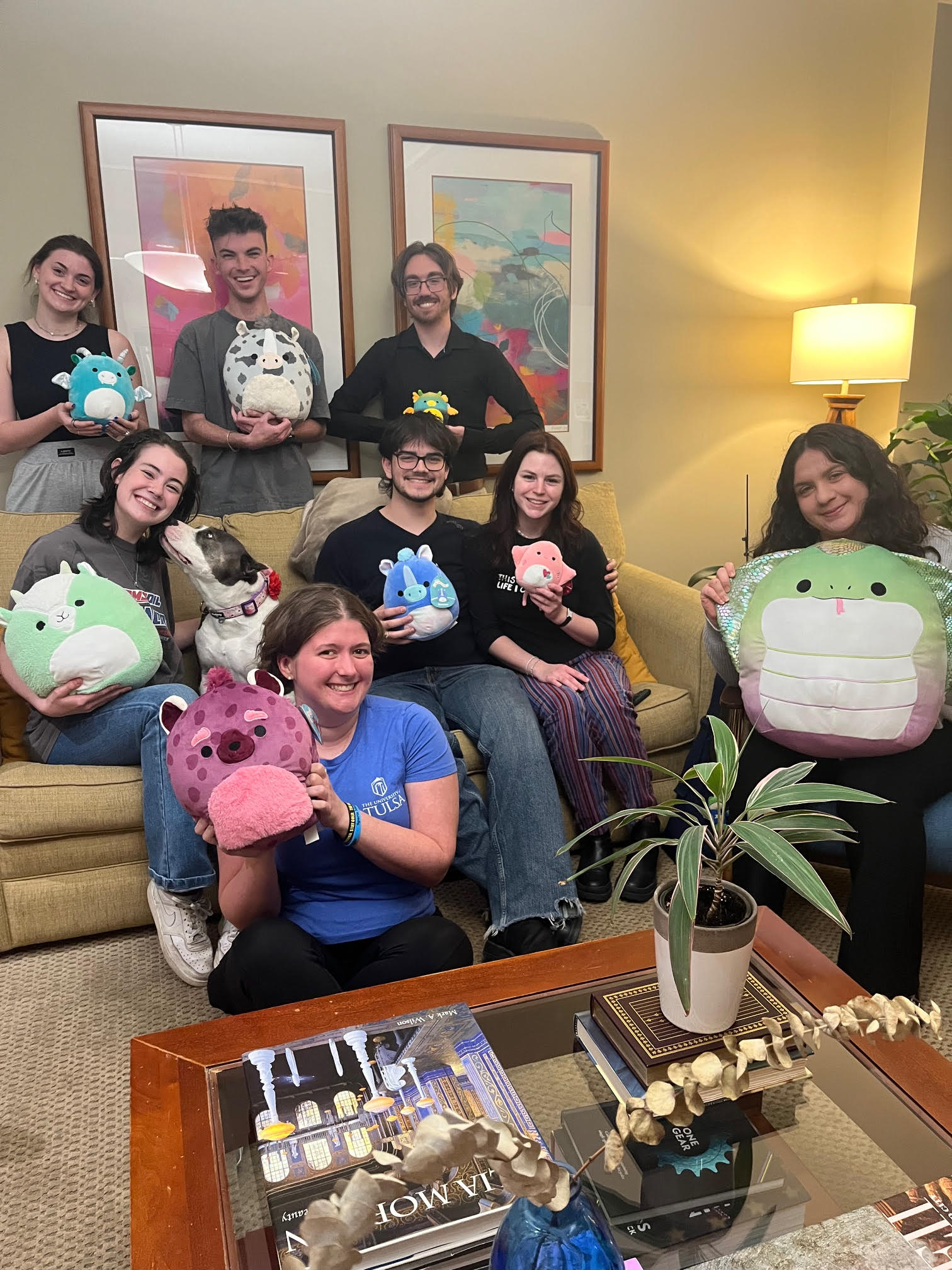
  • Hosted a Welcome Hour event in the FiR apartment with study tips, snacks, giveaways, and fellowship

Even years later, some students remember their welcome, such as Amber Restivo, a junior Biology major with minors in Chemistry and Psychology, who writes,

I met Professor Contois on move-in day my freshman year. Her infectious positivity and kindness set a welcoming tone in LaFortune House and made moving away from home much less scary. Professor Contois’ investment in community building has grown beyond the limits of LaFortune House, though. Despite having moved out of LaFortune two years ago, I continue to attend events, such as faculty in residence dinners, where I get to catch up with Professor Contois and have the opportunity to meet new people. It is incredible how many friendly faces on campus are people I first met at an event hosted or planned by Professor Contois. I will always be grateful for the support and community I have received from Professor Contois and the faculty in residence program. 

FiR Program Communication Efforts

Communication efforts are constant and ongoing to build awareness about the FiR program and encourage students to engage with us. This year I:

  • Designed, printed, and posted FiR flyers throughout LaFortune summarizing our events in fall 2024 and spring 2025
  • Designed promotional images for every event and posted on Instagram
  • Presented about the FiR program at UTulsa recruitment events, like Tulsa Time
  • Posted every FiR event to the UTulsa events calendar to invite all students to attend
  • Posted multiple reminders for every event on my Instagram Stories
  • Posted photo recaps of every event on my Instagram

Standing FiR Events

During the 2024-2025 academic year, we held the following events on a regular basis to offer students academic and social support.

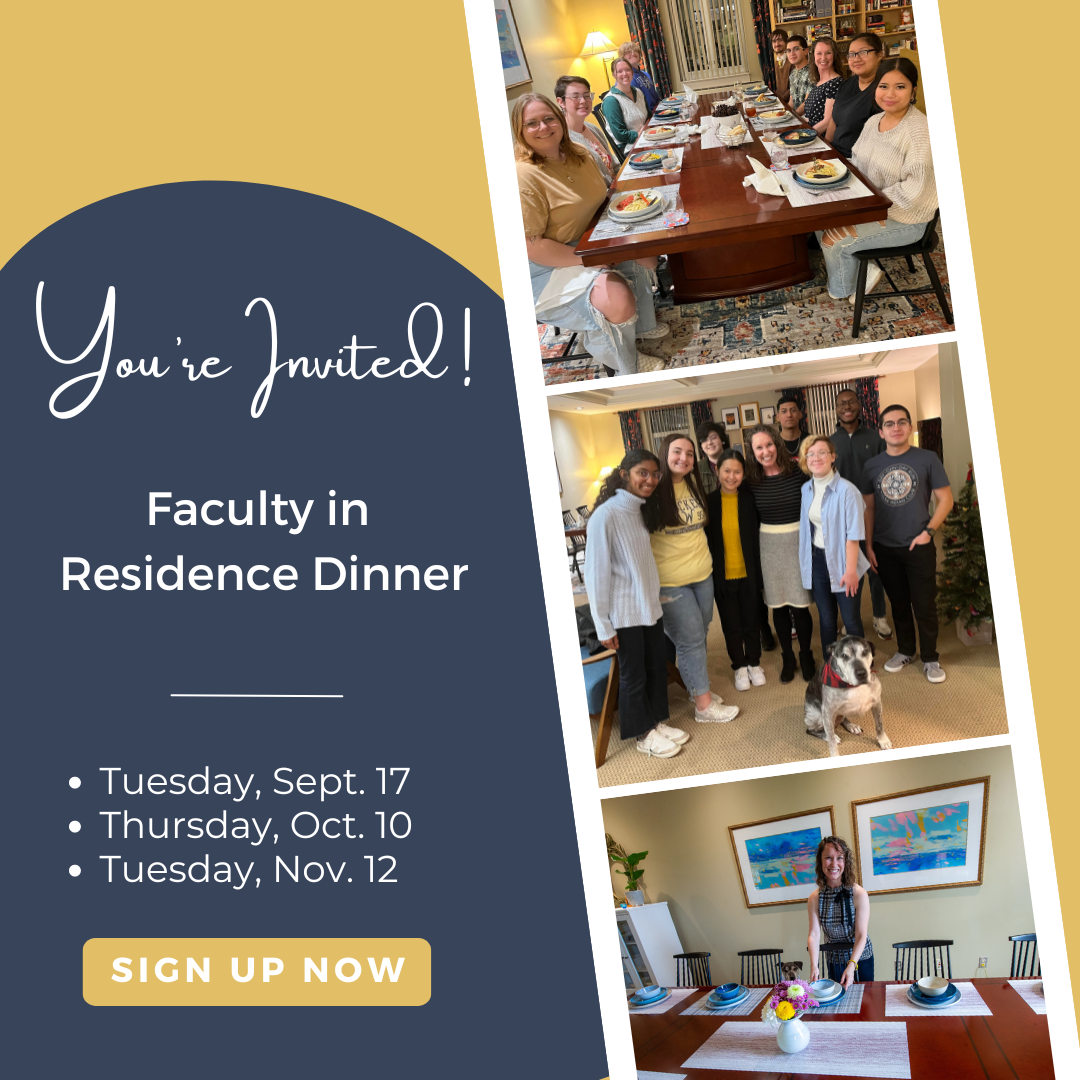
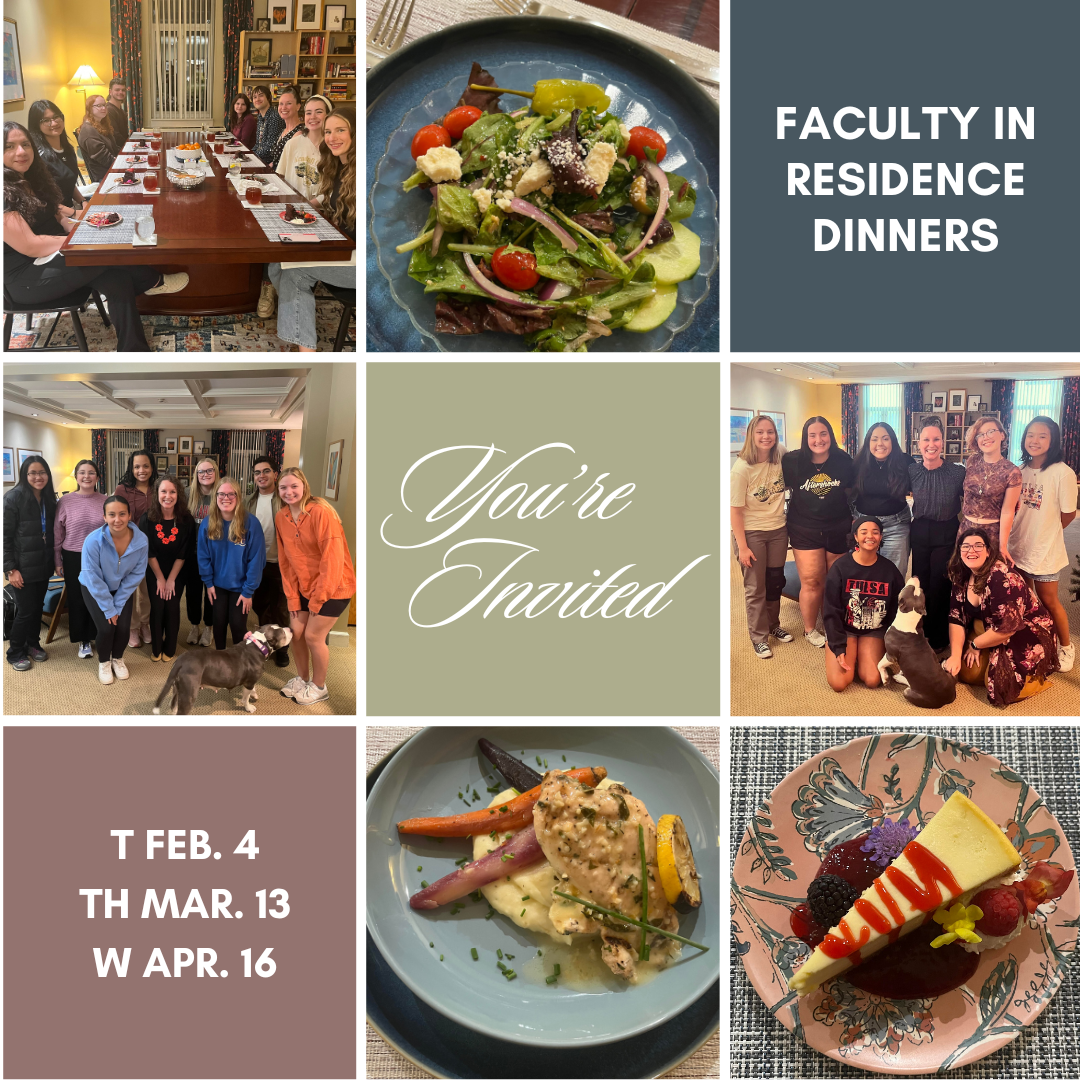
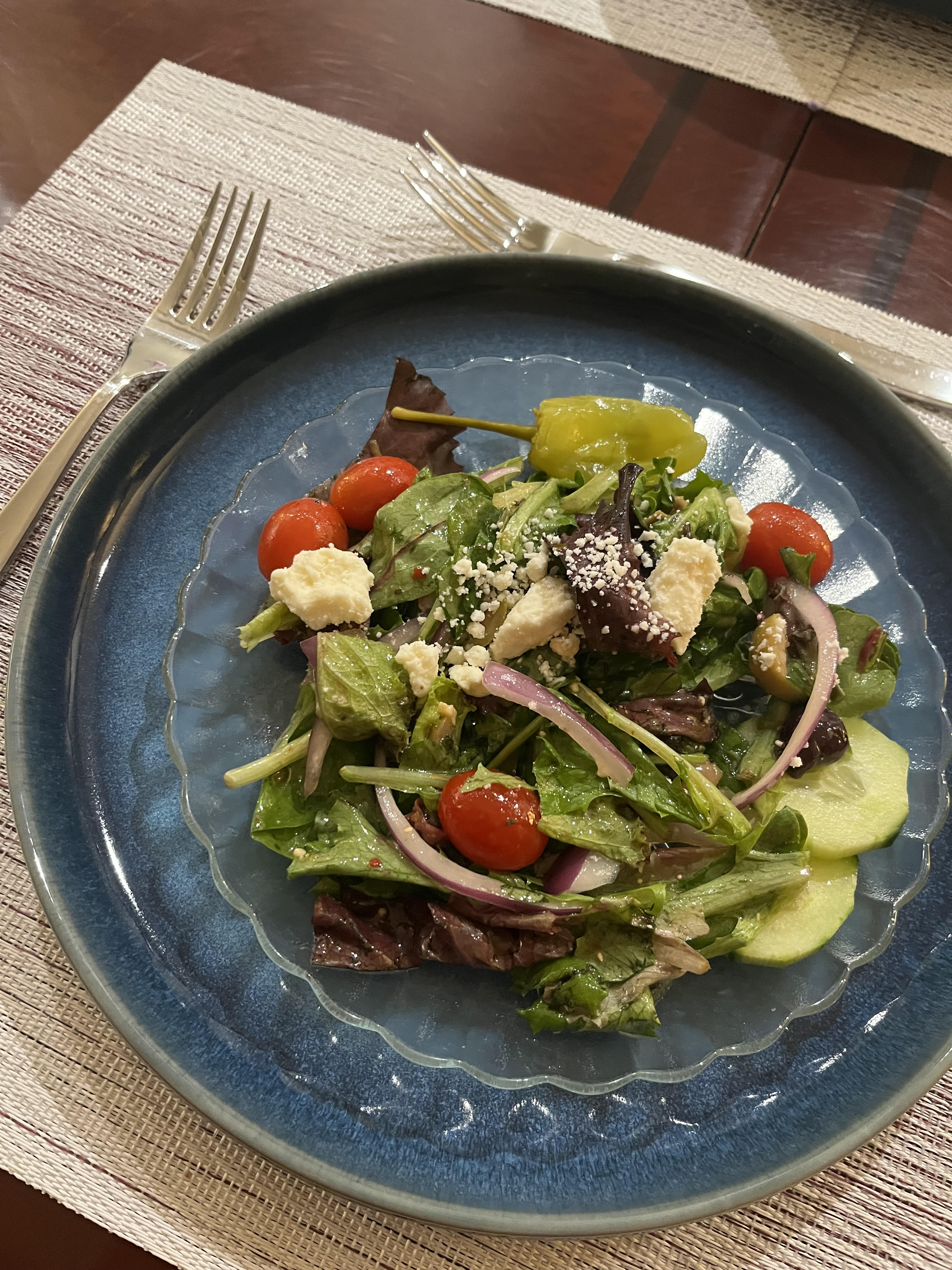
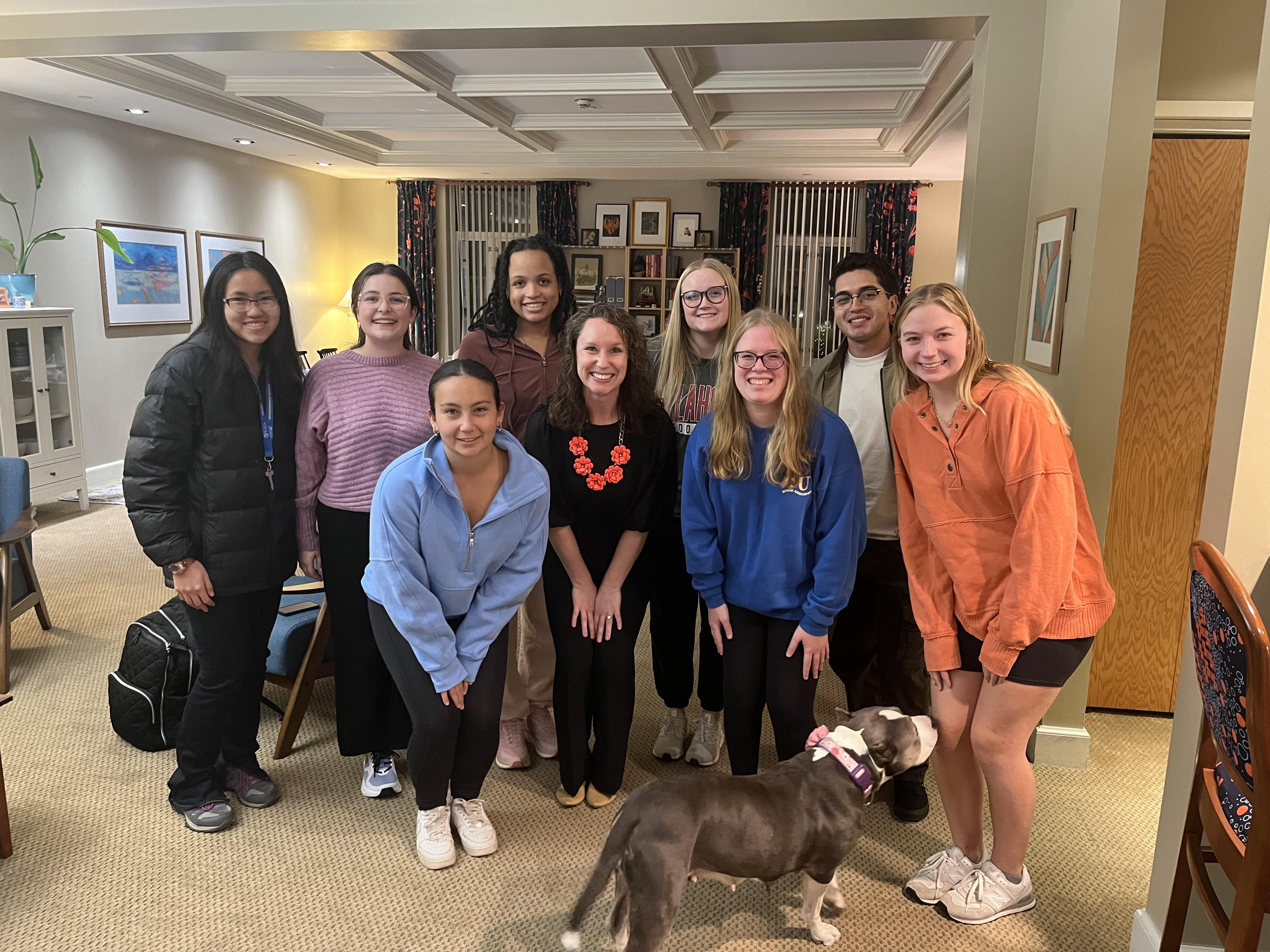
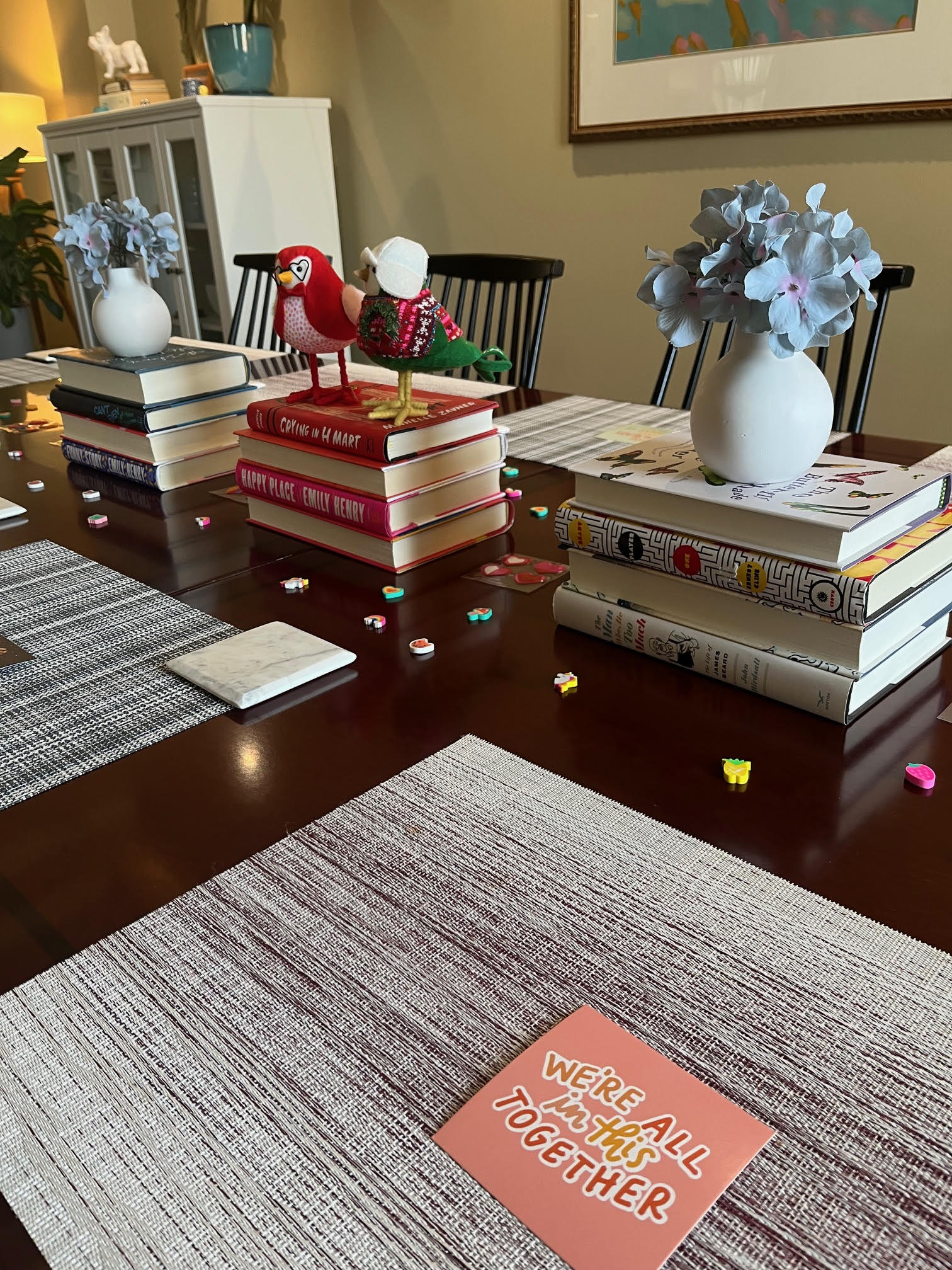
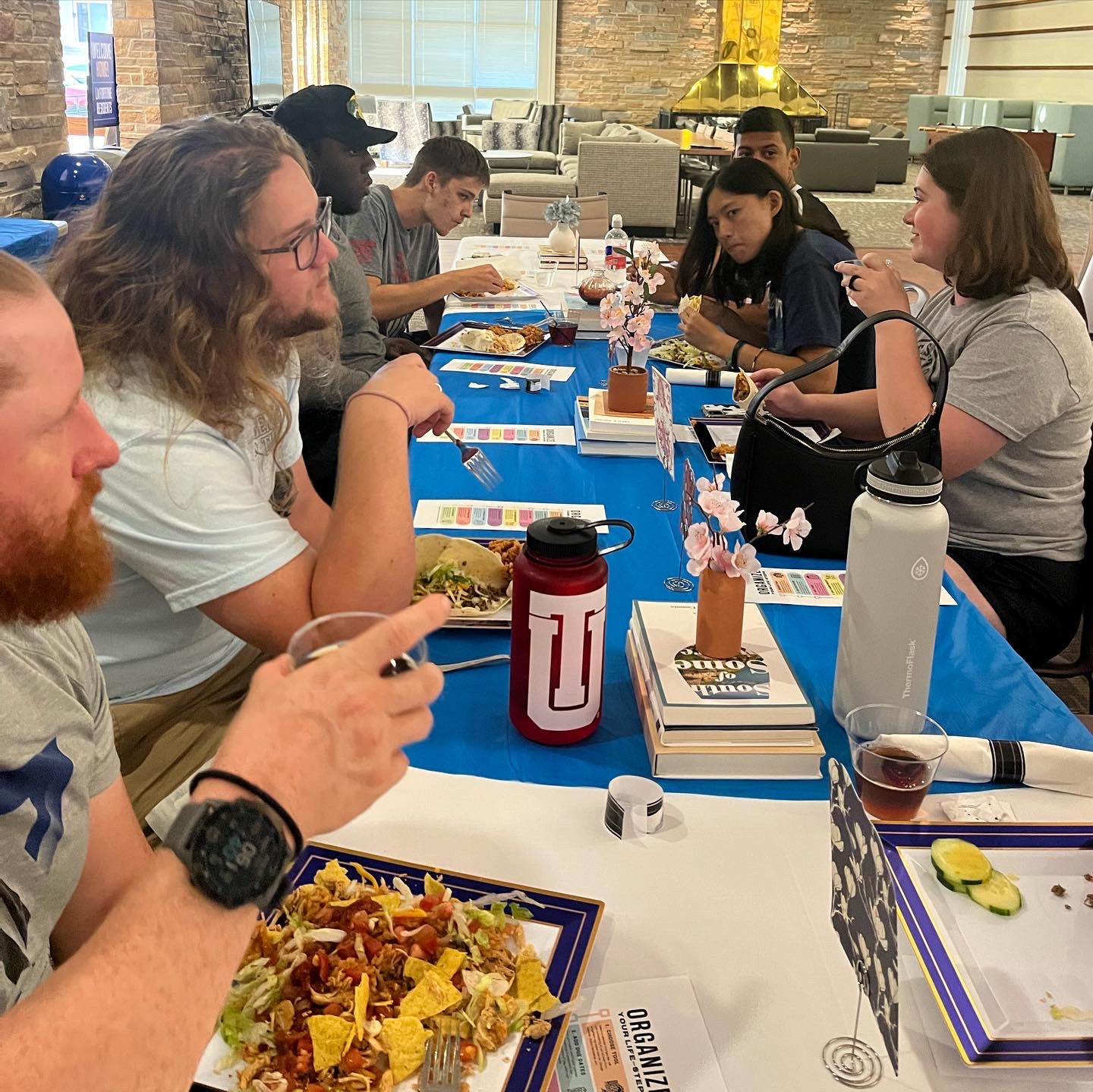
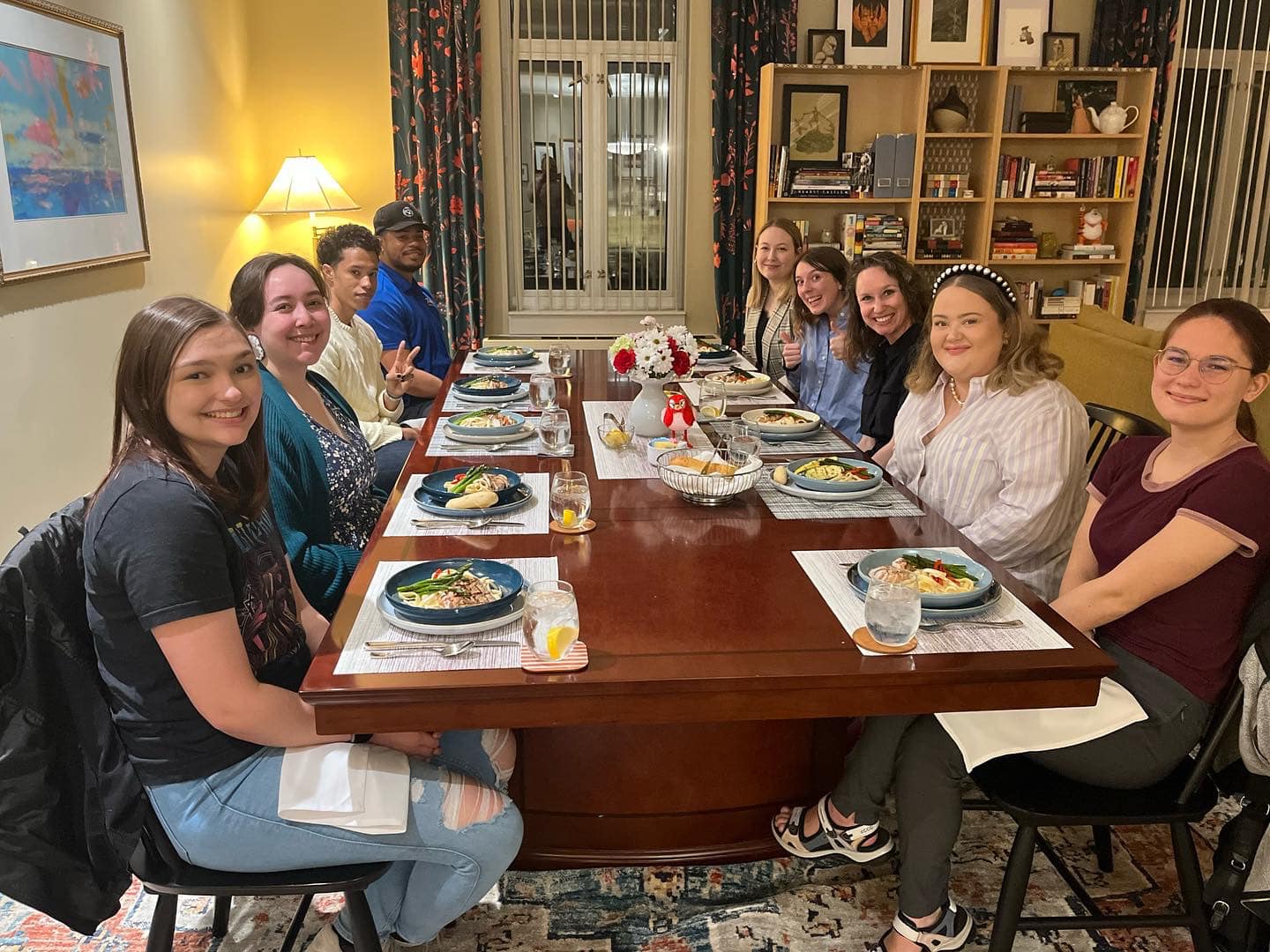
FiR Family Dinners are open to all UTulsa students. We hosted three dinners in our home each semester, thanks to the wonderful support of UTulsa Catering. Some students have attended a dinner every year, or even each semester, so we get to stay in touch with them, such as with Oswaldo Atilano, a sophomore Nursing major, who was a LaFortune resident and FYE student of mine last year. He writes:

I’ve attended about four Faculty in Residence dinner events since coming to TU, and I’ve really enjoyed each one. These dinners gave me the chance to meet students on campus that I wouldn’t normally interact with, which helped me feel more connected to TU and made campus life feel a little more close-knit. Plus, they’re just genuinely fun events to be a part of!

Georgee David—who’s a sophomore majoring in Business with a minor in Real Estate and pursuing the Law Accelerated program—also writes:

I have not only been fortunate enough to participate in Faculty in Residence, but I also was very fortunate to have Professor Contois as my FYE 1001 professor. I have participated in the Faculty in Residence dinner multiple times and Pup and PJs. The love and support from Professor Contois and her family has really helped my college experience by knowing I always have somebody I can trust and talk to no matter the situation. I came to Tulsa not really knowing anybody and Professor Contois and her family always made me feel like I was part of her family and continued to push me towards my dreams and goals. I love you Professor Contois!

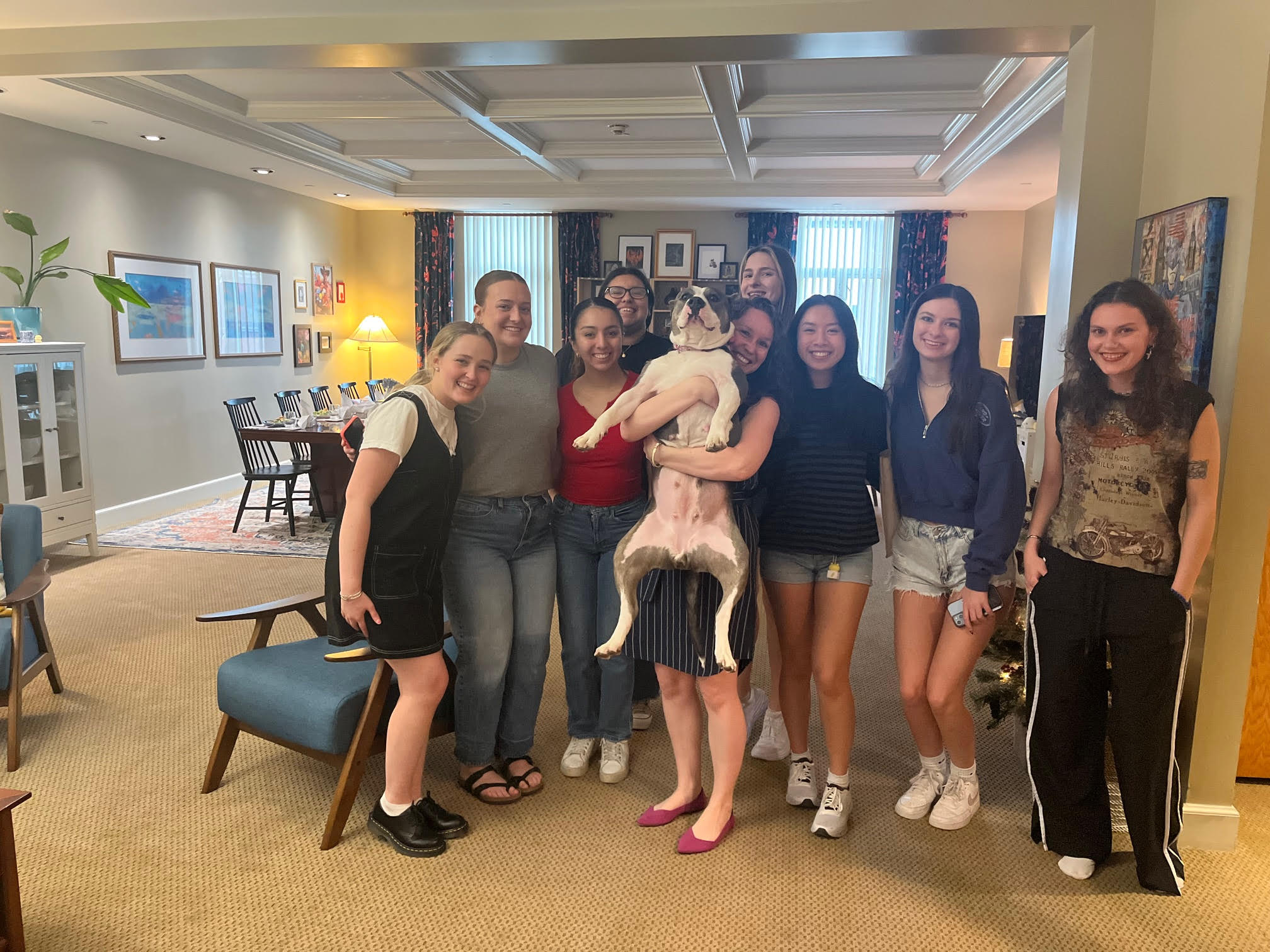
A LaFortune Lobby Office Hour took place weekly for students to stop by for academic and social help, or just to chat, co-work, or pet Ruby. Lobby hours also facilitated informal interactions with LaFortune residents as they passed through the space, like Heide Renteria, a first year student studying Elementary Education with a minor in Spanish, who writes,

During this past year, I lived in LaFortune, so I had Faculty in Residence right there! It was nice to interact with Professor Contois and her family. I participated in the Faculty Dinner, a finals workshop, many office hours in LaFortune, along with many Pups and PJs. Throughout these events, I managed to meet and learn from many other students here at TU, along with good tips that will follow me throughout college.

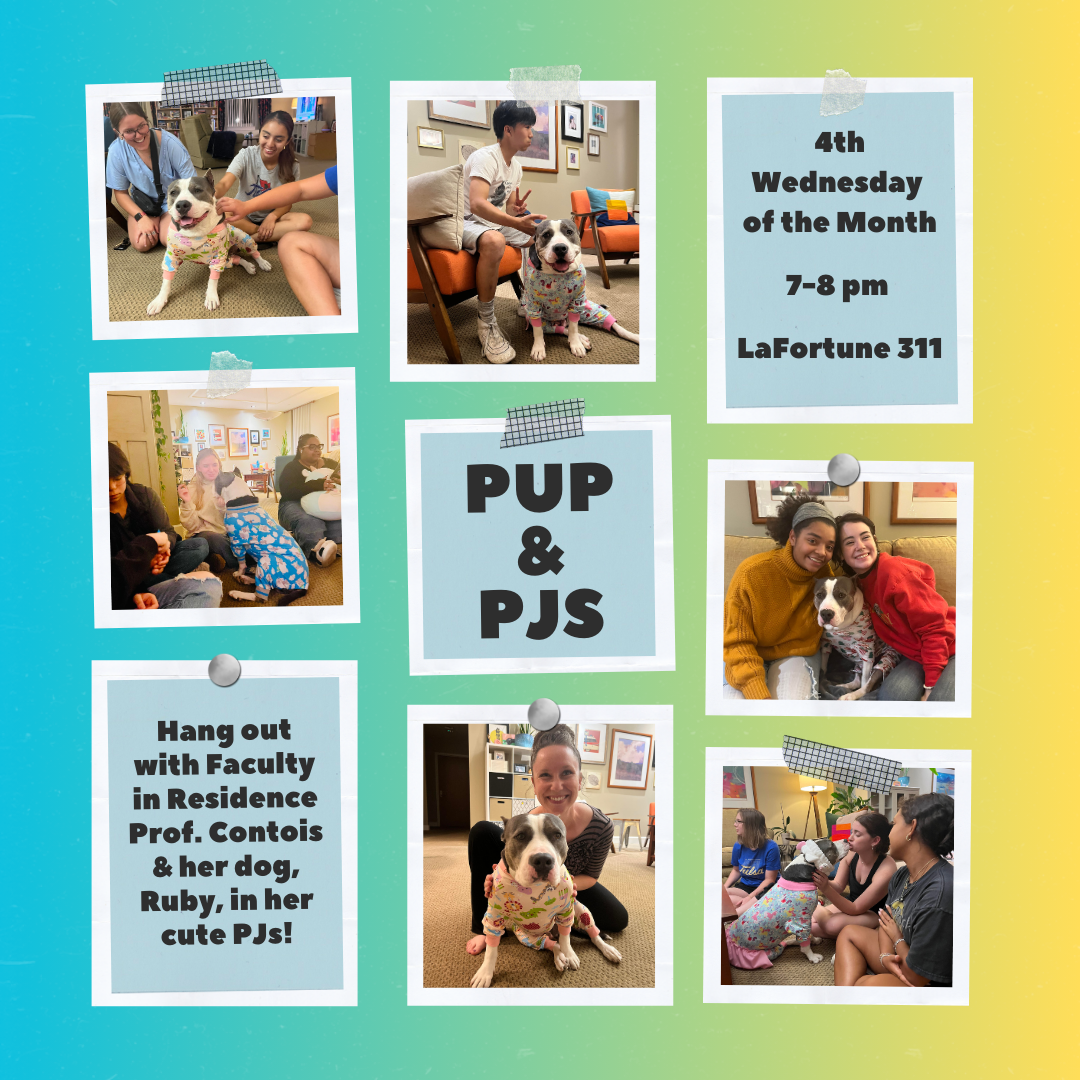
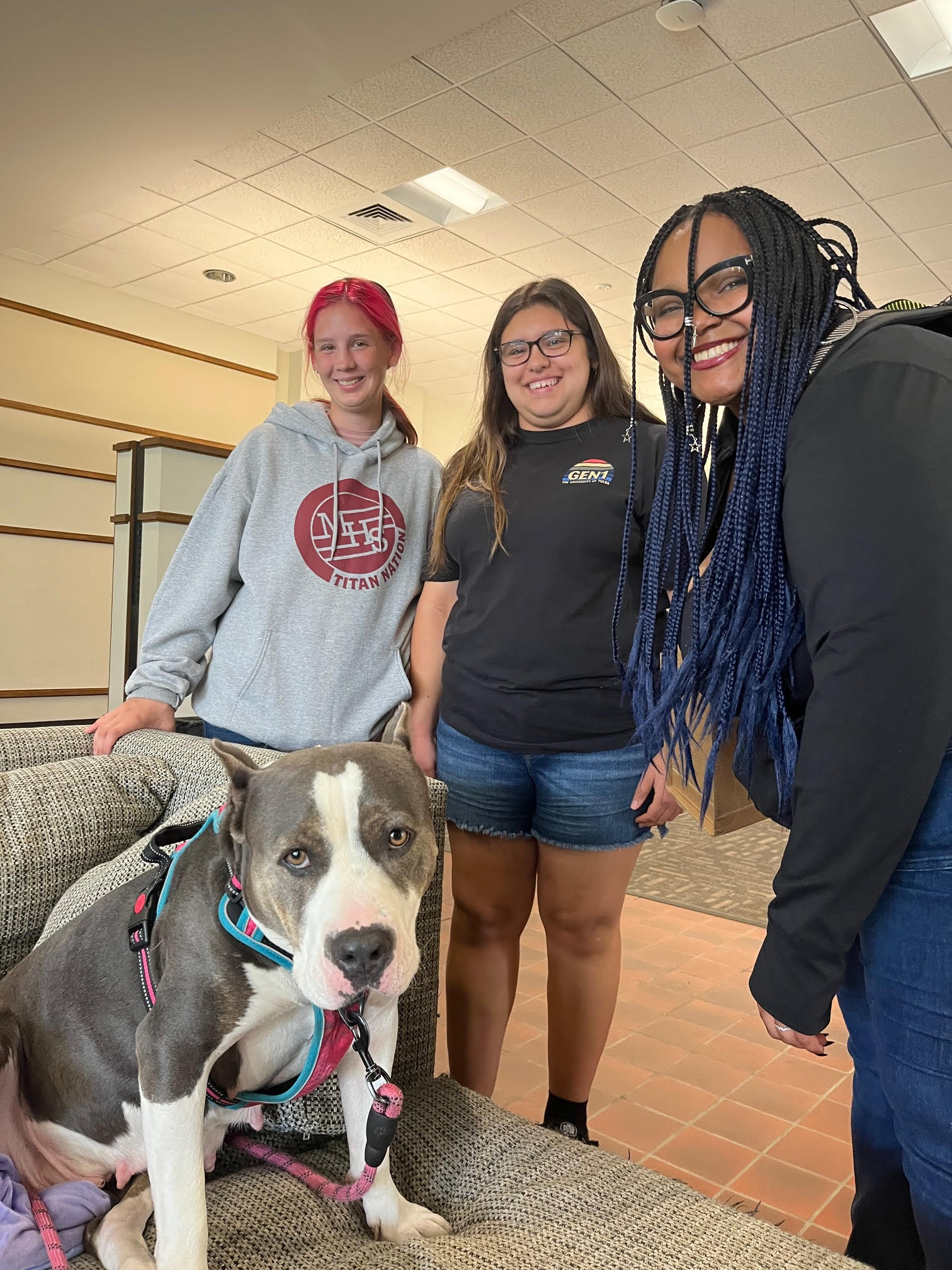
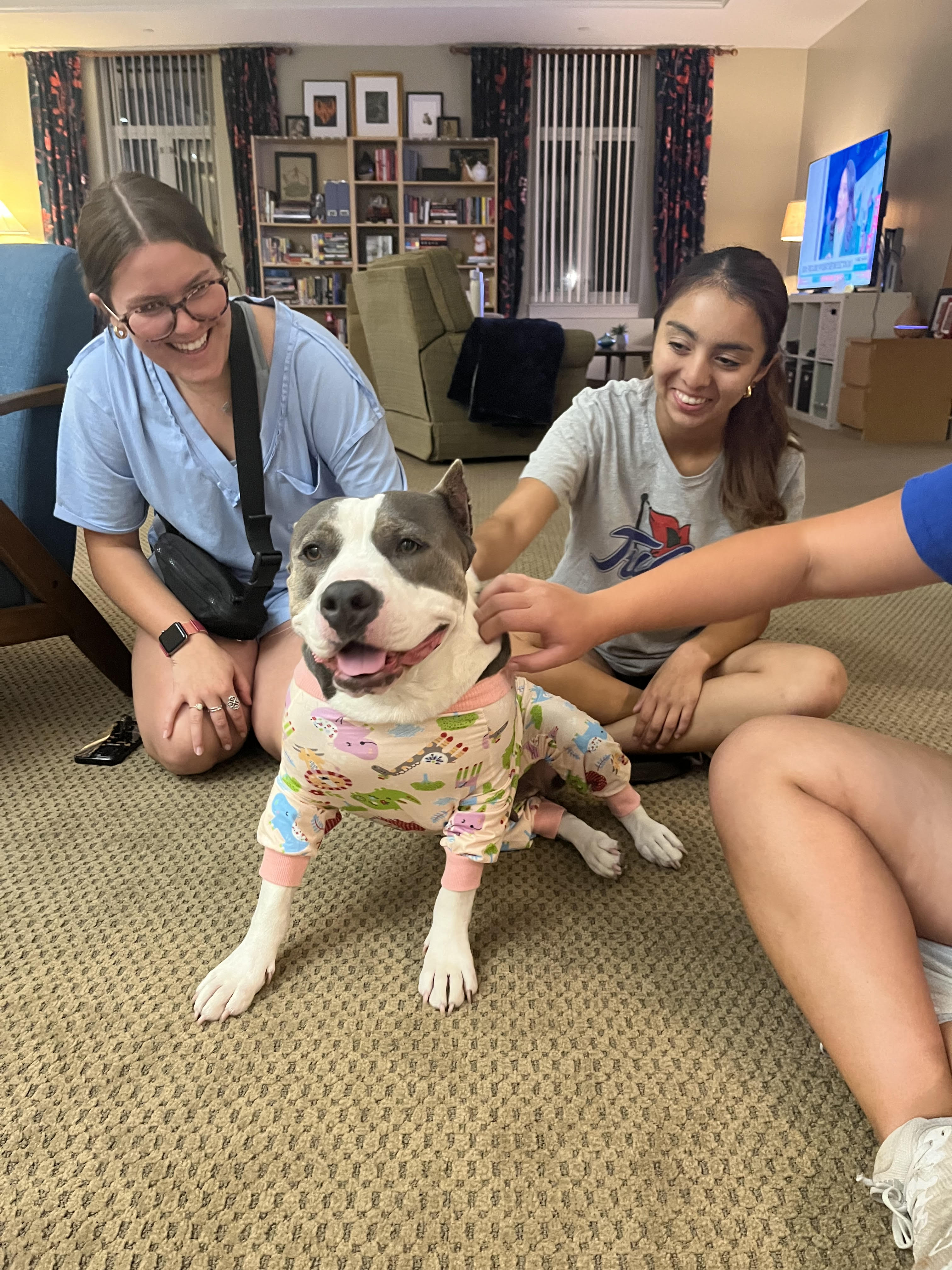
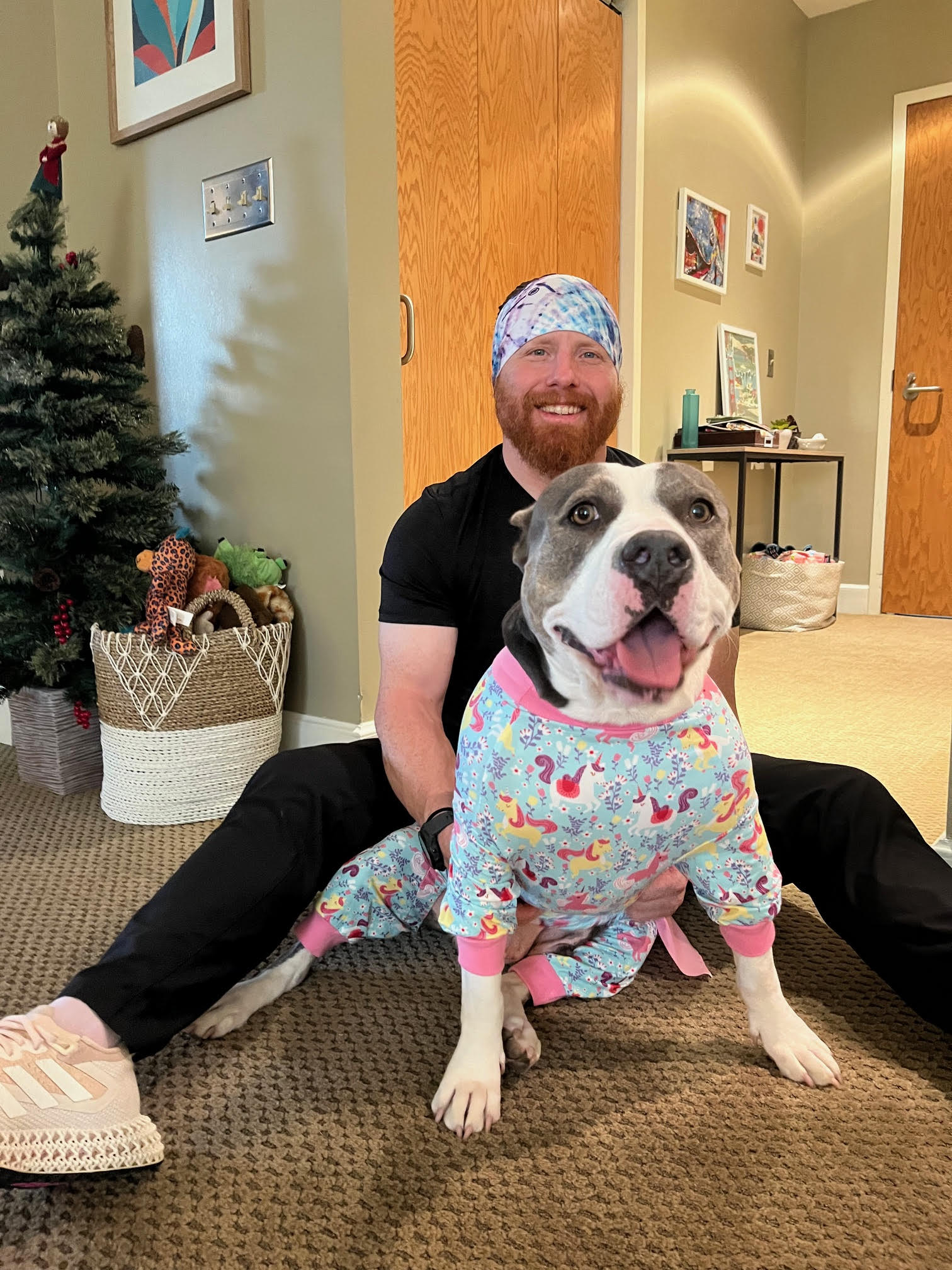
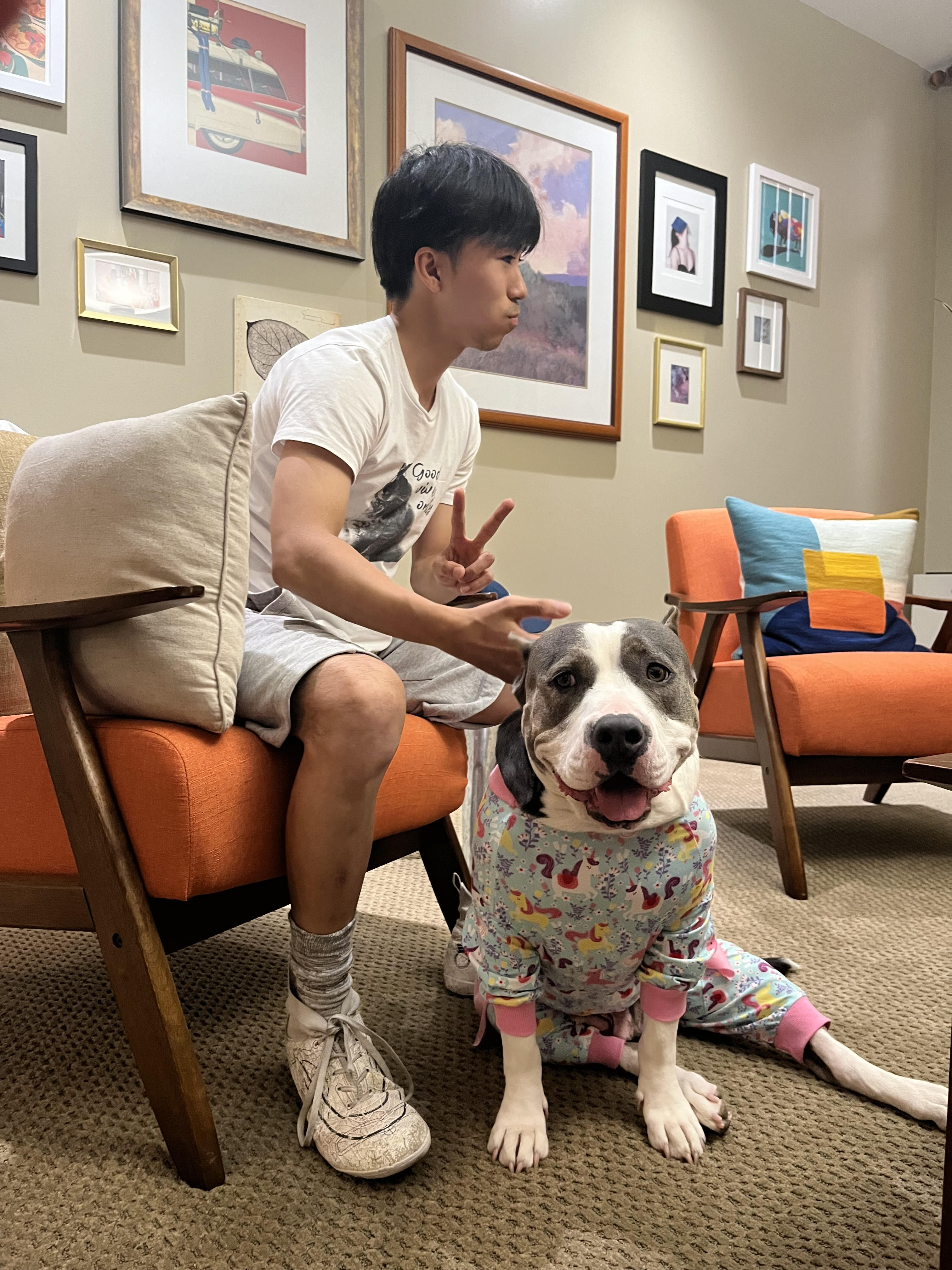
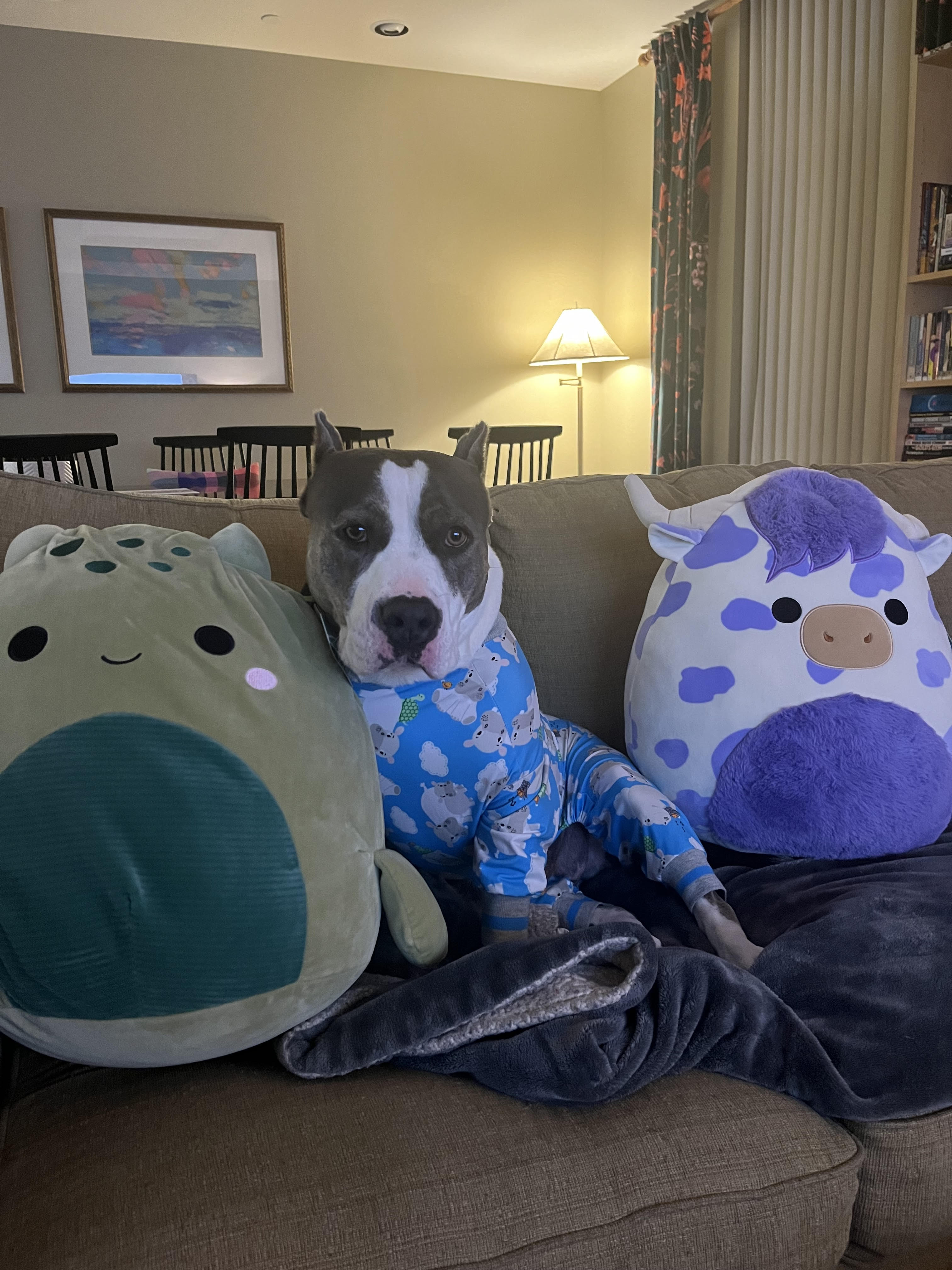
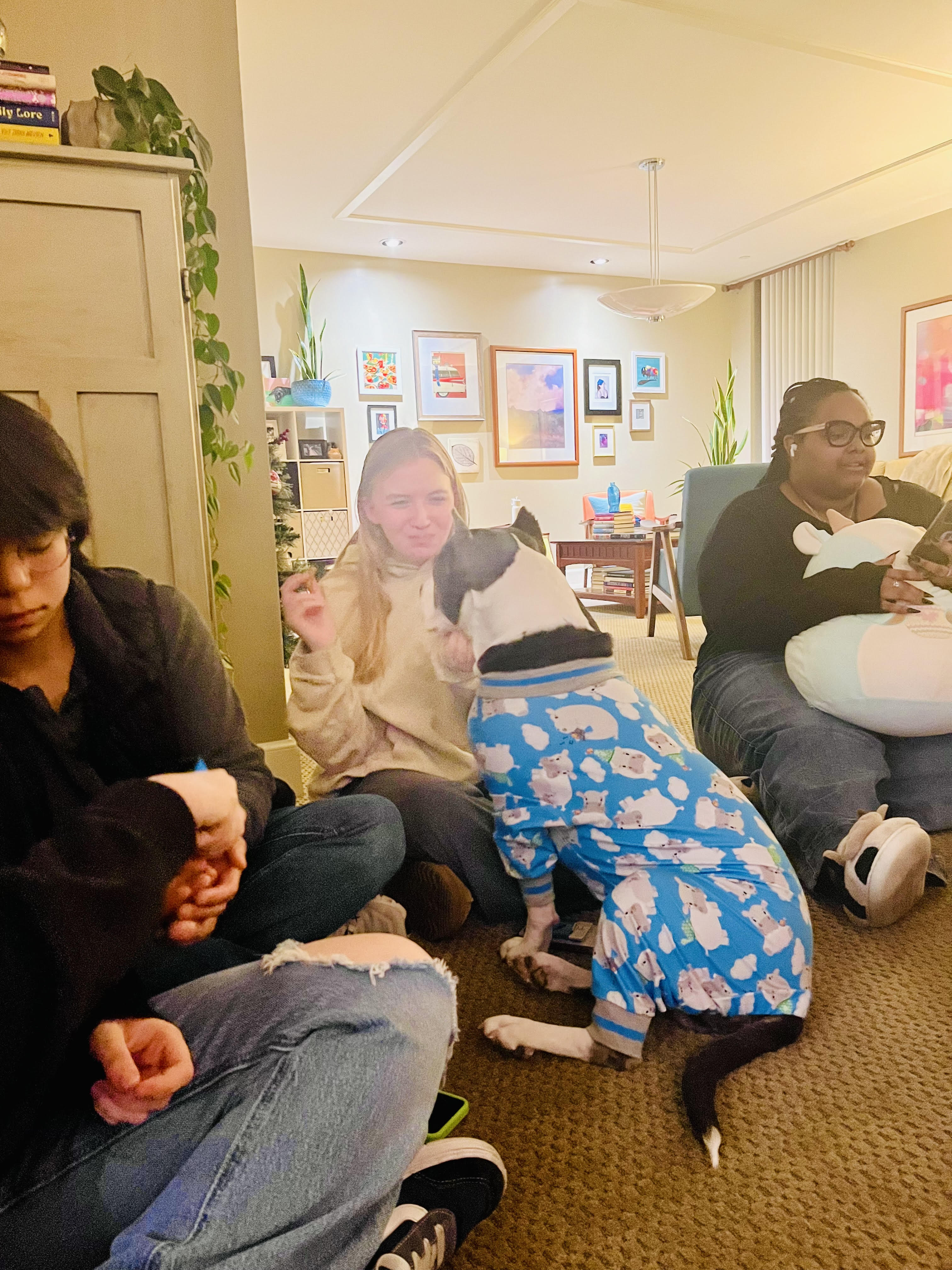
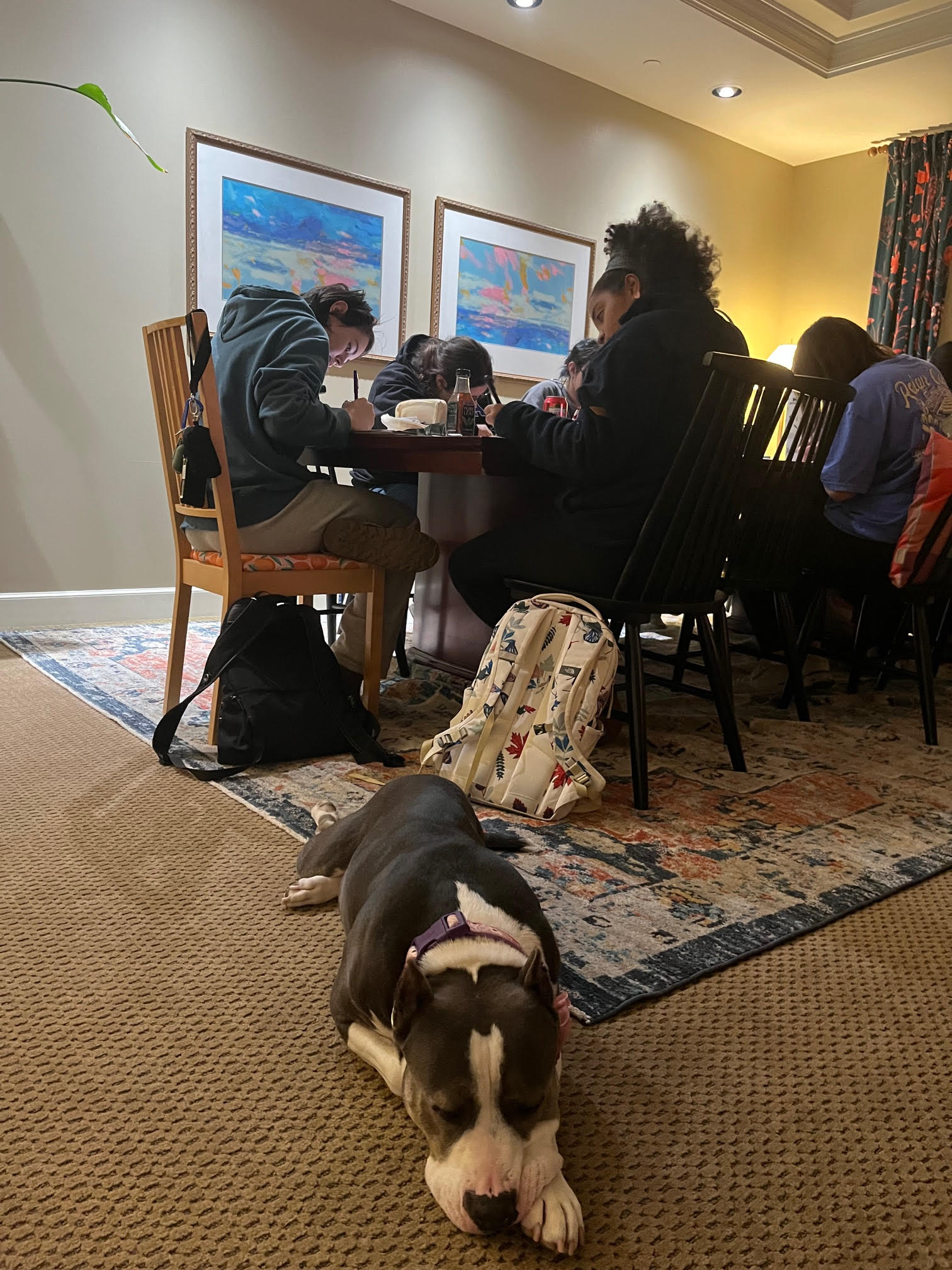
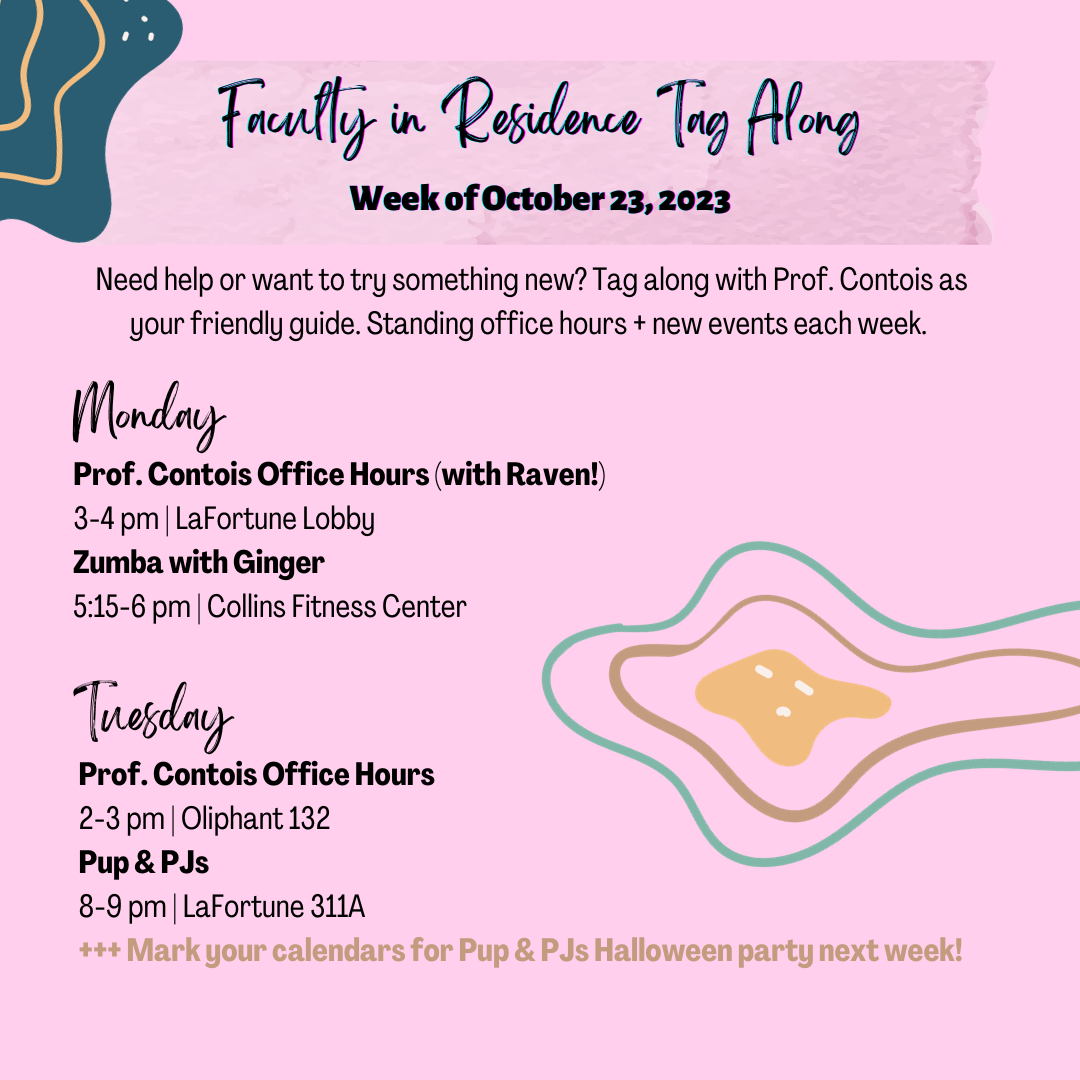
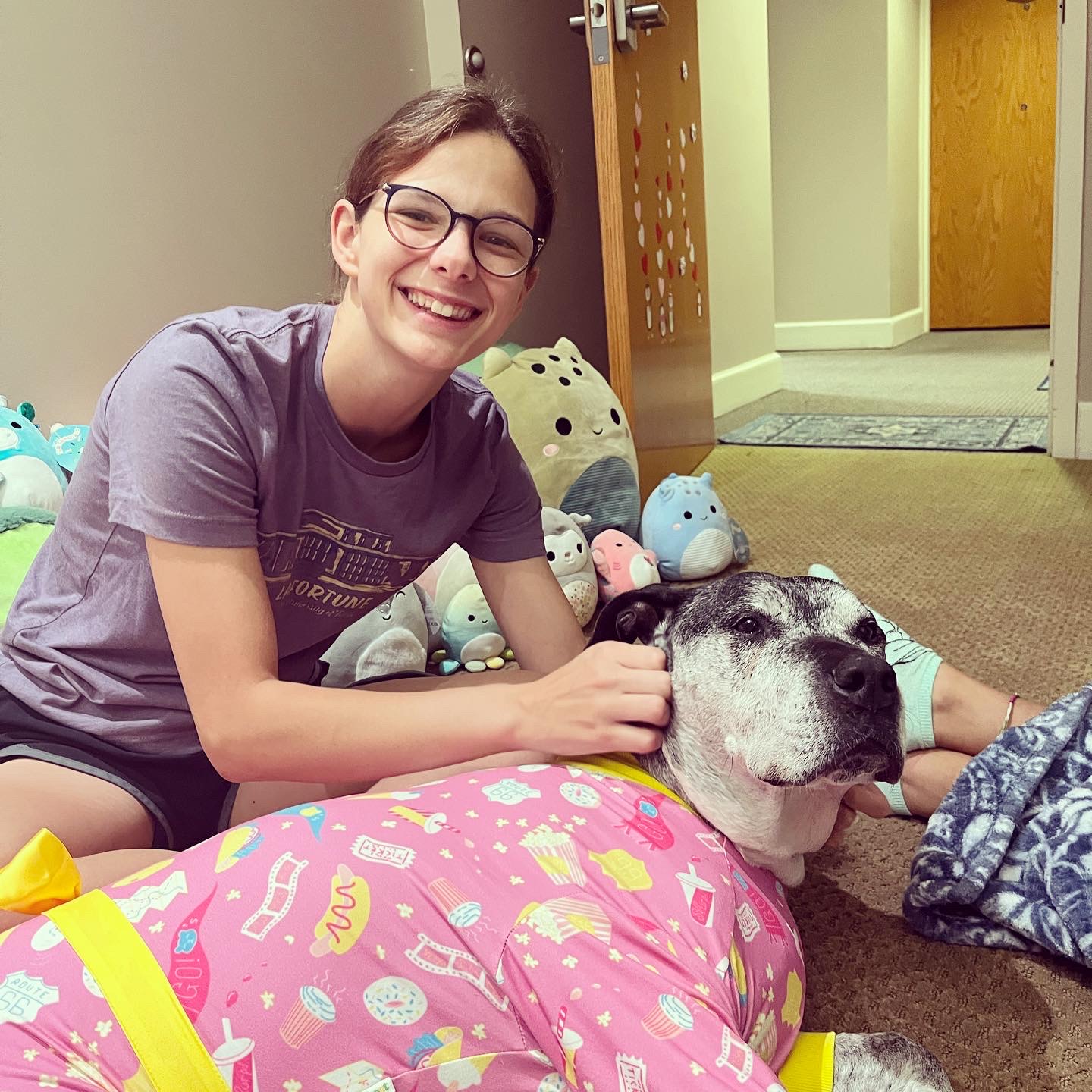
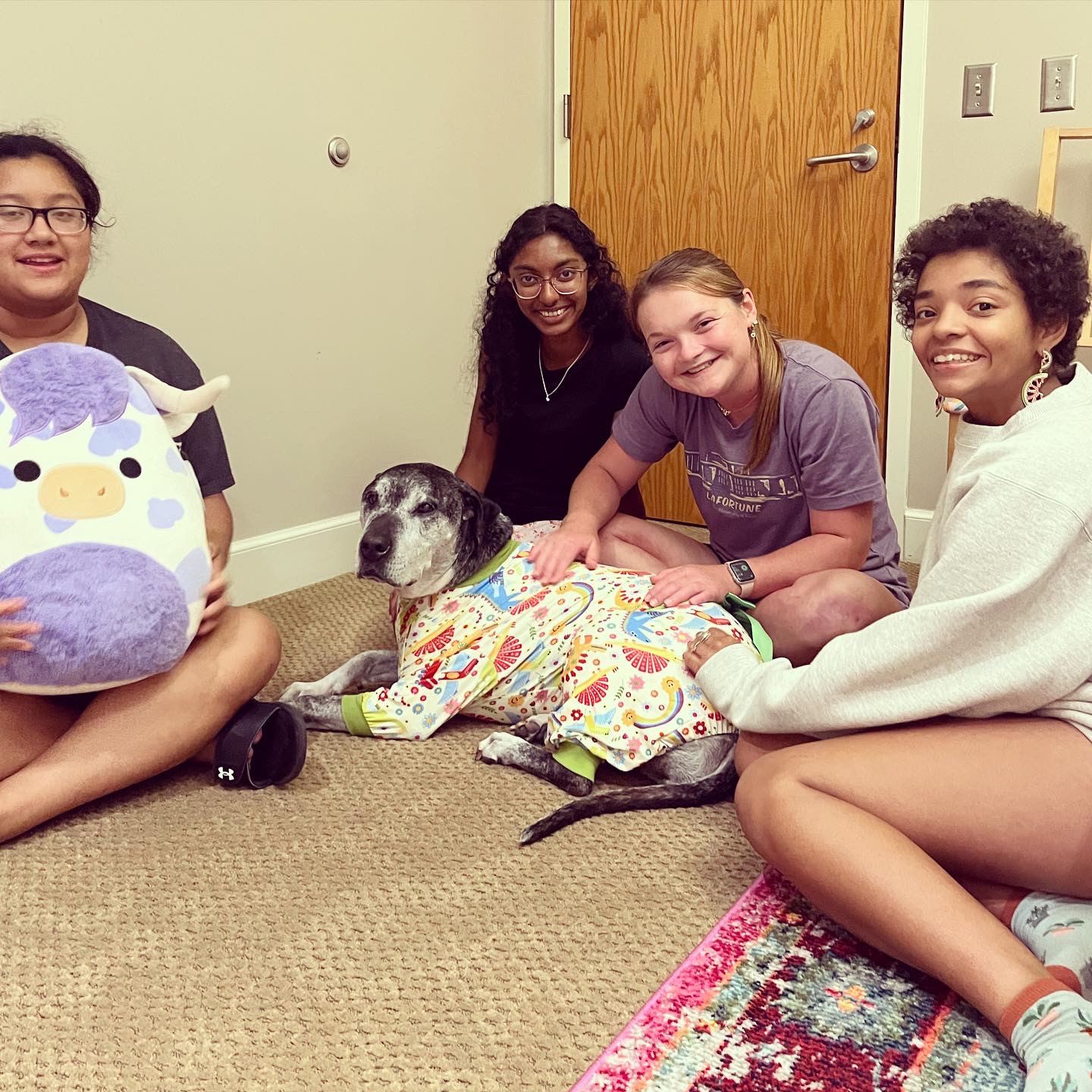
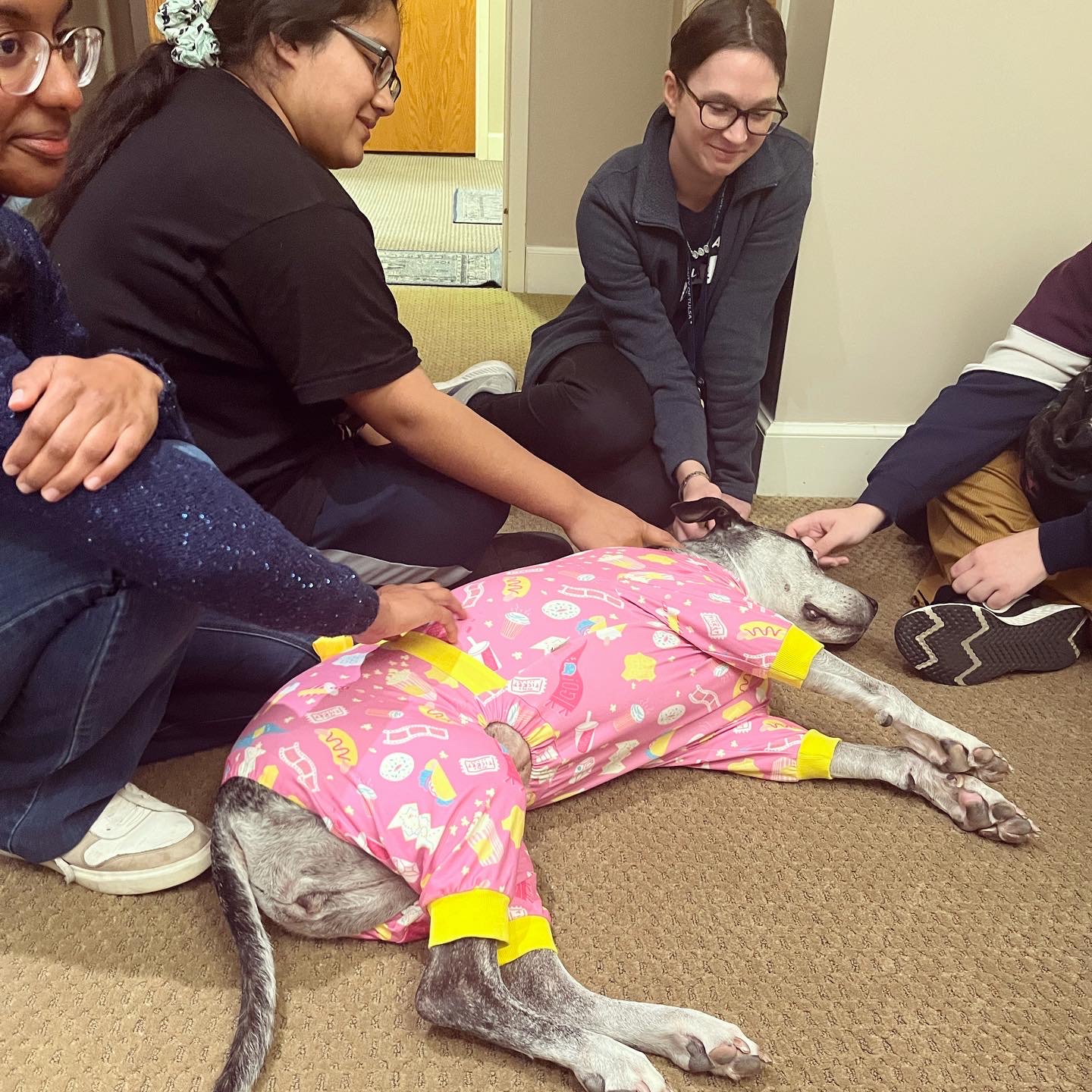
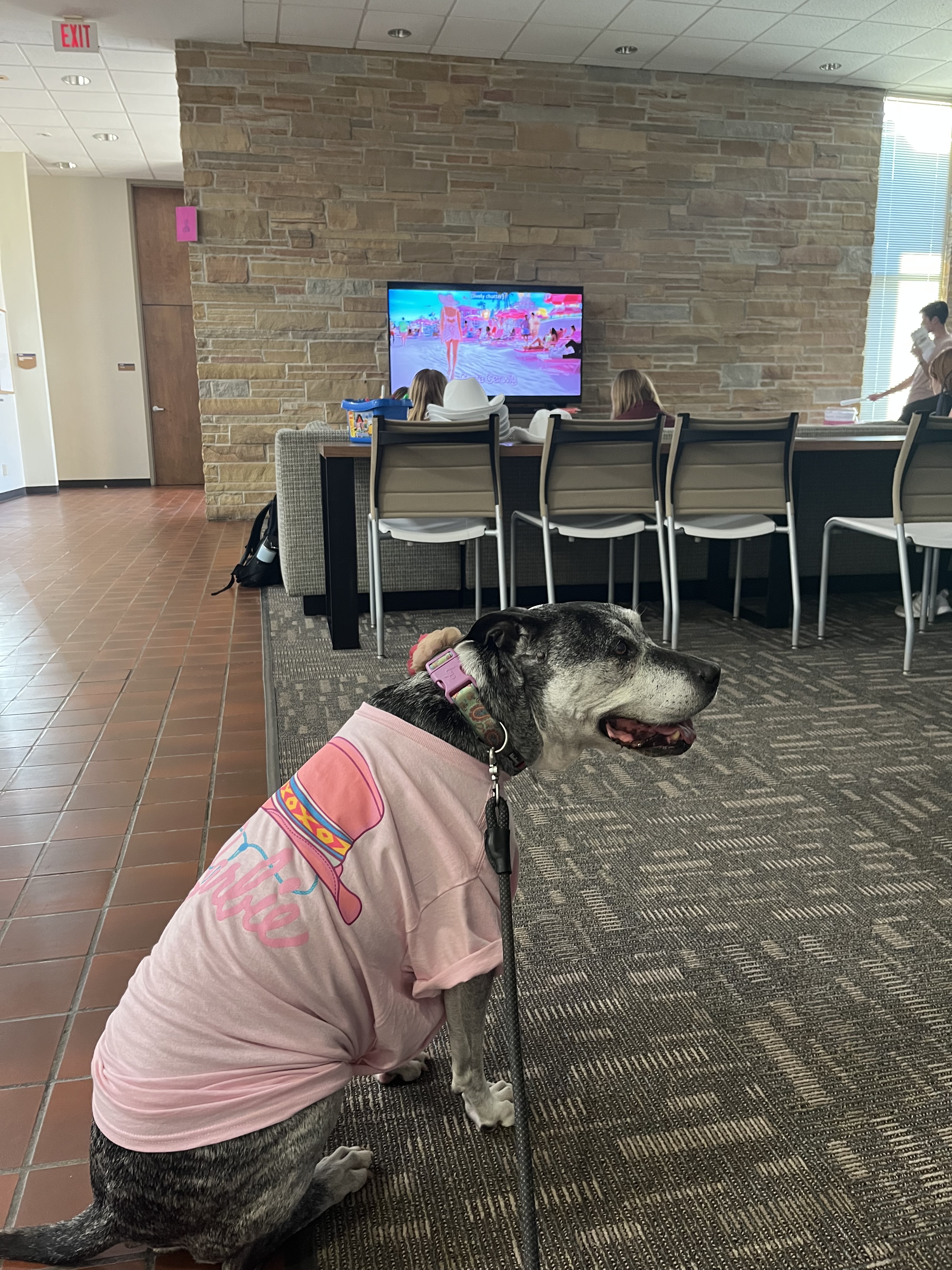
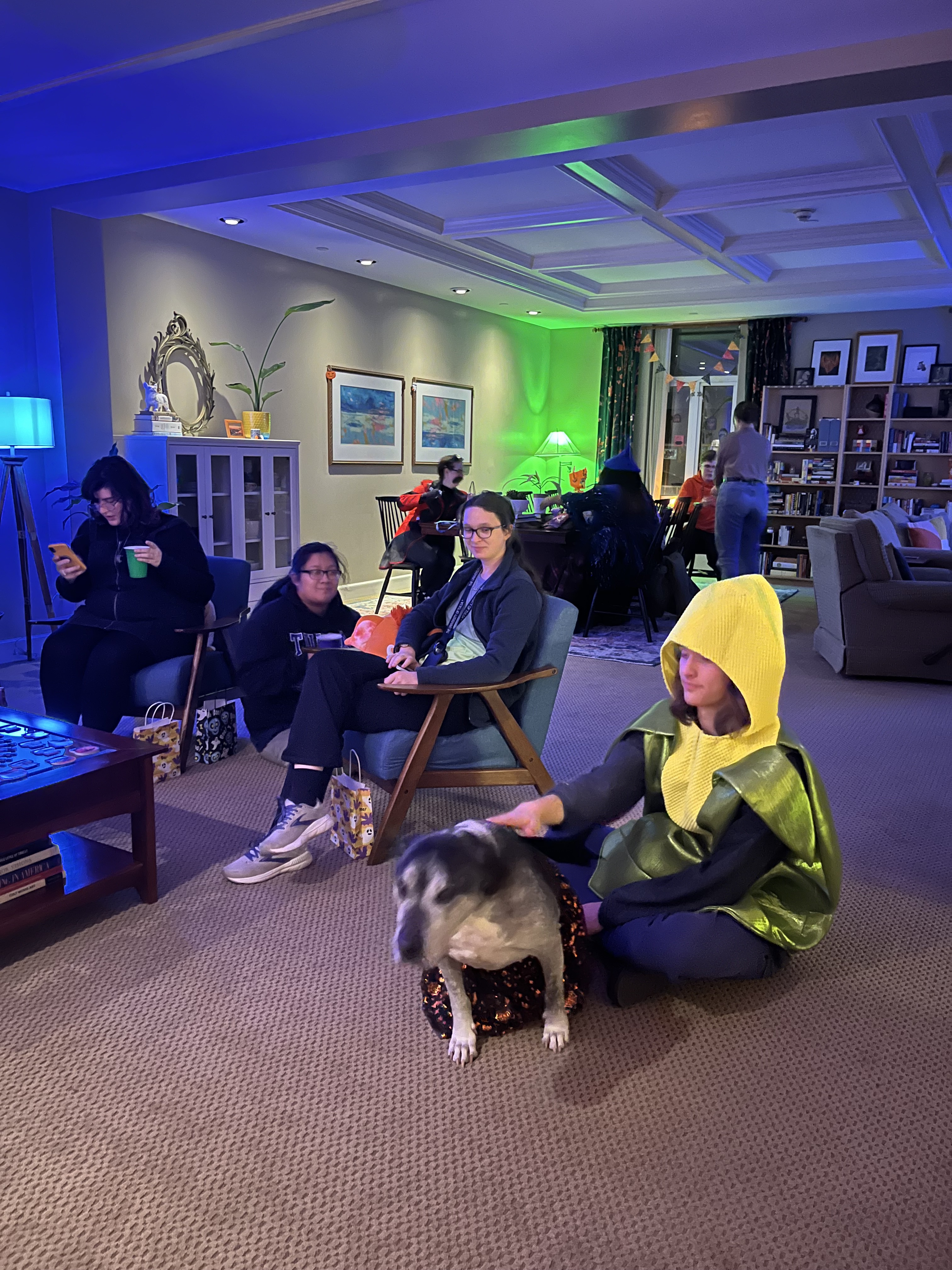
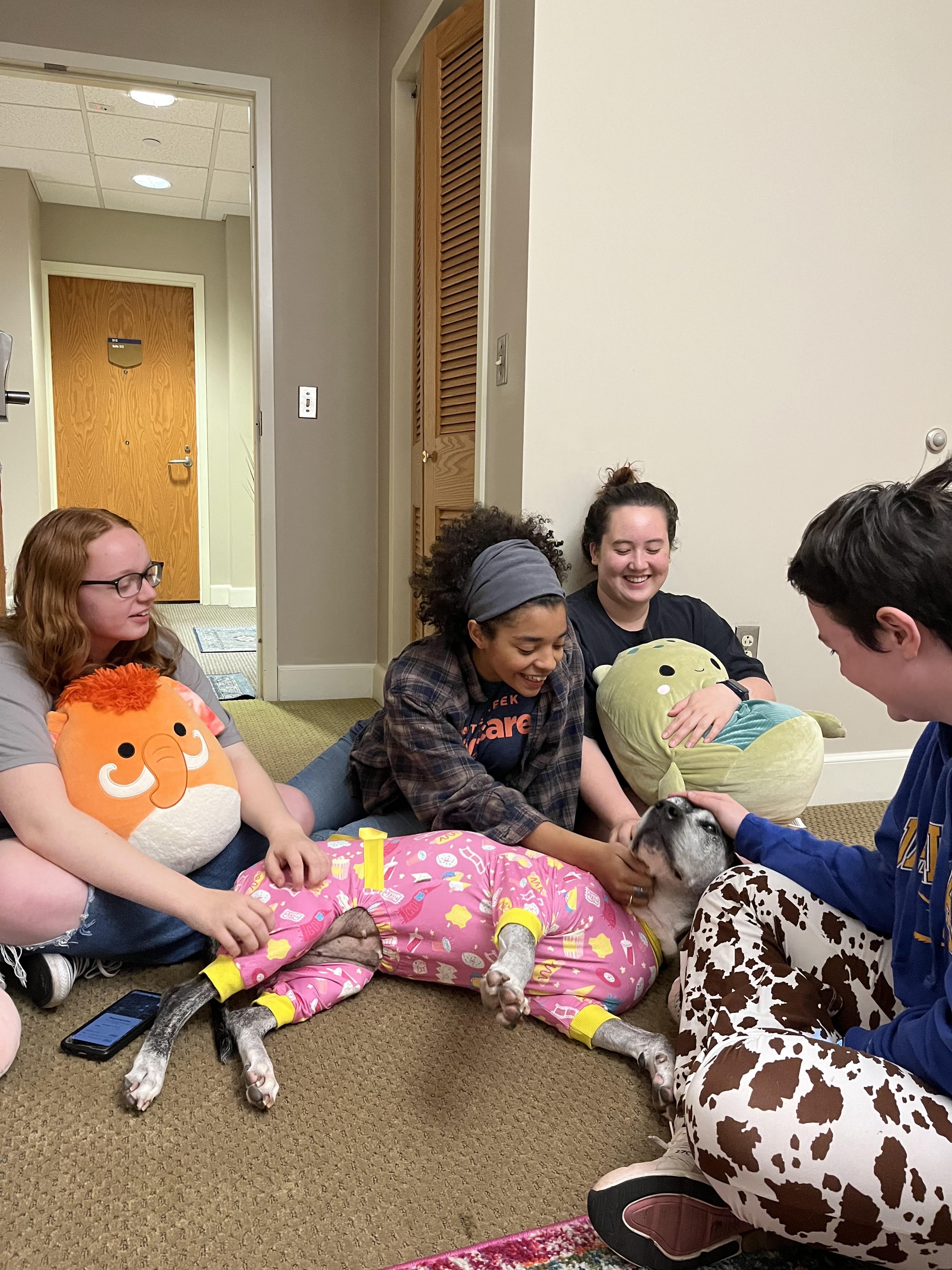
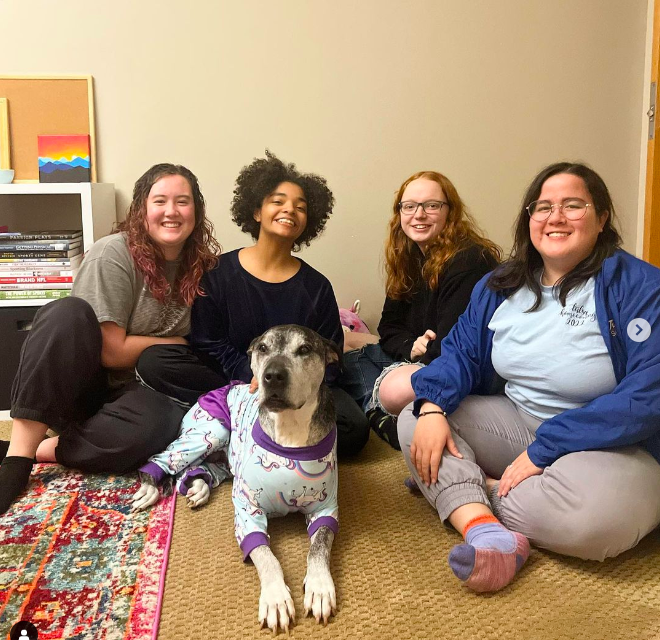
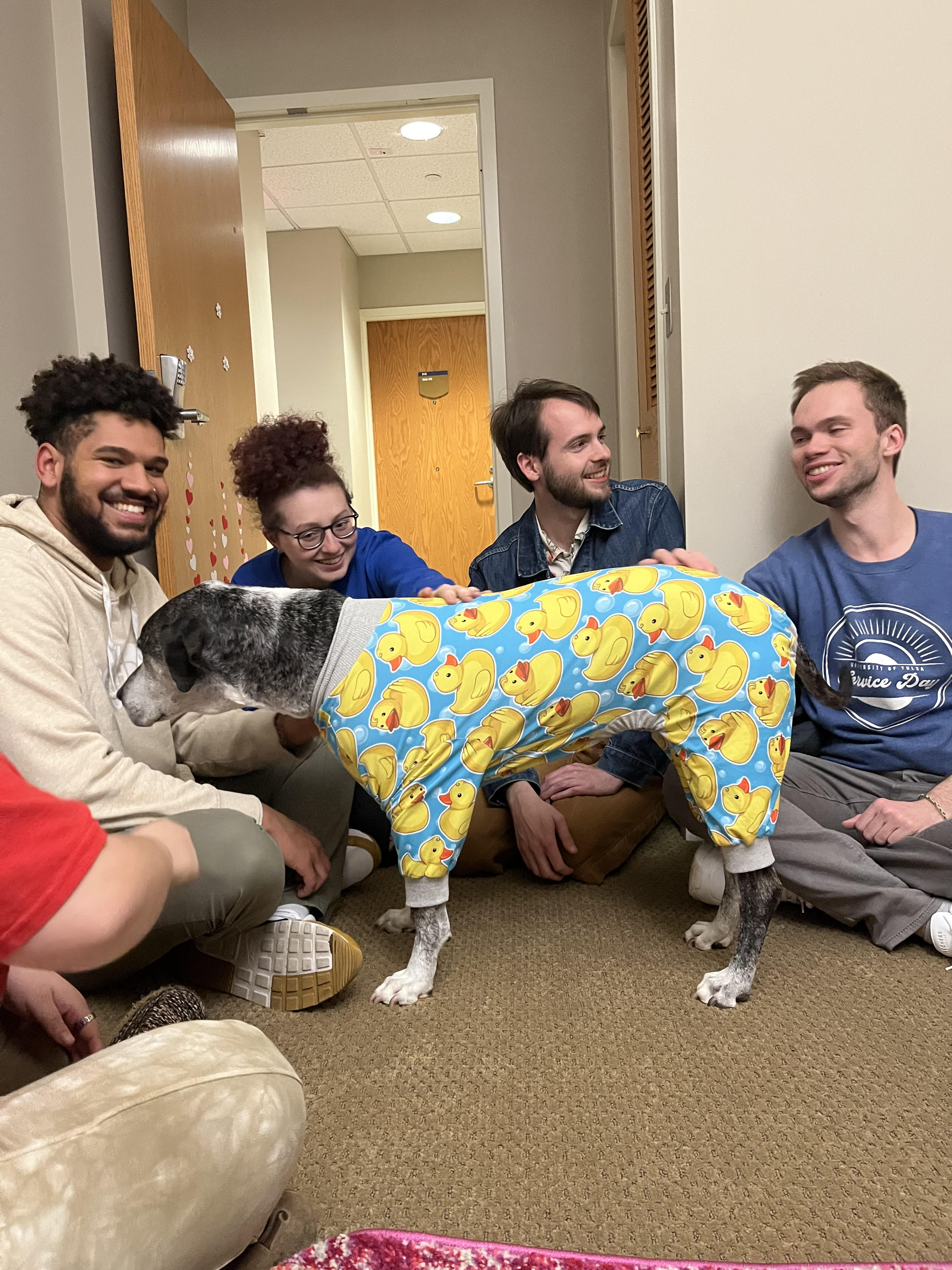
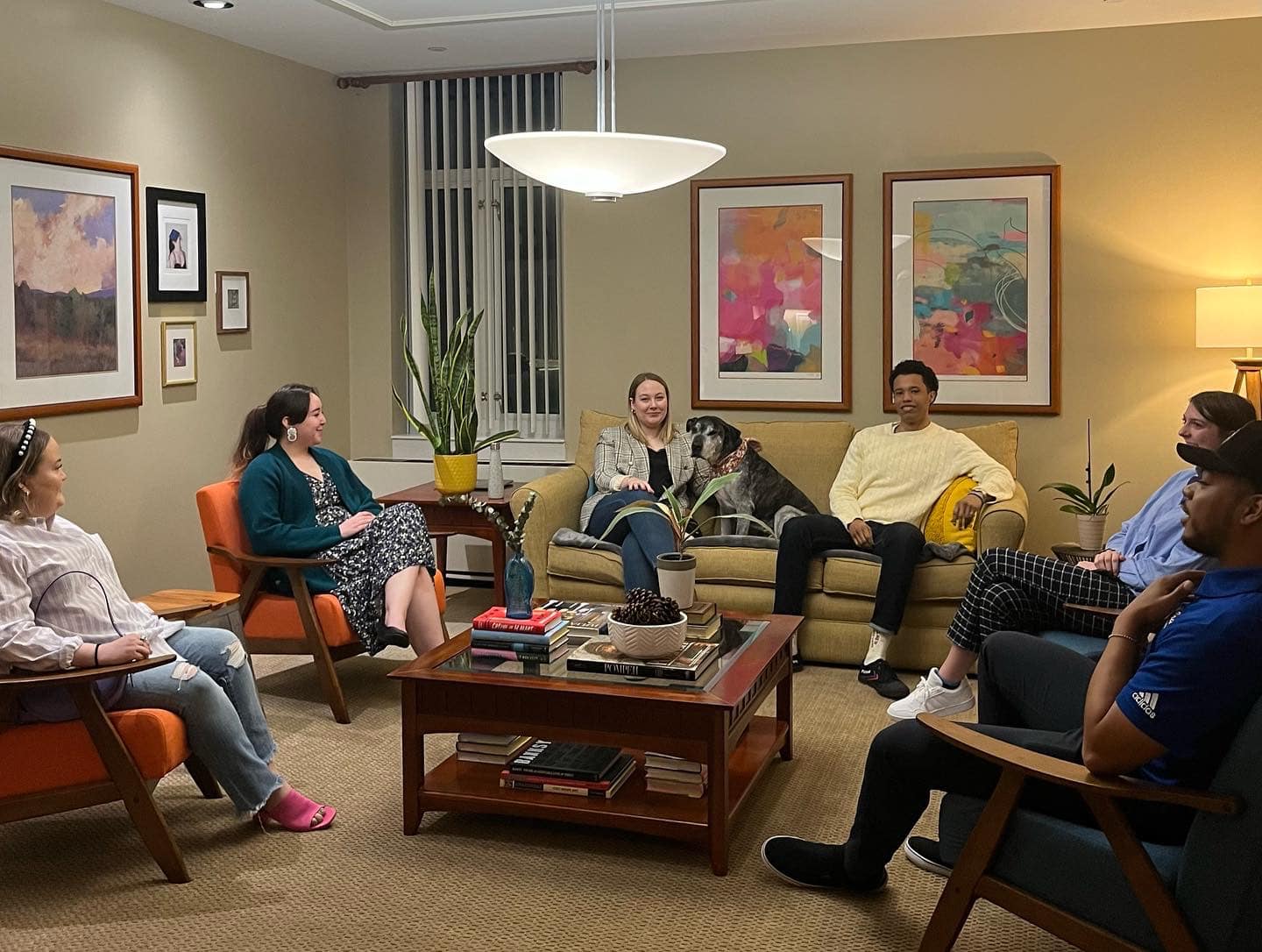
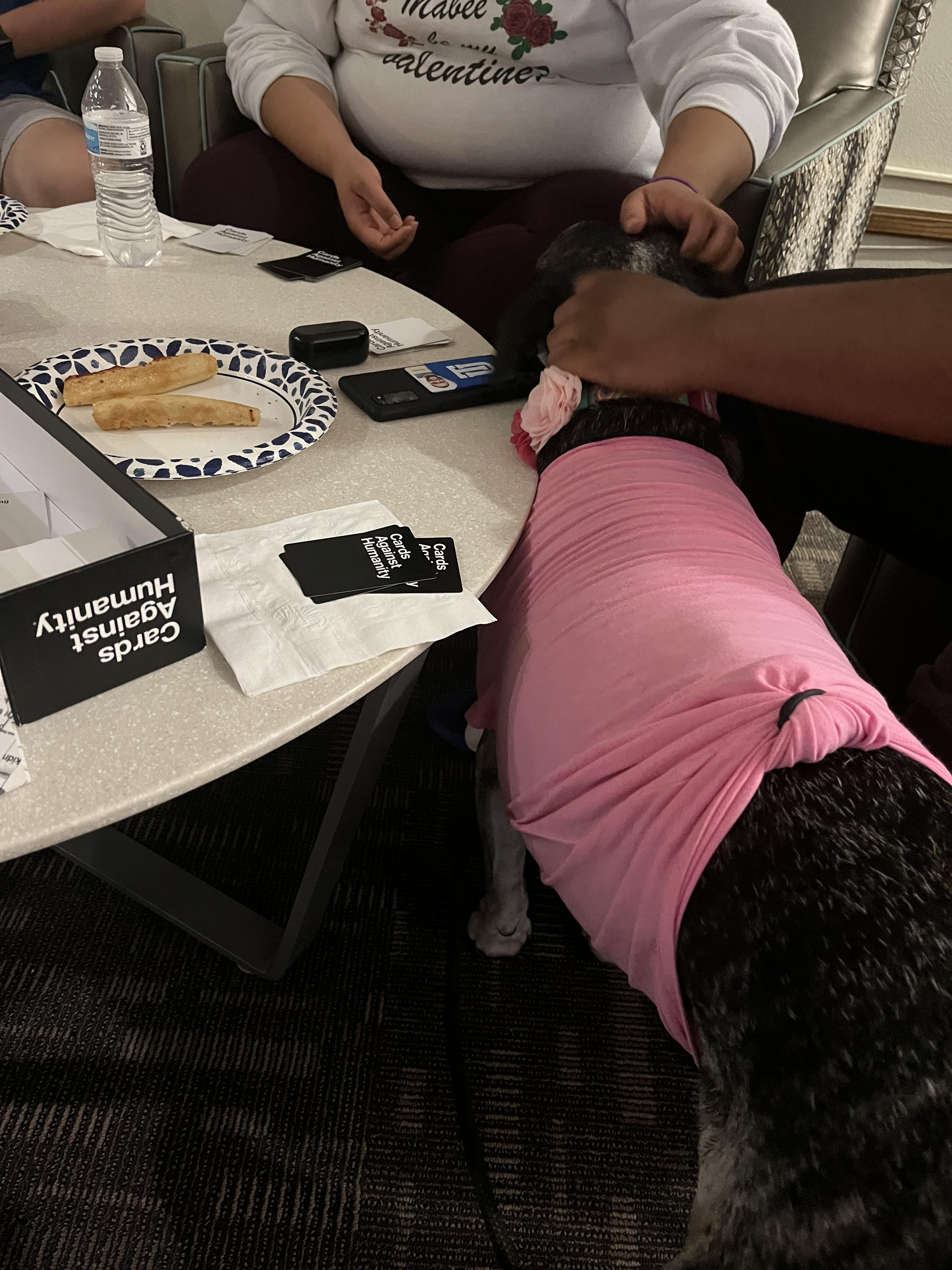
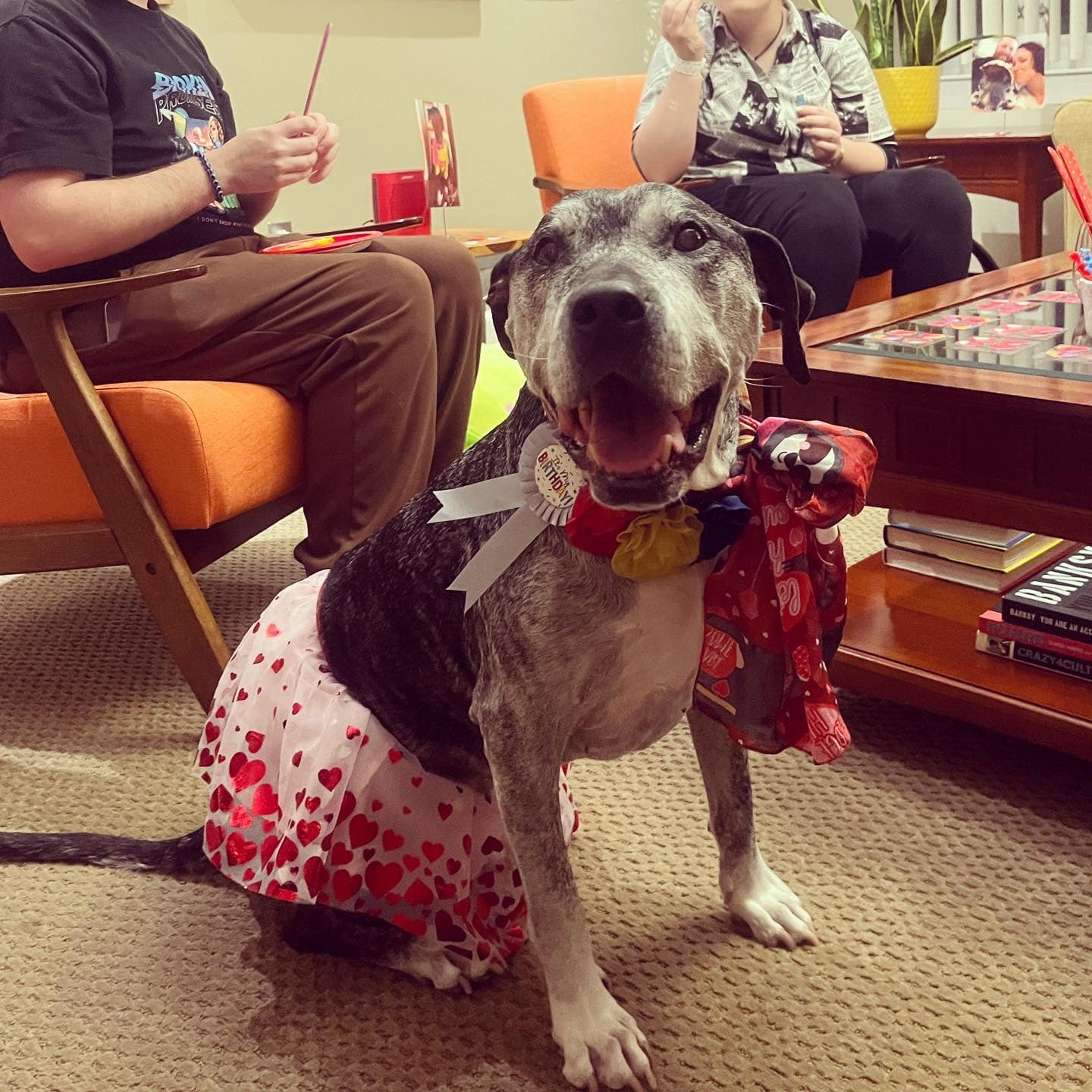
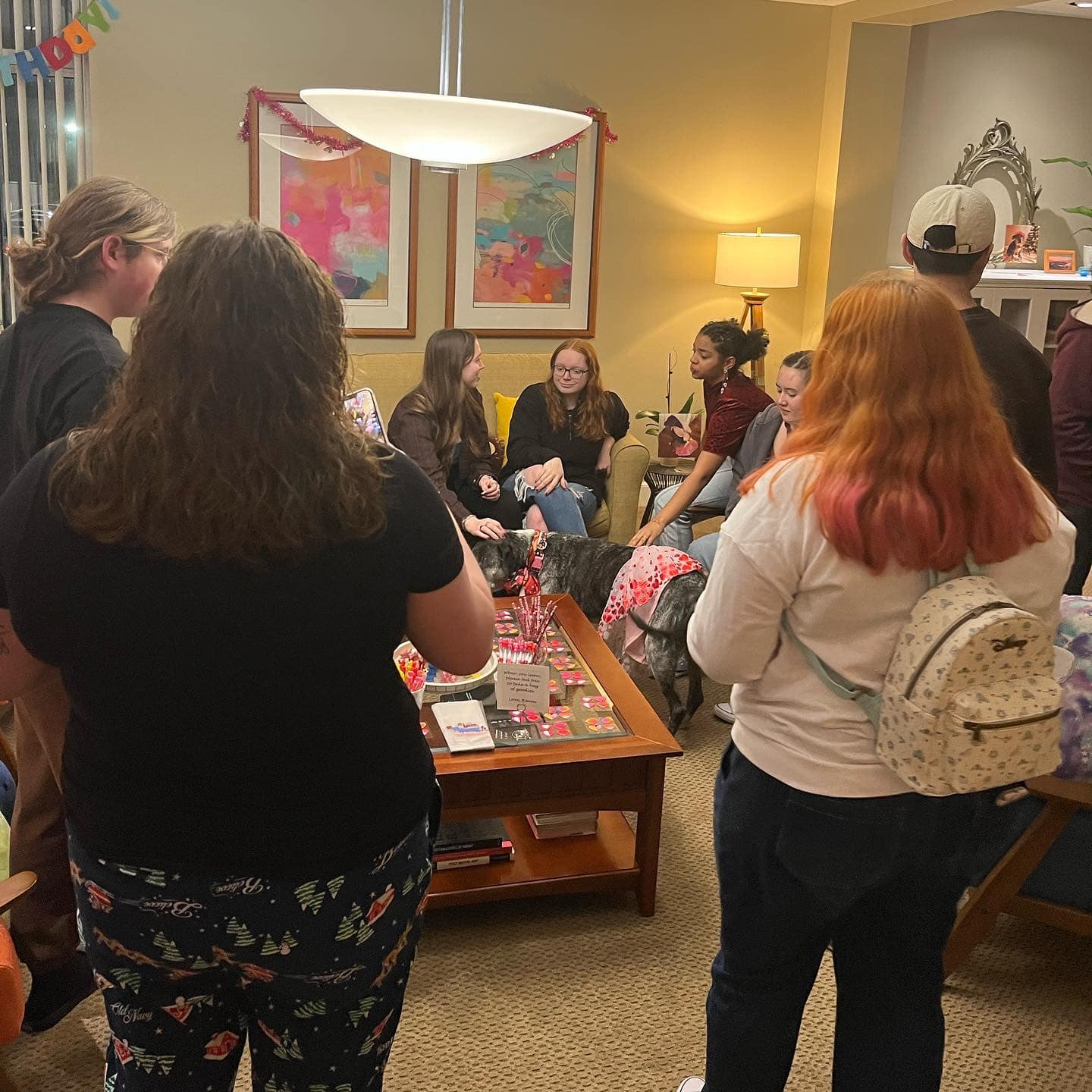
Pup & PJs were able to return after we adopted Ruby. Typically, students would join us for an hour in the evening to pet and play with her and talk about how they’re doing. A few times, we expanded the event beyond pup social time. One night we watched and discussed the Vice Presidential Debate. On another, we watched episodes of Pop Culture Jeopardy. Election Night 2024 also fell during a Pup & PJs event, so we invited students to experience the culmination of their first voting experience in community and in a nurturing environment.
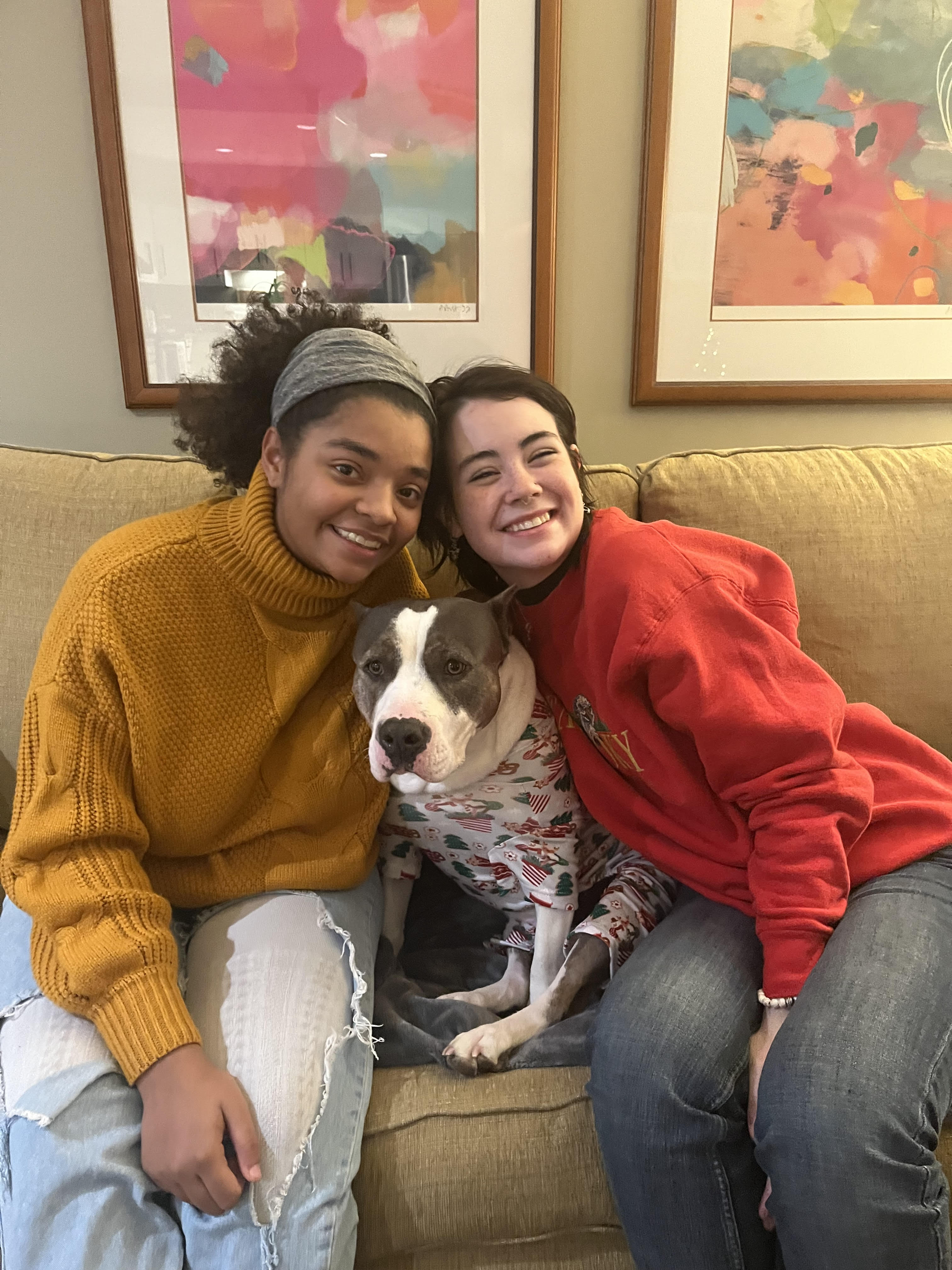
Carter Enos, who was a LaFortune resident last year and is now a sophomore majoring in Computer Science Simulation & Gaming writes:

The Faculty in Residence program was super beneficial for me my first year. It was super helpful for me after a long day to come back to LaFortune, pet her dog, and talk with Professor Contois about all of the things that were going on or that I was stressed about. It was nice having her as an extra resource right outside of my doorstep because personally the more steps it takes for me to do something, the less motivated I am to do it. This is also why I loved Pup and PJs so much because it gave me a reason to get out and do something fun while also staying cozy and not needing to leave the dorms.

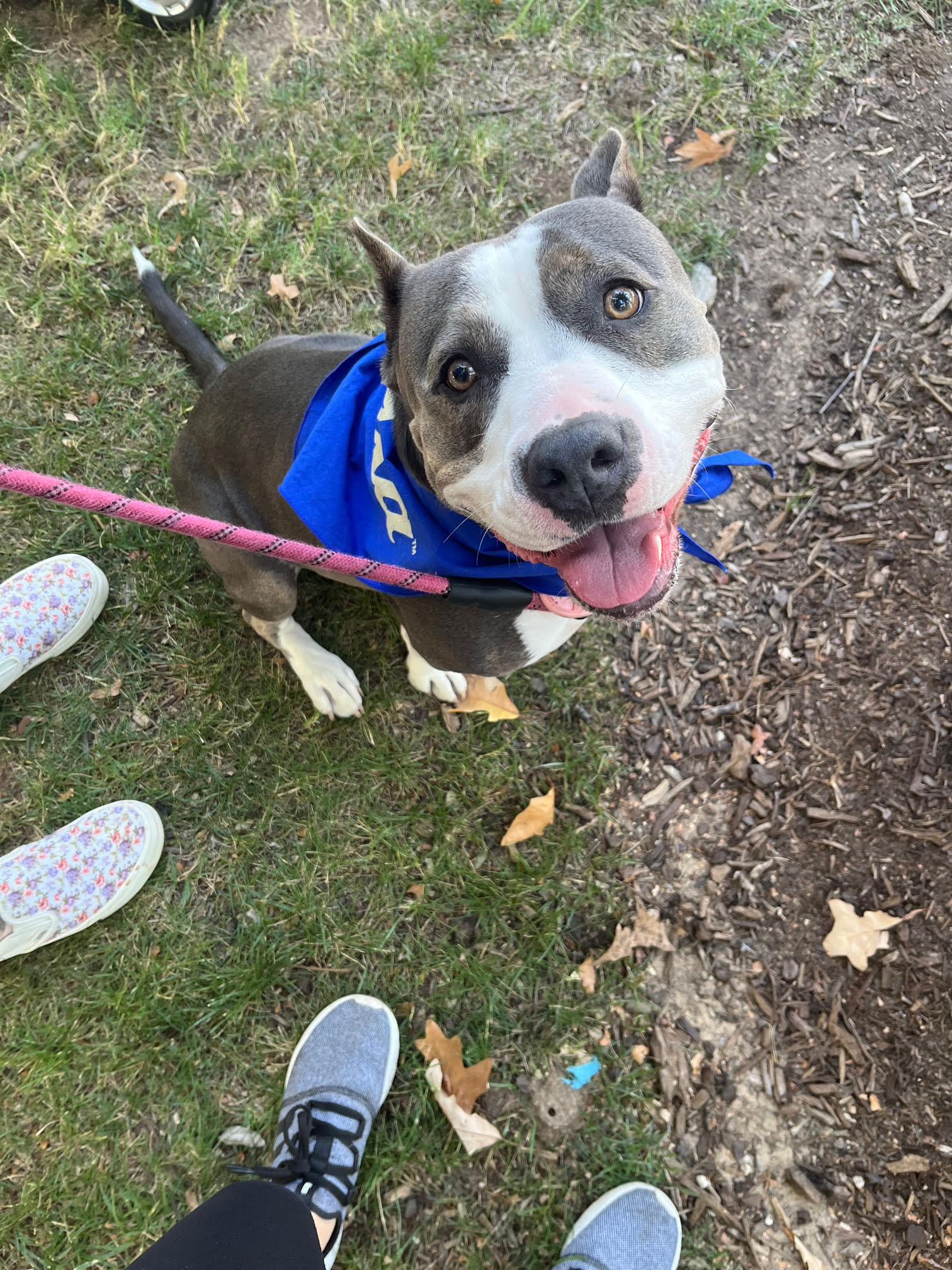
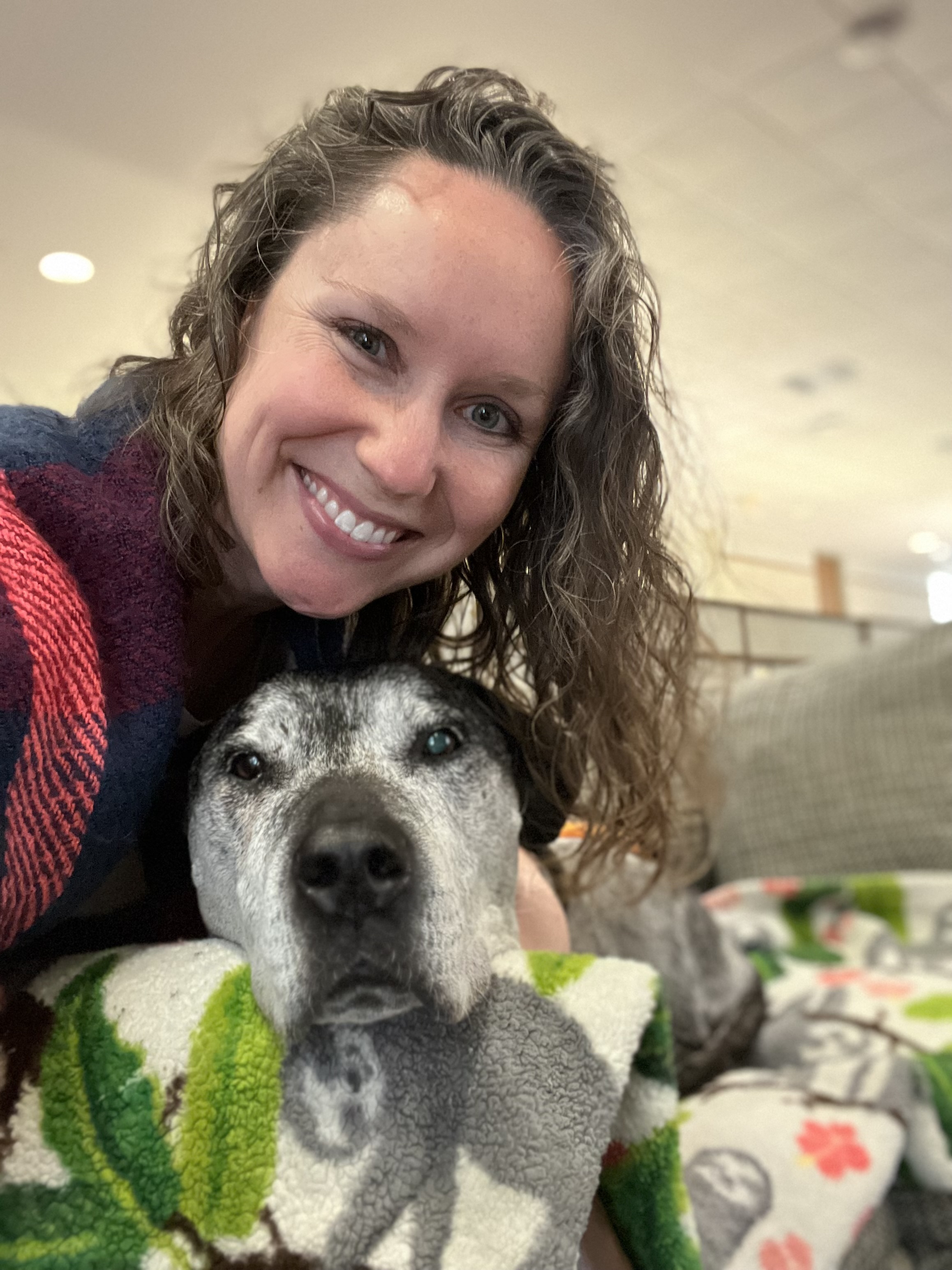
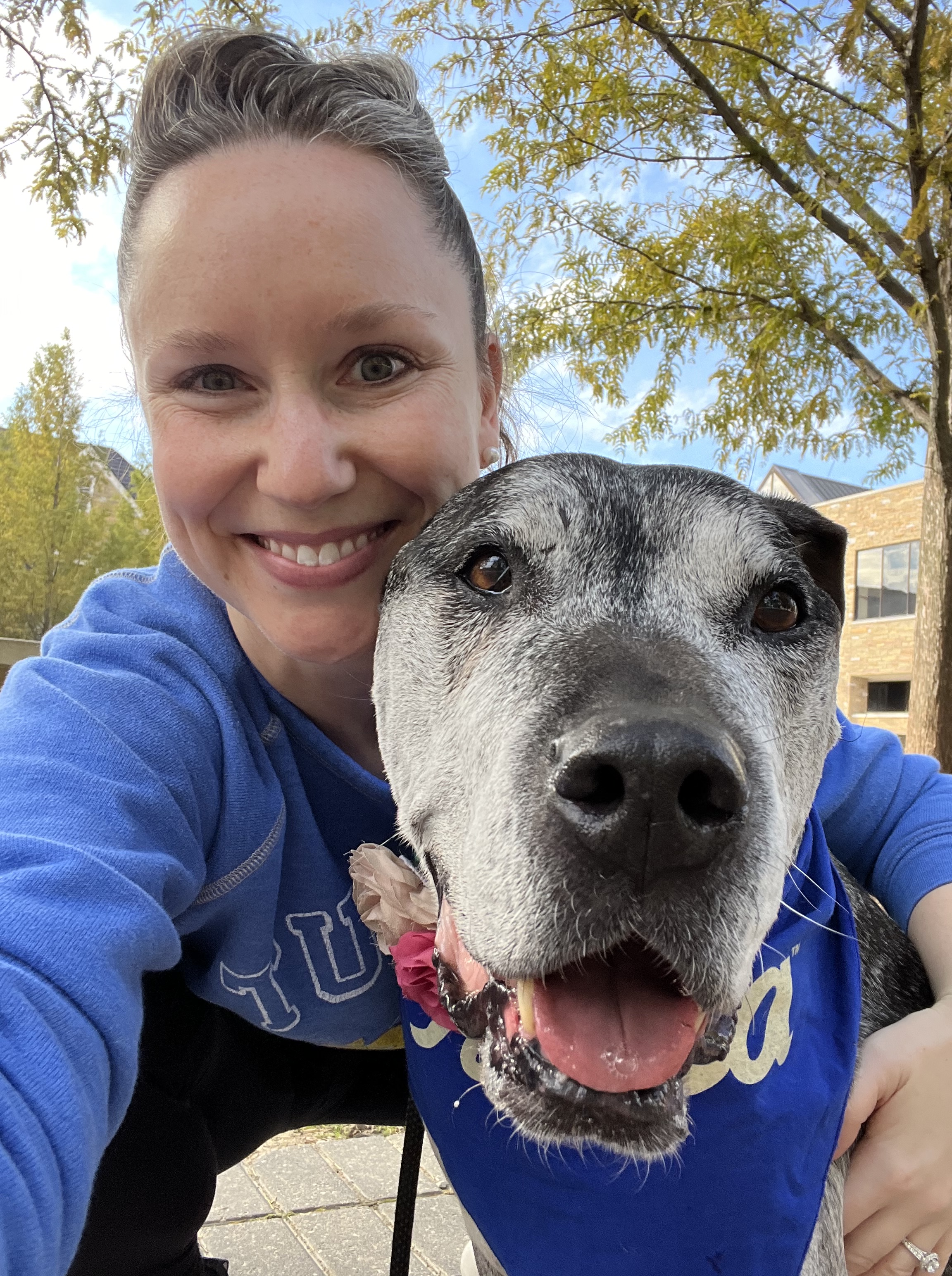
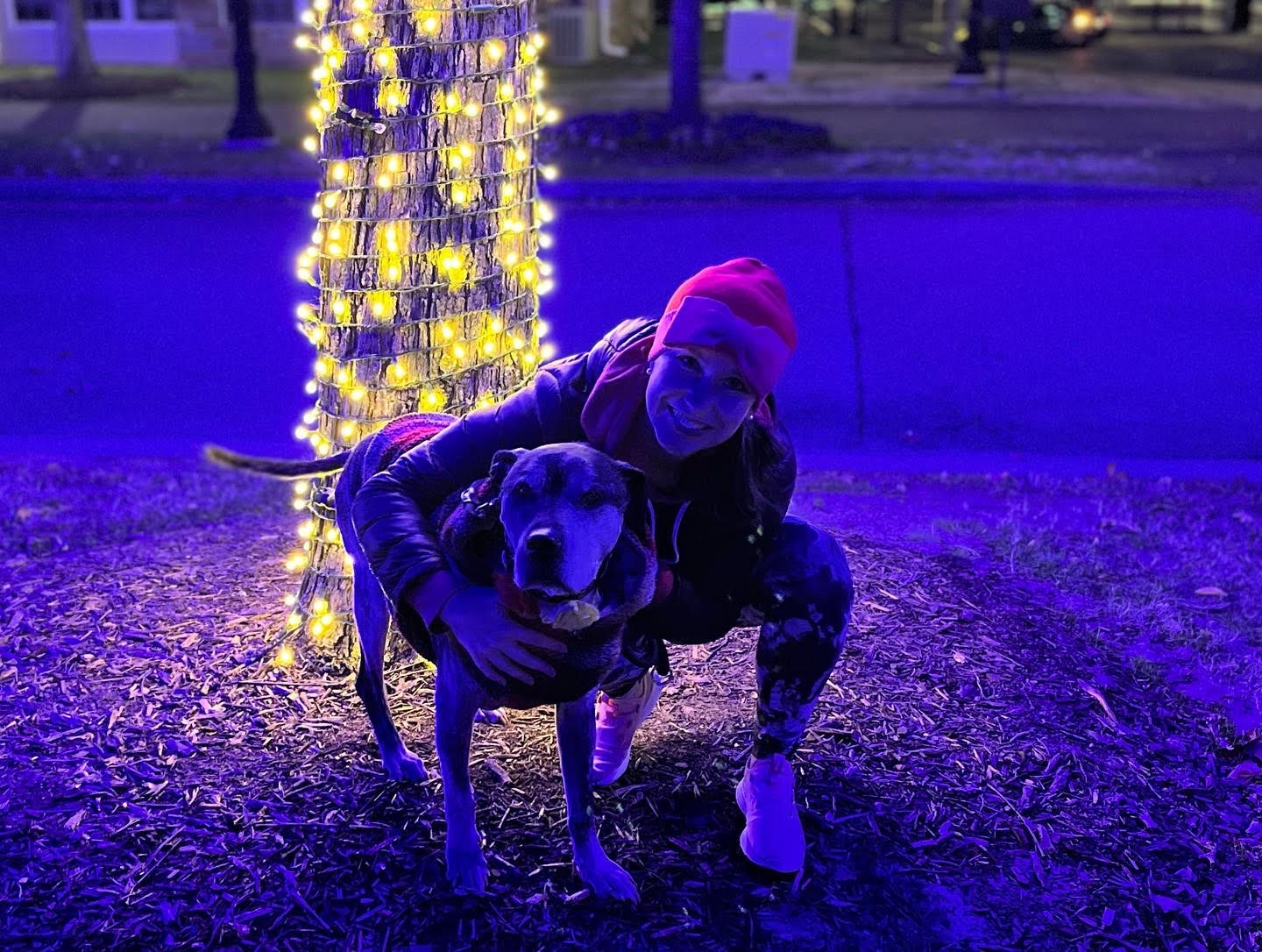
Daily Walks. Ruby and I are a constant presence on campus, walking our miles every morning and running errands in the afternoon. We’re always delighted to stop, say hello, and catch up with students—except for when Ruby is hard at work chasing squirrels, that is.

First year student and LaFortune resident Brooklynne Clark writes:

I attended Professor Contois’ Pup & PJ events, her final study sessions, and one of the dinners hosted in her home. These events and seeing her and Ruby around campus and the dorm helped LaFortune feel like home. Seeing the notes she would leave on doors during final weeks and knowing she was a resource if I needed her made the transition to college so much easier!

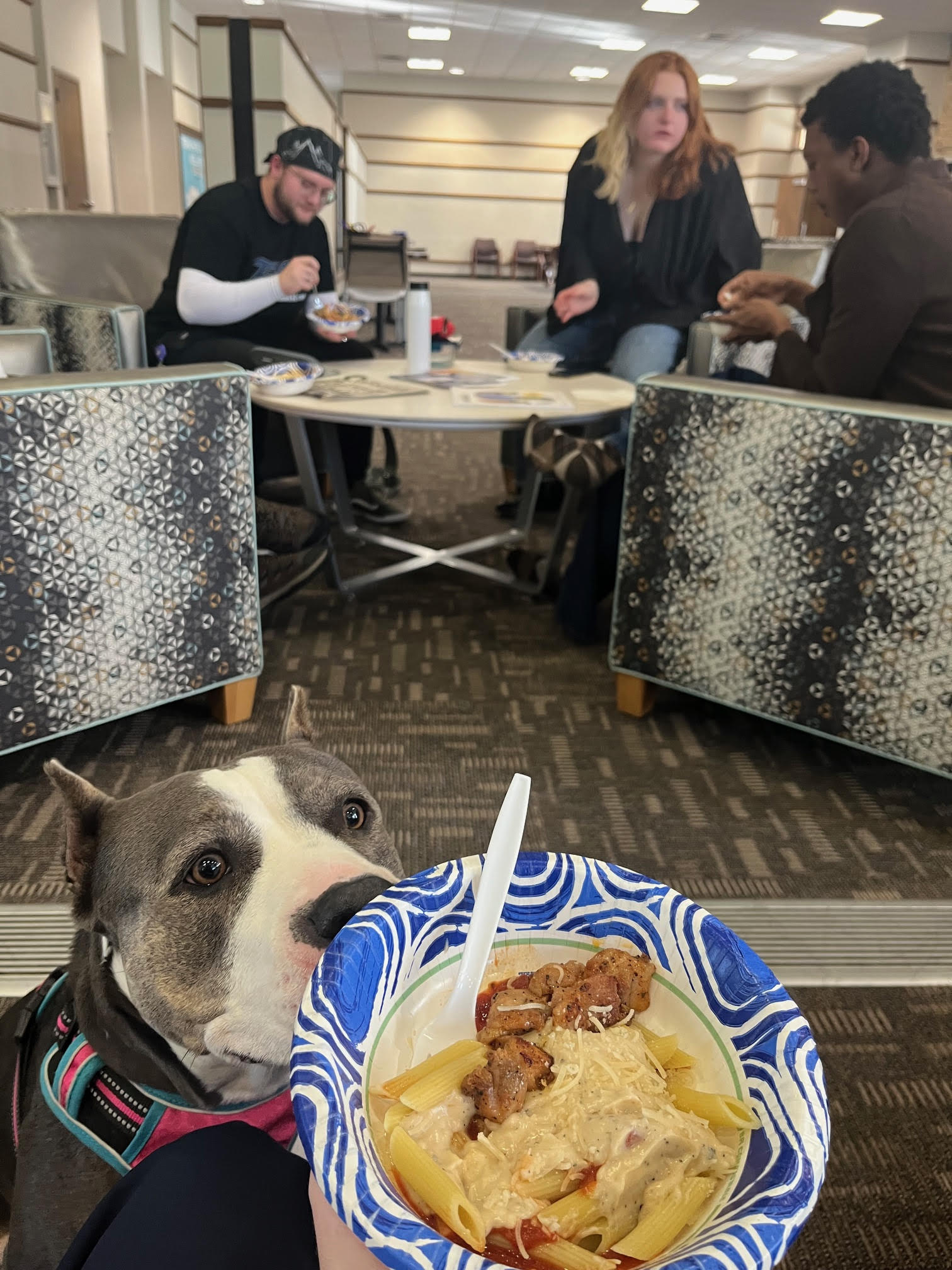
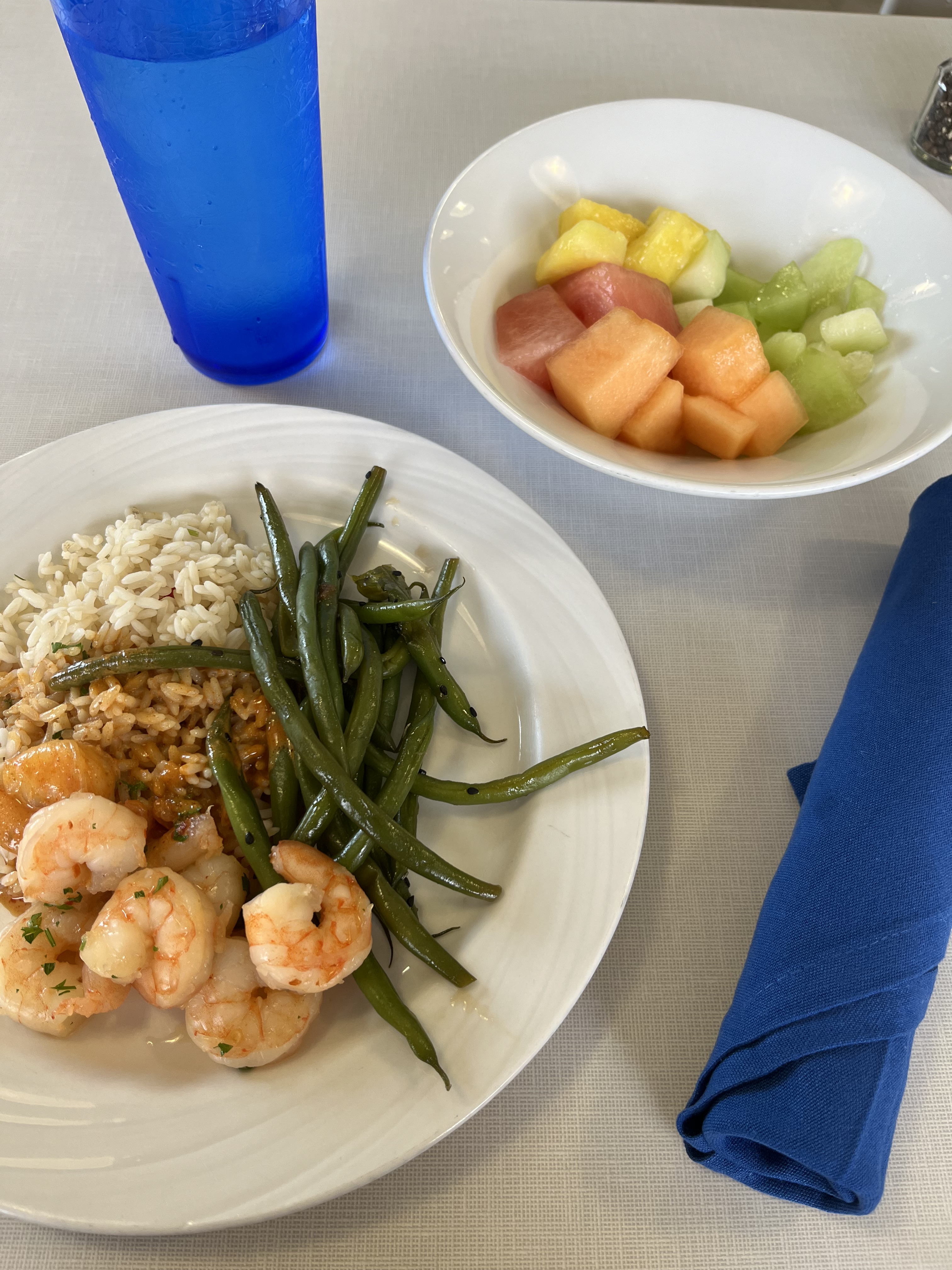
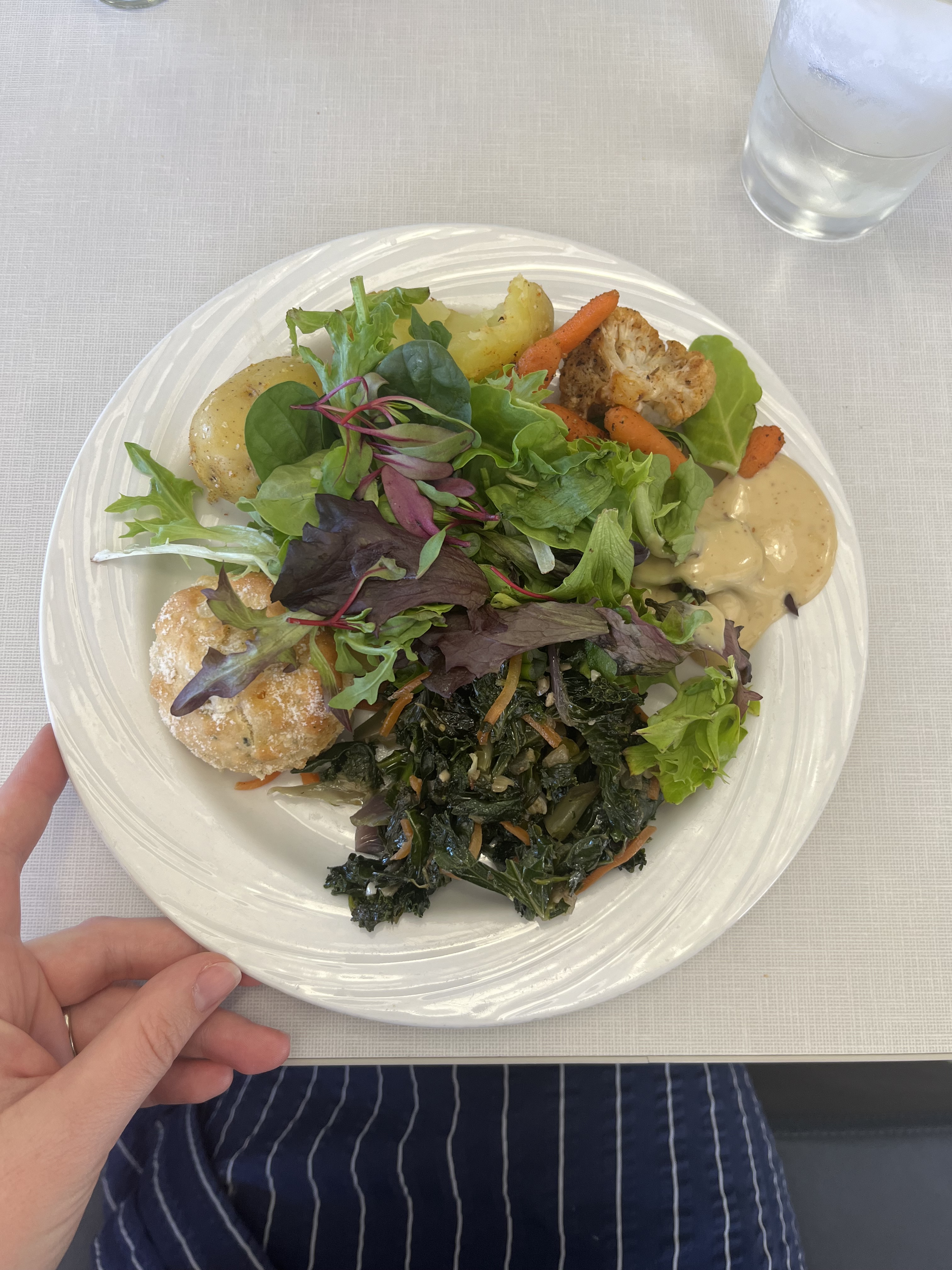
UTulsa Dining. I interacted with students (as well as faculty and staff friends) multiple times a week at Pate Case Dining Center, the Union food court, and the McFarlin Library Starbucks. Given my evening teaching schedule in Spring 2025, I ate dinner with students every Monday at 5 pm.

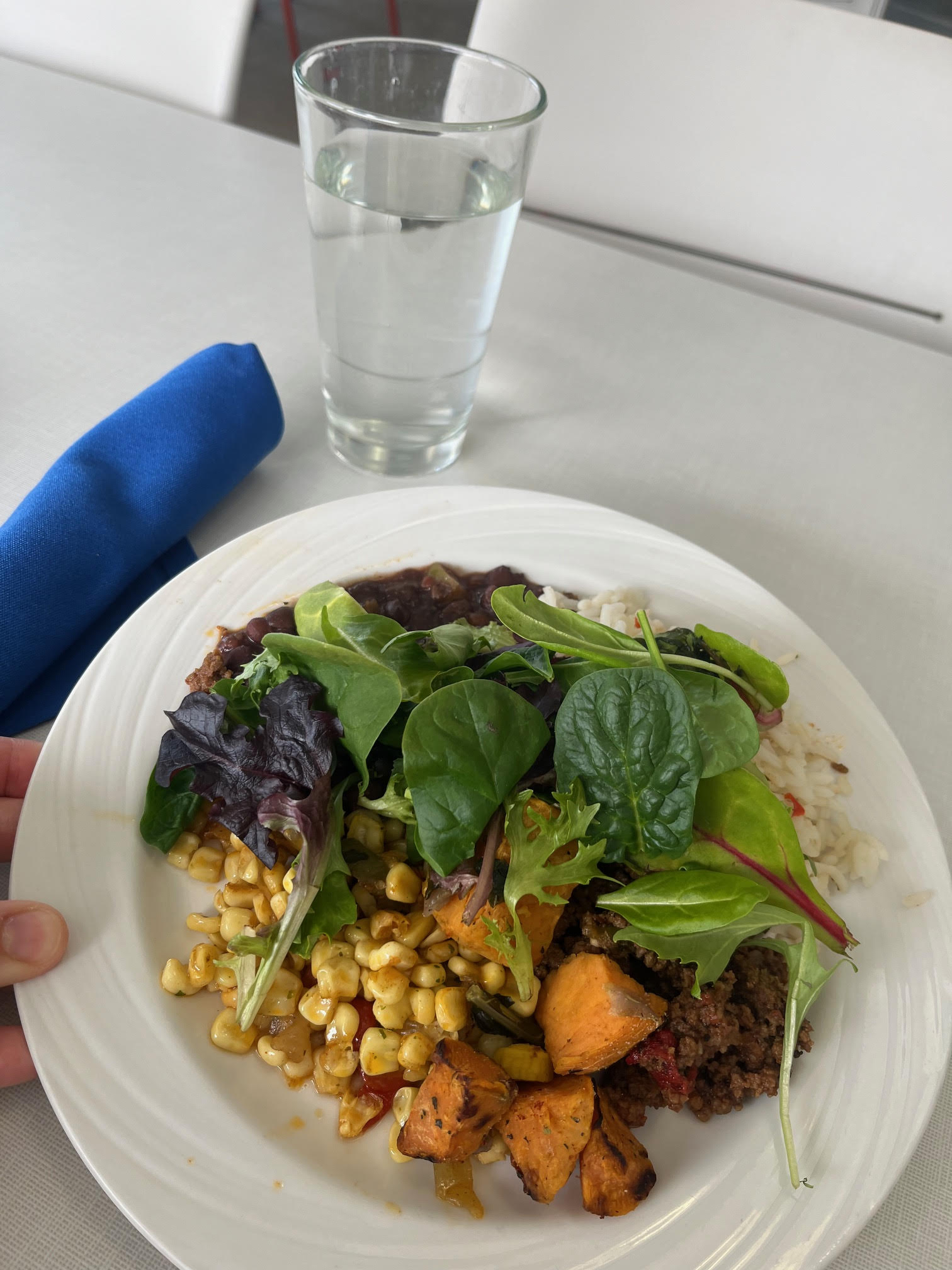
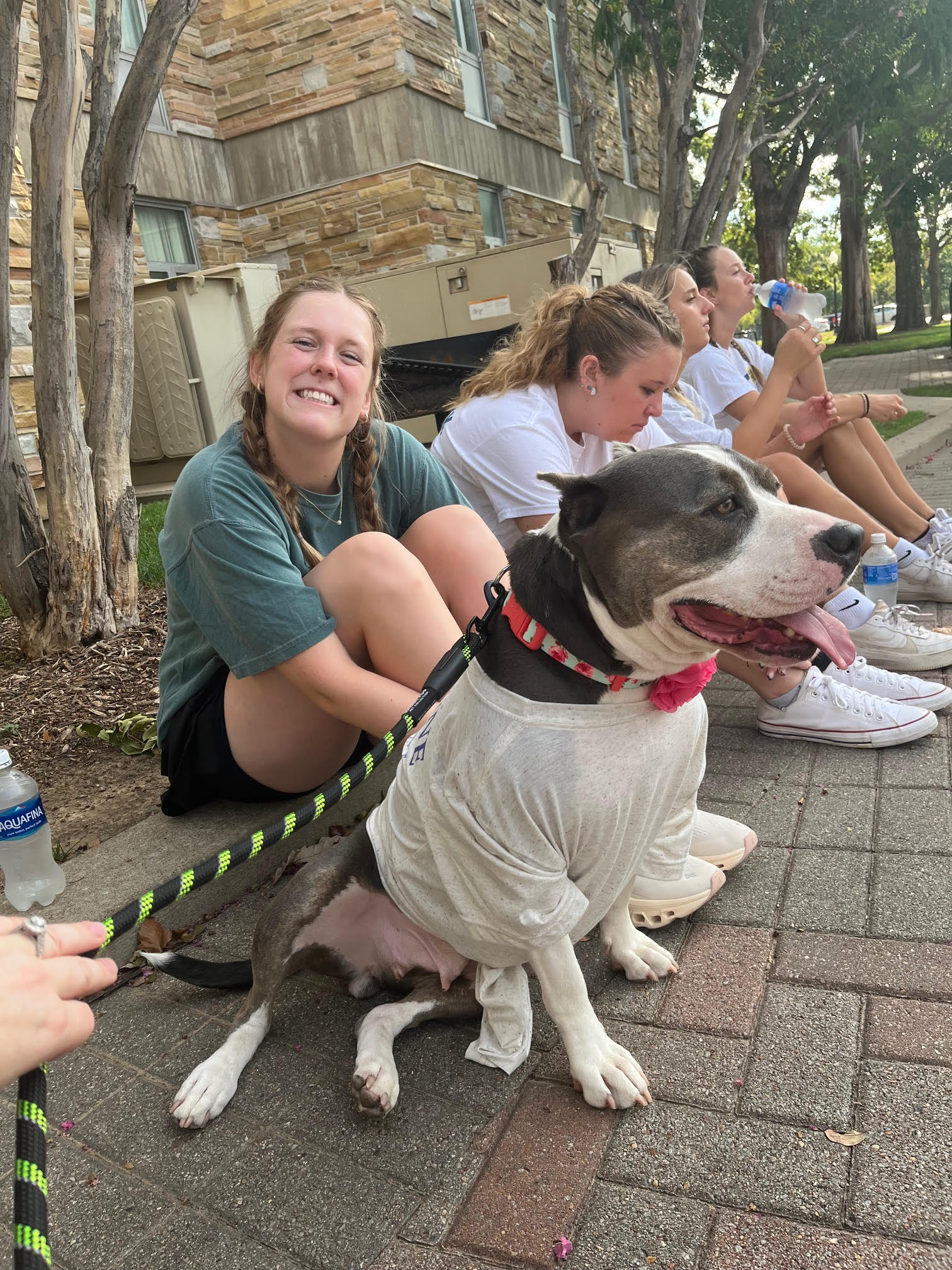
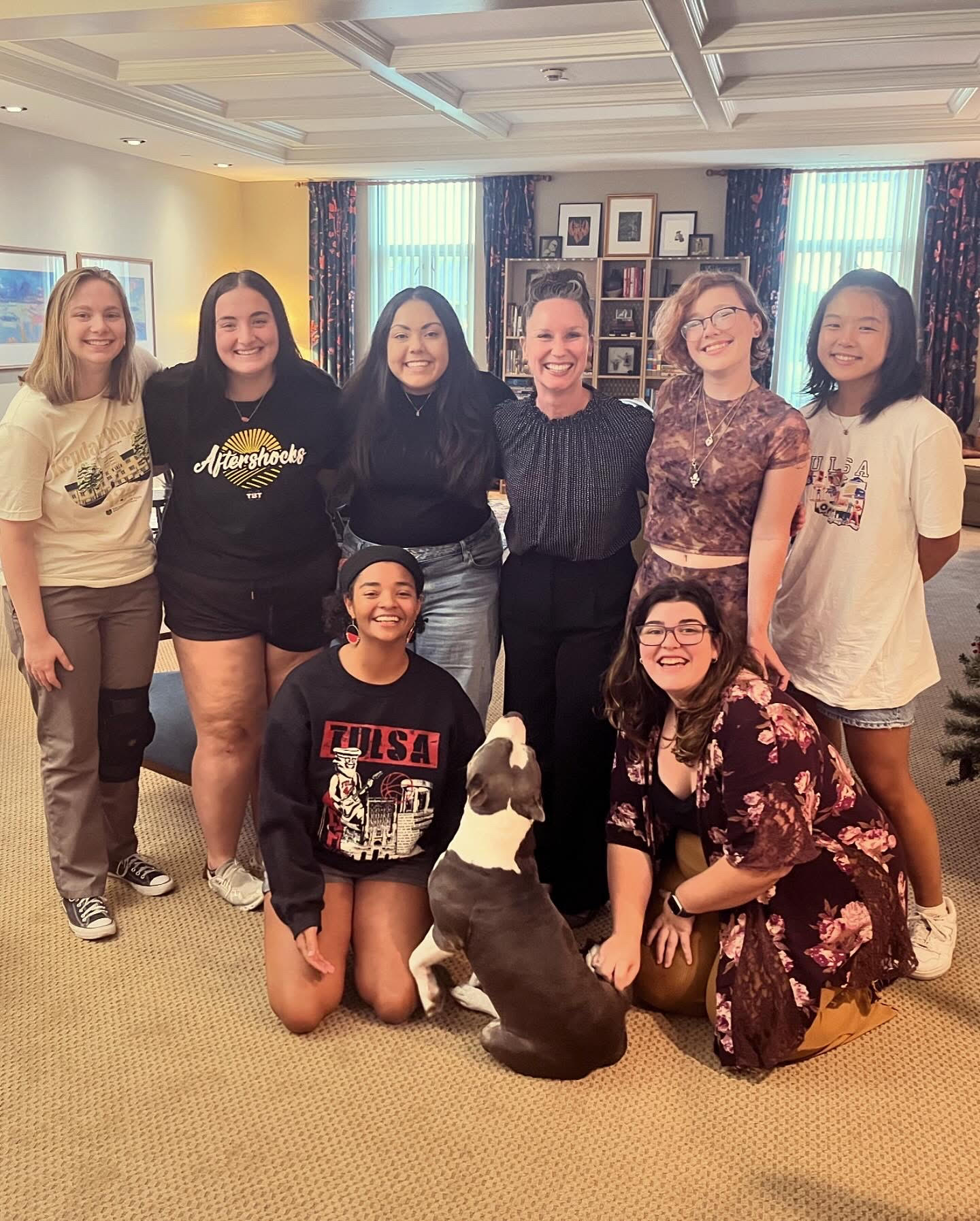
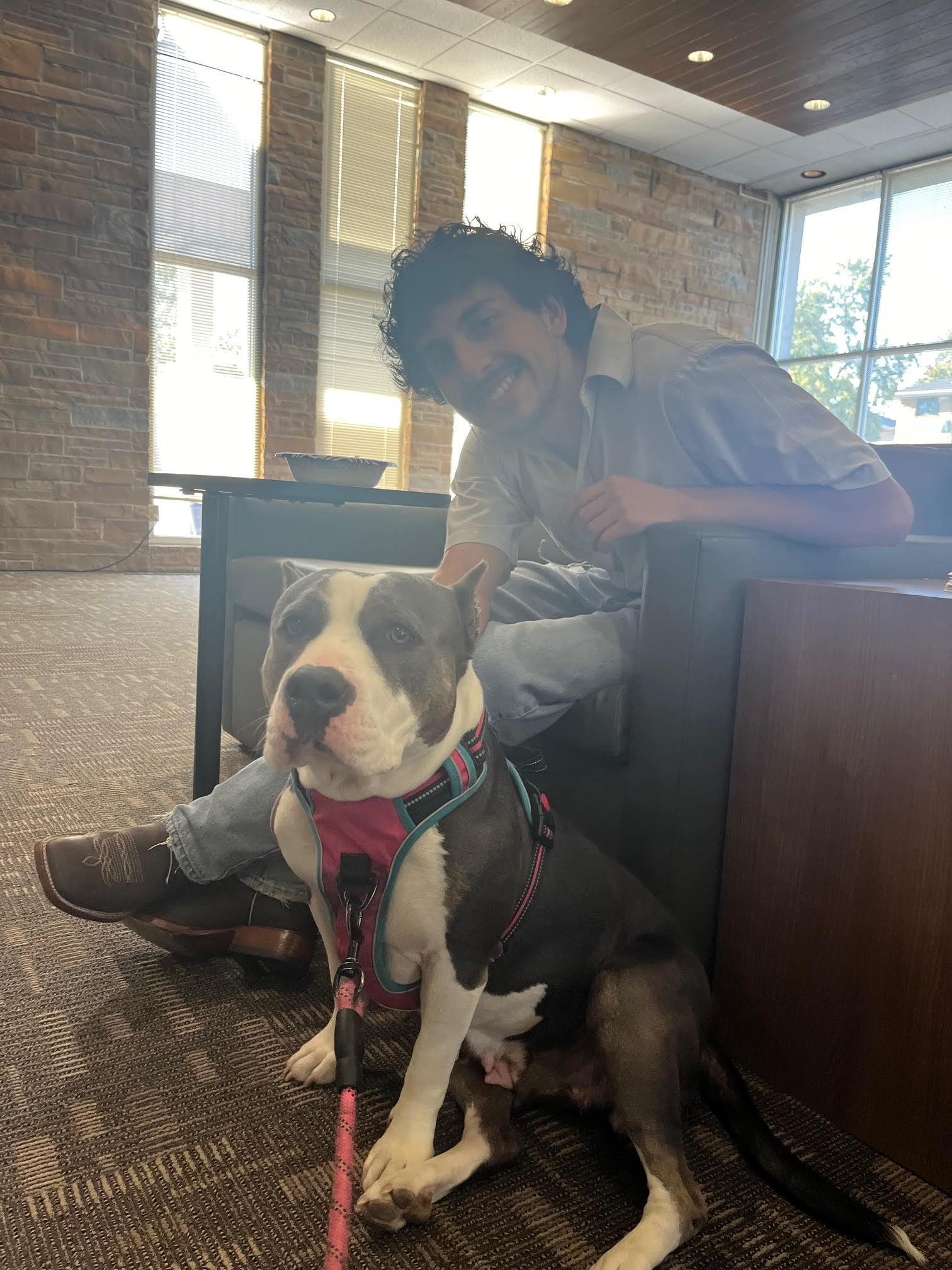
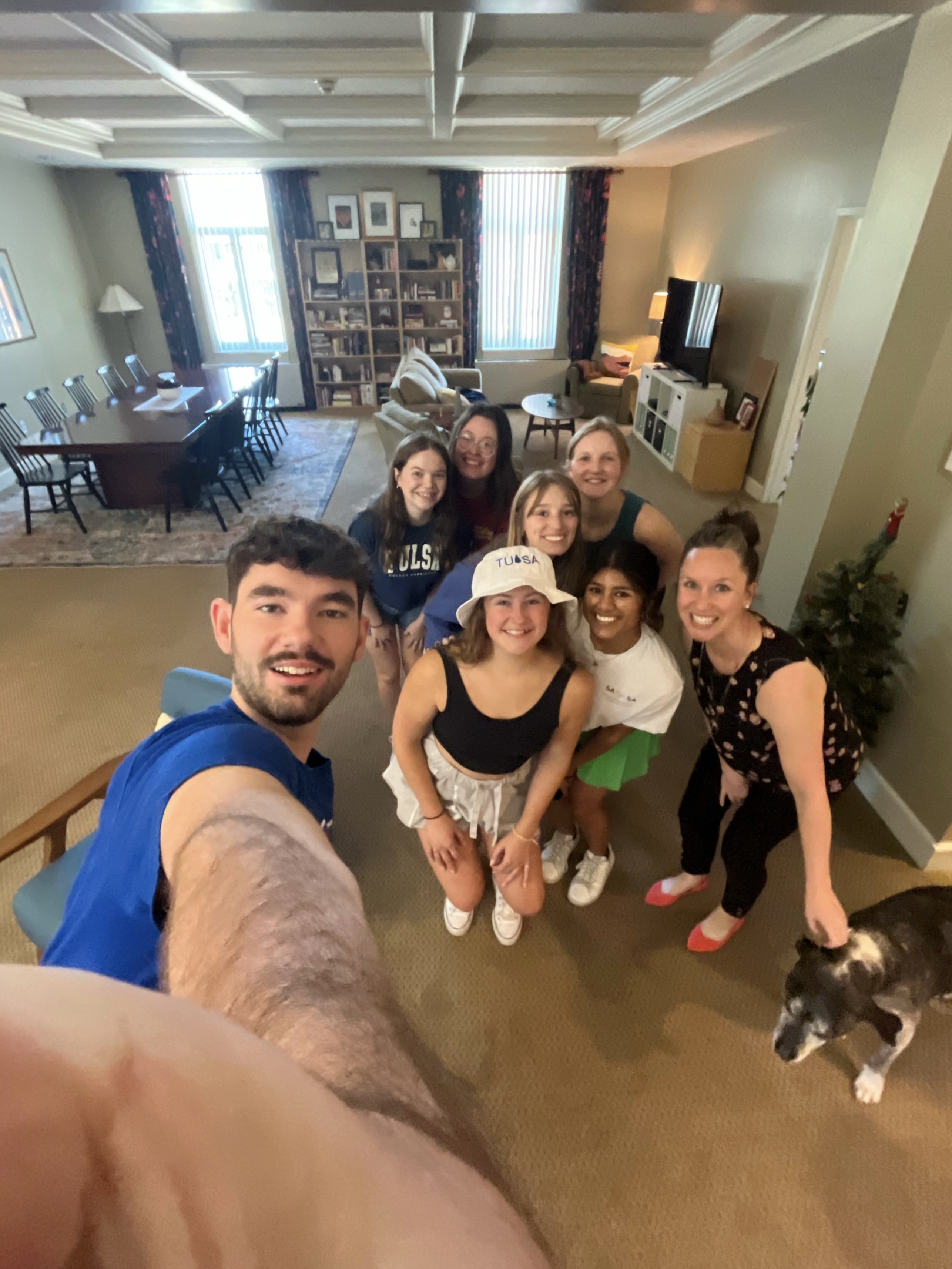
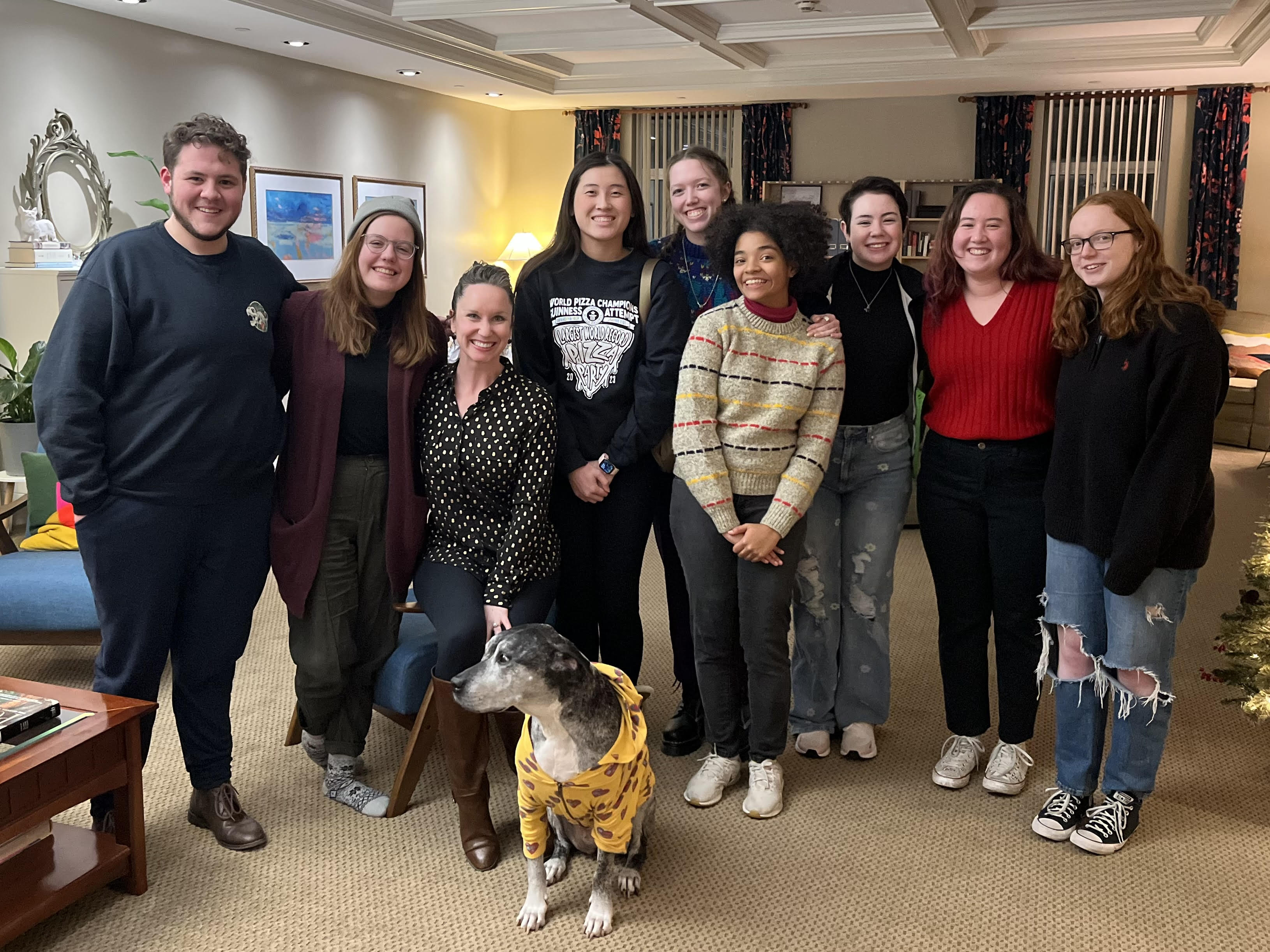
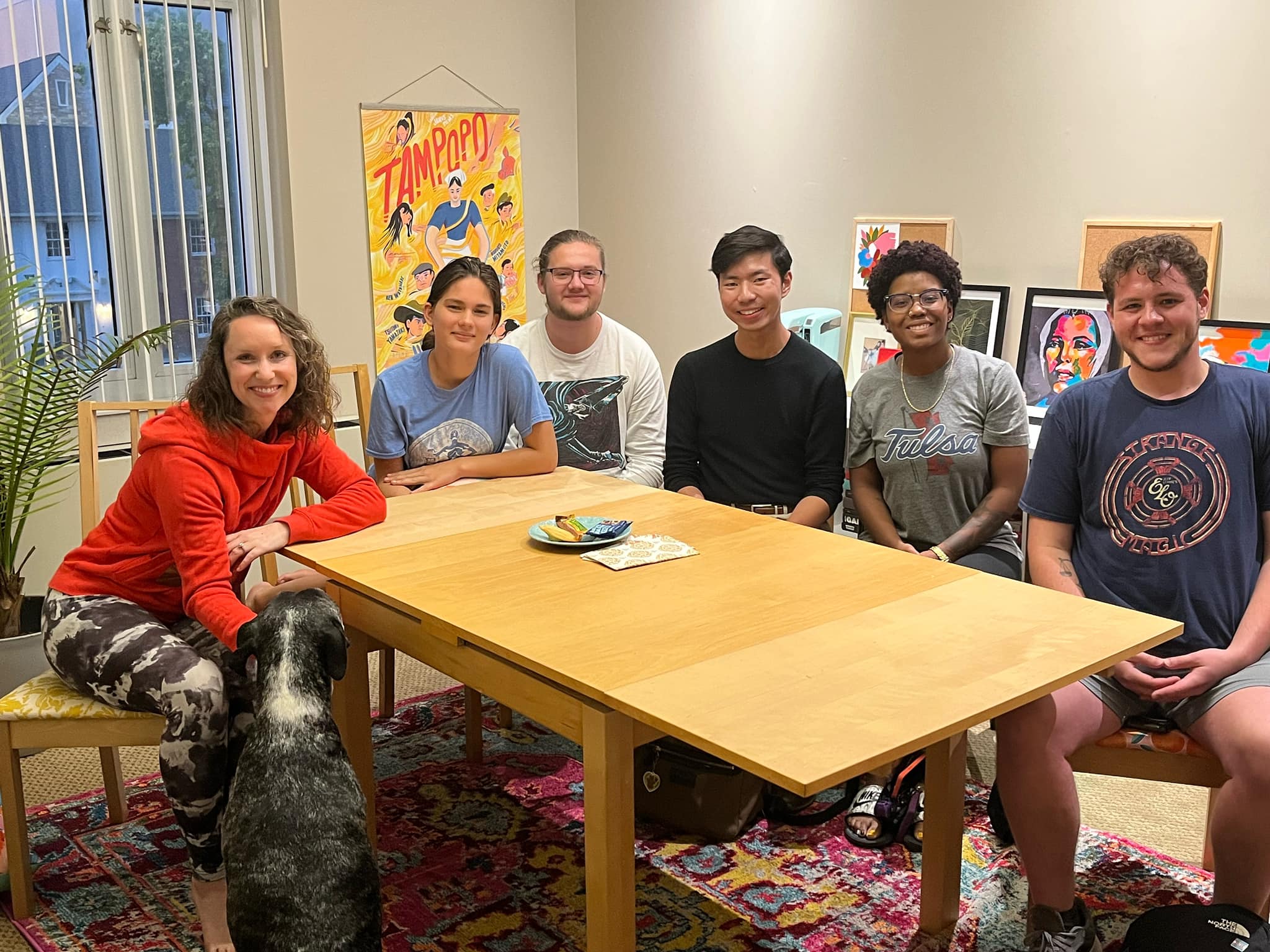
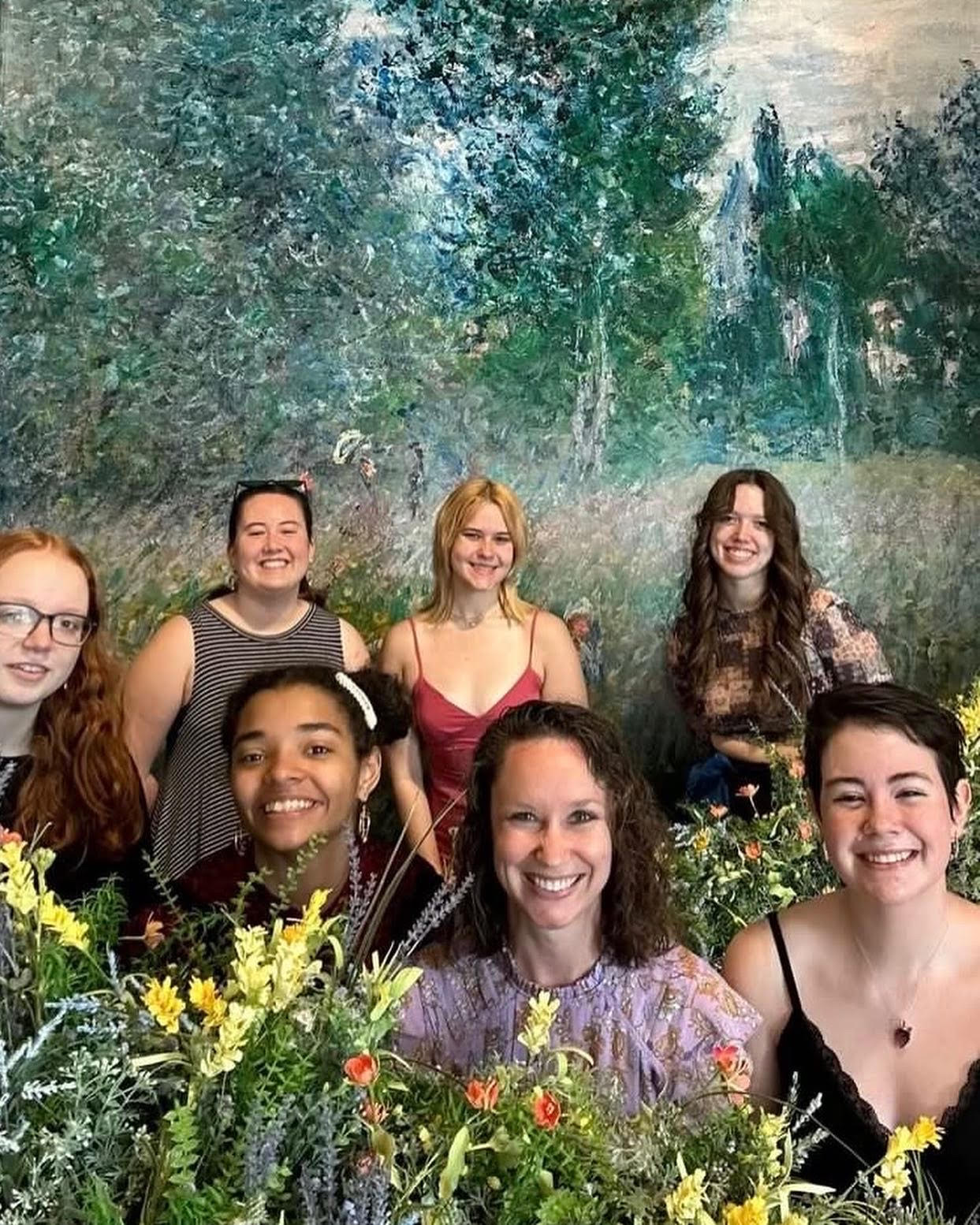
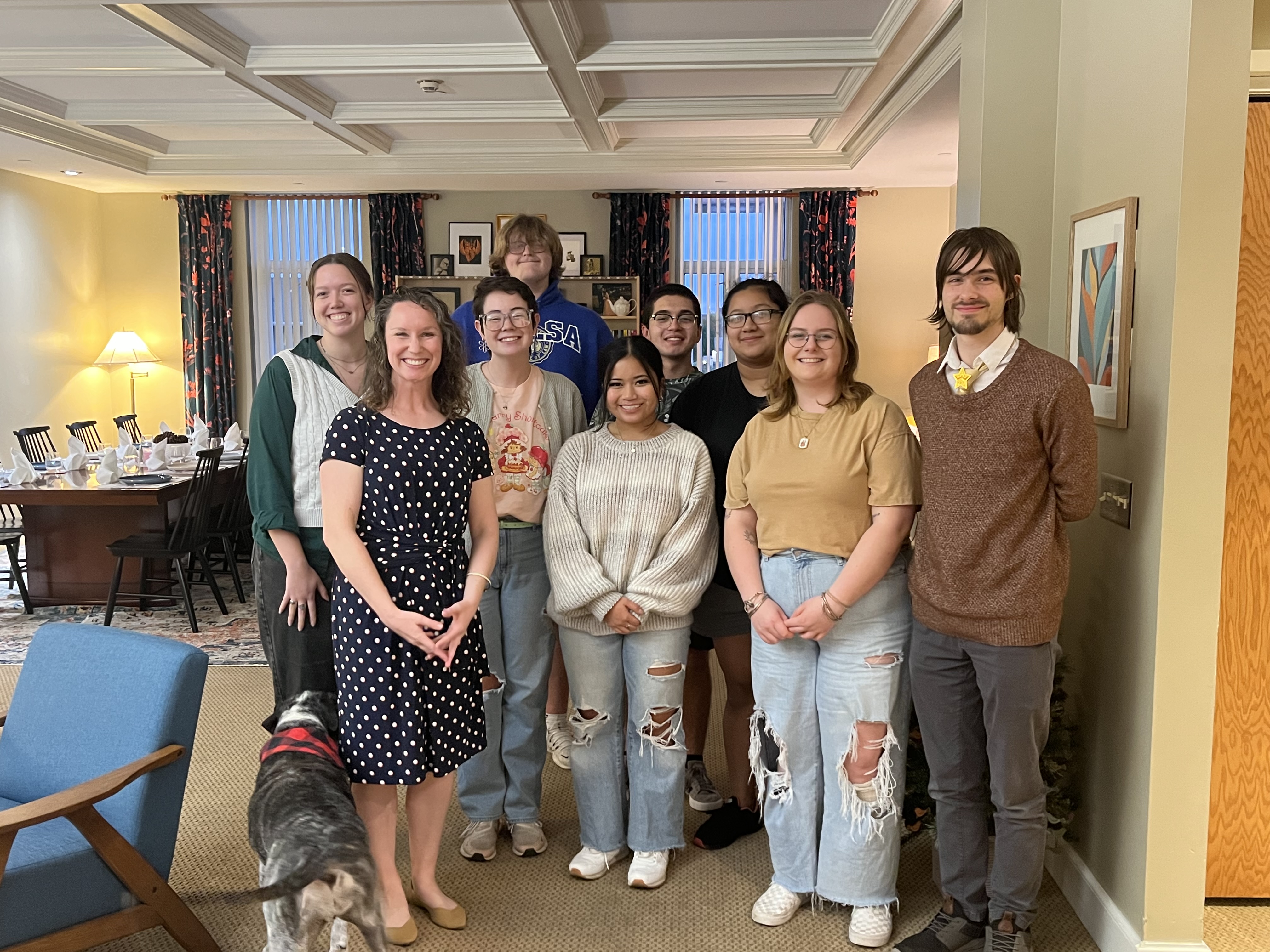
Konnor McGuire, a junior Political Science major pictured above, says:

The Faculty in Residence program is what is because of Professor Contois and her family. The thought and care that she puts into each event and topic in class shines through in all that she does. Whether it be fresh baked cookies and puppy pets, or sit down 3 course meals, her love for students is clearly stated and shown. This program gives students the opportunity to find community and comfort during their years away from home and provide support when they need it most. I would tell everyone to utilize this program early on, because it has truly made such a difference in my semester and college experience.

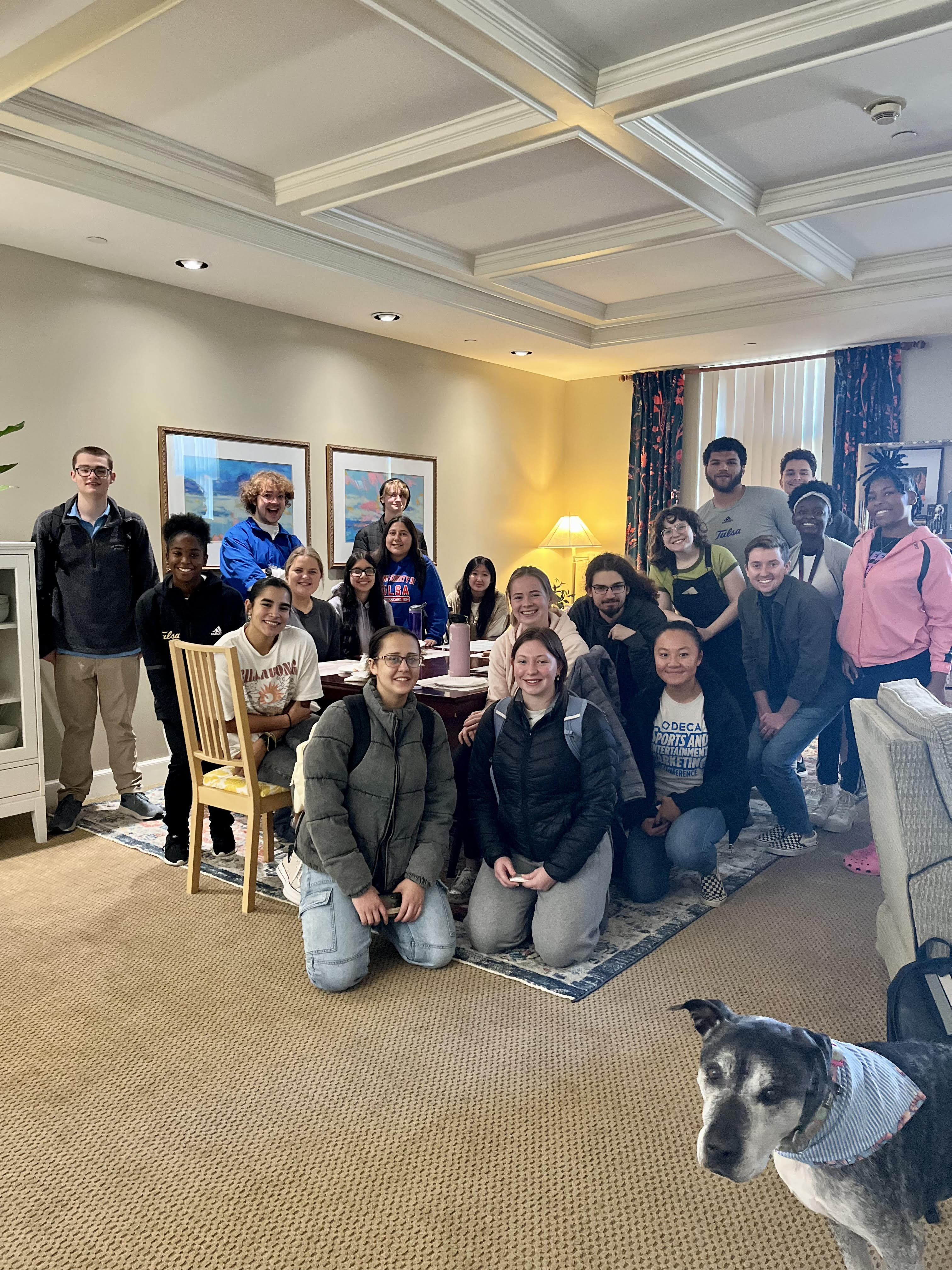
Semesterly class visits provided opportunities to host nearly all of my classes at my home. I aim to foster a special learning environment grounded in nurturing hospitality, while also raising FiR program awareness.
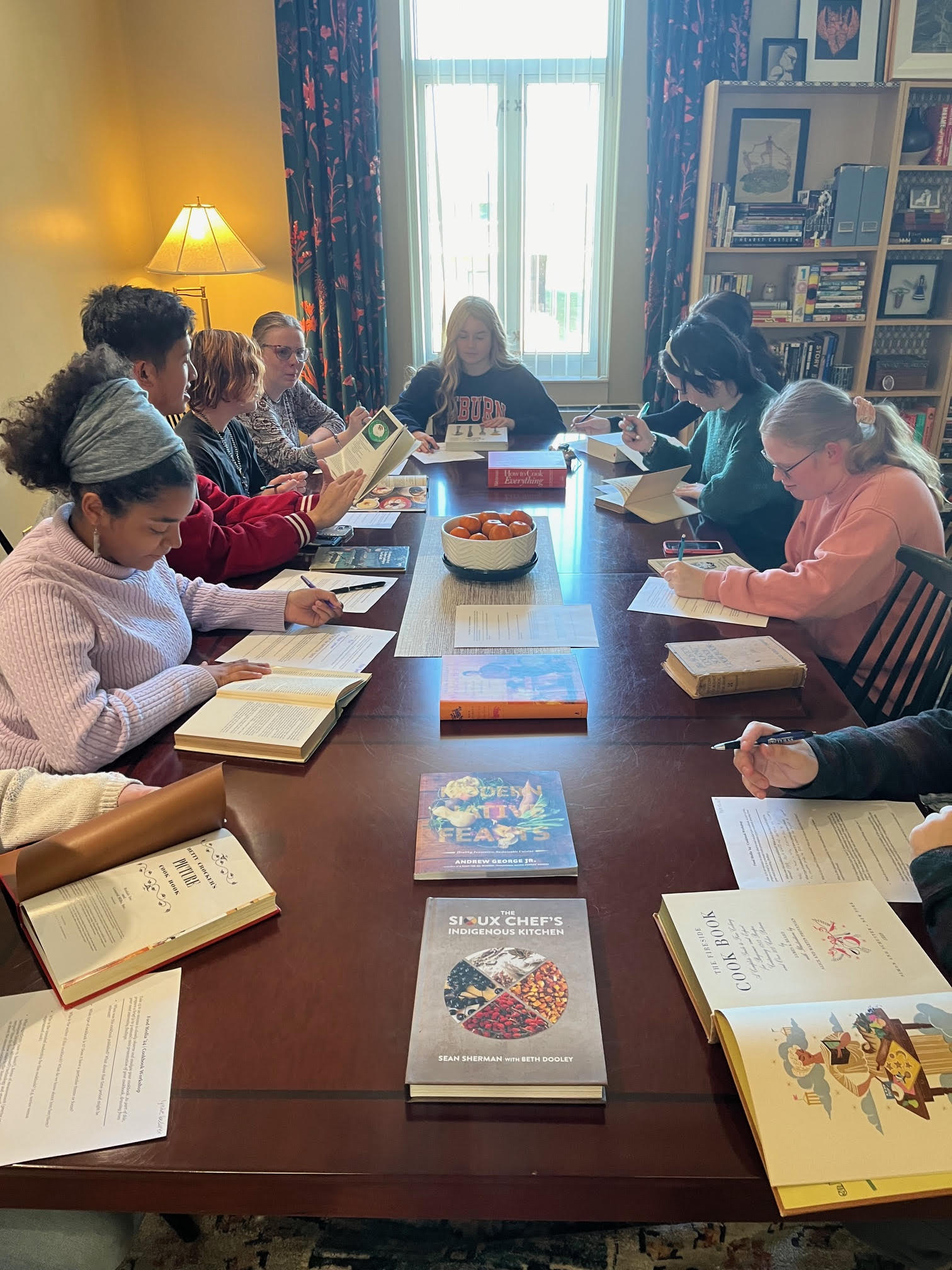
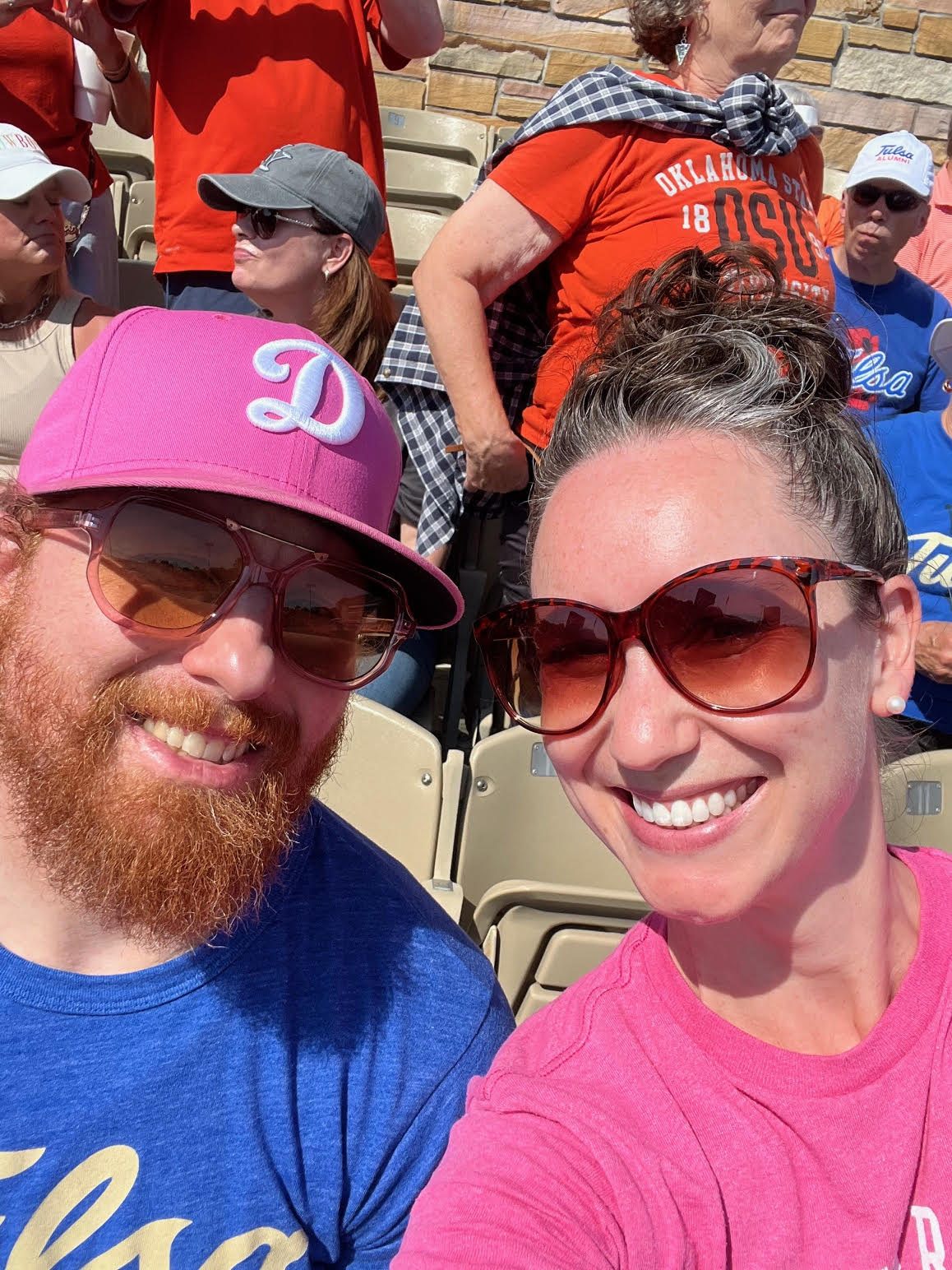
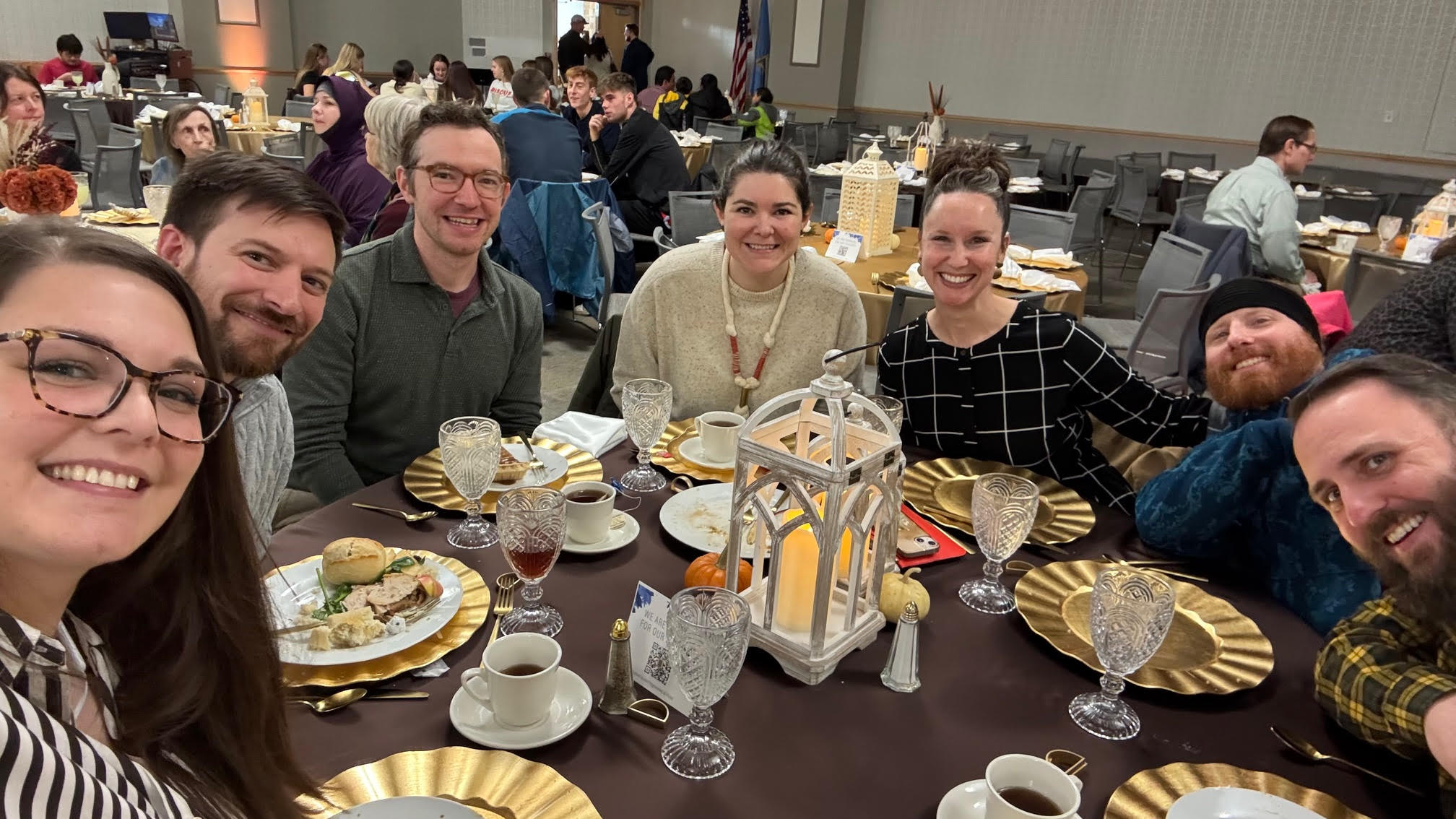
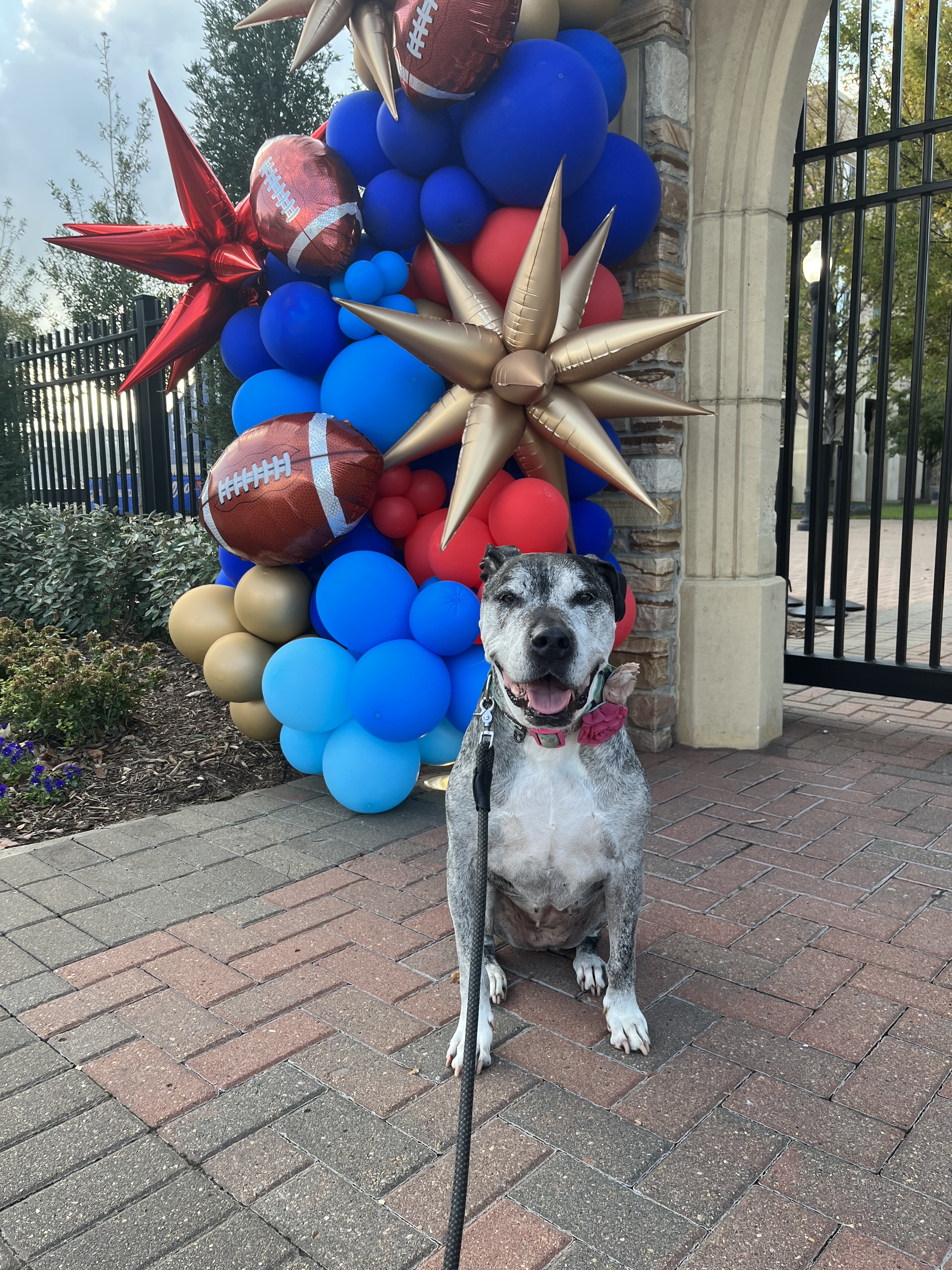
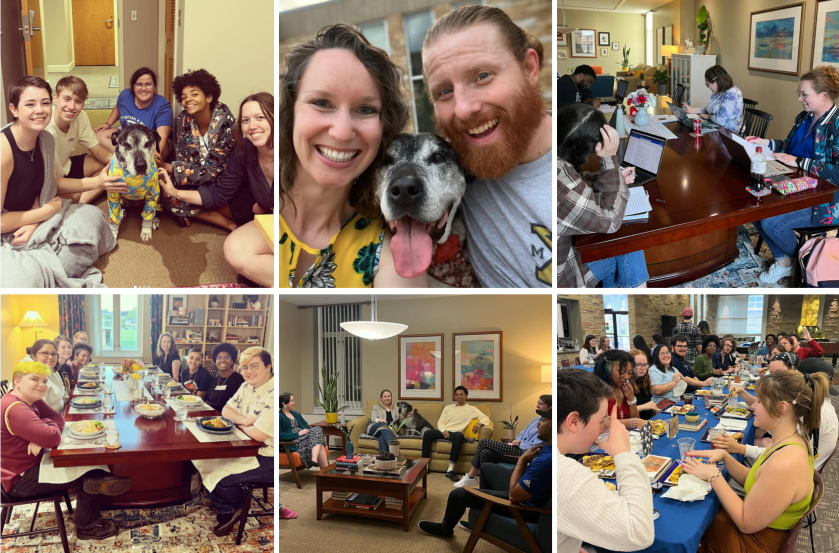
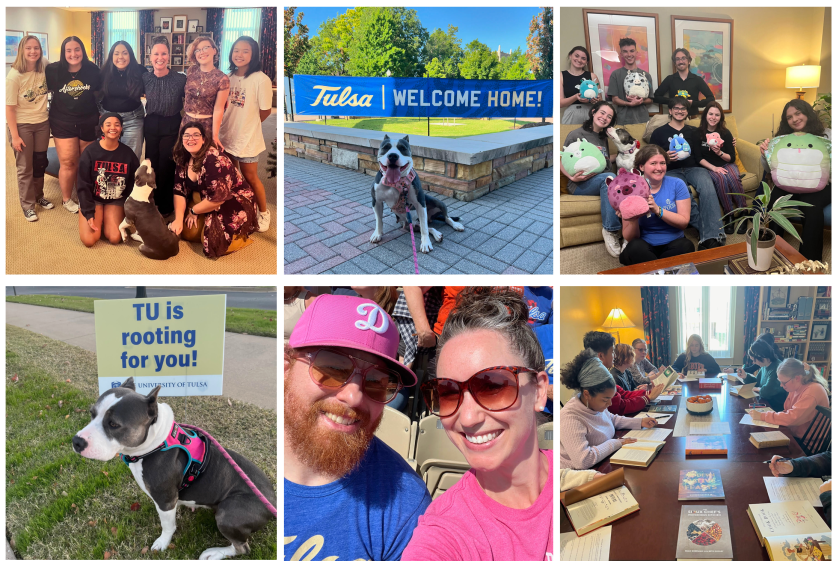
Monthly (at least) residential and campus events (some pictured below) were opportunities for us to further integrate with our UTulsa community like: back to school fireworks, UTulsa football tailgates and games, cheering on Route 66 Marathon runners on campus, and attending UTulsa Thanksgiving dinner with fellow faculty friends. We also attended numerous events in LaFortune House planned by RAs, CCs, and hall government, ranging from a Real Talk event on gender identity to pizza and pasta parties to a late night yoga class.

Haley Tanega, a first year student majoring in Psychology, writes:

I have had the unique experience of having Professor Contois as both my faculty resident “dorm mom” and my professor. Getting to know her on a more personal level while living in LaFortune has strengthened the bond I share with her now as my teacher. Some of my fondest memories are from when Professor Contois attended the Real Talk event in our lobby, where she courageously shared her own stories about gender identity. I have also witnessed her unconditional kindness and support toward all students and residents on numerous occasions. Professor Contois organizes numerous engaging events that help students feel recognized and comfortable during their college experience. I am thankful to have met her and to have her as my professor.

Special Events

’90s Snack Night aligned with my fall 2024 Food Media course. We provided a sampling of snacks and created a YouTube playlist of their TV ads originally developed in the 1990s, the decade of my childhood. It was all for good fun and thoughtful discussions about food product development, marketing, and package design, as well as evolving ideas about childhood health and nutrition.

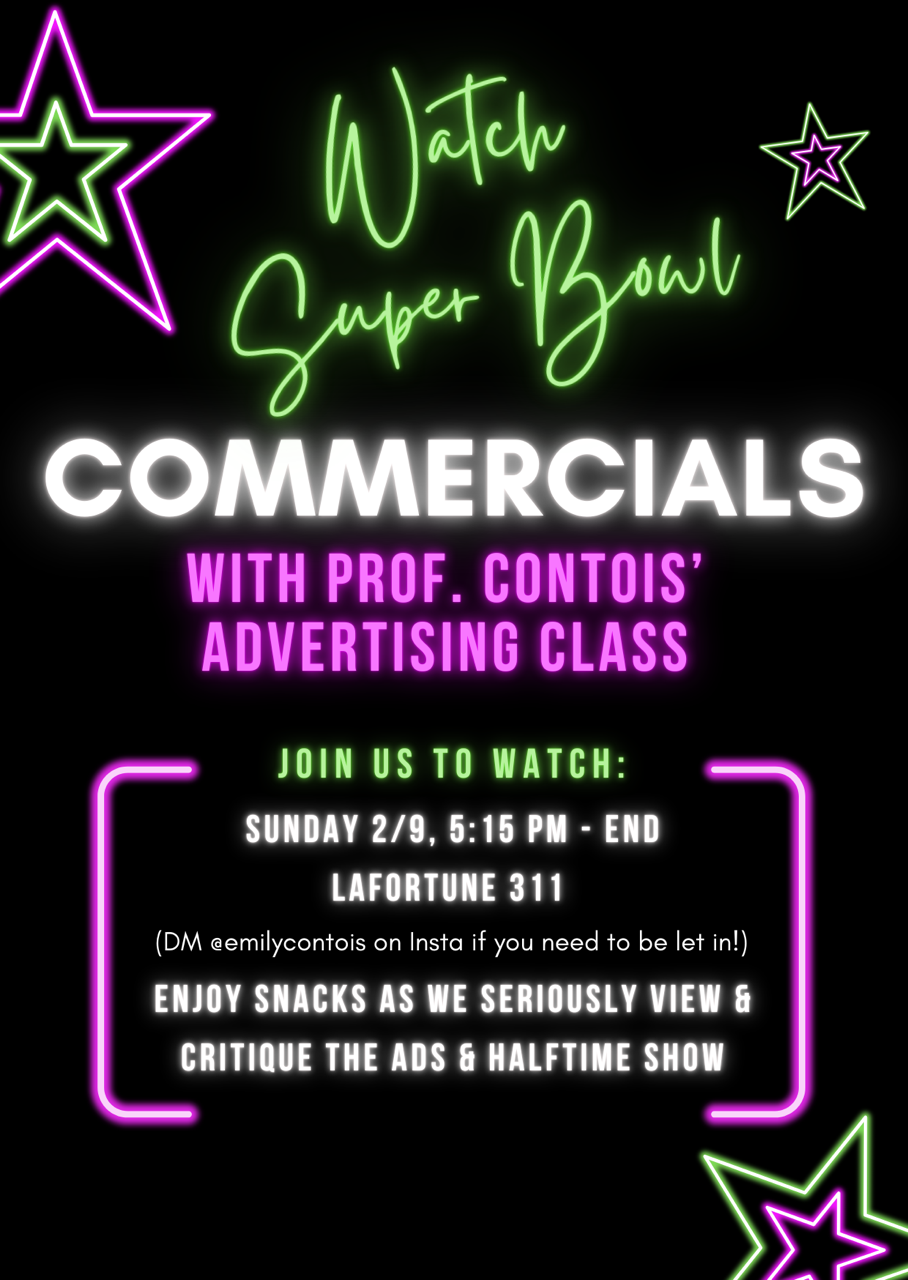
Super Bowl Ad Watch Party aligned with my spring 2025 Advertising History, Culture & Critique course. I hosted a watch party with snacks for students who wanted to seriously watch and critique the ads along with my class, who were preparing for their ad ranking assignment.

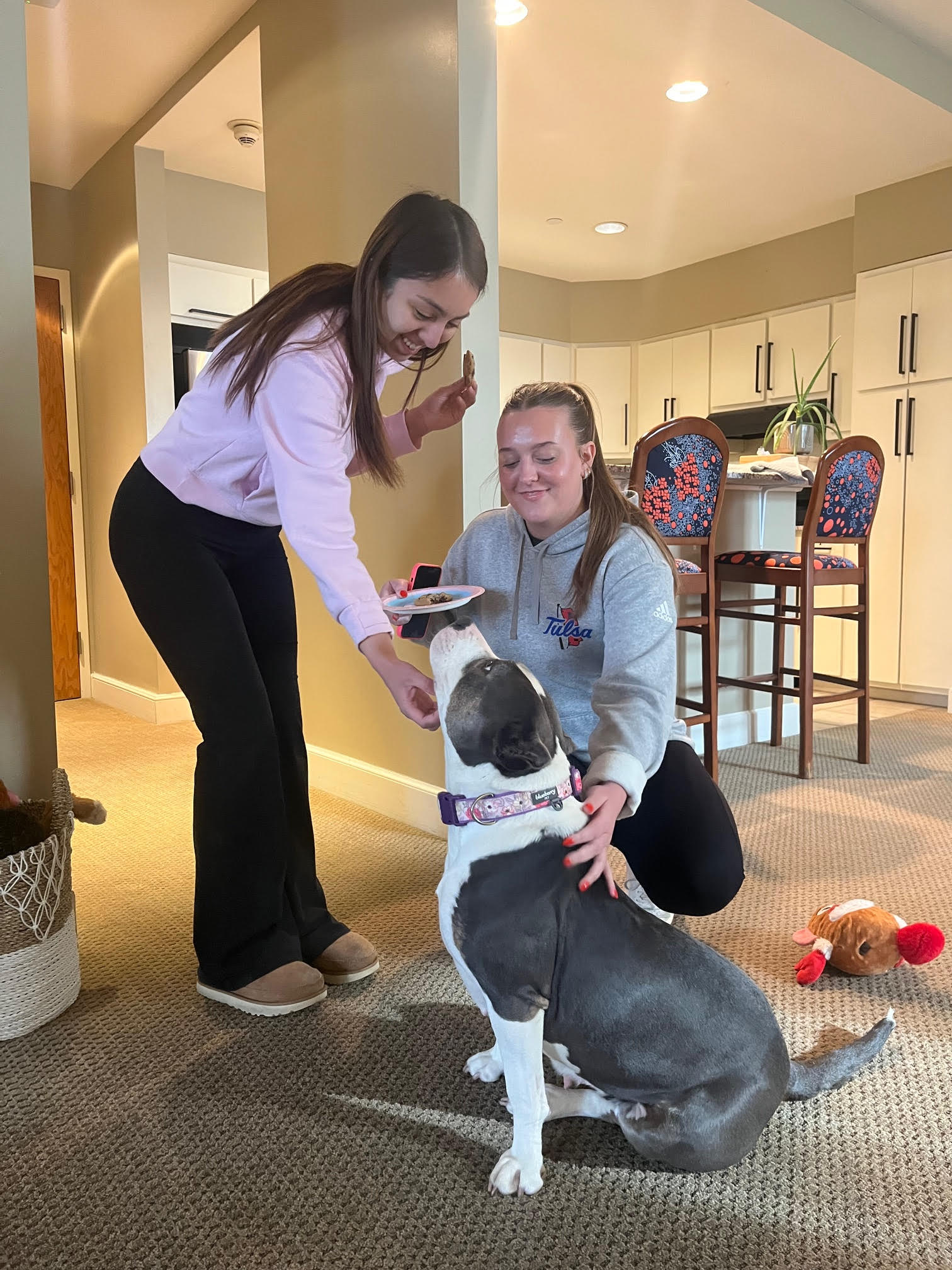
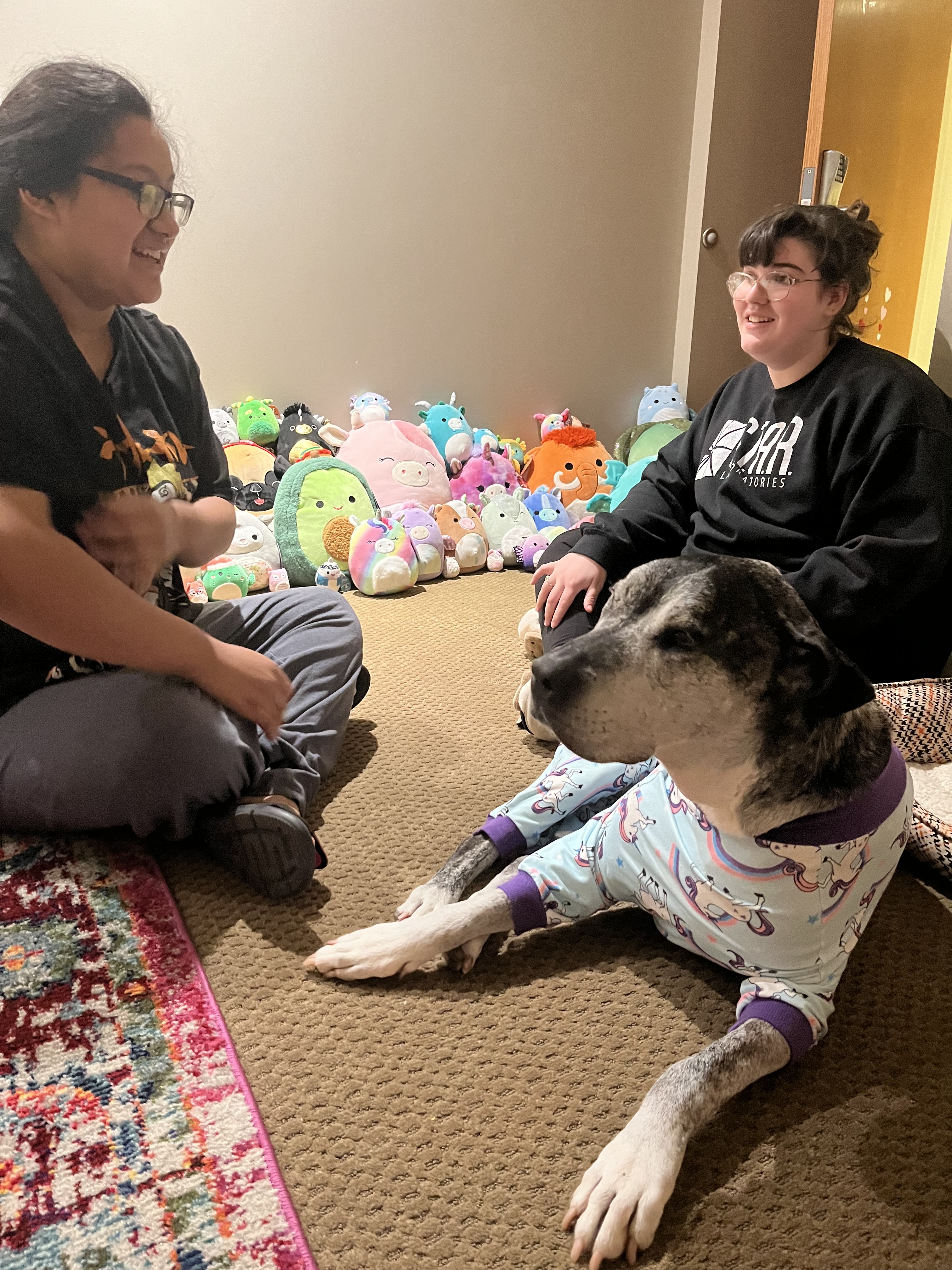
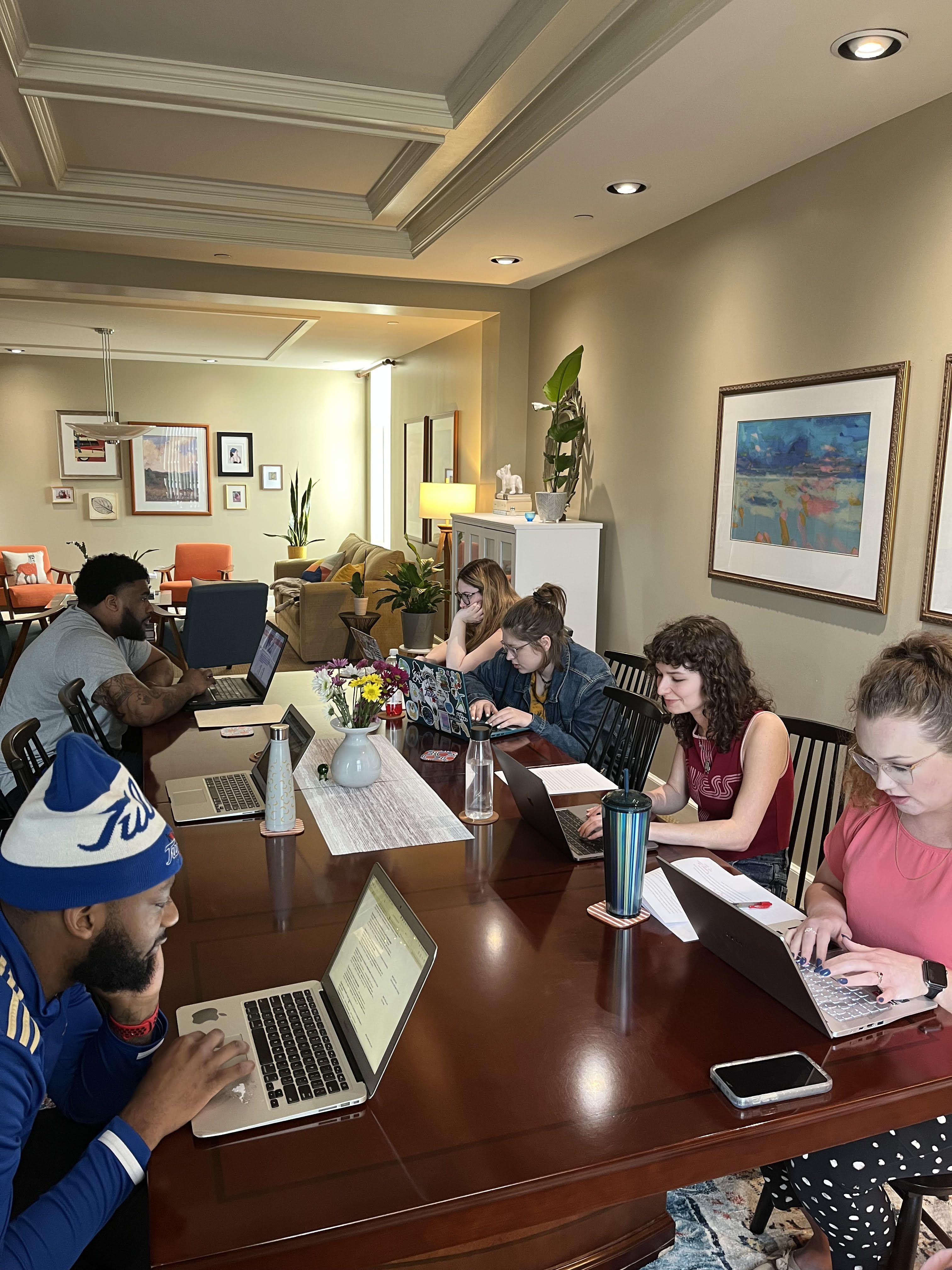
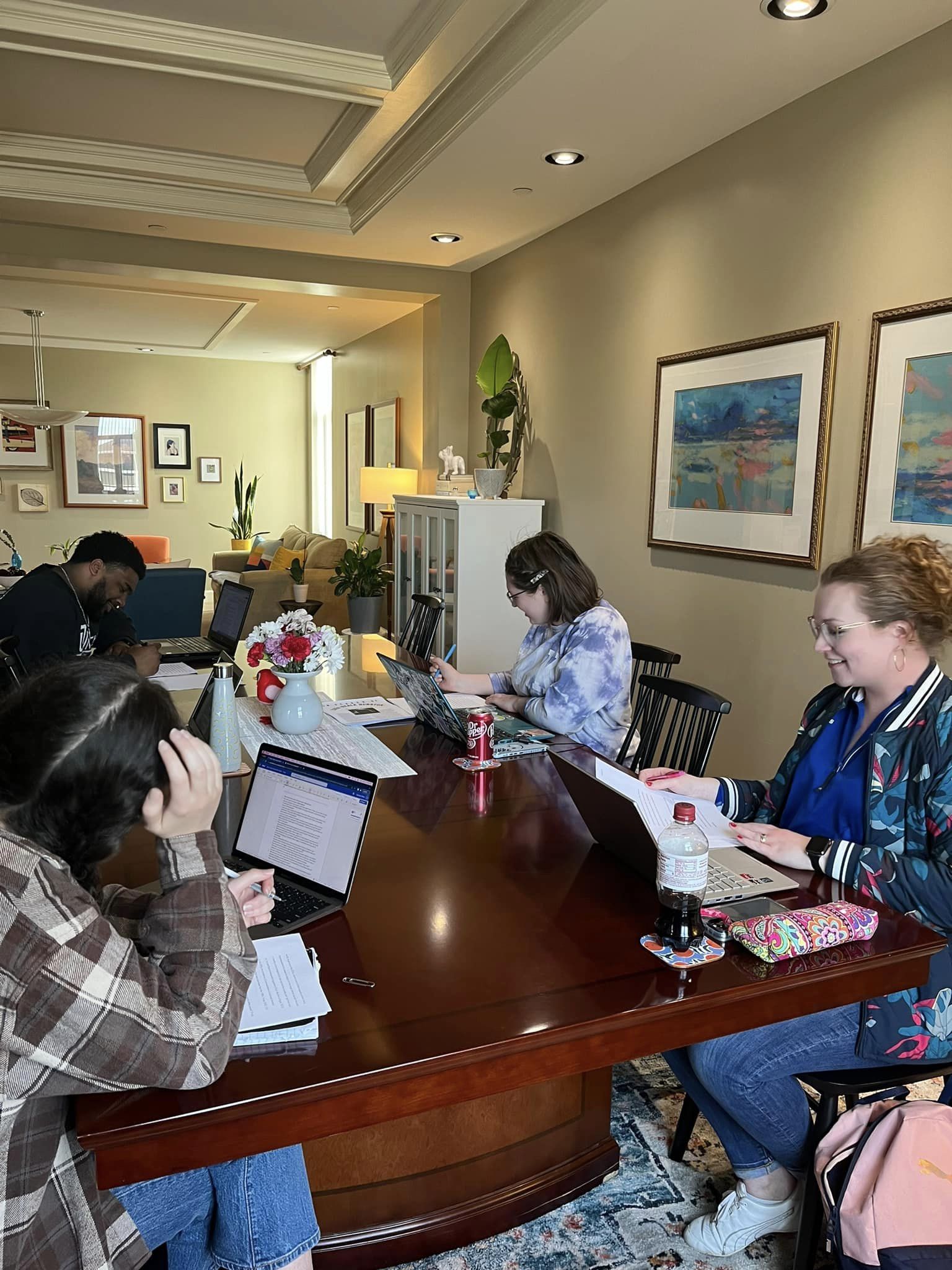
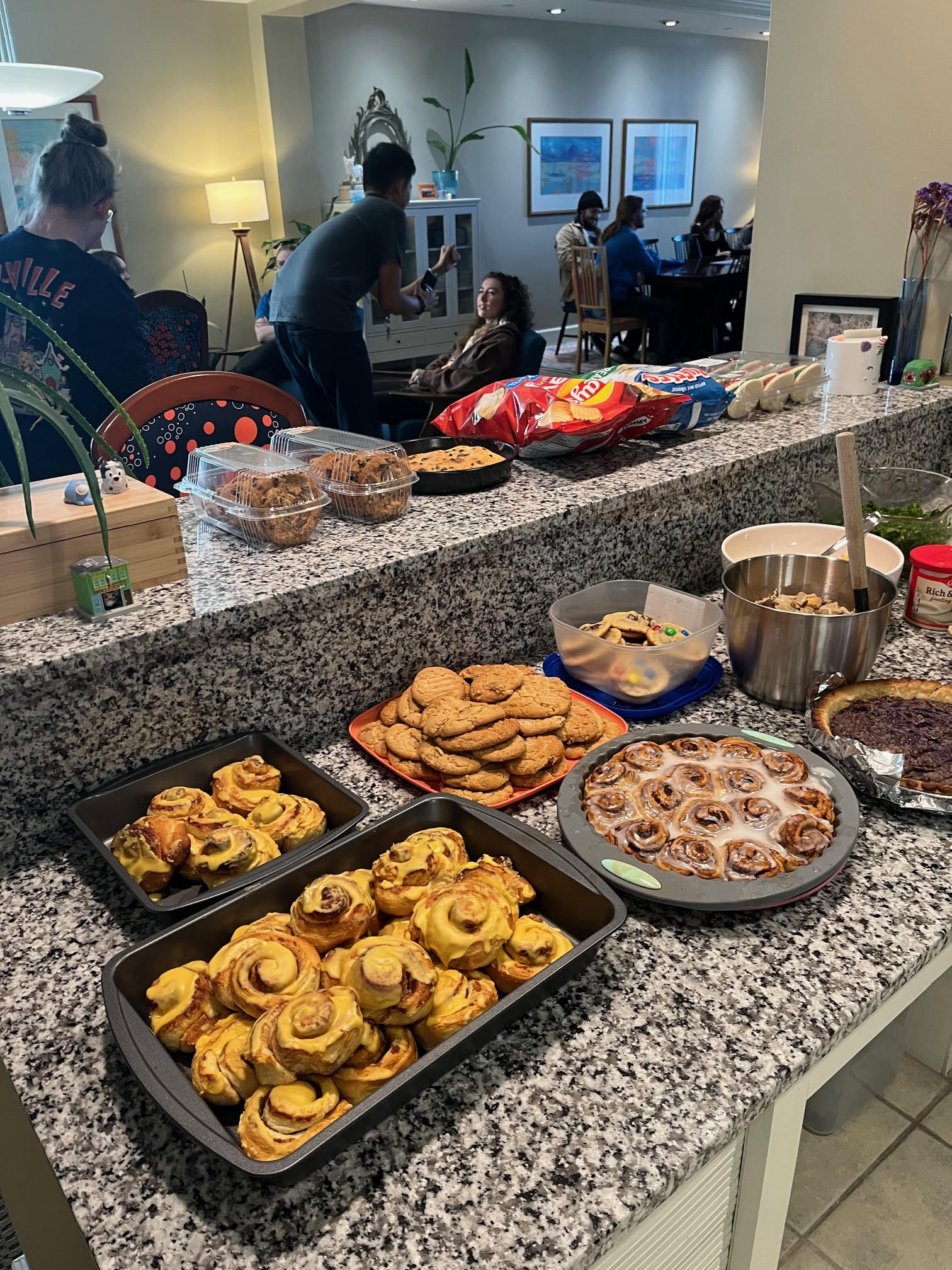
Cookie Study Hour in spring 2025 supported student study habits for midterms alongside mental and social health needs. It provided space, time, and supplies to study in community and with chocolate-chip cookies fresh from the oven!

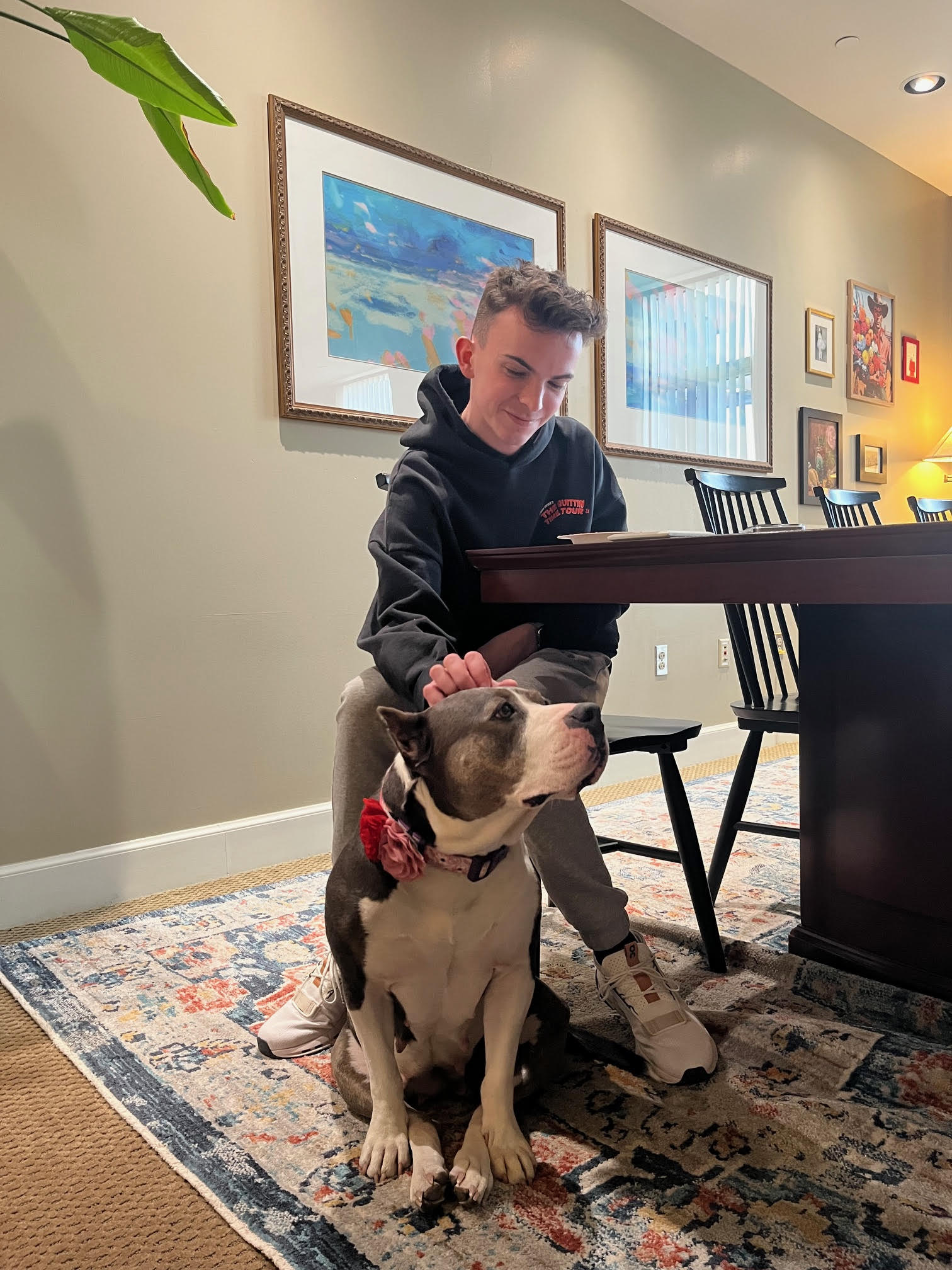
The event resonated with senior Film Studies major, Milena Perkins, pictured seated above, who writes:

I’ve gone to MANY Faculty in Residence events over the years. Some of my favorites have been Pups and PJs and the study event in which Professor Contois provided us with fresh baked cookies are we prepared for our midterms. I truly enjoy going to events because Professor Contois is so welcoming and shows up for her students not just in the classroom but outside as well. She truly cares about her students, and it shows by the special events that she puts on throughout the semesters. Going to her events has made my time at TU even more special and the events, as well as Professor Contois, will be something I miss once I graduate. Thanks for everything you’ve done for me over my 4 years at TU!

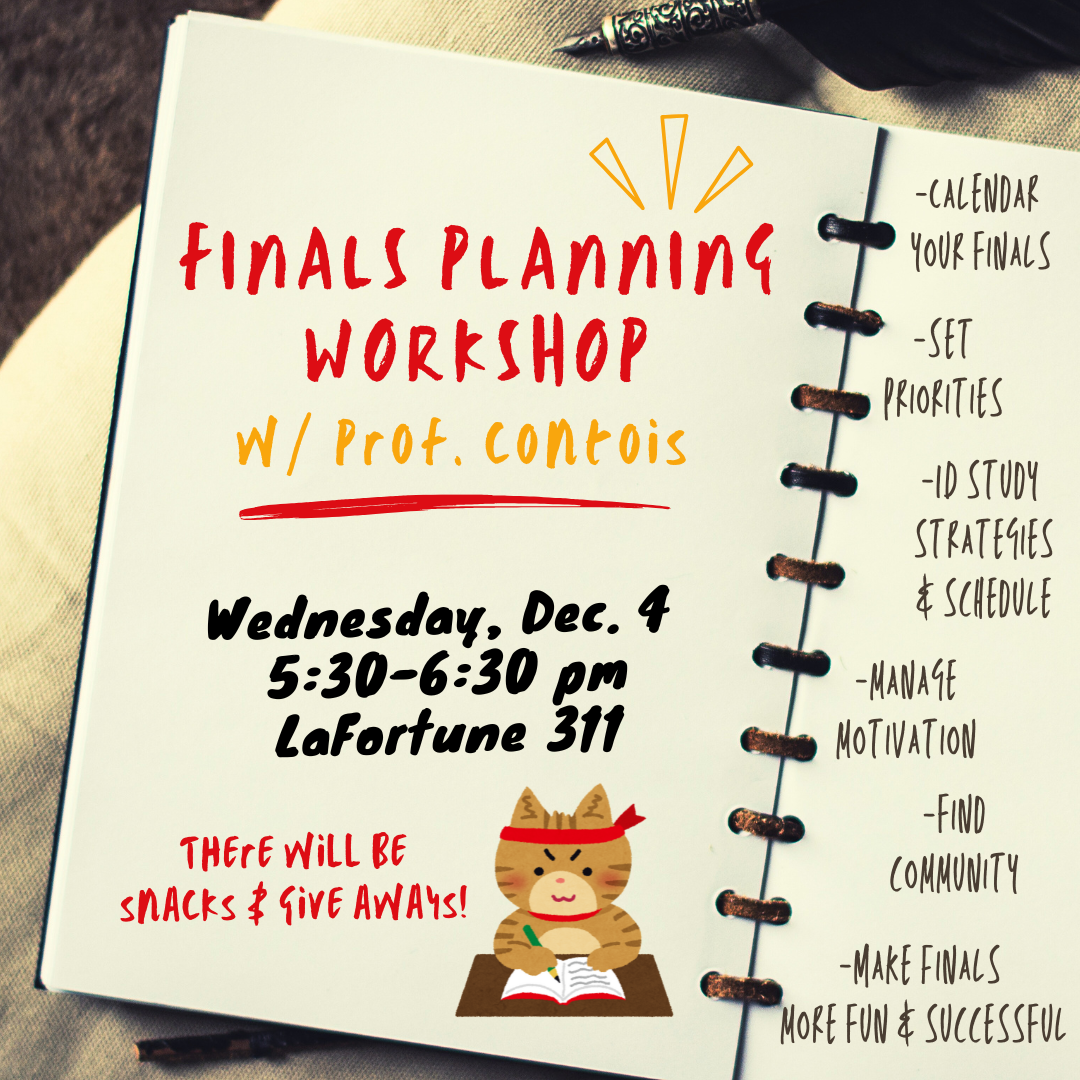
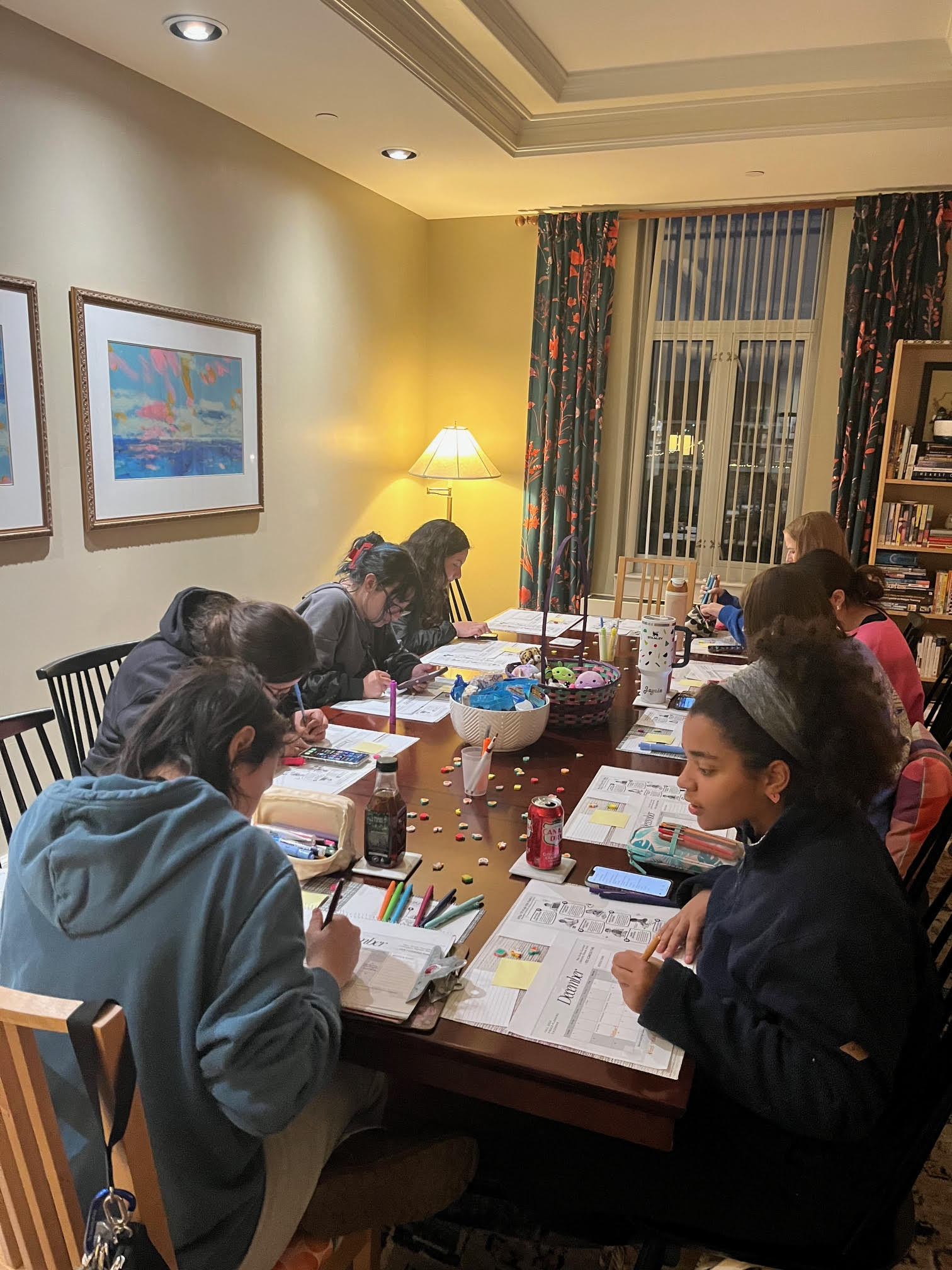
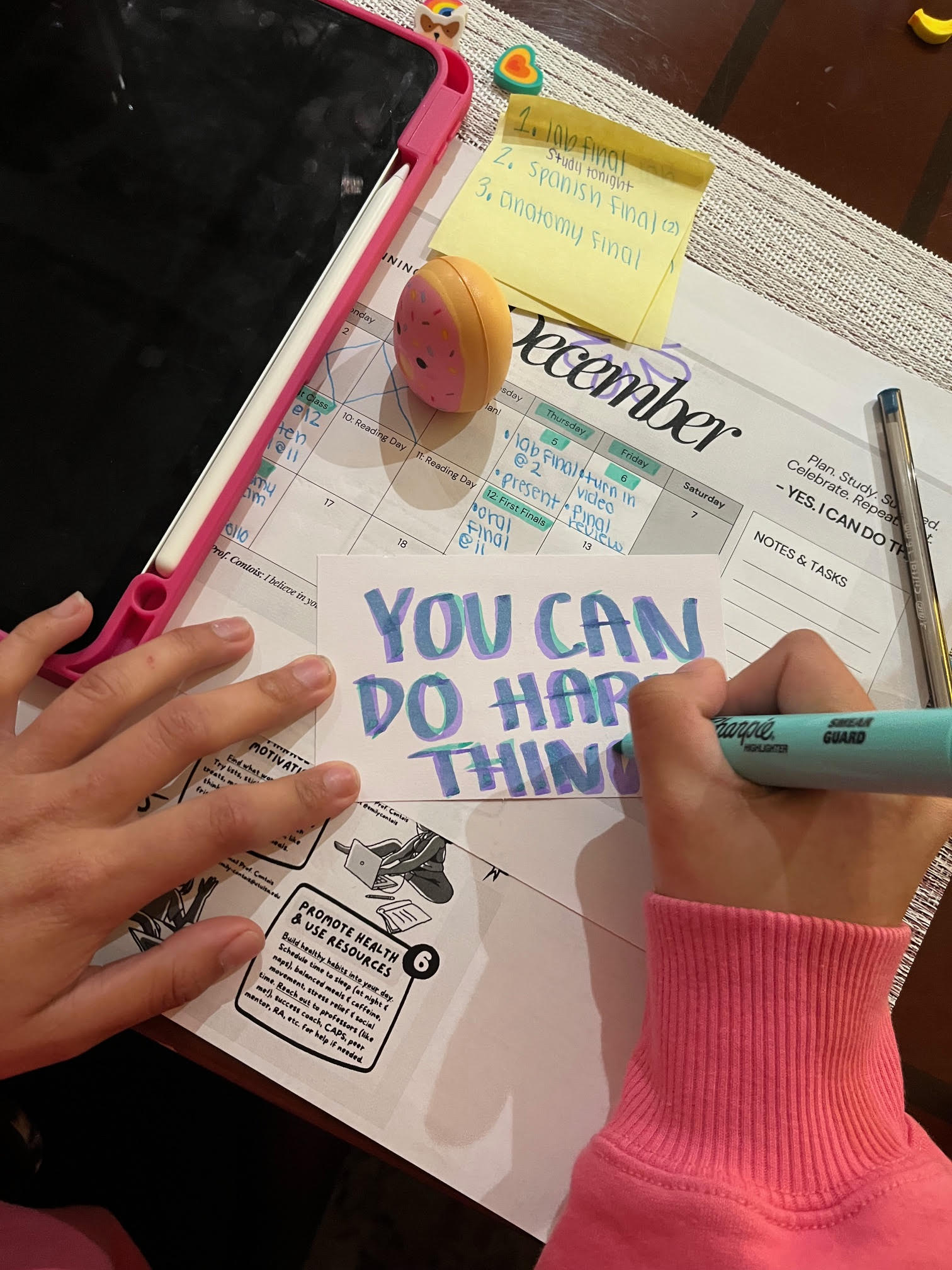
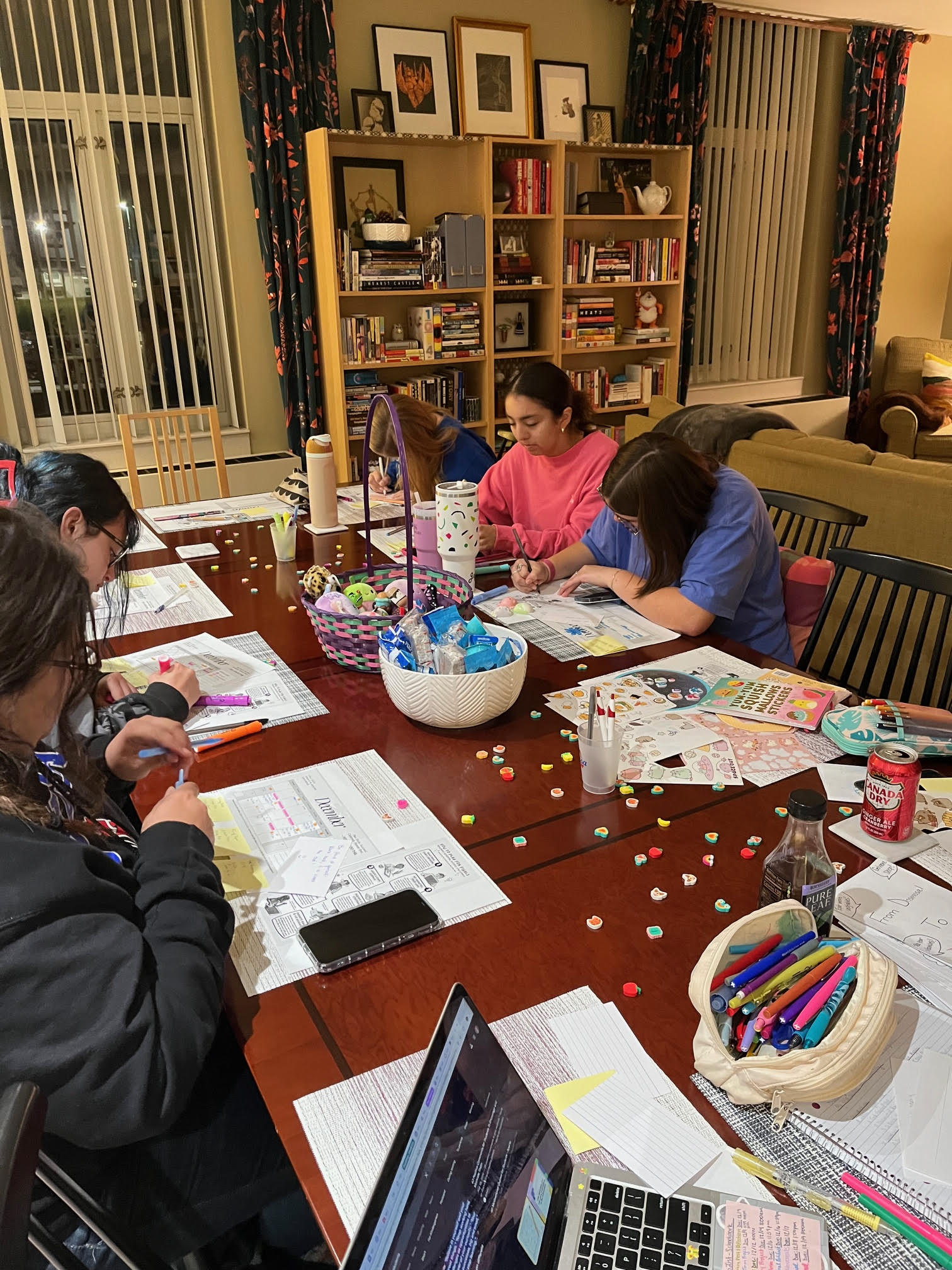
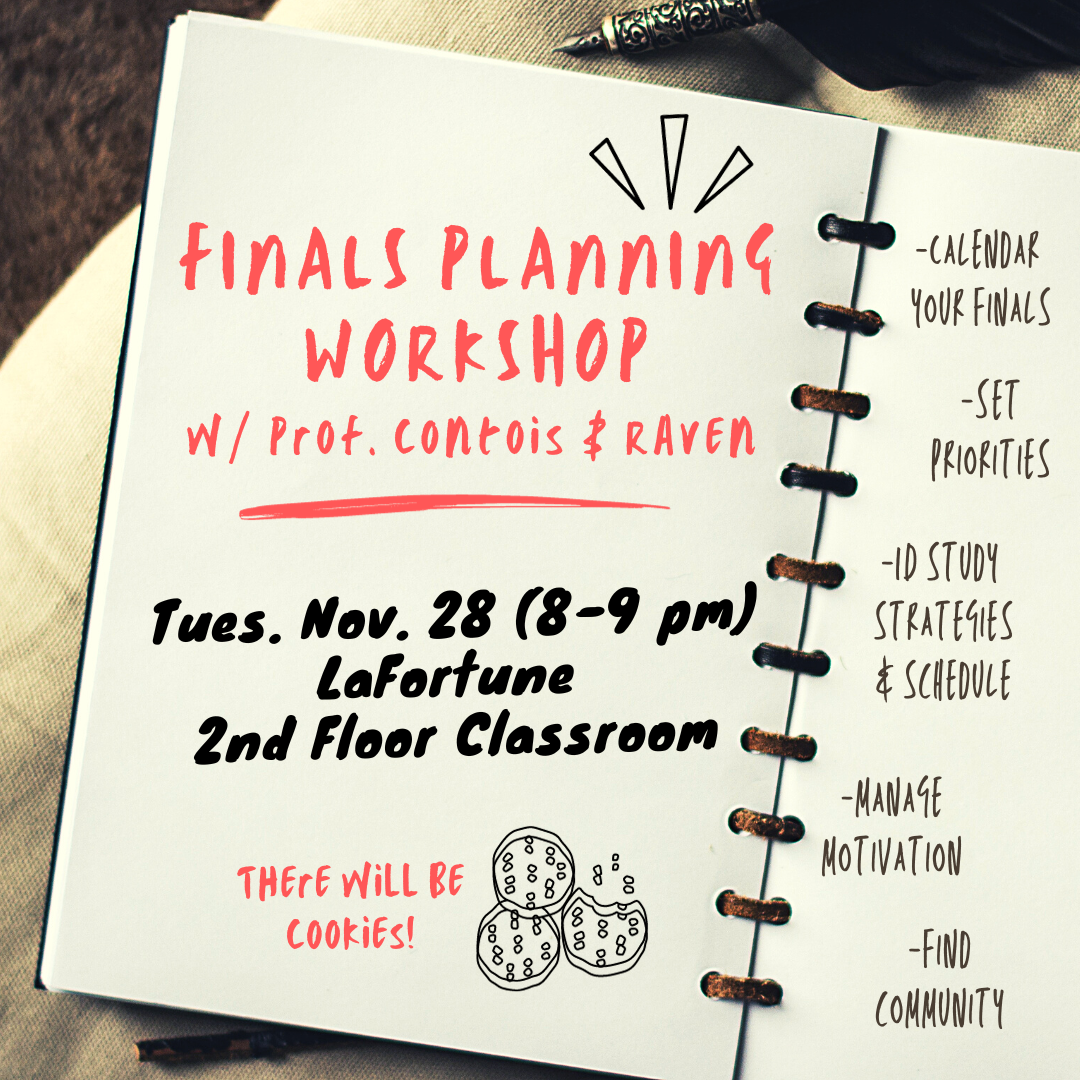
Finals Planning Support took place as a formal workshop in fall 2024 and an informal resource pick-up event in spring 2025. These sessions helped students to identify study and time management techniques that promote success on their exams and assignments, while managing motivation alongside mental, emotional, and social health needs.

Conclusion

As we conclude our third year as Faculty in Residence having hosted more than one hundred events, we are heartened and inspired by the many relationships we’ve formed with students on campus.

Building relationships with students over time is one of my favorite parts of being a professor and Faculty in Residence, such as with junior Media Studies and Women’s & Gender Studies major, Kellie Smith, who lived in LaFortune during her first two years at UTulsa. She writes:

Being from a small town and leaving a dance company, I craved family, connections, and leadership when I began college. This program gave me everything I needed and more. I went to every event put on by the Faculty in Residence program and met so many people. I’ve been to Pup and PJs, the Finals Prep Workshop, the monthly dinners that the Contois family put on, and the group trips that Prof. Contois has led, like to Philbrook Museum and events at 101 Archer. I grew as a person and as a student. My favorite event is Pup and PJs because it allowed me to have a space to just relax and get stress and worry out. The biggest plus is Contois’s dog always wears the cutest PJs. In all these events, I got to learn from peers, professors, and guests to the university about how college has shaped them as the person they are. Going into my senior year, I am grateful to the Faculty in Residence program for helping me build a foundation for my college career and adult life. The experiences and lessons I have learned from the Faculty in Residence program will stay with me the rest of my life.

Next year, I’m excited and grateful to be on research sabbatical with the time and space to write my next book. We’ll travel a bit, but we will still live much of the year on campus and plan to host an event or two during the year. We hope to return in fall 2026 eager to continue growing in community with UTulsa students.


Tips to Revitalize Your Writing When You Feel Stuck

I’ve been feeling stuck and overall less positive and optimistic about my writing lately. I’m working on book proposal revisions after a difficult 2024 stalled my progress, which I wrote about here. This personal history, mindset, and feelings made me avoid my writing, something I hadn’t experienced before. Even when I’d get my butt in the chair and open the document ready to work, I’d quickly start to feel overwhelmed and frustrated. Many writing experts recommend academic writing progress in 15-minute increments, but I literally couldn’t work on the project for much longer than that. Once considered by my friends to be a “prolific” writer, this state of affairs was distressing and depressing to me.

While not the case every year, this spring break was a week when I could dedicate all my time to writing and restoration. In the hope that they’re useful to others, here’s a recap of the strategies I used to reset my writing outlook and get back into my writing.

Plan to Succeed

Seek Support. I’d been trying for weeks to write on my own and it wasn’t working. I needed support beyond myself, so I scheduled a coaching session with Dr. Katie Linder ahead of my writing week. We processed what felt challenging and made a plan for moving forward.

Visualize Writing Going Well. From my “think like an athlete” research for the book project itself, I’d learned about the power of positive visualization. So, ahead of the spring break week, I visualized the writing going well, rather than how it had been going lately. In my mind’s eye, I saw myself sitting at my laptop typing and scribbling outlines on paper. The sun shined in the window. I was surrounded by an aura of positivity, competence, and gentle determination.

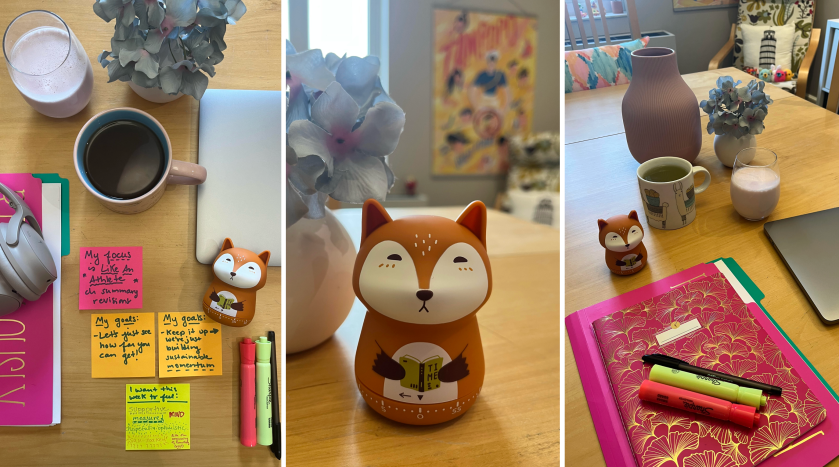
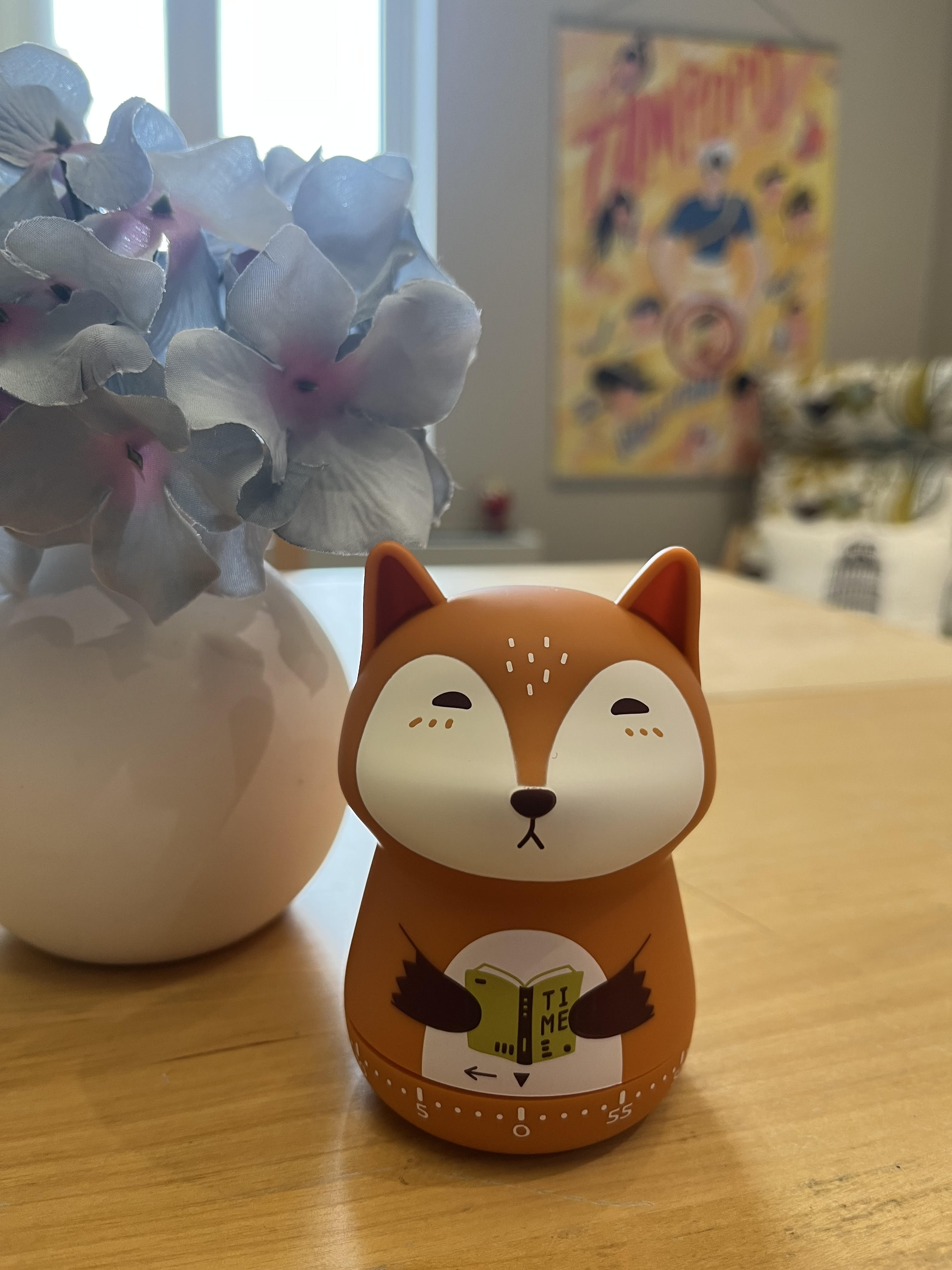
Purchase Supplies You Need. Since I was struggling to work for more than 10 or 15 minutes before frustration and overwhelm set in, I purchased ahead of time these cute animal timers. I don’t typically practice the pomodoro technique but felt how useful it can be. I also love cute things, so the fact that it was a darling fox made it more effective. I started with a 30-minute session and was relieved how quickly and easily the time passed. After the first day, I didn’t need my foxy timer anymore, but it was still fun to use. 

Set Writing Goals Differently

I approached the week intentionally and in a kinder, softer way than I usually treat myself and my work. My focus was on revising the chapter summaries for my current book proposal. I didn’t set a quantified goal of minutes or words or writing sessions completed. I didn’t even set baseline or stretch goals for how many chapter summaries I hoped to touch or complete. Instead, I had just two general process goals for the week. I wrote them on sticky notes the day before I started writing:

  • Let’s just see how far you can get!
  • We’re just building sustainable momentum; keep it up!

I also brainstormed how I wanted the week to feel. I’m normally a taskmaster, but this time around I needed to be gentler, and it helped!

Design Pleasant Writing Rituals

I know some writers can get knotted up in rituals and never get to the actual writing. But a combination of physical, mental, nutritional, and social rituals helped me write during a week when I needed a boost. My five days looked like this:

Manage & Care for Life Logistics. The first part of my day was the same as always. I woke up at 6:00 am along with my husband and dog. When I was revising my dissertation into my first book, I used to start writing right away, isolating myself from my family. Now, I drink coffee, check email, and chat with my husband while he eats breakfast. Then I kiss him goodbye for the day, leaving to walk the pup for two miles so she can be a calm writing buddy upon our return.

Facilitate a Writerly Mood with Podcasts. I always listen to podcasts while we walk. For this week, I didn’t listen to the news and higher ed content I typically listen to, which in our present moment is mostly anxiety-inducing. Instead, I listened to shows that put me in an optimistic and writerly mood. Favorites include:

Prepare Body and Mind to Write. Joli Jensen, author of Write No Matter What and one of my dearest writing mentors, advises us to reserve exercise for our “B” or “C time,” reserving our brightest “A time” for writing. For many writers, A time is as early as possible in the day. I typically do that, but for this week, I wanted to help my body and mind feel as well as possible, to remove one more potential barrier so I could write easily.

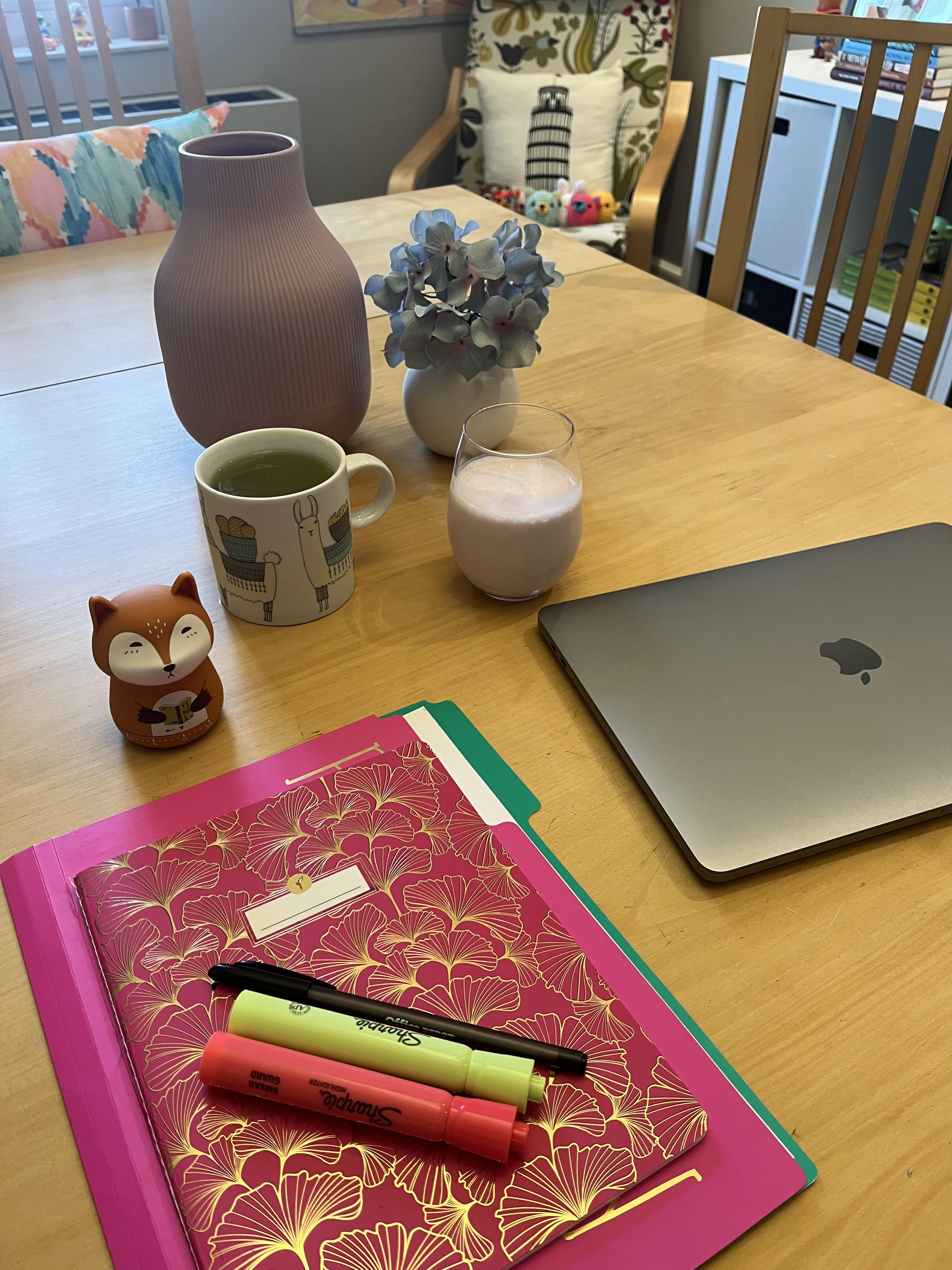
For me that meant I’d foam roll for 5-10 minutes after walking the dog. Then I did 15-20 minutes of gentle yoga, focusing on stretching, deep breathing, and affirmations, rather than an intense workout, which I did later in the day. This quiet, non-sweaty movement centered and calmed me. I also made a cup of tea and poured a Greek yogurt shake into a glass to sip while I worked, so I wasn’t hungry or parched.

Emphasize Space & Aesthetic Motivation, If It Helps. To jumpstart my writing, I wrote in a different space than usual, working from my home office rather than my work one. I set up my writing area aesthetically and a little differently everyday to lift my spirits—a different vase, a new mug, a candle to brighten the cloudy day, and so on.

Use social media. When I was a PhD student, I wrote about how taking and sharing photos of my academic work helped the process:

Call it a waste of time, but taking a pretty photo of the day’s [academic work] makes the effort a bit easier, a tad lighter, and a modicum more fun, especially when the going gets tough. It transforms this scholarly labor from the world of work to the land of aesthetics, amateur art, and gentle hobby-making. … It creates an object of inspiration and commemoration of my own design. It makes my intellectual effort material, legible, translatable and worthy of a stranger’s gaze, if not their understanding. A mental trick? Decidedly millennial silliness? Perhaps. But if it works, why not go with it?

I still feel this way, so every day, I’d snap a photo before I sat down to write. After my writing session, I’d share the photo on my Instagram account. Writing can be such solitary labor. Through their likes and comments, it was nice to feel supported by friends, fellow academic writers, and students.

Utilize All Your Materials

Start Fresh Documents. Part of what made me feel stuck with this writing was the fact that all the chapter summaries lived in a Word doc draft of the book proposal and in an overview document, both of which I’d revised multiple times already. I felt like a failure whenever I opened these documents and struggled to make good progress, so I started fresh. I copied and pasted each chapter summary into their own document and saved them on my desktop in a nice orderly line that grew with each passing day.

Work with Hard Copies, Pen & Paper. In addition to Word docs up on my laptop, I also printed everything out. I annotated the hard copies with colored highlighters when it helped me to find key points and themes across the chapters. I also mapped out the structure of each chapter by hand with paper and pen before writing it into the Word doc. 

After Writing, Rest & Restore

It’s of course a privilege, but dedicated writing days like this make it possible to reward yourself with free time to rest and restore after the work of writing is complete. I was lucky that once I was done with my writing (60-120 minutes each day), I could (mostly) enjoy the rest of the day however I wanted.

*****

These strategies helped me to revise everything but the introduction summary of the proposal! Sure, every summary still needs further revision before I share them with my agents for another round of feedback. But this week helped me to cultivate the three things I desperately needed: an optimistic outlook on my writing (generally) and this project (specifically), positive momentum, and enough progress that I now know what to do next.

I hope sharing these struggles and strategies is helpful. I’m wishing everyone writing that feels good! 

Class Engagement Tips from My Most Engaged Students

I had one wonderfully engaged class last semester, and one less so. I asked my engaged class, Intro to Media Studies (pictured above via an AI-assisted sketch), what we did well. I wanted to know what helped them to have consistent attendance, focused attention in class, and dynamic discussions with active participation from most students. Here’s what they said.

For context, this was an undergraduate course that enrolled 21 students. Most were Media Studies majors or minors, but some weren’t. Students ranged from their first semester of college to seniors. Several were international students.

1. Help everyone to learn each other’s names.

Students shared that my knowing their names, and that they knew one another’s names, both made it easier to engage in class discussions.

I facilitate this a couple ways. One is with blank nameplates. I cut cardstock in half ahead of class time on the first or second day of the course, and bring a bunch of brightly colored markers. At the start of class, I instruct students to fold their sheet in half lengthwise (so it makes a little tent on their desk) and to write their first name in a color of their choice. I often encourage them to also add a small doodle of something that they like or that defines them in some way. We then go around the room and introduce ourselves by our name and our doodle. I use the nameplates as an easy attendance measure. Students pick them up as they enter the classroom and deposit them as they leave.

We also spent one full day of class getting to know one another. As a small, no-points homework assignment, each student made an introduction slide in a Google Slide deck that everyone had access to. Students were encouraged to “use whatever design, style, fonts, colors, images, etc. you like to reflect you” and to include:

  • Your name (& pronouns, if you like)
  • A photo of you that you like
  • Where you’re from
  • Your major (or your aca-interests)
  • Anything you’re involved in on campus (e.g. sports, clubs, orgs) that you want to share with us
  • Media you love (e.g. favorite show, podcast, movie, website, TikTok account, etc.)
  • Something you want to learn in this class (this could be a skill, idea, or a particular topic/reading on the syllabus that interests you)

To further a lively feeling in our class and create social connection, as each student presented an intro slide, everyone was invited to snap their fingers if something the student presented resonated with them.

I also arrive to each class about 10 minutes early so I can greet students by name as they enter the classroom and say goodbye to them as they leave. I always call on students by name during class.

2. Capture & nurture the first brave sparks of engagement.

It can be awkward, nerve-wracking, or even scary to be the first person to speak up in a new group. My students said faculty can help drive that engagement by being especially encouraging and supportive of the first brave students who start the discussion. Even if a response isn’t perfectly correct or complete, I can always relate a student’s comment back to our core content or frame it as a starting point for other students to add to.

3. Encourage everyone to speak early in the semester.

Students said it helped to hear everyone’s voice early on in the semester. We did this with a couple of different prompts during our first few classes, in addition to our intro slide day. For example, during the second week, every student was prompted to rate how their first week of class went and to share any details (good, bad, or weird) that they wanted to.

Even when not directly about course content, these discussion exercises that were more social and silly helped us to build rapport. This paid off in our more vulnerable and nuanced conversations later on about, for example, social media and mental health, the state of journalism and politics, and sportswashing.

4. Explain engagement’s various elements.

Students understand the expectation to speak up in discussion, but it can be useful to talk through the other ways we show engagement in the classroom, such as:

  • Communicate intellectual engagement through our body by sitting in our desks with as much energy and posture as we can muster.
  • Make eye contact with the professor and classmates, if we’re able to.
  • Nod along when something said resonates with us.
  • Arrive to class on time, or even better, a few minutes early.
  • Stay off our phones.
  • If we use a laptop or tablet, use it solely for class purposes.

These aren’t just how we express and enact engagement. These are how we show care, consideration, and respect for everyone we’re learning with.

5. Teach discussion skills.

Students shared that our workshop day (when we explicitly covered how to actively engaged in class discussion) was helpful.

We covered these basic tips for how to engage in a class discussion:

  • Explicitly build on what someone else has said. 
  • Ask a question that encourages someone to clarify or elaborate a point.
  • Make a comment to link two people’s contributions.
  • If you found another person’s ideas interesting or useful, describe why.
  • Summarize people’s contributions, taking into account a recurring theme. 
  • Find a way to express appreciation for the insights you have gained from the discussion. Be specific.
  • Respectfully disagree in a constructive way. 
  • Aim for clarity and brevity. (You can even write your question/comment beforehand.)
  • Share discussion space with classmates.

We also covered how to phrase one’s entry into discussion with example scripts:

  • “I appreciate your point, but could you clarify [x]?:
  • “Ah, your point resonates so well with what [x] just said because [y].” 
  • “That’s so interesting / I agree because [x].” 
  • “Building on what [x] said, I think [y].” 
  • “Both [x] and [y] have pointed out [z], which reveals key theme [w].”
  • “I’m confused about what you mean about [x]. Could you explain a bit more?”
  • “I learned a lot today. I especially appreciated [x].” 
  • “Respectfully, I disagree with [y] because [z].”

6. Practice discussion with something bonkers fun.

After we covered the basics for how to engage in a discussion, we practiced. We first tried a silly discussion topic to get us warmed up and then a discipline-specific topic (“Are e-sports sports?”). My silly prompt was: “Which part of the Kool-Aid Man is sentient: the pitcher or the liquid?”

Admittedly, I’ve used this prompt with multiple classes and this was the first group who LOVED it and discussed it with significant energy. They could have debated Kool-Aid Man’s liveliness for the entire class period! This was a stroke of luck for me. But what the students shared that is more universal is that facilitating a discussion where students are thinking, caring, laughing, being creative and maybe even weird, and truly engaging with one another is what matters.

7. Create opportunities for students to share that class participation is difficult for them.

Students shared that being able to let me know that discussion felt difficult or very anxious for them was helpful so that I understood where they were coming from if/when they spoke up.

I facilitate this with the first low stakes assignment in my classes: a Letter of Introduction. One of the prompts reads:

State your goals for this course (e.g. sharpen a particular skill, earn a particular grade, to participate actively, etc.), and how you plan to meet them. Include if you anticipate needing any accommodations, help, or support from me and/or classmates. And I always love to know if you’re the first in your family to go to college and/or if you work a job alongside your studies, provide care giving for someone, or have other significant responsibilities or challenges beyond your studies alone, so I can keep that in mind this semester.

///

Engagement—that combination of attendance, attention, participation, and active learning that makes the college classroom a truly magical place—is harder to come by post-pandemic. It was such a pleasure to have this class excel in these measures. I’ll practice more intentionally some of these elements the students emphasized.

Best wishes to all faculty and students working together to build worthwhile and memorable learning experiences!

My 2024 in Dogs, Grief, Writing & Thinking

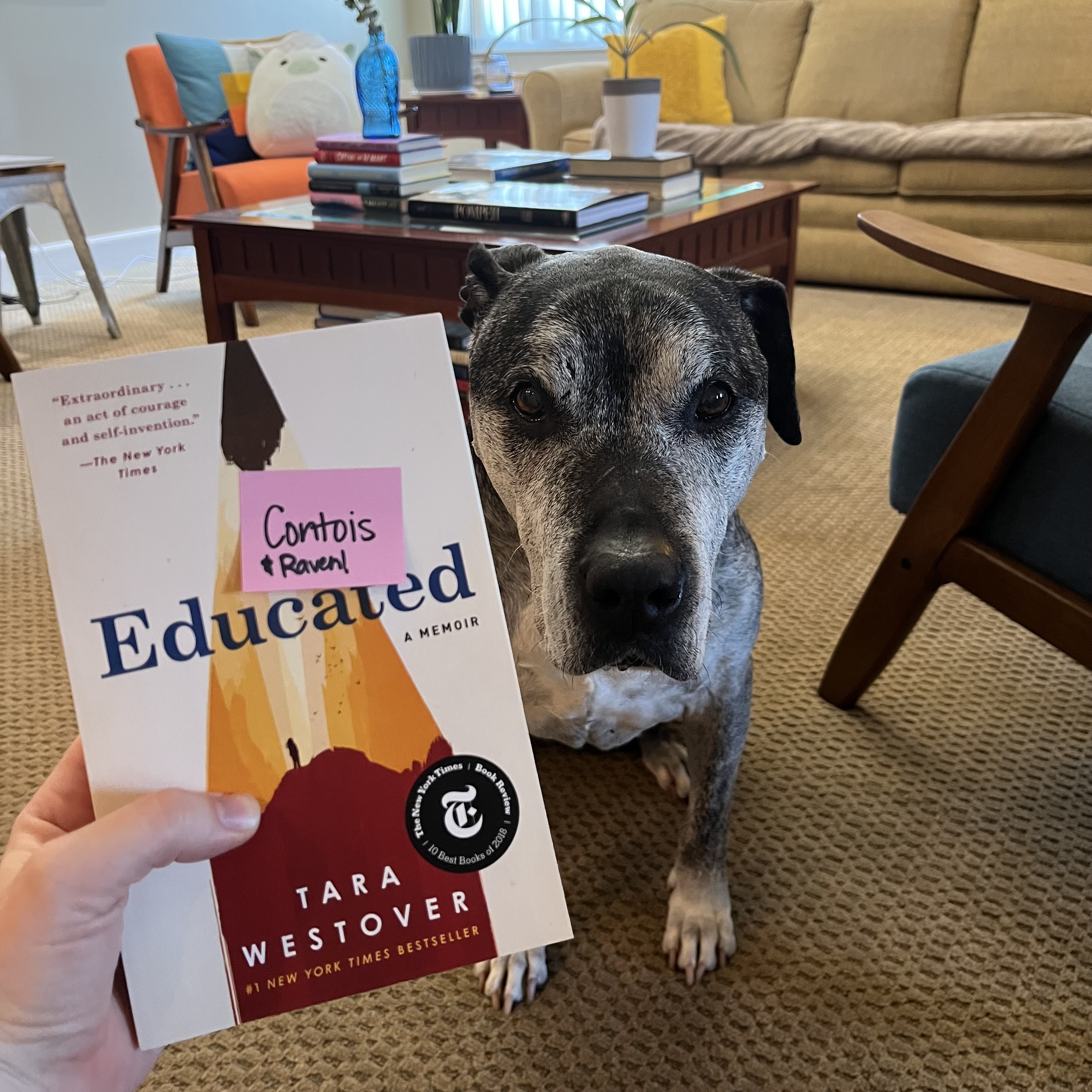
2024 was a difficult year for me. My beloved dog, Raven, died in February, unsettling much of my day-to-day life and imploding my annual writing plans.

We adopted Raven when she was four years old, while I was finishing my PhD coursework at Brown. Our daily walks and snuggles punctuated and structured every academic milestone over the next nine years. She was my stalwart writing buddy. When I was intensely working on a piece, she was with me, everyday, in my office. She came to office hours and visited most of my classes, becoming a favorite of my students, too. She was loving and loyal, sweet and a bit stubborn. Most days she was our zen queen. We have no children, so she was our baby, even as she aged into grey hair, a more angular face, and bony little hips.

Then she was gone. Lost to us, over the course of a single day.

I cried more than at any other moment in my life, sobs so big and constant that they left my core muscles aching. I had to email my students ahead of class to tell them that they couldn’t talk to me about Raven because I would start to cry and wouldn’t be able to stop. Losing her literally broke me. As an ultrasound would later show, my grief sprouted a benign lump in my left breast, right over my heart.

It would have made sense, as my husband pointed out, to wait to adopt a new dog. It would free us up for travel more easily, especially during my (hopefully upcoming) sabbatical. But I couldn’t hold out. I couldn’t handle the loneliness of daily life without a dog.

And so in May we adopted Ruby, who we adore. If you’ve ever seen Noah and Lincoln on social media, you’ll recognize our transition from an older, calm dog to a younger, more energetic pup. 2024 was the year of Moo Deng, the riotous pygmy hippo. Ruby is very much our “bouncy pork,” with her boundless love and playfulness. After a few months getting settled as a new family, I taught three courses in the fall 2024 semester. It was a busy time of transition, new routines, and much less writing than usual.

The wonderful thing about producing knowledge is that it doesn’t stop when you do. The work you’ve already created and shared continues to circulate. It builds or finds resonance. You get to keep thinking, even if putting new words on the page feels arduous.

And so that was the bulk of my year. I got to engage with journalists and podcast hosts on an array of topics, while I churned out just a few new things.

Health & Fitness

Given the research I’m doing on my next book, Like an Athlete, questions of health, fitness, and diet animated a lot of my writing and thinking in 2024.

The year began with a piece I wrote in late 2023 and published in TIME Made by History, “Your New Year’s Resolution to Carry a Water Bottle Has a History.” I got to discuss it on 1A via WAMU NPR, too. I also published some 2023 Like an Athlete research—“Are We Becoming Ivan Drago? Analyzing Today’s Fitness Tech through Rocky IV”—in Nursing Clio in the spring. (Funnily enough, my husband got me an Apple Watch this Christmas. I’ll see if using it inspires me to change my mind.)

Diet culture is shifting yet again with the rise of new prescription drugs deployed for weight loss. I chatted with both the New York Times and Canvas8 about the so-called era of “Brozempic,” as men take these drugs and navigate gendered notions of dieting and weight loss.

I also was a guest on an episode of Sabrina Magnan’s The Live Unrestricted Podcast discussing how the truth (and lies) of wellness, diet, and fitness culture intersect. I also chatted with The Sporkful senior producer, Andres O’Hara, for the episode, “Super Size Me, 20 Years Later.” I pondered the legacy of this fast food documentary, along with valuable insights from my students’ experiences, too.

Social Media & Pop Culture

I got to think with journalists and podcast producers on an array of global social media and pop culture trends: from kicking off Sam Low and Jean Ten’s new Ate, Ate, Ate podcast out of New Zealand to discussing “girl dinner” and other TikTok “girl” trends with Michelle Linn for Fox23’s On Her Mind here in Tulsa.

I also chatted with Dakshana Bascaramurty about the history of food criticism and the transition to influencers for Canada’s The Globe and Mail, and with Emma Jacobs of the Financial Times about how social media resurfaces and remediates older food trends, like cottage cheese.

I never would’ve guessed that my past research on Instagram and trophy kitchens would perfectly collide to inform 2024 writing on “fridgescaping” by Caitlin PenzeyMoog for Vox and by KC Hysmith and Stephanie Ganz for Eater, but it did!

Drawing from my work on gender and pop culture and the anti-fandom research I did on Guy Fieri for Diners, Dudes & Diets, I got to be part of “Episode 3: Love 2 Hate” of Generation Barney. It’s a podcast from Connecticut Public Media that unpacks the legacy of the 1990s TV show and the broader influence of nostalgia for children’s media. Like when I analyzed Hot Ones through the lens of gender, my comments generated a fair amount of right wing media response, sigh.

The first new words I was able to write after Raven died were for a book review of editors Christina Bartz, Jens Ruchatz, and Eva Wattolik’s Food – Media – Senses: Interdisciplinary Approaches for the Society for the Anthropology of Food and Nutrition. Over the summer, I also wrote the chapter “Cooking as Popular Culture” on the history and present of cooking television for Cambridge History of American Popular Culture, edited by Lauren Rabinovitz, which is set to come out in 2025. I also wrote and revised a chapter analyzing Lessons in Chemistry for a one-day forthcoming volume on food television.

Soda

Soda had a 2024 moment! I loved chatting with journalists about the rise, fall, and rise again of soda, including their medicalization for Vox, their celebritization for Business Insider, how they became “zero” for The Colin McEnroe Show, and why soda is all the rage in Utah for The Salt Lake Tribune, alongside food studies friend Christy Spackman.

Food, Politics, Gender & Culture

Food and gender is one of the most enduring themes of my research agenda and 2024 was no different. I had a quote or two in NPR’s big climate package, which included discussion about why some men find it hard to reduce their meat consumption. I was also delighted to be a guest on the first season of Bite Back with Abbey Sharp in which we chatted about “Gendered Eating Tropes in Media & Marketing” and how they affect women’s social power.

For my first media mention of the year, I chatted with a student journalist for Spoon University about food as a sex symbol and later with Highsnobiety about gourmand perfume, diet culture, and what smelling sweet means.

Since 2024 was an election year, I got to talk with journalists at NPR, the LA Times, and Mother Jones about the role of food on the political campaign trail.

And I was truly honored to be among the “scores of chefs, recipe writers, historians, and food luminaries” that Dan Kois and J. Bryan Lowder reached out to for Slate‘s “The 25 Most Important Recipes of the Past 100 Years.”

///

I’m currently making plans for the 2025 writing I can control. And I’ll look forward to seeing what new thinking and chatting opportunities come my way in the year to come, with Ruby by my side!

To anyone reading, I wish you all the best in life and writing, too.

2023-2024 TU Faculty in Residence Annual Report

Executive Summary

The 2023-2024 academic year marked the second year in my (Emily Contois, Associate Professor of Media Studies) Faculty in Residence (FiR) journey at The University of Tulsa, along with my husband, Chris, and our dog, Raven.

TU’s FiR program is a living-learning community that provides both formal and informal interactions between students and professors that form a bridge between the classroom and student life, with the goal of enriching students’ daily lives and overall college experience.

Our second year continued successful first-year programming—like weekly office hours, weekly tag along calendars, and monthly dinners at our home—as well as new additions like semesterly academic skills workshops, updates to a community study space in LaFortune House, and my teaching three sections of the First Year Experience course.

This year’s program was also marked by tragedy, as our beloved family dog, Raven, died unexpectedly in early February 2024. She was a student favorite and played an active role in our FiR program. Her loss introduced some unavoidable changes to our plans, but her passing also documented the intended outcomes of our FiR program—sustained, meaningful relationships between faculty and students that enrich the college experience. I was touched and grateful to receive messages, cards, flowers, and other sweet gestures from students and alumni here in Tulsa and from around the world. Chris and I are excited to adopt a new rescue dog this summer, and eager to introduce her to students in the fall.

Starting in spring 2024, our FiR program also began an expansion in focus, from mostly LaFortune House residents to all TU students. This broader, campus-wide audience will comprise our efforts in future years, which we look forward to embarking upon in fall 2024.

FiR Program Elements

Building from the higher ed literature on effective FiR programs, we seek to facilitate sustained interactions with students that combine academic and social elements, as well as providing opportunities for “deeper life” conversations once solid professor-student relationships have been cultivated.

2023 Pilot: FYE-FiR Coordination

In fall 2023, the FiR program—with support from TU’s President and Provost offices—coordinated with Housing, Student Advising and Student Success, and New Student Programs to pilot an FiR program enhancement. Rather than just living with LaFortune House residents and offering in-building programming, I taught about 50% of these residents across three sections of TU’s 1-credit hour First Year Experience course, along with first-year students living in other dorms. This effort aspired to further integrate the FiR program into the first-year student experience and foster stronger connections between myself as FiR with students living in LaFortune House.

The coordination between FYE and FiR was received very positively by some students. For example, one student commented on the FYE course evaluation:

Professor Contois clearly enjoyed teaching the course which in turn really allowed me to enjoy the course and what we were talking about each class. She was also extremely easy to reach and was clear about when her office hours were and even held some in my dorm which made it even easier to reach her.

Another student commented at length:

Professor Contois is absolutely amazing! I love her so so much. She cares about all of her students so much and wants the best for all of us. She wants to make sure we are always comfortable with what we are talking about but also engaged in the conversation and getting us all involved. I absolutely love her and Raven!! For our reflection papers, she takes time out of her day and her nights to read every single word and write us several comments back and then a genuine comment back to us which just makes me feel so loved. Professor Contois genuinely feels like my college momma because she invited me for dinner at her house, I go to office hours with her and she talks to me not only about school but also about my life and always says to come to her if I ever need anything or need help with anything. I just love her and her family so much!

For other students, the synthesis between FiR and FYE was less influential. Several students who were placed in LaFortune House as part of Hurricane Prep (a summer-time bridge program) rather than voluntarily selecting the dorm and the FiR program, reported in their evaluations that they found their fall FYE class with me duplicative, and were thus less engaged with both FYE and the FiR program.

I’m taking these pilot program results into account as I ponder if and when to continue intensive FYE teaching. I am also considering other innovative possibilities to synthesize FiR programming with coursework in future years.

FiR’s Role in Student Recruitment

As Faculty in Residence, I participate in student recruitment events each semester, usually speaking on panels for prospective student parents. Having done so for two years, the FiR program is now able to support students and their families, even before they enroll at TU. For example, at the spring 2024 TU Up Close lunch, I re-met several parents whose student will enroll in the fall.

One representative comment from a student’s father sent to me on Instagram reads:

Can’t tell you how excited [our child] is to be coming to Tulsa next year! You were a huge part of her decision! Thank you for everything you do!

FiR Student Welcome Efforts

Handwritten Welcome Notes on every suite door were one way that I welcomed students to their new home in LaFortune House.

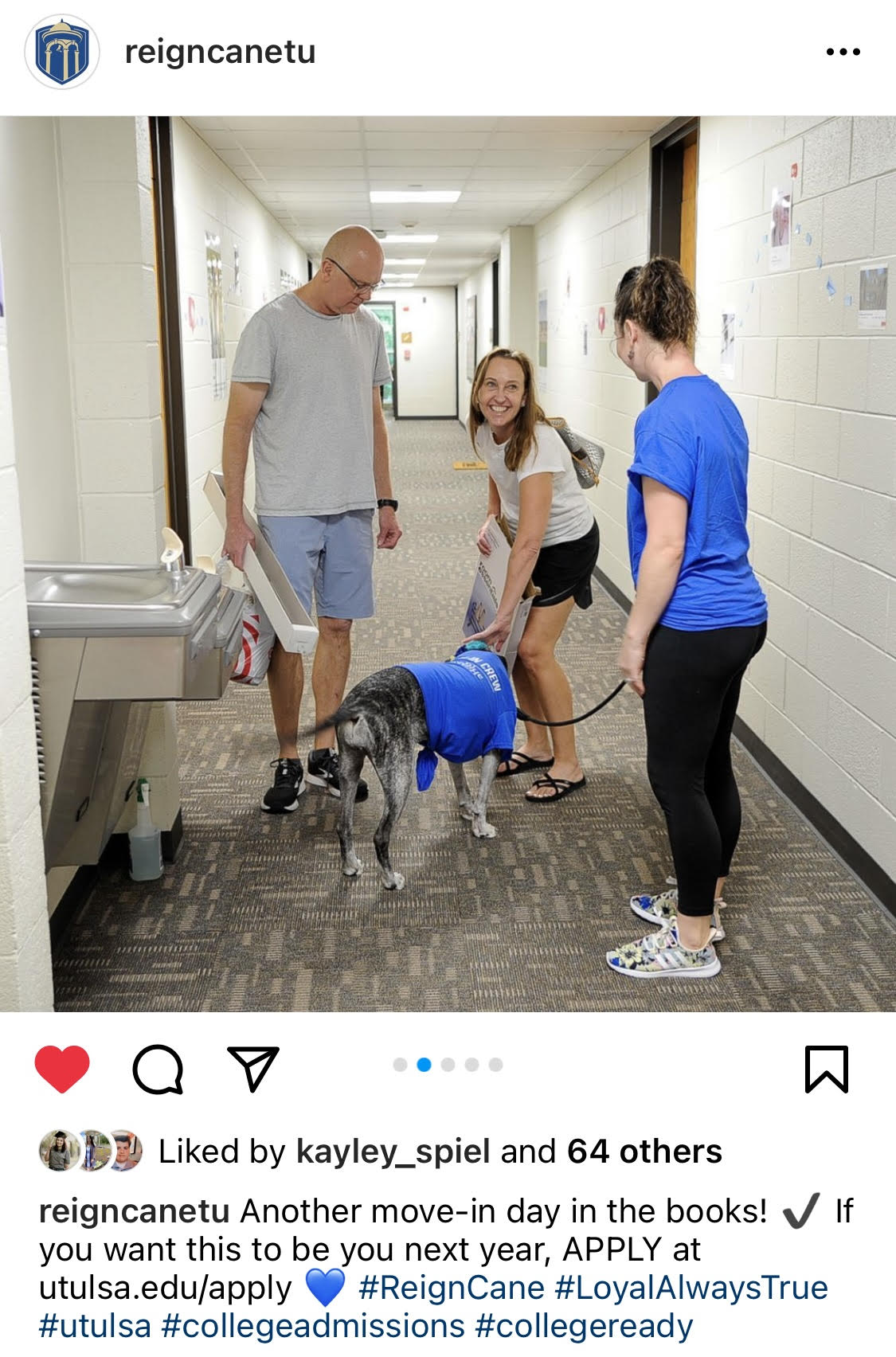
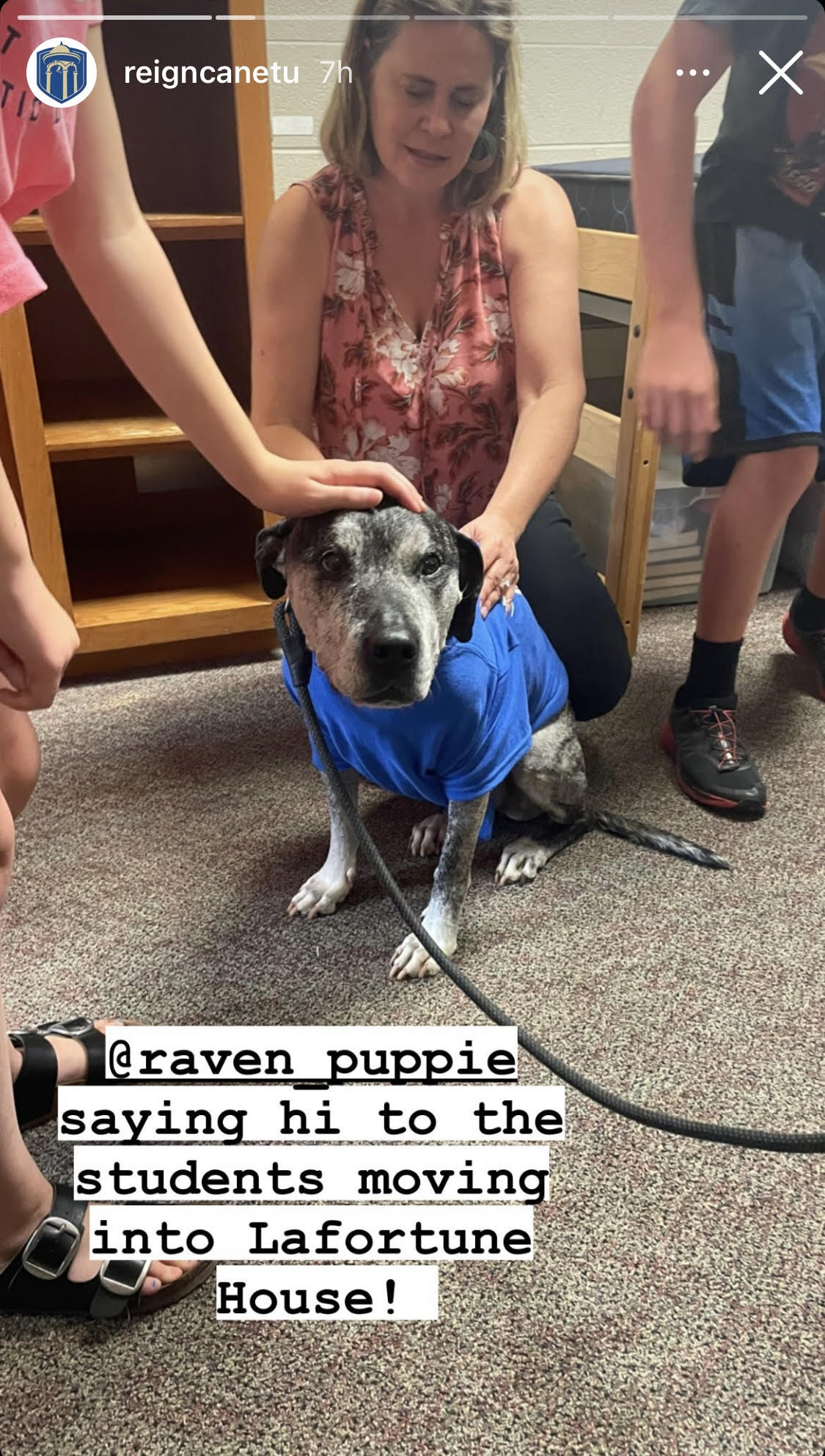
Move in Day in August 2023 was an opportunity to meet many students and their families as they moved into LaFortune House. Raven and I met families outside and walked the halls to introduce ourselves and answer questions.

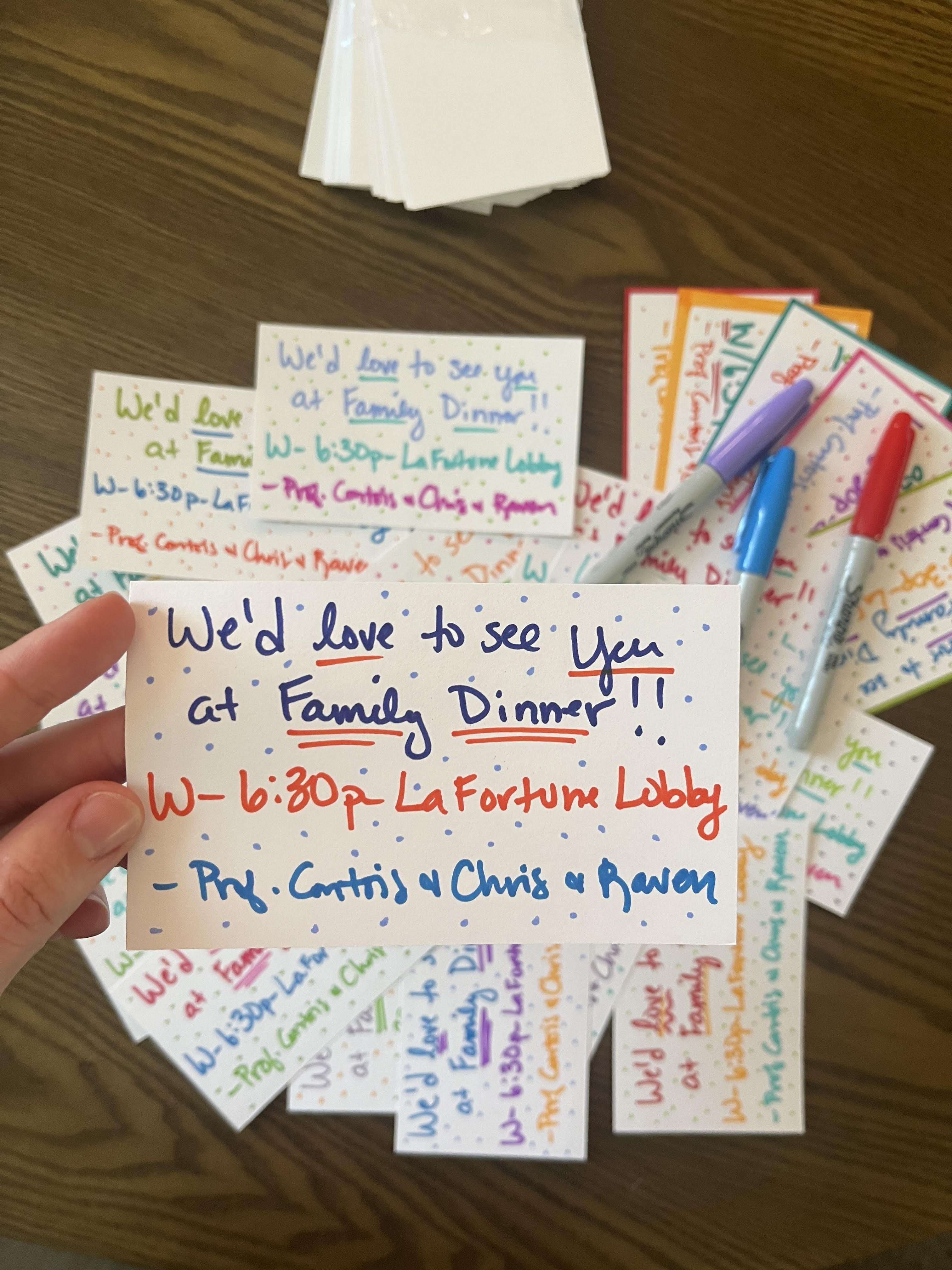
FiR Flyers & Business Cards communicated FiR standing events. I designed them each semester, and with RA help, they were posted throughout the building. I also distributed FiR business cards to all residents at our first LaFortune hall meeting, left stacks in the LaFortune lobby for all of the fall semester, and passed them out in all of my fall 2023 classes.

Student Orientation provided an opportunity for me and Raven to introduce our FiR program to new students, beyond those who live in LaFortune House.

Standing FiR Events

During the 2023-2024 academic year, we held the following events on a regular basis to offer both academic and social support to students, especially those in their first year of college.

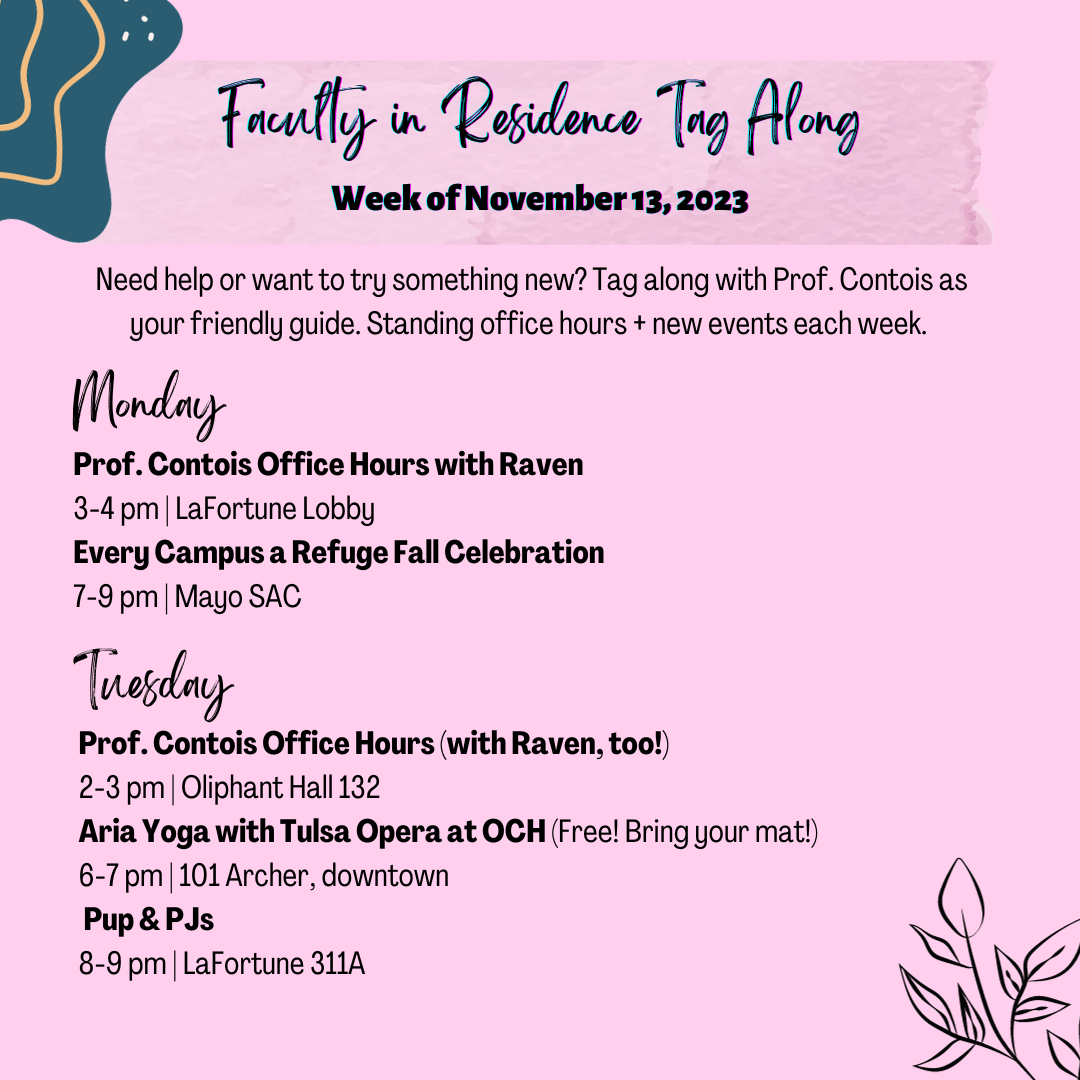
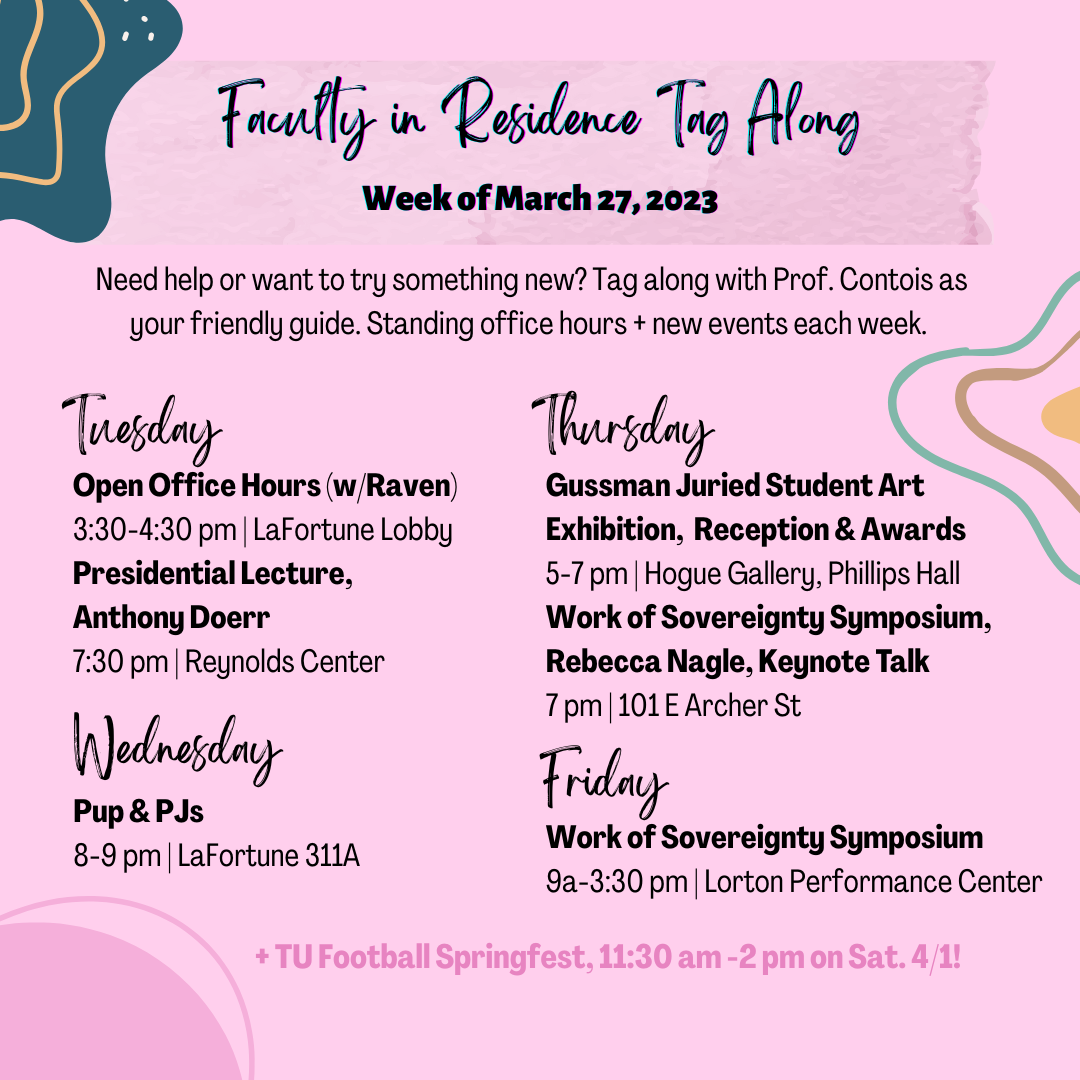
A Weekly Tag Along schedule was posted on my Instagram (@emilycontois) every Sunday or Monday, listing campus events that I planned to attend that week, in an effort to model university citizenship and engagement. Students were always welcome to tag along with me, so they could explore and engage all that TU offers without having to do so alone. We’ve attended TU Symphony Orchestra concerts, student organization events, student athletic events, fitness classes at the Collins Fitness Center, events hosted by the Oklahoma Center for the Humanities at 101 Archer, and much more.

FiR Apartment Dinners were possible thanks to the wonderful support of TU Catering. We hosted 3 dinners in our home each semester, dining with LaFortune residents and RAs, as well as students from across the TU campus and recent alumni, too. These dinners will continue to be open to all TU students with invites sent to students who complete our RSVP survey. Next year, we’ll share the survey via my Instagram, emails to students enrolled in my classes, and with postings in the TU Events calendar.

A LaFortune Lobby Office Hour took place one afternoon every week. These provided opportunities for students in my classes, as well as any and all TU students to stop by for academic and social help, or just to chat or co-work. Lobby office hours also provided opportunity for informal and impromptu interactions with LaFortune residents as they passed through the lobby on their way to classes.

A Pup & PJs Office Hour took place one night every week from 8-9 pm in the Faculty Study adjacent to our FiR apartment. The students, Raven, and I loved this special time together. These office hours were discontinued after February 2024, but we hope to bring them back in the future, if and when our new rescue dog feels ready to do so.

Daily Campus Walks: Every day we could, Raven and I walked campus in the morning (and often in the afternoon and evening, too), making every effort to say hello and engage with TU students and our entire TU community. She was also a fan of the new Starbucks on campus, where she was always offered a pup cup.

Meals at Pat Case Dining Center: I interacted with residents and students (as well as faculty and staff friends) multiple times a week, whether at lunch, dinner, or weekend brunch. Sometimes I swung by for a quick bite. Other times I settled in for a couple hours with my meal and reading or other work.

Funnily enough, parents off campus loved seeing these photos. One representative comment sent to me on Instagram reads:

I love that you’re showing that it’s possible to eat healthy on a college campus.

RA Meetings were hosted in my home once per month, so I can work closely with the student leaders in LaFortune House on events and staying up to date on any students of concern. I also hosted a dinner at the end of the academic year to thank the RAs for their hard work.

Semesterly Class Visits provided opportunity to host all of my classes at my home at least once per semester with the goal of fostering a special learning environment grounded in nurturing hospitality, while also raising FiR program awareness.

Monthly (or more) Residential and Campus Events were opportunities for Chris, Raven, and I to further integrate with our TU community like (pictured below) game night, attending TU football games, a sex ed event, the annual Student Activities Fair, and watching Barbie together.

Special Events

Get Organized Workshop & Dinner in early fall 2023 was a new academic skills workshop I developed to provide step-by-step recommendations for students to lead an organized, lower-stress, and well-balanced college life.

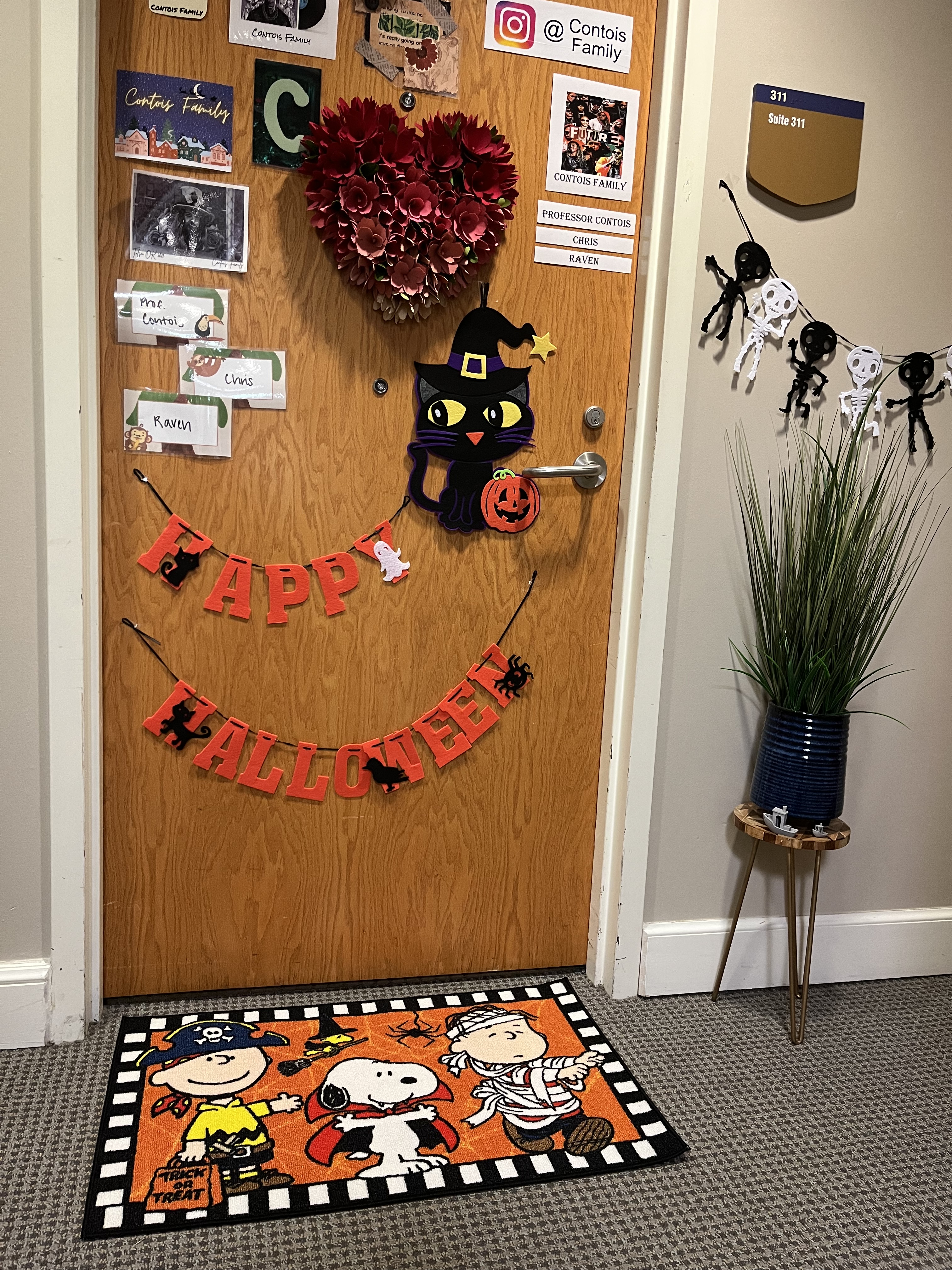
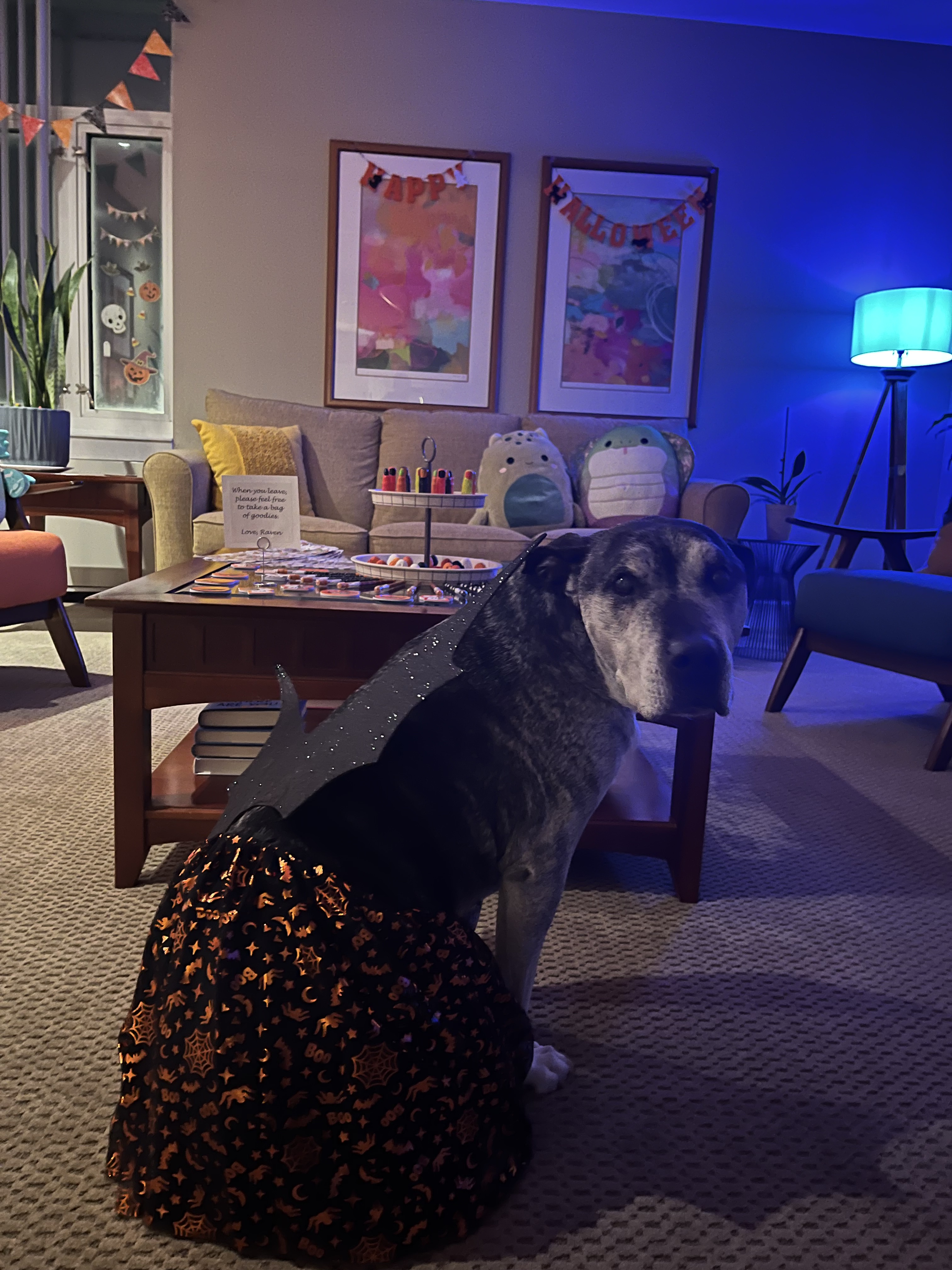
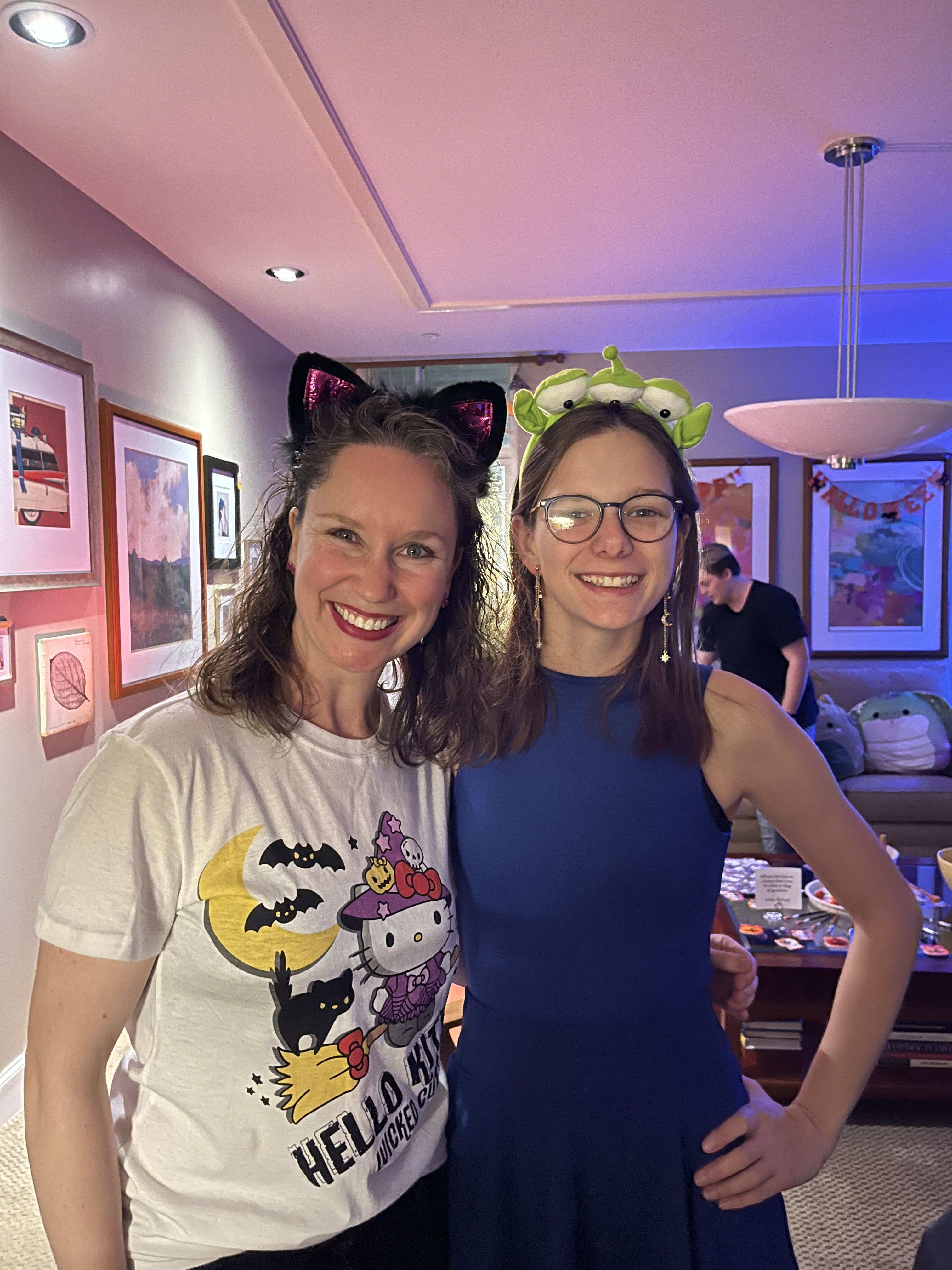
Halloween Party was a fun, social event to welcome students into our home for fellowship and community-building.

Mid-Semester Notes, handwritten and posted to every suite door, offered encouragement to students, along with the reminder that I was always available to meet with and support them.

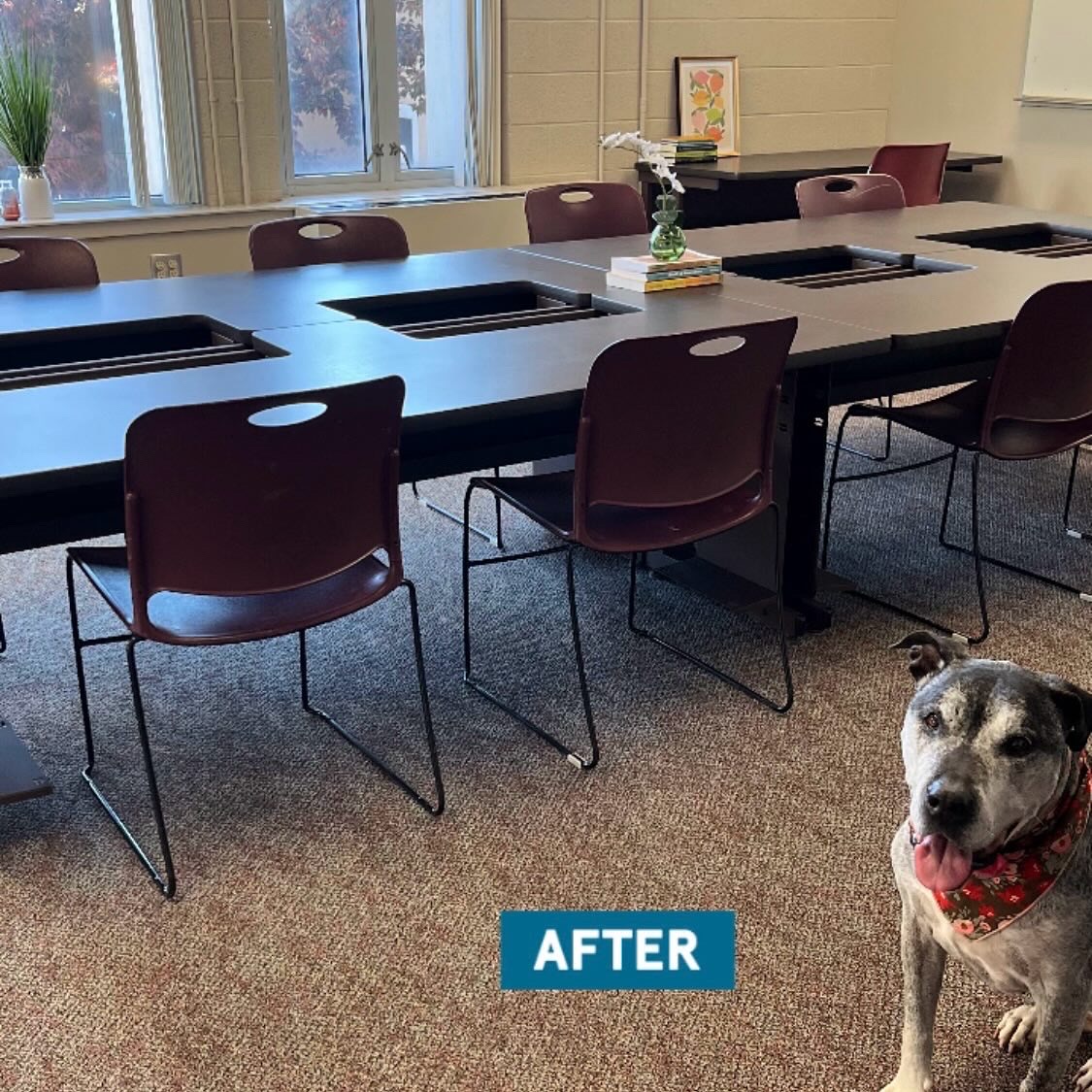
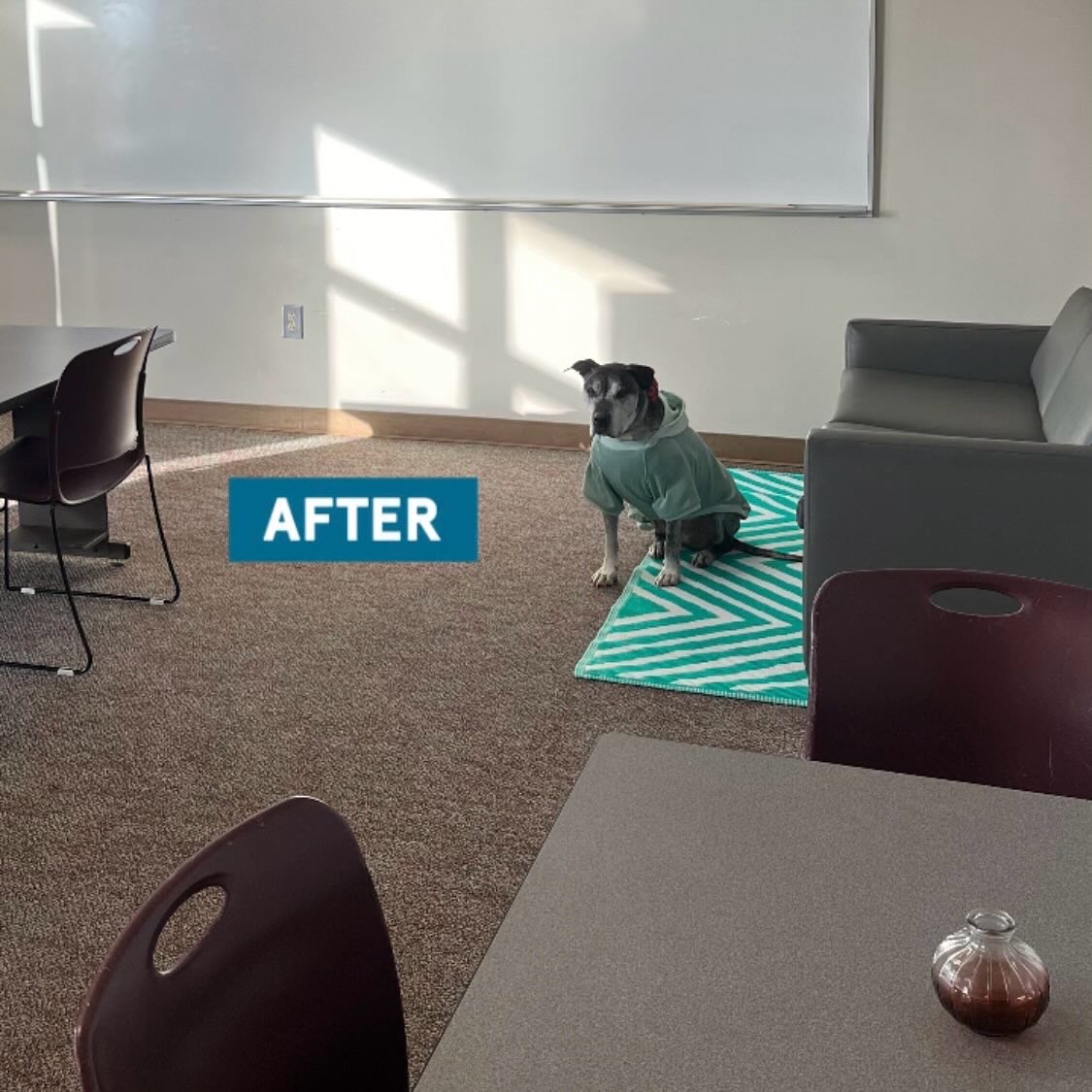
LaFortune 2nd Floor Classroom Update was a project I took on over the Thanksgiving 2023 break. This space had fallen into disorganization and was rarely used, but some cleaning, furniture repositioning, and a few stylish touches made it a favorite study spot for LaFortune residents.

Valentine’s on every suite door was a way for me as Faculty in Residence to express care for every student. We had planned and already purchased goodies and other supplies for a Valentine’s Birthday Party for Raven, so we instead gave away those items as part of special office hours and during my classes on February 14.

Finals Planning Workshops took place in both fall 2023 and spring 2024 to assist students to plan ahead for the busy weeks of finals. I developed and distributed to students custom calendars; infographics depicting “The Contois Method” for intentional, successful, low-stress finals; as well as snacks and giveaways.

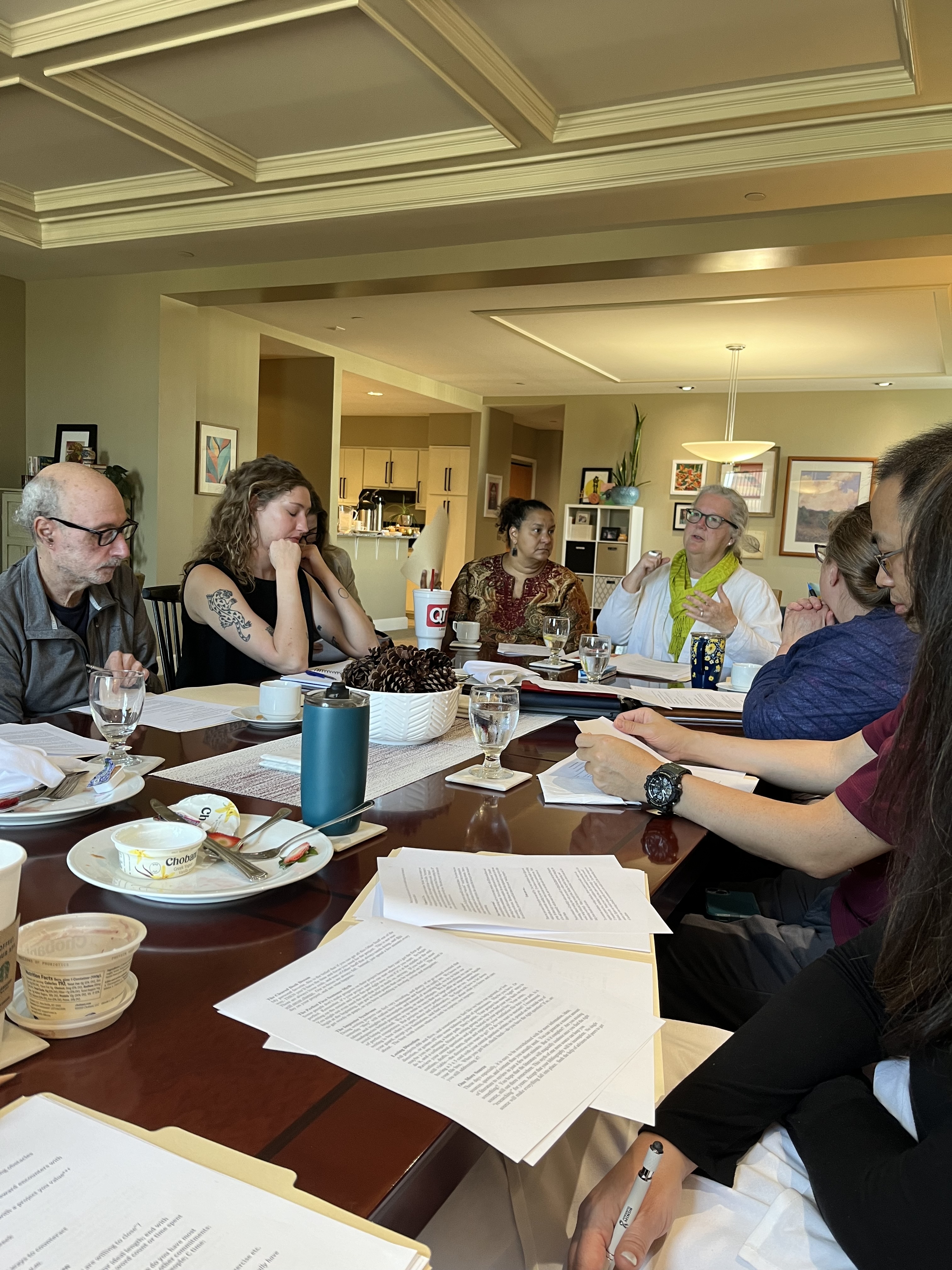
Faculty Summer Writing Plan Workshop is hosted annually by Dr. Danielle Macdonald, TU professor and Director of the Henneke Center, with writing coach and TU Professor Emerita, Joli Jensen, in the Faculty Study in the McFarlin Library. When April 2024 storms caused flooding in the library, I volunteered to host the writing workshop in the FiR apartment. It was a wonderful opportunity to welcome faculty peers into LaFortune House and into my home.

Conclusion

As we conclude our second year as TU’s Faculty in Residence family, we’ve established events, rituals, and communication methods that realize our mission to cultivate meaningful relationships between students and faculty. As we look to our third year, we will build on these successes and further expand our efforts beyond LaFortune House to all TU students. Watch the TU Events Calendar for postings, as well as my Instagram, @emilycontois!

New Faculty Advice: What I Wish I Knew

I recently participated in a panel for our new faculty at the University of Tulsa on what I wish I knew as I started my academic career here. This post gathers those learnings and bits of advice from my early tenure-track experience, and I hope it’s useful to others. As this post’s image captures, this stage in one’s career is a new beginning. It contains both triumphs and challenges, clear days and storms.

Research

  • Protect research & “A” time, but find a new verb. We often talk about “protecting” our research time, which is undeniably important if we want, or need, to produce a significant amount of quality research. I agree with everyone who advises to put research and writing on your calendar just like you do the classes you teach, and to always show up. As often as possible, follow Joli Jensen’s advice to give your research and writing your “A time,” that is, your best and brightest brain energy and attention. While all of that is good advice, protection can be a problematic, and even destructive, framing, when it comes to research’s place within the rest of our careers and lives. Instead, I’d say: keep, nurture, and honor your research time.
  • Reduce research at the start. All that said, it’s okay to temporarily reduce research at the start of your first semester teaching multiple courses. I did. (Read more on that in this post on how I wrote my first academic book from my dissertation.) Give yourself an “ignition date,” maybe 4-6 weeks into your first semester, to start creating the schedule and habits to ensure that writing and research become, and remain, routine.
  • Seek out resources for writing and research. Don’t try to go it alone! Attend whatever workshops are offered at your university on research, writing, review processes, and tenure and promotion. Find and be part of a writing group for supportive accountability. If your library has a faculty resource center, visit it at regular intervals. Whenever I need a boost, I check out academic “self-help” books on writing, teaching, sustainable academic careers, and so on. Even if they don’t contain life-changing advice, just reading them often makes me feel better.
  • Practice being a public scholar. Find opportunities to write for different types of audiences and in different voices. This helps your research make it out into the world where it can make a difference. It’ll also make you a better, more adaptive, and readable writer. It’s important for the academy and academics to be integrated into society. Be someone to think with.
  • Celebrate every milestone and all the small wins. Higher ed increasingly crafts moments of celebration and joy for undergraduate students, but not always for faculty. Make sure you do this for yourself and and colleagues, along with your peers, friends, and family. Celebrate every submission, acceptance, publication, grant, review, and so on. We’ll be cheering you on.

Teaching

  • Focus on relationships & content, care & challenge. Before you dive into the content of a course, get to know your students as people and learners, whether through intro surveys, intro letters, or similar assignments. I agree with William Deresiewicz’s summary that what resonates most with students is that they know we care about them as people and learners (and that we show it), and that we challenge them intellectually.
  • Assign the right amount. When I was a new faculty member, I probably assigned too much work. Now I always think: what do I want my students to learn in the short term and what do I want them to take with them for the much longer term. Then I design assignments around that. And always include plenty of scaffolding, especially for more creative assignments.
  • Do mid-term (or even earlier) evaluations. With this simple tool, students feel heard and respected for their role in the learning process, and engage more readily. And you receive valuable feedback to help you make revisions and/or a confidence boost; this is working! We’re okay! Depending upon the class (for example, if it’s a new course or the class vibe feels either off or difficult to parse), I sometimes do a feedback check as early as four weeks into the course.
  • Ask, don’t assume. If something about a student’s performance isn’t meeting expectations, don’t assume you know why or what’s going on. Sometimes as professors, we take it personally and negatively when students are late to class, late to turn in assignments, or disengaged. Use this performance gap to start a conversation, not issue a reprimand. I follow Kevin Gannon’s thinking that as professors, we are facilitators of learning and growth, not cops.  

Service

  • Seek out meaningful service. Rather than anxiously waiting for service requests to find (and overwhelm) you, seek out service that you genuinely enjoy and care about. That way, you’re making a contribution and have more agency to decline other asks, especially if you have an understanding chair and dean pre-tenure.
  • Balance service to your institution and to the field. You’ll need both for tenure and the expectation to develop a national, and then international, scholarly reputation.

Community, Self & Life

  • Find academic community for your research, teaching, and other mentorship needs. Don’t go it alone. This can be in person and locally on your campus, as well as online and via social media.
  • Invest in friends. If the city and university are new to you, take time to make new friends, colleagues, and connections. They’ll help to sustain you! Make friends off campus who aren’t academics, if you can. (I admit this can be easier said than done.)
  • Engage in your campus community. Attend talks and symposia, campus events, and so on. It can feel exhausting to do more, especially at the start of your academic journey, but digging deep into an intellectual and social community is part of what makes a faculty job an enjoyable profession.
  • Find and nurture your hobbies and interests outside of work.
  • Practice as many healthy habits as you can, especially sleep, move your body, eat a balanced diet, manage stress, and tend to your mental health. Make at least some of these habits non-negotiable and be kind to yourself when the others slide sometimes.
  • Dedicate time to your partner or family, if you have them. This is a different type of time to “protect,” and just as important.
  • Prioritize during seasons. That said, a mentor once told me there are seasons of your life and career when you can’t do everything well. Our commitments to our research, our students, our family and loved ones, our colleagues, and ourselves sometimes compete because there are only so many hours in the day. There may be moments when you let those you love down. (I feel like I did when I worked long and hard to revise my dissertation into a book.) Have a conversation about your seasons with your family and be open about your shorter-term needs, rather than letting it just happen and perhaps causing ill effects along the way.
  • Know your mission. Write down for yourself what you aspire to contribute and do through your profession as an academic. Know why this is meaningful work. Know why it matters to you, so you can turn to this mission in moments of challenge.

For me as a professor, in the most basic terms, I create knowledge and thinkers. I create knowledge that interprets the culture of our everyday lives and explains how it shapes us, fostering for readers a critical understanding that makes our journeys through difficult times easier and more joyful. I create thinkers who are critical, creative, and powerfully communicative, ready to tackle our time’s most complex and seemingly intractable problems. Both threads of my academic work contribute to making justice and happiness for all closer to a reality. I believe in my bones that higher education can be transformative, a truly good and meaningful contribution to our society in both the present and for the future.

I hoped all of this at the start of my academic career. Now I know it.

2022-2023 TU Faculty in Residence Annual Report

Executive Summary

Summer 2022 marked the revival of The University of Tulsa’s Faculty in Residence (FiR) program. In June, I (Dr. Emily Contois, Assistant Professor of Media Studies, see CV here) moved into LaFortune House with my husband, Chris, and our dog, Raven, as the first TU FiR family in more than a decade.

TU’s FiR program is a living-learning community that provides both formal and informal interactions between students and professors that form a bridge between the classroom and student life, with the goal of enriching students’ daily lives and overall college experience.

In our first year, we’ve hosted hundreds of students in our home, created from scratch new FiR programming and traditions, and worked to increase program awareness with students, faculty, administrators, and staff all across campus. Our first year’s efforts lay a foundation for the program’s growth and success in the coming years.

FiR Program Elements

Building from the higher ed literature on effective FiR programs, we seek to facilitate sustained interactions with students that are a combination of academic and social, as well as providing opportunities for “deeper life” conversations once solid professor-student relationships have been cultivated.

Standing FiR Events

During the 2022-2023 academic year, we held the following events on a regular basis to offer both academic and social support to students, especially those in their first year of college.

A Pup & PJs Office Hour took place one night every week from 8-9 pm in the Faculty Study adjacent to our FiR apartment. They quickly became one of our favorite FiR traditions, as students gathered to pet Raven in her cute PJs, while we talked about classes, the joys and struggles of student life, internships, jobs, and so much more.

A LaFortune Lobby Office Hour took place one afternoon every week. These provided opportunities for students in my classes, LaFortune residents, as well as any and all TU students to stop by for academic and social help, advice, support, or just to chat and pet Raven.

Daily Campus Walks: Raven and I walk every morning (and often in the afternoon and evening, too), making every effort to say hello and engage with TU students and our entire TU community.

A Weekly Tag Along schedule is posted on my Instagram (@emilycontois) every Sunday or Monday, listing campus events that I plan to attend that week, in an effort to model university citizenship and engagement. Students are always welcome to tag along with me, so they can explore and engage all that TU offers without having to do so alone. We’ve attended TU Symphony Orchestra concerts, student organization events, student athletic events, fitness classes at the Collins Fitness Center, and numerous talks and symposia hosted by the Oklahoma Center for the Humanities.

Dinners at Pat Case Dining Center provide Chris and I the opportunity to interact with residents and students multiple times a week, as we enjoy dinner and conversation together, too.

FiR Apartment Dinners were possible thanks to the wonderful support of TU Catering. We hosted 3 dinners in our home each semester, dining with LaFortune residents, LaFortune RAs, and recent alumni around our table.

RA Meetings are hosted in my home once per month, so I can work closely with the student leaders in LaFortune House, who work hard every day (and many nights!) caring for our residents.

Monthly (or more) Residential Events are opportunities for Chris, Raven, and I to be part of the building community by attending the events that RAs and Hall Government plan, including game nights, parties, dinners, and other creative, fun gatherings.

Semesterly Class Visits were an opportunity for me to host all of my classes (including my FYE section) at my home in the FiR apartment at least once per semester with the goal of fostering a special learning environment grounded in nurturing hospitality, while also raising awareness about the FiR program.

My Media Studies Senior Project class in spring 2023 was small enough that we were able to have class in the FiR apartment around my dining room table nearly every meeting, which provided an intimate and socially supportive environment for these students as they embarked upon the challenge of conducting original research and writing top quality 20-page papers.

Special Events

Tulsa School of Arts and Sciences students visited the FiR apartment in September 2022 as part of their Contemporary Studies class, taught by Jennifer Lamkin, to discuss my food and identity research and publications.

Phi Beta Kappa Visiting Scholar Dr. Kathryn Lofton of Yale University visited TU in October 2022, and students were able to meet her over breakfast in my home.

Halloween Office Hours were a fun way to welcome to students into our home for costumes, treats, and to check in about how the semester was going.

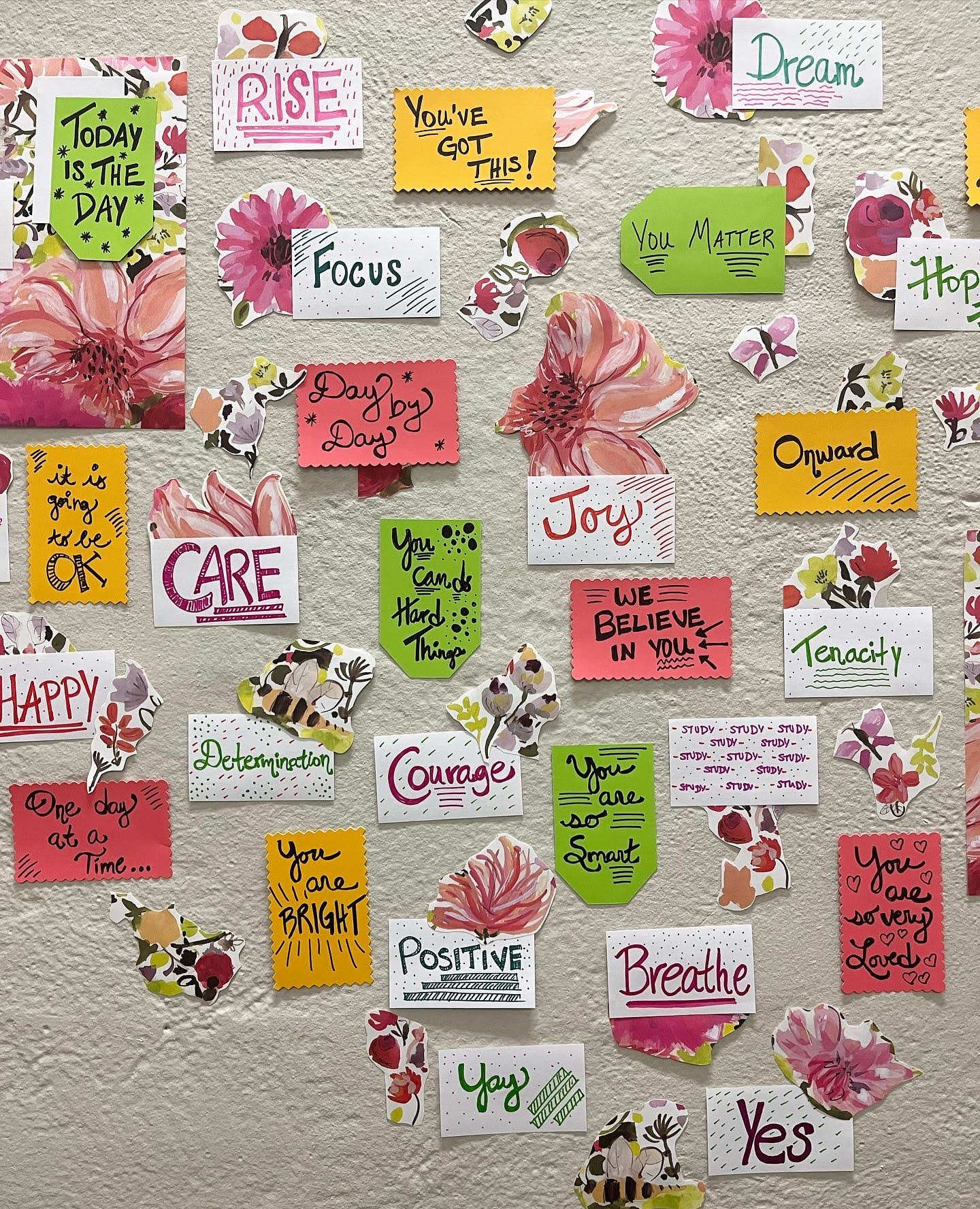
Stairwell of Positivity was a project I created for students over Thanksgiving break, filling one wall with positive affirmations to support them through the stresses of final exams.

Late Night Breakfast is a fun TU tradition where faculty and staff serve a free meal at Pat Case Dining Center to students as they embark upon finals. You can tell from my smiling way too hard in this photo that I had a lot of fun working a shift in December 2022 alongside Dean of Students, Michael McClendon.

Raven’s Birthday sounds a little silly but it was one of our funnest events all year. We invited the entire campus community to our home to celebrate our sweet old dog’s 12th birthday with costumes, decorations, sweet treats, a party play list from her birth year, and goodie bags for all the students. We’ll definitely keep this annual tradition as long as we can.

Family Dinner for 40 guests welcomed students in March 2023 for a family-style taco and nacho dinner in the LaFortune Lobby. We plan to make this a tradition and host one large family dinner early on in both the fall and spring semester to foster community building and engagement.

FiR Field Trip to Philbrook to see Art in Bloom, followed by a taco lunch, got students off campus, whether to visit the museum again or for the first time.

Handwritten notes of support for final exams were something that I wrote and posted on every suite door and throughout LaFortune in April 2023 to provide social support from a faculty source through the stresses of finals.

Communications to Raise Program Awareness

Since the FiR program was new and unfamiliar to all TU students and many faculty and staff, I led and/or supported the following communications in an effort to raise awareness of the program’s existence, how to collaborate with us, and to help students understand how and why to interact with us:

  • Social media provided a space for me to post all about the FiR program—from us moving in to our weekly events—using the hashtag #utulsafir on Instagram and sometimes on Twitter, too.
  • FiR program webpage launched on the TU website in August 2022.
  • FiR program TU news story launched online in August 2022.
  • LaFortune House welcome email in August 2022 included all of our building’s fantastic RAs, as well as mention of the FiR family.
  • FiR business cards explained the program’s purpose and listed the times for standing events. These were distributed at the LaFortune House welcome hall meeting in August 2022 (with extras available all year in the Lobby) as well as to all the students I taught in fall 2022.
  • FiR flyers were posted throughout LaFortune in August 2022 and refreshed in January 2023.
  • Welcome Back notes were handwritten and posted by me on every LaFortune suite door as students moved back into the building at the start of the spring 2023 semester.
  • Admitted student emails went out signed by me in spring/summer 2022 and 2023 to welcome all students to TU and preview the student-centered experience and personalized attention they can expect and that the FiR program exemplifies.
  • @utulsa Magazine story and video in the spring 2023 issue reflected upon my first year as FiR with stories from students who’ve been part of the program.

Event & Meeting Participation to Raise Program Awareness

Beyond print and digital communications, I also attended the following events and meetings to help raise awareness and garner support for the FiR program:

  • FiR Program presentation to the TU Board of Trustees in June 2022
  • FiR Apartment visits were hosted for more than a dozen TU administrators, leaders, and staff from July through September 2022
  • FiR Program presentation to TU Admissions staff in August 2022
  • Move In Day in August 2022 was an opportunity for Raven and I to meet students and their families as they moved into LaFortune House
  • New Student Orientation in August 2022 provided a few minutes for Raven and I to speak about the FiR program at the back-to-back “Here4U@TU” sessions so that we could meet all new students
  • Tulsa Time panel presentations and receptions in November 2022 and February 2023 provided opportunities for me to share the FiR program with prospective student parents
  • Discussion with TU Success Coaches in March 2023
  • Presentation to TU Alumni Association Tulsa Chapter Board Members in March 2023

Faculty in Residence Apartment

I also spent summer 2022 restoring and intentionally designing the Faculty in Residence apartment into a space for students to feel welcome and engaged for events, classes, and meals.

Before: June 1, 2022

After: July 20, 2022

Conclusion

Our first year’s efforts lay a foundation for the TU FiR program’s growth and success in the coming years. Chris, Raven, and I sincerely hope that we’re positively influencing the TU student experience and campus culture.

Top 10 Things My Women’s & Gender Studies Students Learned

In fall 2022, I taught Introduction to Women’s and Gender Studies, working with about 30 students from departments across the University of Tulsa. My section was cross-listed with my home department of Media Studies, so in addition to learning key WGS theories, histories, tools, and perspectives, we also focused time and energy on analyzing gender and power in a variety of media forms: film, television, social media and hashtags, romance novels, and so on.

As I’ve done before in Food Media and Media & Popular Culture, our final assignment was a top 10 listicle, which each student completed individually, ranking from 10 to 1 the most important ideas and concepts they’d learned. (For anyone interested, I’ve included the assignment prompt at the end of this post.) Then, during our finals period, we condensed our personal lists into a collective ranking of the most important things we learned this semester, the list that we’ll take with us from this course and into our lives.

Here are the ranked top 10 learnings that resonated most with my students.
10. Students loved Catherine D’Ignazio and Lauren Klein’s, Data Feminism, which is available open access online to all. Students appreciated the authors’ point that nothing is outside of datafication today, but data science narratives have typically been white, male and techno-heroic. Students joined the authors’ call for a data science and ethics informed by intersectional feminism.

9. Classic readings on sex and sex/gender informed students’ understandings of science and culture, including Anne Fausto-Sterling’s “The Five Sexes” and Emily Martin’s “The Egg and the Sperm.” Elizabeth Reis’s Nursing Clio essay also helped them to think through the contemporary politics of sex and gender binaries when it comes to intersex individuals and for those seeking gender-affirming healthcare.

8. Intersectionality was a term students had often heard of before taking the course, but they left with a fuller understanding of it, especially its complex focus on identity’s relationship to interlocking social systems that cause oppression and privilege. Unpacking gender as a social and cultural construction also proved a foundational concept, something students knew in their bones, but then grew to have the words to fully articulate, especially the critique of the gender binary. These concepts shaped the students’ knowledge of what gender is, how it is experienced and embodied, and informed their thinking around truly inclusive feminist futures, which they further explored in our final reading from Sara Ahmed’s Living a Feminist Life.

7. There was much insight and utility in the foundational work of Simone de Beauvoir, including her well-known words, “One is not born but rather becomes a woman.” Students considered this assertion alongside Susan Stryker’s words on who gets to claim the identity of woman and who “gets womaned” in society. They also appreciated de Beauvoir’s thinking around binaries of alterity that subordinate women (masculine/feminine, subject/object, the one/the other), and her gendered analysis of immanence and transcendence and how it shapes the possibilities of women’s lives.

6. Given my students’ relative youth, de Beauvoir’s writing on the power of childhood to socialize us into gender roles and behaviors resonated strongly. They thought critically about how everything from baby clothes to children’s toys to adolescent sports all shape gender. Relatedly, they liked this episode of The Daily Podcast, “Boy Scouts or Girl Scouts.”

5. WGS explores all aspects of gender, including men and masculinities, ranging from toxic examples to the theory of hegemonic masculinity and my own research on dude masculinity. Men experience and navigate gender, even if they maintain a more powerful position within a patriarchal society, though students also minded bell hooks that all men don’t experience equality either. Many of the men in the course thought critically all semester long about how masculinity norms have shaped, and in some cases harmed and limited, them.

4. Many of our readings reinforced a simple truth that no question is without a gendered dimension, though students read it first in Penny Weiss’s Feminist Manifestos: A Global Documentary Reader. Some folks want to relegate gendered concerns to only a handful of “women’s issues” (like reproduction, sexual violence, childcare, or equal access to employment and education) but gender is at hand in everything. Related to this learning, students appreciated the theorizing of doing gender, that gender isn’t something that we have but something that we do, and make meaning from, in every arena of our lives.

3. Feminism can be a misunderstood social movement, but students reflected most on how its power comes from its collective spirit, organizing, and action. Relatedly, student shared the critique of commodity feminism, which reduces the movement’s politics to an individual identity for consumers to acquire through the marketplace, particularly via tote bags, T-shirts, and mugs emblazoned with feel-good feminist phrases. Students also pondered the possibilities and limits of social media for feminist action. They appreciated learning about hashtag activism, as well as the nuances of particular hashtags like #blackgirlmagic, especially as they read from Julia S. Jordan-Zachery and Duchess Harris’s Black Girl Magic Beyond the Hashtag: Twenty-First-Century Acts of Self-Definition.

2. Disability studies added another rich dimension to students’ understanding of identity and social systems and structures of oppression. They were lucky to learn from fellow University of Tulsa Professor Jan Wilson and to read from her new book, Becoming Disabled: Forging a Disability View of the World. The point that disability is not a tragedy resonated with many students thinking on these issues for the first time.

1. Given our course’s focus on media, women’s representation in film and TV stood out for nearly all students. Many of their lists noted tools they found useful for analyzing gender in media, especially classics like the Bechdel Test (and ways to push it further) and the male gaze, as well more recent theorization of the female and queer gaze. We also considered how TV has represented (and misrepresented) abortion on screen. Students also enjoyed our course assignment in which they analyzed media of their choice (a TV show, film, commercial, celebrity, video game, and so on) using their newly learned feminist media concepts, an experience that will hopefully lend insight to their media lives going forward.

In Closing

It felt a heavy and important responsibility to teach this course in the fall of 2022, just months after the Supreme Court overturned Roe v. Wade. My students came from a wide variety of backgrounds, and they came to class every week with open hearts and minds to learn the history of this field, its theories and tools, its commitment to action and community, so to consider how we might make a more just, inclusive, and joyful society for all. I’m grateful to have learned and journeyed with them, and glad that the course resonated with them. This post’s image is a screenshot from one of my student’s Instagram Stories. It feels pretty special to have our class (willingly and lovingly!) become part of my students’ lives, digital and otherwise.

Top 10 Listicle Assignment Prompt

First, consult our course-long reading schedule. Then, compose your own top 10 list of the most important ideas and concepts from this semester for the study of Women’s and Gender Studies and to you, as a thinker and a person. Note that your list must be equally weighted between content from part 1 and part 2 of our course.

Once you’ve brainstormed your list, rank them from 10 to 1, with 1 as the most important in your assessment and to you.

Give each item a number and a clear and snappy title.

Then write a short (50-100) word description for each item. It should include a summary of the idea or concept along with a defense for 1) why it is important to the study of Women’s and Gender Studies and 2) why it is important to you. You don’t need to include citations, but your list must reference our course readings and big ideas in specific ways. Overall, your item descriptions should be concise, clear, persuasive, and conceptually- and grammatically-correct.

During our finals period, we’ll each share our top rankings, continuing to share from our lists until all of our points have been recorded into our collective class list.

Teaching Reflection: Unessays, Again!

This semester in Advertising History, Culture & Critique at the University of Tulsa, I assigned unessays for the second time. Just like the first round, students designed fantastic projects, communicating what they’d learned in creative, fun, engaging—but still critical and intellectually deep—ways!

The full assignment instructions, scaffolding, and rubric are all at the end of the post, but generally, students selected a creative unessay format of their choice to communicate and synthesize everything they had learned in the course, drawing from our three main sections: 1) advertising’s history, 2) advertising’s sociocultural influence when it comes to power and identity, and 3) the advertising industry’s contemporary condition.

A few students were inspired to capture how advertising has changed over time (or not) when it comes to issues of representation, identity, and power. Jayden created a “Then and Now” comparative presentation. Chloris created a timeline collage of ad photo books from 1900 to the present, while Jacob took a similar approach, but starting in 1920 and focusing on a different decade in each letter of the word “advertising.”

Chloris’s Photo Book Timeline Ad Collage
Jacob’s Letter-Based Timeline Ad Collage

During one class day, we viewed the pilot episode of Mad Men and pondered what the series teaches us about the past, present, and future of advertising. Ray’s project represented the entire course’s themes through the show, presenting it in a traditional pitch deck.

One of the pieces in Ray’s Mad-Men-Inspired Pitch Deck

Jacob created a spoof on The Twilight Zone, which he called The Advertising Zone. In addition to an opening narration, the three parody ads consider midcentury norms of gender and cleanliness, the contradictions of branding (represented through the “Bland brand” chips), and the tropes of political advertising.

Jacob’s “The Advertising Zone”

Emily created a movie poster for the course, titling it “Ad Dicted” to critique the addictive aspects of consumer culture. Among the symbols she included, the Gothic mirror on the left represents Roland Marchand’s assessment of advertising as a social mirror that distorts reality, as well as the tactics of modern advertising to inspire and exploit consumer anxieties. The television symbolizes a type of visual cliche of a happy family watching TV together, taking in commercials that offer Disney-like promises of happy-ever-afters, as well as the promise and peril of addressable television, where every consumer receives ads tailored to their data-mined preferences.

Emily’s Critical Advertising Movie Poster

Gracie’s project shows how some of advertising’s intentions remain obscured, which she visualized by recreating ads we analyzed in class as billboards where the visuals are made out of words, all passages drawn from our course readings. These images document the role of consumer anxiety in modern advertising, how companies (like the United Colors of Benetton) co-opt social movements, and the contradictions of branding, whether for butter or margarine or (as we studied on one day of our course) universities, too.

Gracie’s Billboards Constructed of Key Words

Inspired by the conceptual slippage between advertising and pop artists like Andy Warhol, Catherine recreated the iconic Coca-Cola logo for the consumer culture themes of our course. Merging classic Coca-Cola ads like “Hilltop” with the more recent “Share a Coke” campaign that melded unity and individuality, Catherine created Coke bottles for the authors we read in class who most inspired her, from Jennifer Scanlon’s history of 1920s ad women to Vance Packard’s classic critique of motivational research and postwar affluence to Matthew McAllister’s analysis of the Super Bowl as commercial spectacle.

Catherine’s Pop Art Critique of Advertising

Gabby created a digital art series that critiques advertising’s disempowering representations of gender and race, as well as how planned obsolescence, the American Dream, and consumer culture’s insatiability each encroach upon nature.

Gabby’s Digital Art Series

While remaining critical and close to multiple course texts, Bella created a fashion line, for cats! She created Instagram-style vignette shots that recreate key course readings. She captures historical concepts—like Anne McClintock’s nineteenth-century soap fetishes and Roland Marchand’s documentation of the modern woman as social tableaux—as well as contemporary advertising issues like branding the university experience, marketplace feminism (i.e. “the future is female/feline”), and commodity activism.

Bella’s Critical Kitty Fashion Line

Beyond that, Kenney created a Kahoot! quiz that students completed live during his presentation. Trace made a watercolor painting that critiqued advertising’s cyclical use of data, selling ourselves and our desires back to us. Isold made an educational board game. Steven created a photo gallery and wrote an acrostic poem to define what advertising means to him. Keyshawn and Tim made playlists and designed album covers. And there’s so much more.

I was delighted and impressed that students developed such creative and thoughtful projects after yet another strange and challenging semester. Due to the Omicron variant, the first weeks of our course were online before we transitioned to in-person, after which we had multiple snow days that further interrupted our course. Nevertheless, these students persevered, and I’m proud of all they learned and accomplished.

The students of Advertising History, Culture & Critique, Spring 2022

Full Assignment Instructions & Rubric

For your final project, your task is to synthesize the most important concepts and ideas you’ve learned this semester about 1) advertising’s history, 2) advertising’s sociocultural influence when it comes to power and identity, and 3) the advertising industry’s contemporary condition. This project doesn’t require any additional research, but it does involve sustained consideration of the content presented in our course’s semester-worth of readings and podcasts, lecture videos, and in-class discussions.

This project will take the form of an “unessay,” meaning, rather than writing a lengthy paper in response to this prompt, your project can take any format you like! You can represent your learning through a poem, a work of art, a song, a playlist, a music video (or parody), a short film or documentary, a game, a recipe, a craft, a fashion line, even an advertising campaign or PSA! The options are endless, limited only by your own creativity and commitment.

In addition to your unessay itself, you’ll include a brief but specific 1-to-2-page paper that explains and interprets your unessay. It should clearly explain how your creative project communicates key ideas from throughout our course’s three sections: advertising history, identity and power, and contemporary issues. Said another way, this paper is where you explain your creative vision and connect it to specific course concepts and theoretical ideas. You do not need to include citations, but you should reference class readings (e.g. “As Marchand documents in Advertising the American Dream”) and/or key concepts (e.g. planned obsolescence or brand covenant or corporate social responsibility) throughout it.

To support you to develop this creative project, we’ll dedicate some class time, three weeks before the due date, for you to share your proposed unessay format, so you can get immediate feedback from me, as well as learn (and be inspired!) by one another’s ideas. You do not need to turn anything in on this day, but you should have a very clear and well-developed idea ready to share. If you have any questions or concerns before or after this check-in point, you’re welcome to email me, come visit during office hours, or make an appointment to meet with me.

When your unessay is complete, you’ll submit it online before our finals period, along with the 1-to-2-page interpretive paper. If your unessay is 3-dimensional, submit a photo or other representation of it.

Then, during our finals period, you’ll share and explain your unessay with us in a short but lively 3-minute presentation. If your project is a physical object, you can bring it into class to present. If your project is digital, you can add it to the group Google slide deck, which we’ll use to present in class.

Your unessay (worth 25% of the course grade) will be graded using the following rubric:

  1. Conceptual Adherence (5) | Does the unessay deploy a creative format that clearly and compellingly synthesizes key ideas about advertising’s history, culture, and contemporary resonance in a critical fashion?
  2. Depth of Course Learning Application (10) | Does the unessay and its interpretive paper specifically and effectively build upon the knowledge learned in this class from our readings, listenings, video lectures, and our in-class discussions?
  3. Invested Effort (5) | Does the unessay, whatever format it might take, represent the energy and performance expected for a final course project that culminates our learning and is worth 25% of the course grade? As a general guide, this project should involve 5-10 hours of invested time and energy.
  4. Presentational Skills (5) | Does the presentation clearly and effectively describe the unessay and explain how it represents key course ideas and learning? Is it well-rehearsed and 3-minutes in length? Does it demonstrate strong public speaking skills, such as speaking at an appropriate pace and volume, making eye-contact with the audience, and energetically engaging the audience?

What We Learned in Critical Media Studies of Health & Medicine

This semester I taught a new special topics course, Critical Media Studies of Health and Medicine. Here’s the course description:

This course is for the next generation of health communicators, health care providers, and informed citizen patients. Together we’ll explore critical perspectives on a number of complex issues facing the fields of medicine and public health.

The course explores what health (and related terms like disease, illness, and wellness) mean to various audiences, including healthcare providers, institutions, and funding organizations, as well as to individuals, whether they are conceived of as patients, consumers, or fellow human beings. The course ponders how we can consider these terms in various (and even contradictory) contexts. The course explores what shapes our dominant cultural ideas and understandings of health and disease, from moralized beliefs to logics of quantification to systems of authority, expertise, surveillance, and control. The course considers how these ideas shape the way practitioners interact with their patients. How is the human body framed and treated within medicalized systems? What do the examples of “obesity,” maternal health, and genetics reveal about how the health care system understands, codifies, and treats bodies, especially when considering categories of identity like gender, sexuality, race, and social class?

Every step of the way, the course considers the role of communication, media, and culture in shaping how medicine understands and communicates health, disease, data, the body, and notions of selfhood—and how critique might be deployed to imagine new futures for health and healthcare.

We experimented with reading less than usual, challenging ourselves to read just one chapter closely and deeply before every class, drawn from two great books that we highly recommend:

Students engaged in many weeks of intense discussion, tried (and tried again) to define in their own words seven surprisingly slippery terms (health, healthy, disease, medicine, nutrition, wellness, fitness), and completed two group projects deconstructing and reimagining dietary advice and health communication campaigns. In their final assignment, students reflected on what they learned this semester and how it shaped their thinking. What follows is my best attempt to summarize common themes across their critical reflections, which I shared and discussed with students during our final class meeting.

The following insights come from TU students Joseph Boehm, Catherine Case, Kaley Core, Isaac Hamby, Rosalind Hobbs, Kate Hubner, Cara Johnson, Katie Rickman, Hana Saad, Kayley Spielbusch, David Stump, Lexie Tafoya, and Camden Walker, all pictured above in this post’s featured image.

What We Learned in Critical Media Studies of Health and Medicine

Health is not about striving or optimization or achievement or perfection. It’s more subjective and mutable and personal and necessarily vulnerable than we initially thought. We came to describe health as contentment, happiness, a journey, and an experience, one that can turn out well (or not) due to pure luck.

Health is about self-awareness—listening to, nurturing, and working with your body and what it needs at a particular moment. Within this, we recognize the importance of mental health, the mind-body connection, and a holistic perspective to our embodied lives.

Health is also, at its core, a privilege, just as Biltekoff argued eating right is, one made inequitably available to White and affluent people in the Global North. Health should be collective. Health should be truly accessible to all, shared with all.

Health should not be treated or enacted in moralized terms, despite how very often that occurs. Health can’t and shouldn’t be judged by appearances alone. Our bodies are visible and they tell our stories, but our society (and our media) routinely place bodies under a cultural microscope, especially on our Instagram and TikTok feeds. What’s more, some strife is invisible despite its significant presence in our lives and doesn’t receive the attention and resources it requires.

Capitalism strongly shapes our definitions of health and healthcare, especially when it comes to the pharmaceutical industry. A Western, White, and very American view of health and disease overemphasizes cures, triumphant narratives, and forceful, even battle-focused rhetoric. It also reduces people to diminutive patients positioned beneath the expertise of physicians, into consumers shopping their way to wellbeing, and into little other than laborers working and struggling to get by.

Relatedly, we were hugely influenced by the multiple authors who critiqued neoliberalism and notions of individual responsibility for one’s health, which overemphasizes the power of personal choice and fails to acknowledge, let alone fix, systemic inequities.

Some more key concepts that we’ll take with us from this course:

  • Key “-tion” terms: normalization, medicalization, quantification, standardization.
  • We’ll endeavor to constantly unpack all binaries but especially normal/abnormal and healthy self/unhealthy others.
  • Although very depressing to digest, we loved Joseph Masco’s “Atomic Health” chapter in Against Health. He argues that the development of the atomic bomb introduced a new, fatalistic worldview that shaped health, disease, dying, and death—in ways that resonate for us today, too, as we ponder climate crisis. Masco posits: what if health is understood as just the beginning of our death, which is certain, and not being prevented or eased to the extent it could be by those in power? We demand more; something better.
  • We learned from Eunjung Kim’s insightful chapter that asexuality exists, matters, and needs to be understood in more complex ways than an abnormality in need of treatment. This was but one case where we learned that diagnosis can be an act of empowering recognition but it can also close doors, end conversations, and cause harm.
  • From Vincanne Adams’ chapter, we learned how knowledge hierarchies shape our local and global healthcare systems through connections forged between science, research, culture, global economies, health policies and programs.

We learned to dismantle assumptions our society (and many of us) have long held. We now question our assumptions about:

  • disability, pain, and suffering. Guided by Tobin Siebers’ chapter, we recognize that many people live well and happily with a disease, chronic condition, or disability;
  • fat bodies; fat stigma, bias, and oppression; and an “obesity epidemic;” like Katie LeBesco did in her chapter, we assert that health is not one-size-fits-all and endorse health at every size;
  • the rights and roles of women shape our understanding of health. From Joan B. Wolf’s chapter, we learned that women are too often framed as just potential mothers in a society where total motherhood reigns but bodily autonomy doesn’t, where a mother’s “wants” are positioned against and as always less than a baby’s “needs;” where women, specifically, are expected to weigh risks and manage the impossible desire to eliminate them all.

We always knew, but now we know for sure, thanks to Dorothy Roberts’ chapter, that poor health is rooted in, caused by, and the result of social inequities, including within global health alongside histories and contemporary forces of imperialism and colonialism.

On a more positive and transformative note, we discussed taste and pleasure when it comes to food and eating, but also in other aspects of health, as we read Biltekoff’s book and Richard’s Klein’s chapter. What happens when we put pleasure at the center of health in a non-judgmental way that welcomes others inclusively into healthiness? How could this transform health communication, branding, and messaging, for the better?

Overall, deconstructing something like health is hard work, and sometimes very disorienting, but it’s worth it. It turned our learning inward to ourselves: our assumptions, our biases, our families and stories, our pasts, and how we want to think, be, and act in the future. It also turned our learning outward to our culture, society, media, government, and healthcare system.

This is a course that changed us, what we think, how, and why. We can now approach health (and to communicate about it!) with nuance, complexity, ambiguity, subjectivity, justice, inclusivity, and endless possibility.

My Media & Pop Culture Students’ Top 9 Learnings

For our finals period, my Media and Popular Culture students at the University of Tulsa prepared individual ranked lists of what they learned this semester—what they found most memorable, most eye-opening, most inspiring, most important; in short, what they’ll take with them into their media lives. During class, students discussed their rankings in small groups to develop a collaborative list. Each group then shared with the class to develop our collective top 9 ranking of concepts, ideas, and moments that resonated most with students this semester:

9 While depressing and infuriating to read, students will never forget the findings of the Women’s Media Center’s “The Status of Women in the U.S. Media 2021” report and USC’s “Inequality in 1,300 Popular Films: Examining Portrayals of Gender, Race/Ethnicity, LGBT & Disability from 2007 to 2019.” They document the relatively minimal progress made when it comes to under-representation in media industries and make proposals for real change.

8 We were lucky to visit our TU Special Collections in McFarlin Library to view their comic book collection, which included older texts and more contemporary publications. This ranked among some students’ favorite class memories and was a notable day for all of us. Here are some photos from our visit.

7 I left several days open on the syllabus for students to choose the topic of study, select the readings, and guide our class discussion. These student-led syllabus moments proved some of students’ favorites as we dove into topics they cared deeply about: women’s representation in sports media, film taste genres (including cult classics like The Room), meme culture, TikTok during the pandemic, and conspiracy theories.

6 The media circuit (or the circuit of culture) helped students to conceive of media not as discrete stages—such as production, consumption, and representation—but as dynamic, inter-related moments, adding enduring complexity to how they view the media they encounter in their daily lives.

5 Students enjoyed diving into fan studies, and because our course is cross-listed with Women’s and Gender Studies, students this semester especially appreciated learning about its gendered (and all-too-often misogynistic) aspects; meaning they loved learning key concepts from Suzanne Scott’s Fake Geek Girls: Fandom, Gender, and the Convergence Culture Industry.

4 Even if they come to the course with preconceived notions about media being manipulative, top-down, and all-controlling, students found theories of prosumption illuminating to consider consumers’ ambivalent agency, power, and meaning-making. They also enjoyed reading Henry Jenkins’ work on participatory culture and convergence culture.

3 Students continue to be challenged by, but ultimately adore, the day we spend on intersectionality and media representation. We discuss Ariane Cruz’s great article, “Gettin’ Down Home with the Neelys: Gastro-Porn and Televisual Performances of Gender, Race, and Sexuality,” and analyze student-selected images, video clips, and recipes from the show.

2 The theories of Stuart Hall strongly resonated with students, particularly the concepts of encoding and decoding; dominant, negotiated, and oppositional readings; and that “ordinary people are not cultural dopes.”

1 As I tweeted about here, students really enjoyed learning about anti-fandom—that is, how and why consumers form deep, affective, and often social relationships with media that they loath. Together we tried a new final group project format—podcasts—which students found memorable, challenging, useful, and fun, as they explored their own anti-fandom. They also liked our “Anti-Fan Pop-Con,” which used panel discussions as an energetic alternative to oral presentations.


Overall, students appreciated how our course was discussion-based and as focused on our classroom community and collective mental health as it was on theory, content, and creative assignments. Teaching and learning during a pandemic is hard, sometimes very hard. But this group of students did an outstanding job transitioning back into the classroom, learning despite significant challenges, fostering a supportive and engaged community, and mastering challenging concepts that will hopefully inform their media lives moving forward.

Lastly, students shared that despite their exhaustion during final’s week, the semester’s conclusion felt bittersweet. After three semesters that ended anticlimactically online with the click of a button, it’s been unexpectedly emotional to meet together as a group for the last time. I remind them and myself:

Our class may be ending, but you will always be my students.
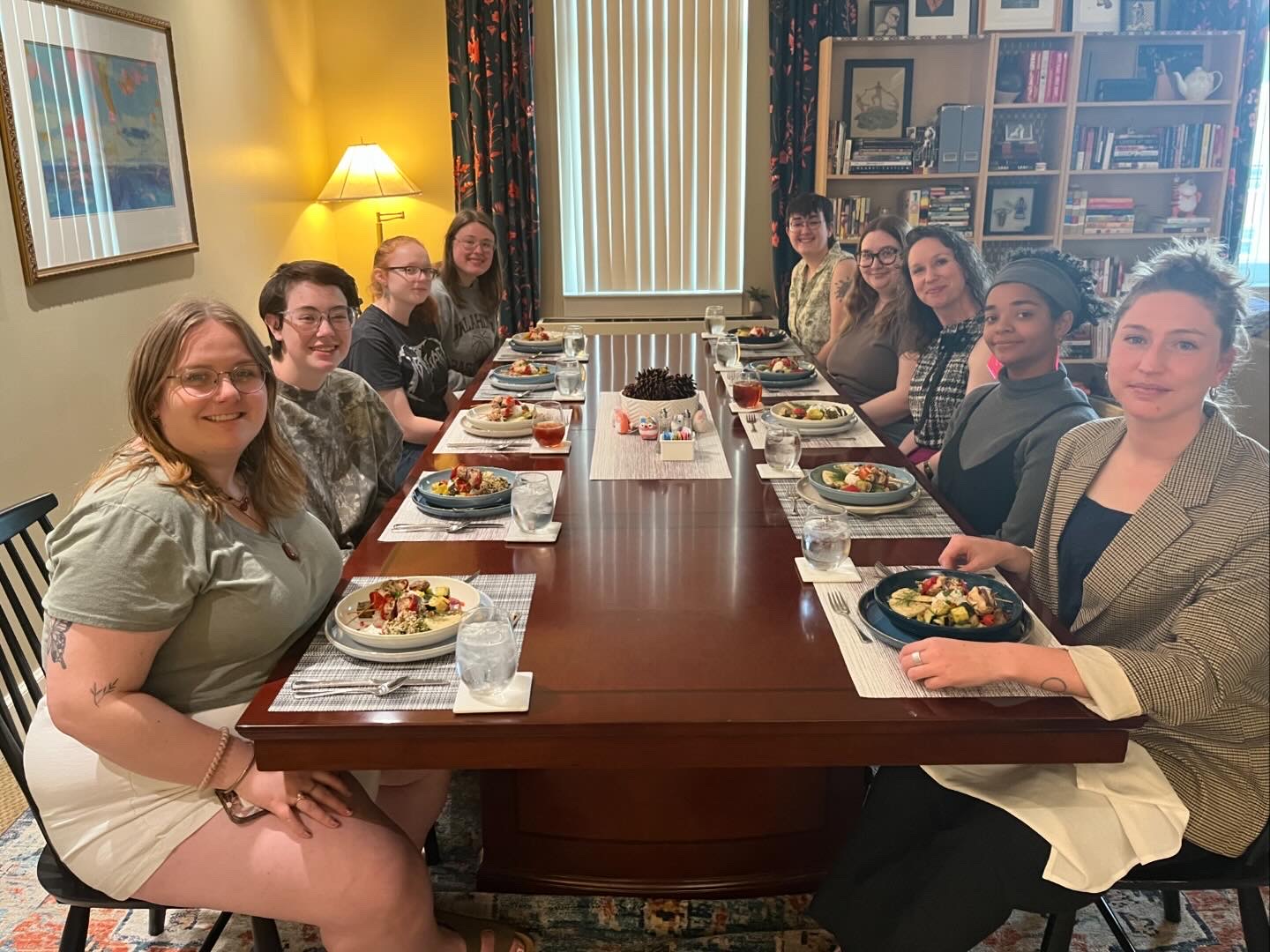
Gratitude for 4 Months of Diners, Dudes & Diets

I can hardly believe it, but Diners, Dudes, and Diets: How Gender and Power Collide in Food Media and Culture has been out in the world for four months today. I am overwhelmed with gratitude for everyone who helped me to research, write, revise, publish, and promote this book. Below are the Acknowledgments that appear at the end of Diners, Dudes, and Diets.

*****

I could not have written this book without the support of a great many people.

I thank Warren Belasco, Carole Counihan, and Rachel Black for their mentorship while I was at Boston University and their support in all the years since.

I am grateful to Brown University’s Graduate School for the University Fellowship that made it possible for me to research and write full time while pursuing my PhD. I warmly thank Susan Smulyan, Richard Meckel, and Debbie Weinstein, a trio of historians, who richly transformed my methods for studying the present as they provided critical feedback and unending support. Susan knows how much she means to me, so I will not embarrass her further here.

I thank the five women in my PhD cohort—Alyssa Anderson, Felicia Bevel, Kate Dufy, Suzanne Enzerink, and Diza Rule. They know all the reasons why.

I thank Elizabeth Hoover for saying yes when I wanted to launch Food Studies at Brown and for being the perfect pairing to my orderliness.

I also thank Ralph Rodriguez for showing me that radical love inspires transformative teaching and learning. That hope is part of this book’s aim too. 

I thank Matt Guterl for being a text message away for advice (still), and for introducing me to my editor, Mark Simpson-Vos at the University of North Carolina Press. I thank Mark, Kathleen LeBesco, Peter Naccarato, and one anonymous reader who helped me to complete the revisions on this book, my first, a task many presses and readers shy away from.

At UNC Press, I also thank Cate Hodorowicz and Dominique Moore (who’s now at UIP) in Acquisitions, as well as Dino Battista, Ann Bingham, Anna Faison (who’s now started a new venture), Gina Mahalek (who is now enjoying retirement), and Alison Shay in Marketing, for all they have done (and will do!) to support this book. I thank Kim Bryant and Matt Avery for my book’s cover and interior design. I also thank Diane Cipollone for copy editing and Kate Gibson for production editing.

I am grateful to Jessica Ryan for proof editing and Michelle Martinez for indexing—and to the University of Tulsa’s Office of Research and Sponsored Programs, the Kendall College of Arts and Sciences, and the Department of Media Studies for funding them.

At The University of Tulsa, I thank Joli Jensen for the Faculty Writing Program that helped so many of us to write no matter what and all the members of the Department of Media Studies—Zenia Kish, Justin Rawlins, Mark Brewin, Ben Peters, John Coward, Jennifer Jones, Jan Reynolds, and Amy Howe—for their genuine collegiality. I also thank TU for Faculty Development Summer Fellowships in 2019 and 2020.

I thank all my students, at TU and at Brown, who’ve shared in this book’s ideas in classes on advertising, popular culture, and food media, especially Val Hinkle who designed preorder promotional materials.

Promotional materials for Diners, Dudes & Diets, designed by Val Hinkle.

I first presented many of the ideas in this book at the annual meetings of the Association for the Study of Food and Society. At these conferences, I’ve been fortunate to find critical feedback, helpful comments, mentors, friends, and memorable meals. It’s a community so meaningful I’ve happily dedicated many hours to serving it. I also thank Zingerman’s and all the women connected to Fresh Work and HHH Retreat, especially Ander Wilson. 

I thank Diana Garvin, Rachal Laudan, and KC Hysmith for their feedback on chapters and concepts, Julia Ehrhardt, Melissa Hackman, and Warren Belasco for their helpful notes on the entire manuscript, all of them for their friendship.

I’m grateful for my rescue pup writing buddy, Raven, who snuggled next to me all the years I worked on this book.

I also thank my mother, who has not only read every word of this book (more than once) but quite literally every word I’ve ever written. Along with my academic peers and students, she is the smart everyday reader for whom I try to write, without too much jargon and with some style and a little humor. (She liked this book, but she is my mom so perhaps she has to say that.)

Without the love of my mother, father, sister, and husband this book wouldn’t exist. Despite the many hours I spent writing (and revising and revising) this book instead of spending more time with them, I hope they are glad that it does.

*****

Beyond the book’s printed acknowledgements, I’m also so thankful to everyone who preordered the book. You helped me to sell out the first print run ahead of launch day!

I’m also thankful for folks who’ve reviewed the book in public spaces like Amazon and Goodreads. Apparently such reviews matter as I think about writing a second and a third book, so I humbly ask others to write such reviews, and please let me send you a postcard as thanks!

I still can’t believe that Helen Rosner included the book in her Great Food-ish Nonfiction 2020 list, that Matthew Wheeland reviewed it in Civil Eats’ 2020 Food and Farming Holiday Book Gift Guide, or that Food Tank featured it in their Summer 2020 Reading List. Thank you!

I’m also grateful to the journalists and writers who’ve interviewed me about the book, including Rachel Sugar for Vox; Ashlie Stevens for Salon; Anne Helen Petersen for Culture Study; Séverine Pierron for Elle (France); Dana Ferrante for BU Today; Connor Goodwin for Inside Hook; James Watts for the Tulsa World; Madeline Humphrey for The Daily Free Press; and Jesse Haynes for The University of Tulsa News.

I also thank outlets that published pieces related to the book, including Nursing Clio for publishing an excerpt from the book’s intro and this great interview with one of my favorite college professors Julia Ehrhardt; Meredith Bennett-Smith for inviting me to publish an op-ed for NBC News; Dianne Jacob for publishing a piece on Will Write for Food; Marshal Zeringue for inviting my contribution to the The Page 99 Test; and Kelly Faircloth at Jezebel for inviting me to write about gender and diet sodas, and then letting me pitch to write about trophy kitchens and bro-gurt too.

I also appreciated the University of Oklahoma Honors College and Bostonia: The Boston University Alumni Magazine covering news of the book. I’m grateful that the book was favorably reviewed (and very quickly!) in Men and Masculinities. I’m also very grateful to Advertising & Society Quarterly for featuring the book in an Author Meets Critics session, which will be published in the Spring 2021 issue.

I’m also so thankful for the folks who’ve invited me on podcasts and radio, including: Soleil Ho, Justin Phillips, and Erica Carlos of Extra Spicy from the San Francisco Chronicle; Nicky Twilley and Cynthia Graber of Gastropod; Christy Harrison of FoodPsych; Joan Salge Blake of Spot On!; Carrie Helms Tippen of New Books Network, Food; Rich Fisher of StudioTulsa on Public Radio Tulsa; Bob LeDrew of Can I Have a Word? on CKCU FM 93.1 in Canada; Sarah Duignan of AnthroDish; the womxn of Femidish; and Ann & Peter Haigh of On the Menu; as well as Madhvi and Rina of Ms Informed.

Thank you to everyone who’s invited me to give talks and participate in book events, including Magic City Books; Elizabeth Neswald and the Department of History Speaker Series at Brock University; Emily Schumacher of Lambda Alpha at The University of Tulsa; The University of Tulsa Community Lecture Series; Gurpinder Lalli and Julie Parsons of the British Sociological Association Food Studies Group International Seminar Series; Megan Elias and Barbara Rotger of the Boston University Pepin Lecture Series; John Wills for the Annual Bolt Lecture at the University of Kent; and Allison Surgeary of the Center for Women’s History at the New York Historical Society; plus upcoming events thanks to the Graduate Association for Food Studies Reading Collective; Polly Russell at the British Library; and the University of Oregon’s Food Studies Program and Department of Women’s, Gender, and Sexuality Studies.

Thank you to Karen Tongson at the University of Southern California, Sarah Dempsey at the University of North Carolina, and Ben Cohen at Lafayette College for assigning my book in their courses and for inviting me to chat with their wonderful students. (And please know that I’m happy to virtually visit classes that read my book!)

I promise to write more in the future about the art and labor of book promotion, to share what I’m learning with others. Till then, I’m brimming full of gratitude for all of this, and for all of you.

Coming in 2022: Food Instagram: Identity, Influence & Negotiation

With my friend, colleague, and co-editor Zenia Kish, I’m delighted to announce that our edited collection Food Instagram: Identity, Influence, and Negotiation will be published by the University of Illinois Press in early 2022. It will join a growing corpus of texts on digital food cultures as the first book dedicated to the study of Instagram and food.

This book presents the novel concept of “food Instagram,” a quasi-genre on the platform distinguished by recognizable aesthetic conventions, the presence of both everyday users and industry professionals, and a shared focus on representations of food, eating, and food-related phenomena. The volume considers how users engage food Instagram across diverse global sites to construct identity, to seek influence, and to negotiate aesthetic norms, institutional access, and cultural power, as well as social and economic control.

As such, food Instagram provides ripe opportunities for interdisciplinary conversations, particularly between the academic fields of media studies and food studies, as well as with new media studies, cultural studies, gender and sexuality studies, and other approaches to analyzing digital food cultures.

The international authors in this volume draw from multiple disciplinary traditions and from experiences outside of the academy. Many are teachers. Two are practicing artists. One is a journalist. One is an influencer IRL. The result is a rich exploration of transnational visual and culinary practices unique to Instagram that are reshaping how and what we eat.

In our introductory chapter, we editors position the study of food Instagram within the history of visual representation and photography, the concept of “food porn,” and the platform’s specific affordances, architecture, and style. Then, to demonstrate the interdisciplinary possibilities at the juncture of media studies and food studies, we dive into Instagram’s visual ecosystem, systematically analyzing it from soil and seed to our digital feed, and beyond. We also preview and synthesize the work of the volume’s more than twenty contributors, whose seventeen chapters engage the book’s key themes: identity, influence, and negotiation.

Sincere thanks to our contributors for their wonderful chapters and to colleagues and interested readers for the enthusiasm they’ve already expressed about this volume. We can’t wait for you to read it.

Food Instagram: Table of Contents

Introduction. From Seed to Feed: How Food Instagram Changed What and Why We Eat by Dr. Zenia Kish and Dr. Emily J.H. Contois 

// I. Identity

1. @hotdudesandhummus and the Cultural Politics of Food by Dr. Michael Z. Newman 

2. Starving Beauties? Instabae, Diet Food, and Japanese Girl Culture by Dr. Tsugumi Okabe 

3. #Foodporn: An Anatomy of the Meal Gaze by Dr. Gaby David and Dr. Laurence Allard 

4. The South in Your Mouth? Gourmet Biscuit Restaurants, Authenticity, and the Construction of a New Southern Identity by Dr. Deborah Harris and Rachel Phillips 

5. Uncle Green Must Be Coming to Dinner: The Joyful Hospitality of Black Women on Instagram During the Covid-19 Pandemic by Robin Caldwell 

6. Creative Consumption: Art about Eating on Instagram by Dr. Dawn Woolley and Zara Worth 

// II. Influence

7. Picturing Digital Tastes: #unicornlatte, Social Photography, and Instagram Food Marketing by Dr. Emily Truman 

8. Camera Eats First: The Role of Influencers in Hong Kong’s Foodie Instagram Culture by Yue-Chiu Bonni Leung and Dr. Yi-Chieh Jessica Lin 

9. Repackaging Leftovers: Health, Food, and Diet Messages in Influencer Instagram Posts by Dr. Tara Schuwerk, Dr. Sarah Cramer, and Carina Coleman 

10. Meet Your Meat! How Australian Livestock Producers Use Instagram to Promote “Happy Meat” by Dr. Emily Buddle 

11. Freakshakes and Mama Noi: Cases of Transforming Food Industry Influence on Instagram by Dr. Katherine Kirkwood 

12. My Life and Labor as an Instagram Influencer Turned Instagram Scholar by KC Hysmith

// III. Negotiation

13. Transgressive Food Practices on Instagram: The Case of Guldkroen in Copenhagen by Dr. Jonatan Leer and Dr. Stinne Gunder Strøm Krogager 

14. Posing with “the People:” The Far-Right and Food Populism on Instagram by Dr. Sara Garcia Santamaria 

15. Farming, Unedited: Failure, Humor, and Fortitude in Instagram’s Agricultural Underground by Dr. Joceline Andersen 

16. The Surprisingly Long History of Feminist Eateries on Instagram by Dr. Alex Ketchum  

17. How to Think with Your Body: Teaching Critical Eating Literacy through Instagram by Dr. Sarah E. Tracy  

Afterword: Food Instagram’s Next Course by Dr. Emily J.H. Contois and Dr. Zenia Kish 

Top Image Credit: KC Hysmith, 2021

Review Diners, Dudes & Diets—Please & Thank You

As a debut author, I feel super-awkward asking folks to review Diners, Dudes, and Diets: How Gender and Power Collide in Food Media and Culture on Amazon or Goodreads. To make it less weird for all of us, I’d love to send you a note of thanks!

To redeem, just follow these steps:

  1. Order a copy of Diners, Dudes & Diets (preferably from your favorite local bookstore) or borrow it from your local or university library.
  2. Read and {hopefully!} enjoy the book.
  3. Review Diners, Dudes & Diets on Amazon or Goodreads.
  4. Email a link to (or screen grab of) your review, along with your preferred name and mailing address to dinersdudesdiets [at] gmail [dot] com
  5. Then I’ll mail you one of two custom postcards, designed by one of my fab students, Val Hinkle. (If you previously redeemed a postcard for preordering and would like to request the other design, just let me know in your email. And if you’ve already posted a review {thanks!!}, please send me an email to redeem a postcard.)

Thank you so much for your reviews, and happy reading!

More of My Writing Like Diners, Dudes, and Diets

Academic books like Diners, Dudes & Diets take a (very) long time to write. I’ve been researching and writing on the questions that animate this book, figuring out pieces of the story, for almost fifteen years.

Here’s a list of the articles, chapters, and short pieces I wrote along the way, and a couple of pieces I’ve written as the book has launched too. These are here if you’d like to see how these ideas evolved over time; want more to read on these topics of media, food, bodies, and gender; or if you’re teaching on these topics and it doesn’t quite work to assign the entire book.

Learn more about Diners, Dudes & Diets.