Author: Emily Contois

Cheers & Tears: 5 More Reasons for Academics to Blog

This summer marks my second year of blogging, so I thought I’d celebrate by adding to the five lessons I learned in my first year. 1. Blogging connects you to lay readers and fellow scholars.  While having my post, “Tofu & Tapenade? The Unspoken Rules of Football,” Freshly Pressed in January brought 600 new followers my way, blogging has also connected me more closely with just a handful of folks in a meaningful way. Jan Whitaker (who blogs at Restraunt-ing Through History) and I routinely read and comment on one another’s work, which made finally meeting her in person at this summer’s ASFS conference all the more enjoyable. Blogging is also one of the ways I connected with Rachel Lauden, famed food historian, who also blogs and tweets up a storm. If you put your work out there, not only does someone other than your mom and prof read it, people who you cite, admire, and would like to work with can read it too—and that’s when the magic happens. 2. Blogging provides a publication platform that’s always accepting submissions.  I (mostly) love writing papers from scratch to fulfill specific CFPs …

Archive Adventures #2: Wartime, Memorial Day … & Kraft American Cheese?

With the tagline, “Hanker No More!” this advertisement from my archive adventures at the Hartman Center for Sales, Advertising & Marketing History at Duke University celebrates the return of not only America’s World War II heros, but of Kraft cheese products, like Kraft American cheese, Velveeta, and “Old English” Pasteurized Process Cheese, which were rationed on the home front. Ad copy commiserates with America’s housewives: “For a long time during the war, you couldn’t get an ounce of this mellow, smooth-melting cheese; since then a single package has been ‘a find.’” Now, however, the “cheddar goodness you’ve missed so long” has not only returned to supermarket shelves, but “is plentiful.” Furthermore, while an ounce was once impossible to procure, Kraft American cheese could now be purchased in a five-pound loaf or by the half pound (packaged in blue) if preferred. Such linguistic comparisons of weights and measures reveal some evidence of the food industry’s post-war aim to not only find domestic markets for wartime goods, but to increase consumption more generally. Finally, nearly all of the other advertisements that I collected for Kraft cheeses during the …

Publication Update! Toned Tummies & Bloated Bellies: Activia Yogurt & Gendered Digestion

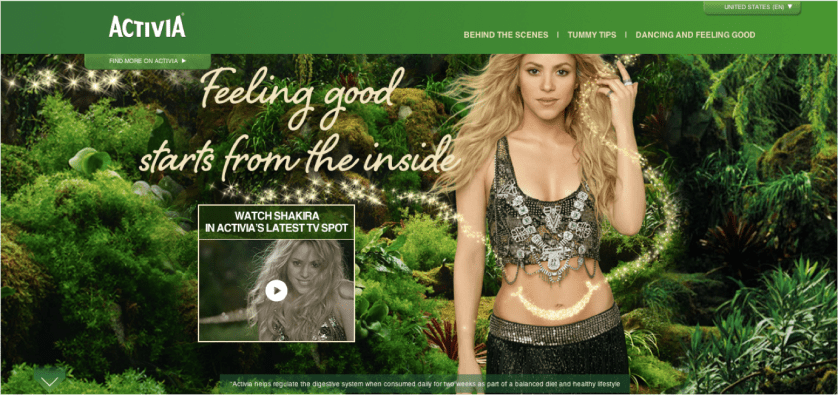
I’m thrilled to share that my article, “Toned Tummies and Bloated Bellies: Activia Yogurt and Gendered Digestion,” was recently published in CuiZine: The Journal of Canadian Food Cultures. I blogged about this project when I first completed it about a year ago and could not be more honored that it was selected as CuiZine‘s best graduate student paper in 2013 by a committee featuring the food writers, scholars, and researchers Maeve Haldane, Ian Mosby, and David Szanto. As I analzyed this probiotic yogurt that continues to populate the dairy case with its iconic green containers, I drew from print and online advertisements, product packaging, press coverage, and industry reports, as well as a variety of secondary sources that analyze digestion as a cultural act. When I first began this study, Jamie Lee Curtis served as a spokeswoman so enthusiastic that her commercials had become the stuff of Saturday Night Live parody. Most all Activia advertisements targeted women, many featuring feminine touches, from the product’s waist-like logo to commercials’ girly jingle—“Ac-tiv-i-aaaah!” Furthermore, whether a print ad or TV commercial, nearly every marketing effort …

Archive Adventures #1: The Oh-So-Glamorous World of Velveeta & Cheez Whiz

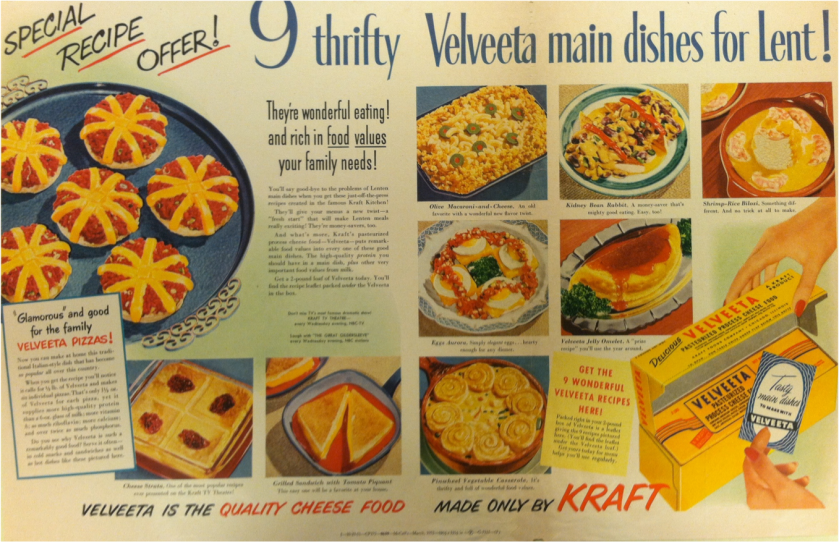
Telling the story of how the food industry won over (albeit not immediately) the hearts and kitchens of America’s housewives, Laura Shapiro‘s Something from the Oven: Reinventing Dinner in 1950s America (2004) is hands down one of my favorite food history texts. I very truly geeked out when she signed my copy at the Siting Julia symposium in 2012. As “deliciously readable” as The New York Times Book Review claims it to be, this delightful book demonstrates how in the years following World War II, the food industry, women’s magazines, and the press alike attempted to sell housewives on convenience food products, emphasizing the technological wonderment and time saving attributes of frozen vegetables, canned meats, and complete frozen meals. I got a taste of this myself when I was researching the marketing of Kraft food products in the archives at the Hartman Center at Duke University last month. But first, let’s talk a little history. Despite the industry’s best efforts, food technology at first failed to capture housewives’ hearts or stomachs. Women who had utilized processed foods during wartime rationing did not desire to do so when …

Celebrating Earth Day with Andrew Ross’ Parable of a Sustainable Phoenix

This year’s Earth Day theme is green cities, a topic that could not relate more directly to today’s post on Phoenix, a city arguably deserving of the title “World’s Least Sustainable City.” A desert vision of unrestrained growth, the history of Phoenix and the surrounding Sunbelt region provides a nationally instructive case study on sustainability. Invited by Future Arts Research, an Arizona State University institute, to “come and do research of [his] choosing in Phoenix” (19), Andrew Ross, Professor of Social and Cultural Analysis at New York University, spent two years in the Valley of the Sun. The result of extensive historical research and 200 interviews with the region’s “more thoughtful, influential, and active citizens” (17), Ross’ recent book, Bird on Fire: Lessons from the World’s Least Sustainable City (2011), makes manifest his aim “to take the social and political temperature of Metro Phoenix” (17). From its early days of Anglo settlement to today, the Sunbelt proves a feverish place, whose post-war metropolitan growth tells a uniquely American story. In the Valley of the Sun, an ideology of excess reigns, one which …

Academe Amuse-Bouche: Expanding the Menu of Academic Publishing

I had the opportunity to attend the Essay in Public conference here at Brown University earlier this week at which speakers and participants discussed a full host of topics related to how we can best bring longform writing and dense content (such as the bulk of work created by academics) to the public. [Update: I summarized all of my live tweeting here. And yes, Storify really is as neat as they say.] At one point in the day, we discussed and re-articulated the very meaning of “the public,” as not only an audience with whom many of us as public intellectuals hope to engage, but also a grouping of individuals that contains the fantasy of accessibility and embodies the breaking down of hierarchies, limits, and borders. Part of my own aspiration with this blog is to connect with just such a public of readers, near and far, through my work, which I strive to communicate in jargon-free and hopefully-at-least-minorly-entertaining prose. A truly satiating day, this conference explored far more than audience, connectivity, and content. In this particular post, however, I’m chewing on the idea that …

Interdisciplinarity & Health: 10 Posts to Celebrate National Public Health Week

During April’s first full week each year, the American Public Health Association celebrates National Public Health Week, a time to bring together communities from sea to shining sea to focus on the contributions and aspirations of public health. National Public Health Week 2014 focuses on the following themes: Be healthy from the start. From maternal health and school nutrition to emergency preparedness, public health starts at home. Don’t panic. Disaster preparedness starts with community-wide commitment and action. Get out ahead. Prevention is now a nationwide priority. Let us show you where you fit in. Eat well. The system that keeps our nation’s food safe and healthy is complex. Be the healthiest nation in one generation. Best practices for community health come from around the globe. In celebration of all that public health is, does, and can do, I offer up these ten previously published posts on the theme of health: 1. Typhoid Mary: Public Health Menace or Plucky Bad Ass? Commonly known as “Typhoid Mary,” Mary Mallon was incarcerated for a total of 26 years in isolation on North Brother Island for unknowingly spreading …

Sink Your Teeth into the First Edition of the ‘Graduate Journal of Food Studies’

I could not be more thrilled to have my paper, “Not Just for Cooking Anymore: Exploring the Twenty-First-Century Trophy Kitchen” published in the first edition of the Graduate Journal of Food Studies, which came out today. In case you’re new to the journal, the Graduate Journal of Food Studies is “an international student-run and refereed journal dedicated to encouraging and promoting interdisciplinary food scholarship at the graduate level. Published bi-yearly in digital form, the journal is a space for promising scholars to showcase their exceptional academic research. The journal hopes to foster dialogue and engender debate among students across the academic community. It features food-focused articles from diverse disciplines including, but not limited to: anthropology, history, sociology, cultural studies, gender studies, economics, art, politics, pedagogy, nutrition, philosophy, and religion.” The Graduate Journal of Food Studies also includes a Book Reviews section. Graduate students interested in being part of the journal’s second edition may submit an original food-related essay by May 31, 2014. Now, get ready to sink your teeth into the fabulous first edition of the Graduate Journal of Food Studies!

Typhoid Mary: Public Health Menace or Plucky Bad Ass?

While many may have heard of “Typhoid Mary” (I’m speaking here of the public health historical figure not either of the hard rock bands that bear her name nor the mutant Marvel villain inspired by her plight), fewer know the complete story of Mary Mallon, the immigrant cook incarcerated in isolation for a quarter century for unknowingly spreading typhoid through her cooking. When one hears the name “Typhoid Mary,” the mind often conjures images of some untamable shrew dishing out ladles full of infected slop, a mental picture not unlike the one that the press created in 1909, in which Mallon is depicted cracking skulls into a skillet, while venomous vapors drift downward from her mouth. Often told with a reductionist focus in science textbooks, Judith Walzer Leavitt’s social history, Typhoid Mary: Captive to the Public Health (1997), sets Mallon’s story straight. While viewed as a menace by the New York public health department, the legal system, media, and general public, Mary Mallon was also a powerfully plucky bad ass, who despite institutional entities against her, little …

‘Graduate School Will Kill You’ and Other 18th Century Health Advice for the Studious

Before I began my doctoral studies, I worked for five years in the field of worksite wellness, an experience that made me painfully aware of the growing evidence that sedentarism—spending too many hours sitting on one’s glorious behind—has deleterious health effects. Unfortunately, as a striving academic, I often find myself seated squarely on my rear for what sometimes feels like endless amounts of time. While many a modern day inforgraphic can summarize how sitting may be killing us, William Buchan, MD’s domestic medicine manual, Domestic Medicine Or, a Treatise on the Prevention and Cure of Diseases By Regimen and Simple Medicines (1772, second edition) provides period recommendations for the studious, which I found entertaining, enlightening, affirming, and worrisome in equal measure.[1] Many of Buchan’s recommendations ring as true today as they did nearly 250 years ago. Buchan writes: Intense thinking is so destructive to health, that few instances can be produced of studious persons who are strong and healthy, or live to an extremely old age. Hard study always implies a sedentary life; and, when intense thinking is joined to …

Hippo: It’s What’s For Dinner

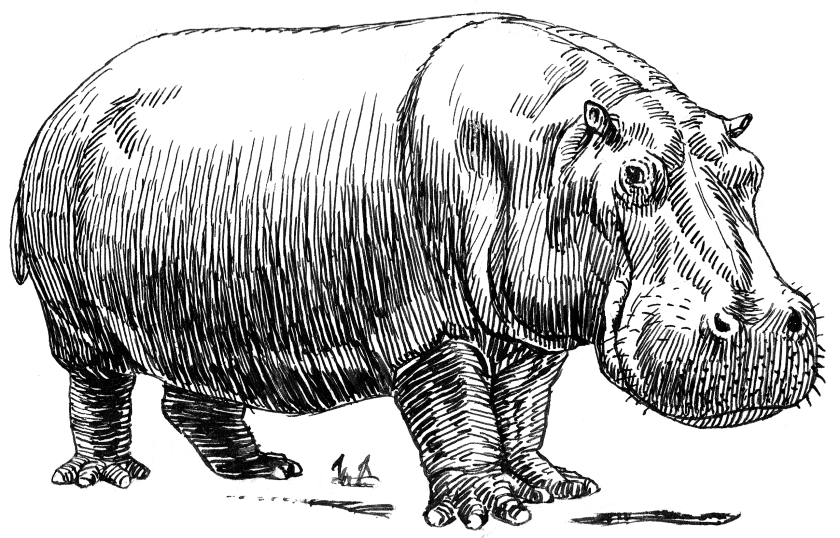
While the global food news often tells of meat shortages in China and India, as middle class demand for meat increases in these extremely populated countries, the United States faced its own meat crisis in the early twentieth century—and believe it or not, hippopotamus ranching emerged as a proposed solution. This is the remarkable story told in American Hippopotamus (2013) by Jon Mooallem, a product of significant archival research, which you can purchase at Atavist or on Kindle for your own reading pleasure. Mooallem’s account orients itself around 1910, when a combination of increasing immigrant populations, growing cities, and overgrazed rangeland caused meat prices to soar, as producers struggled to keep up with domestic meat demands. Christened “the Meat Question” in the newspapers, Louisiana Congressman Robert Broussard proposed importing hippopotamuses from Africa and settling them in the bayous of Florida, Mississippi, and Louisiana to assuage America’s carnivorous ills, as well as to tackle the invasive water hyacinth plants, which clog southern waterways and impact fish populations to this day. The bulk of the American Hippopotamus narrative presents dueling biographies of the …

Presidential Obesity: Taft, Bathtubs, and the Medicalization of Corpulence

Ask your average citizen what he or she knows about President William Howard Taft and you’ll most likely hear recanted the rumor that due to his girth, Taft once became stuck in the White House bathtub. In the article, “Corpulence and Correspondence: President William H. Taft and the Medical Management of Obesity,” Providence College’s Deborah Levine analyzes fascinating primary sources from the Library of Congress—letters in which the 27th president of the United States corresponded with Dr. Nathaniel E. Yorke-Davies, an English diet expert—that chronicle Taft’s efforts to lose weight while in the harsh spotlight of American politics and popular culture. [If you haven’t read Monday’s New York Times coverage or the original article in the most recent issue of Annals of Internal Medicine, they’re marvelous. Go read them now!] As Levine demonstrates, this correspondence reveals Taft’s own views of the relationship between obesity and personal character, as he aspired to lose weight not only “to combat uncomfortable symptoms” (565), but also to “become a better civil servant” (565), revealing the assumption that one’s weight informs both objectives. This perspective is reinforced …