All posts tagged: food

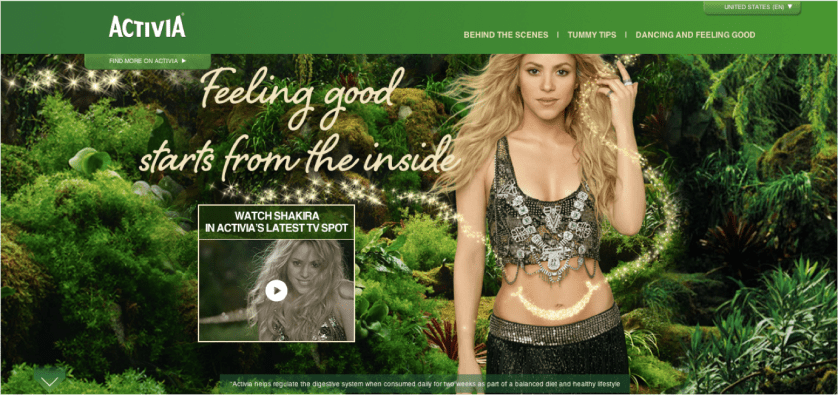
Publication Update! Toned Tummies & Bloated Bellies: Activia Yogurt & Gendered Digestion

I’m thrilled to share that my article, “Toned Tummies and Bloated Bellies: Activia Yogurt and Gendered Digestion,” was recently published in CuiZine: The Journal of Canadian Food Cultures. I blogged about this project when I first completed it about a year ago and could not be more honored that it was selected as CuiZine‘s best graduate student paper in 2013 by a committee featuring the food writers, scholars, and researchers Maeve Haldane, Ian Mosby, and David Szanto. As I analzyed this probiotic yogurt that continues to populate the dairy case with its iconic green containers, I drew from print and online advertisements, product packaging, press coverage, and industry reports, as well as a variety of secondary sources that analyze digestion as a cultural act. When I first began this study, Jamie Lee Curtis served as a spokeswoman so enthusiastic that her commercials had become the stuff of Saturday Night Live parody. Most all Activia advertisements targeted women, many featuring feminine touches, from the product’s waist-like logo to commercials’ girly jingle—“Ac-tiv-i-aaaah!” Furthermore, whether a print ad or TV commercial, nearly every marketing effort …
Archive Adventures #1: The Oh-So-Glamorous World of Velveeta & Cheez Whiz

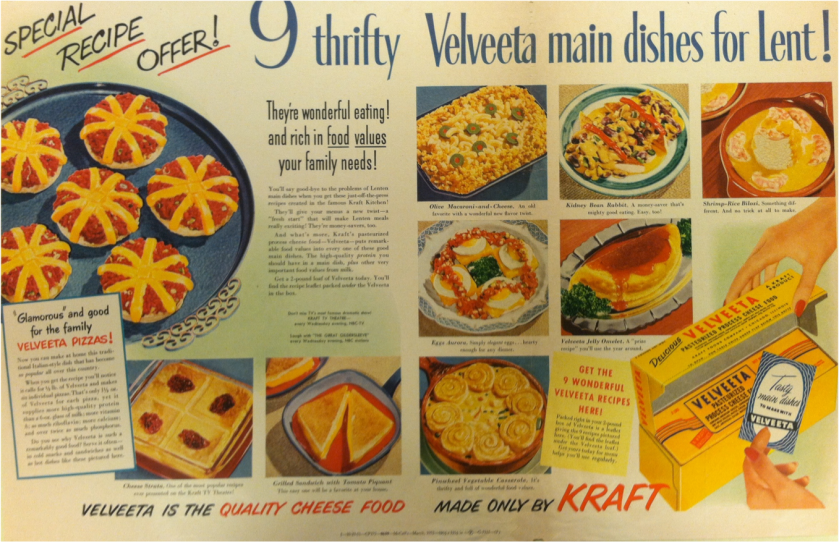
Telling the story of how the food industry won over (albeit not immediately) the hearts and kitchens of America’s housewives, Laura Shapiro‘s Something from the Oven: Reinventing Dinner in 1950s America (2004) is hands down one of my favorite food history texts. I very truly geeked out when she signed my copy at the Siting Julia symposium in 2012. As “deliciously readable” as The New York Times Book Review claims it to be, this delightful book demonstrates how in the years following World War II, the food industry, women’s magazines, and the press alike attempted to sell housewives on convenience food products, emphasizing the technological wonderment and time saving attributes of frozen vegetables, canned meats, and complete frozen meals. I got a taste of this myself when I was researching the marketing of Kraft food products in the archives at the Hartman Center at Duke University last month. But first, let’s talk a little history. Despite the industry’s best efforts, food technology at first failed to capture housewives’ hearts or stomachs. Women who had utilized processed foods during wartime rationing did not desire to do so when …

Food and Matriarchy in “Sons of Anarchy”

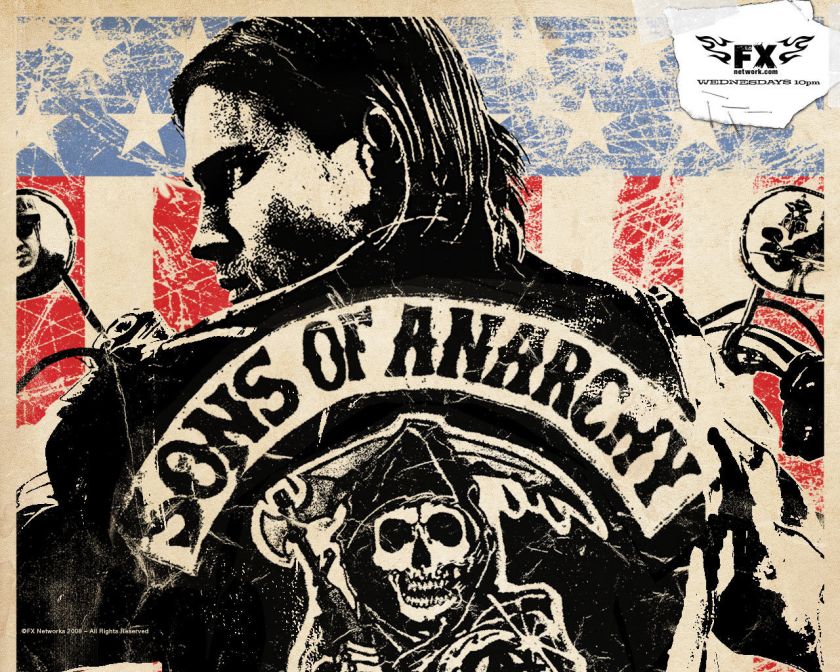
While Charlie Hunnam‘s handsome face and blonde locks are reason enough for anyone to be watching Sons of Anarchy with unwavering interest, after watching the first five seasons, I’m struck by the way that scenes of eating express the harmony or discontent of the motorcycle club (MC). As its members seek to protect the interests of their aptly named hometown of Charming, California, as well as their families and their MC brothers against drugs, violence, and general discord, three meals mark the club’s progress. Notably, the presence and absence of these meals reflect the changing power and influence of the family matriarch, Gemma Teller-Morrow (Katey Sagal). Spoiler alert: If you haven’t yet watched the show and think you might like to, I’d suggest getting up to speed before reading further. Family is a strong theme throughout Sons of Anarchy, as members of the club treat one another as brothers, willing to fight, kill, and die to protect one another and those dear to them. While these family-like ties grow apparent throughout the first episodes, they are also made …

Labor Day Laments and the Masculine Glory of Groom’s Cakes

It’s Labor Day, which signals summer’s approaching end, as well as a seasonally-based, social ban on white clothing. [Though really, when are white pants ever a good idea?] This holiday also tends to mark the end of the summer wedding season, but I’ve got weddings and cakes on the brain because I’m head-over-heels in love with Cherry Levin’s recent article, “He Can Have his Cake and We Will Eat It Too: The Role of the Groom’ Cake in Southeastern Louisiana Wedding Receptions,” in Digest: A Journal of Foodways and Culture.  While I’m not sure the claim that the groom’s cake tradition is waining everywhere but in the south holds water, I greatly enjoyed the author’s analysis of the groom’s cake as a masculine detail within the otherwise ultra-feminine affair that is most big, white weddings. Levin comments upon the “visual and symbolic relationship” between the wedding cake—or “bride’s cake” if you prefer—as its towering tiers and feminine, frosted details mirror the bride herself, adorned with lace, tulle, and beading. Furthermore, she contends that “celebratory cakes communicate important messages …

Defining American Food in ‘The Saturday Evening Post All-American Cookbook’

If you ever want to strike up a passionate food debate, just toss out the the question, “What is American food?” While you’ll hear the unenlightened decree with disdain that the United States has no food culture, the answer is far more nuanced. Like jazz and blues music, some argue that barbecue is a unique American cultural food product, one that loudly communicates a multiethnic history and both local and regional identity. Others will insist that the food traditions of New England form the culinary roots of American cuisine.[1] Others will point to McDonalds and other fast food joints known for selling burgers and fries as quintessentially American in taste, presentation, and capitalistic expansionism.[2] Still others will argue that the continually simmering melting pot[3] of American citizens ensures that all food served within U.S. borders in some way represents, absorbs, and communicates American food culture. These disparate points of view are portrayed in different ways in The Saturday Evening Post All-American Cookbook. Published in 1976, filled with reproductions of the Post’s covers and advertisements, and made up …

Take Me Out to the Ballgame…and Eat 33,000 Hot Dogs

We all know how the 1908 song “Take Me Out to the Ball Game” goes, and if you care about food, the line “buy me some peanuts and cracker jack” will likely stand out. I didn’t grow up a baseball fan (or football or basketball for that matter), as my Australian father instead schooled us on tennis, cycling, and Formula 1 racing. My husband, on the other hand, has loved the game of baseball all his life. And so this summer, on a road trip that covered a bit more than 5,000 miles, we stopped to see five ball games in five cities, meaning I consumed more baseball — and more ballpark concessions — than in my entire life up to this point.

Food & Fat as Metaphor in ‘The Middlesteins’

When NPR included Jami Attenberg’s The Middlesteins as a foodie summer read, I had forgotten that it was on my request list at the library. When it came available with its fast food inspired red and yellow cover, I excitedly carried it home, ready to dig in. Late last year, Hannah Rosefield wrote an incredibly insightful piece on the use of obesity as metaphor in not only The Middlesteins, but also in Michael Kimball’s Big Ray, Heft by Liz Moore, and Erin Lange’s young adult novel Butter. She argues: An obese body is never, any longer, just an obese body, in life or in fiction, but an embodiment of an epidemic, an image of our society…It is true that although 70 percent of American adults are overweight or obese, a relatively small number is super obese. But these novels show Ray, Arthur, Butter, and Edie not at one end of a continuum, but as existing in a separate category, divided from their “normal” friends and family. We see the various societal factors that contribute to obesity, but …

Cooking Up a Storm at the 2013 Cookbook Conference

The Roger Smith Cookbook Conference in New York City drew an eclectic mix of culinary scholars; food studies academics; food writers and bloggers; food photographers and stylists; cookbook writers, editors and publishers; chefs; and those hoping to become any of the above. I participated in the panel, “Cookbooks as Works of Art and Status Objects,” which explored the slew of elaborate and expensive cookbooks that have come out recently that function as coffee table books more so than cookbooks. Examples include: The French Laundry Cookbook, The Big Fat Duck Cookbook, Alinea, Eleven Madison Park, NOMA, and Modernist Cuisine. The panel also featured Kim Beeman, Jane Black, Sarah Cohn, and Anne McBride, each of us bringing a different perspective to the nature and meaning of these cookbooks. I discussed these cookbooks as extensions of the trophy kitchen, given their ornamental nature and status-making potential. I also attended several other panels, which I summarize in this post. I have captured what I found to be the most tantalizing sound bites from panelists, but I have by no means provided an …

Chewing on the ‘Last Supper’ in “Drive” -OR- Viewing Ryan Gosling Through a Food Studies Lens

Today is Labor Day, marking a transition in the year and the pace of my life. The fall semester starts tomorrow, which means I’m equally excited to start my study of Food Anthropology with Carole Counihan and US Food History with Warren Belasco — and fearful that I might be crushed beneath the weight of my academic course load, working full time, studying for the cursed GRE, and applying to PhD programs. What this means for you is that I’ll happily continue blogging, but likely only once a week. So please do continue to visit me, but know I’ll only be posting new content on Mondays — like today!  Drive (2011), directed by Nicolas Winding Refn, turned out to be a film that viewers either adored or loathed. My husband and I were in the adoring camp — and not just because we both have huge crushes on the Gosling. After seeing the film, we read James Sallis’ novel by the same name on which the film is based. As is always the case, the novel …