Latest Posts

How to Write a Statement of Purpose

When I applied to PhD programs, I didn’t really find the advice I was seeking for how to write a statement of purpose, so I wrote this post in the hope that it might help someone in a similar position. 

Folks will tell you that your statement of purpose is the most important part of your PhD application and they’re right. While your transcripts might demonstrate your past academic success and your letters of recommendation can speak volumes, especially if written by significant scholars in your field, no piece of your application package can make more of an impact than your statement. It is your opportunity to clearly and succinctly discuss your past and future research goals in an interesting way. From this document (as well as the rest of your application package), an admissions committee will decide if you are the right “fit” for their program.

While you’re determining which programs are the right fit for you, you can simultaneously put pen to paper (or fingers to keyboard) and start the first of many drafts of your statement of purpose. While you of course want your statement to be unique and stand out from the masses—seriously, masses; some programs review pretty much a gazillion applications—there is a bit of a formula to crafting a stellar statement.

Statement Sections

First Section 

Your first sentences are how you initially capture the committee’s attention. Be unique and engaging, but professional and academic. Remember, you’re applying to a PhD program, not for a job at Google.

Also keep in mind that a statement of purpose is very different from that college admissions essay that you wrote in high school. This must be more about your research and goals than about who you are as a person. As my advisor told me, you need to find subtle ways to have the story of your research also tell a bit about you.

Middle Sections

In the meaty middle section of your statement, you’ll want to address several questions:

  • What are your main areas of scholarly interest? Broadly define the areas that your research touches. If you’re planning to do a food studies dissertation project, make sure you frame your food studies work within the discipline to which you’re applying and integrate it.
  • What is your general research agenda—in a sentence or two? This can be hard to do, but including an elevator pitch in your statement demonstrations how far you are along in your thinking. Be clear. Be specific. Be succinct.
  • What is your proposed dissertation project? You can change your research direction during your doctoral studies, but in your statement, you need to demonstrate your ability to develop and communicate a compelling and original project. Cite the scholarly work that your project will build upon and/or contribute to.
  • What research/work/experiences prepare you to complete your project? Whether you’ve taken classes, already done research in this area, have a degree in the topic area, or have some other experience, paint the trajectory of your academic and professional work, demonstrating how it culminates with you being prepared for doctoral work.
  • Why do you want a PhD? What do you see yourself doing with your degree? What’s your plan for the future? How will you contribute in a unique and effective way to your field? Do not say you just want more education or to stay in school, even if it’s true.
  • Why you? Throughout your statement, you need to be building the argument for why a program should choose you over other candidates. Remember the “show don’t tell” rule your high school English teacher taught you, though. Do not be boastful. Do not let your words come off as arrogant. Let your CV and transcripts speak for themselves and use the statement to focus on your research.

Last Section

Here, explain why this particular school and program are the right fit for your work:

  • What professors do you want to work with? Why? How do your research interests/areas align? How would their work inform your own?
  • What resources are available that would support, influence, or enhance your specific research project and goals? Find out if there are relevant archives, special collections, centers, groups, etc. and include them.
  • How does your work or background align with/contribute to institutional goals or initiatives?

Show that you’ve done your homework and have researched the university and program/department, corresponded with faculty, and figured out if and how you fit. End with a sincere, but not overly flowery (I find the minimally flowery bit particularly challenging) sentence about how you would look forward to the opportunity to study, research, and teach at “X” University, as well as make your own contributions.

Draft Process

Ideally, you should go through several drafts of your statement. Send it to current professors who are willing to give you feedback and to current PhD students who have learned from their own experiences how to write a killer statement.

Several reviewers is key. Some professors give you the positive feedback you need to not want to throw in the towel, which is balanced by the very critical, but in the end extremely helpful, feedback you’ll get from others. Absorb it all. Work in as many changes as you can. Anyone willing to take the time to give you feedback is giving you a gift of their time and expertise, so make good use of it. And send thank you notes!

Draft Timing 

You should have a strong draft of your statement ready by the time you ask professors for letters of recommendation, so that they can reference it, along with your transcripts and CV, in their writing process. While due dates vary by institution, here’s a general timeline to work from, if you’re a control freak like me and want to get things done ahead of time:

  • September-October: Write the best first draft of your statement that you can. Send it to 2 to 3 reviewers for feedback. Make edits accordingly.
  • Mid-October: Submit revised statement and all supporting materials to professors who are writing letters of recommendation for you (usually 3), allowing 4 to 6 weeks of notice because they’re insanely busy people. Ask for their feedback on your statement and incorporate their comments accordingly.
  • November: Have a professor or advisor who has reviewed a previous draft (or drafts if you have an awesome advisor like I did), read over your “final” version. (This is the person to whom you must send a really nice thank you when the application madness concludes.)
  • December: Submit your final statements (customized to each program) with your applications.

I’m sure there are plenty more great statement writing tips out there. If you have insights, please share in the comments—and best of luck to anyone out there writing and editing (and editing some more) a statement of purpose!


4 Steps to Find the Right PhD Program for You, Food Studies or Otherwise

So, you’ve decided to pursue a PhD. You’ve heard the advice, “If there’s anything else you want to do, seriously, do that instead” and pondered it thoroughly. You’ve searched your soul, talked it over with those important to you in your life, and have confirmed beyond a shadow of a doubt that an academic life is the career that will fulfill you.

Congratulations on getting to this point. Now, you have to apply to programs and get accepted, which in this academic and economic climate, isn’t easy. While there’s no magic number for how many programs you ought to apply to, somewhere in the 6 to 12 range works well.

You might have already gone through some of these steps, but here is a four-step plan to finding the right PhD program for you and increasing your chance of acceptance—with some special advice thrown in for food studies students.

Step 1: Choose the right field of study.

For some, this first step will be a no brainer. You might get a PhD in the same discipline as your undergraduate degree or maybe you’ll get to a point in your career where a PhD in a particular field will help you to advance or change course. If that’s you, go ahead and skip on down to step 2.

If you’re planning to do food studies research, however, choosing an academic field can be a bit more complicated than someone who clearly fits into a discipline, such as English, History, or Anthropology, though you can do food studies work in any of those departments. There’s only one Food Studies PhD program in the US (at NYU), so you’ll likely need to explore other options as well.

If your food studies methodology of choice favors a single discipline, you might be best served applying to discipline-based programs. If anthropology is your gig, check out the Anthropology PhD program at the University of Indiana, which has a food studies concentration. Myself, I go crazy without interdisciplinarity, so I applied to American Studies and Cultural Studies programs—”studies” programs similar to food studies in that they allow and encourage theoretical and methodological freedom, flexibility, and innovation that can be inter- and multidisciplinary, as well as cross-departmental.

No matter what discipline or “studies” program you choose, ascertain the program’s specialty, experience, or at least openness to a food studies topic. If you have little background in food studies at this point, you might want a program with a critical mass of folks interested in, researching, and teaching food. If you have some, or a lot, of expertise already, you could alternatively seek out programs where the faculty can help you to grow in other ways, fleshing out and adding context to your focus, as well as challenging you to look at food-related topics in different ways than you have before.

Step 2. Find the programs that fit youand that you fit. 

Once you’ve decided upon the type of programs to which you want to apply, you have to find the ones that fit you. To accomplish this, you’ll need to spend a fair amount of time reviewing program/department websites, talking to current students, and corresponding with the faculty with whom you would want to work to gauge their interest in working with/mentoring you. You’ll want to start doing this at the very latest in the late summer or early fall before the cycle you apply.

Association websites often list (and may rank) graduate programs, such as the American Studies Association’s directory of domestic programs, and can be a great starting point in your program search.

Step 3. Talk to as many people as possible. 

In this process, you’ll be sending out tons of emails, so it can be helpful to draft succinct and humble form messages (one for graduate students, another for faculty) that you can use over and over again, with personal touches, of course, especially for faculty with whom you want to work. Briefly introduce yourself, your academic background, and what you propose for your dissertation project.

For faculty, you may only want to ask something like, “Given the similarity in our research areas, would you be interested in working with me should I be accepted to ‘X’ University?” For graduate students, you’ll likely want to ask specific questions. It can be helpful to talk to current and recently graduated students to get different perspectives.

For any email, use a descriptive subject line so that busy folks will consider opening, reading, and responding to your email. Always say thank you for their time in responding, and if you’re so lucky to receive a response, always reply back and continue the conversation, even if just to say thank you again. Overall, the more people you can talk to the better, so you’ll have a full picture of the program and can have a better idea if the program is a good fit for you.

Step 4. Take your time, energy, money, and emotional health seriously. 

In the end, it’s up to the admissions committee to determine if you’re the right fit for a particular program, but if you follow these steps, at least you’ve given it your best shot. Don’t just randomly apply to programs without doing your research and talking to as many people as you can. There’s a very good chance that you’re throwing your time, energy, and money away. And between application fees, the GRE, transcript requests, and priority postage, grad school application costs are no joke.

Just keep in mind that the more effort you put in up front the more acceptances you’re likely to receive.

Best of luck! 

And for more tips, visit again next week for some thoughts on how to write a winning statement of purpose.

Food and Matriarchy in “Sons of Anarchy”

While Charlie Hunnam‘s handsome face and blonde locks are reason enough for anyone to be watching Sons of Anarchy with unwavering interest, after watching the first five seasons, I’m struck by the way that scenes of eating express the harmony or discontent of the motorcycle club (MC). As its members seek to protect the interests of their aptly named hometown of Charming, California, as well as their families and their MC brothers against drugs, violence, and general discord, three meals mark the club’s progress. Notably, the presence and absence of these meals reflect the changing power and influence of the family matriarch, Gemma Teller-Morrow (Katey Sagal).

Spoiler alert: If you haven’t yet watched the show and think you might like to, I’d suggest getting up to speed before reading further.

Family is a strong theme throughout Sons of Anarchy, as members of the club treat one another as brothers, willing to fight, kill, and die to protect one another and those dear to them. While these family-like ties grow apparent throughout the first episodes, they are also made crystal clear in episode two, “Seeds,”  when Gemma invites the club to dinner. With equal parts motherly love and catty cunning, Gemma exerts control over others in order to support the interests of her son, Jackson “Jax” Teller (Charlie Hunnam). While her husband, Clay (Ron Pearlman), presides over the MC at the clubhouse table, Gemma rules within the home.

In episode two of the first season, the club gather's around Gemma's dining room table for a joyful family meal.

In episode two of the first season, the club gathers around Gemma’s dining room table for a family meal.

As she gathers the club around her long dining table full of dishes that she has prepared, the dining room glows with familial cheer. The camera captures the scene slightly above the height of the table, inviting the viewer in as an extra guest. Beers are sipped. Smiles are exchanged. Large serving dishes of comfort food favorites, such as mashed potatoes and corn on the cob, are passed. The club is always up against violence in their fight to keep their town and families safe, but around this table, at this moment as the camera pulls away at the end of the episode, there is peace, contentment, and conviviality.

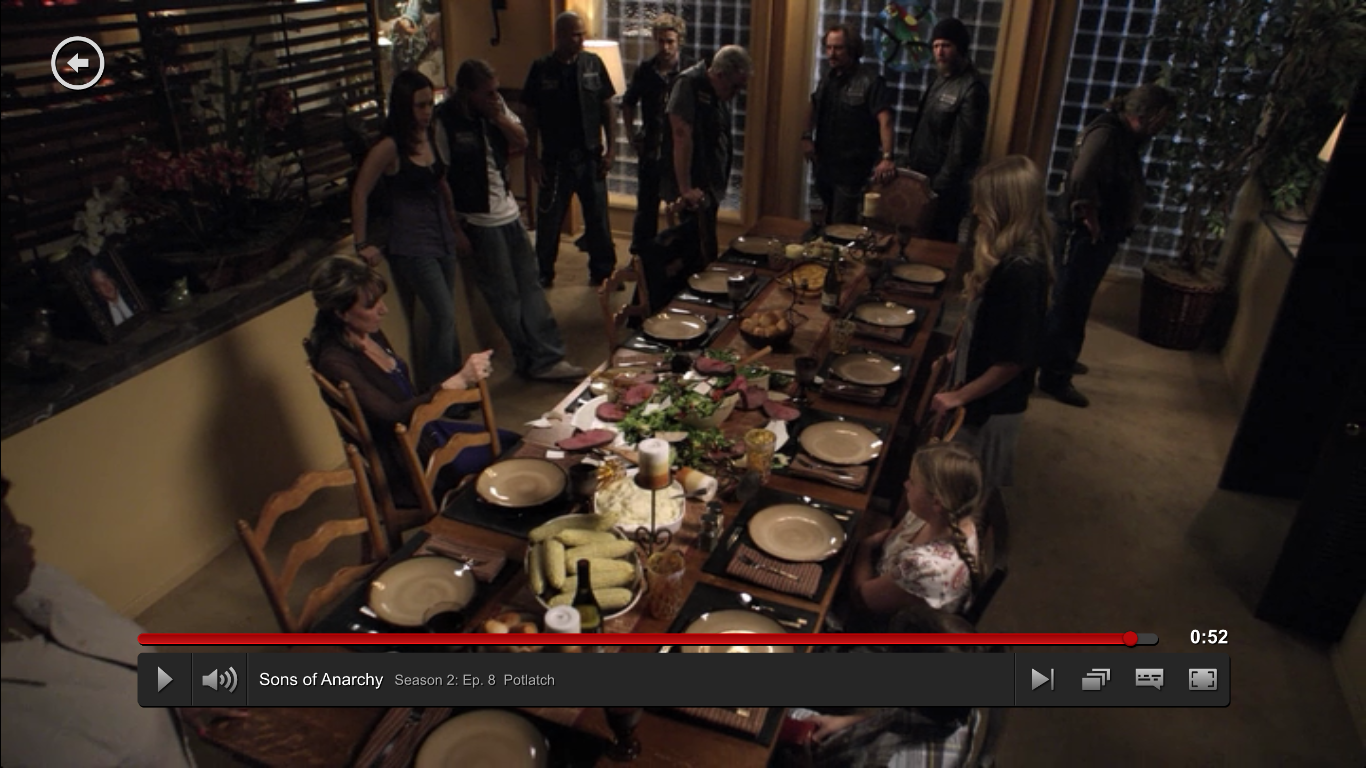
As the club’s gun running grows increasingly violent and complicated, tensions grow between members, particularly between Clay and Jax, who hopes for a different and more peaceful future for the club, one that aligns with the final writings of his deceased father, John Teller. In season 2, episode 8, “Potlatch,” Gemma aims to repair these fractured relationships by again hosting a dinner at her home. While the family meal scene from the first season of the show glows, this meal combusts, as members fight one another until Gemma forcefully slams a dish on the table, shattering it.

The tense family meal mid-way through season 2 stands in stark contrast to the joyful meal in the first season.

The tense family meal mid-way through season 2 stands in stark contrast to the joyful meal in the first season.

While Clay’s bang of the gavel settles club business, Gemm’s outburst truncates the fighting. The camera pulls away, displaying the broken family from above. The club’s escalating issues are portrayed spatially, as the men cluster at the end of the table, dimly lit and turned away from one another, frustrated, angry, and embarrassed. Gemma is the only one who sits, exasperated and worried. The main meat dish of the meal is scattered across the table, interspersed with pieces of the shattered dish. In stark contrast to the joyful meal in the first season, this meal visually demonstrates the growing schisms within the club’s brotherhood and the uncertainty of its future.

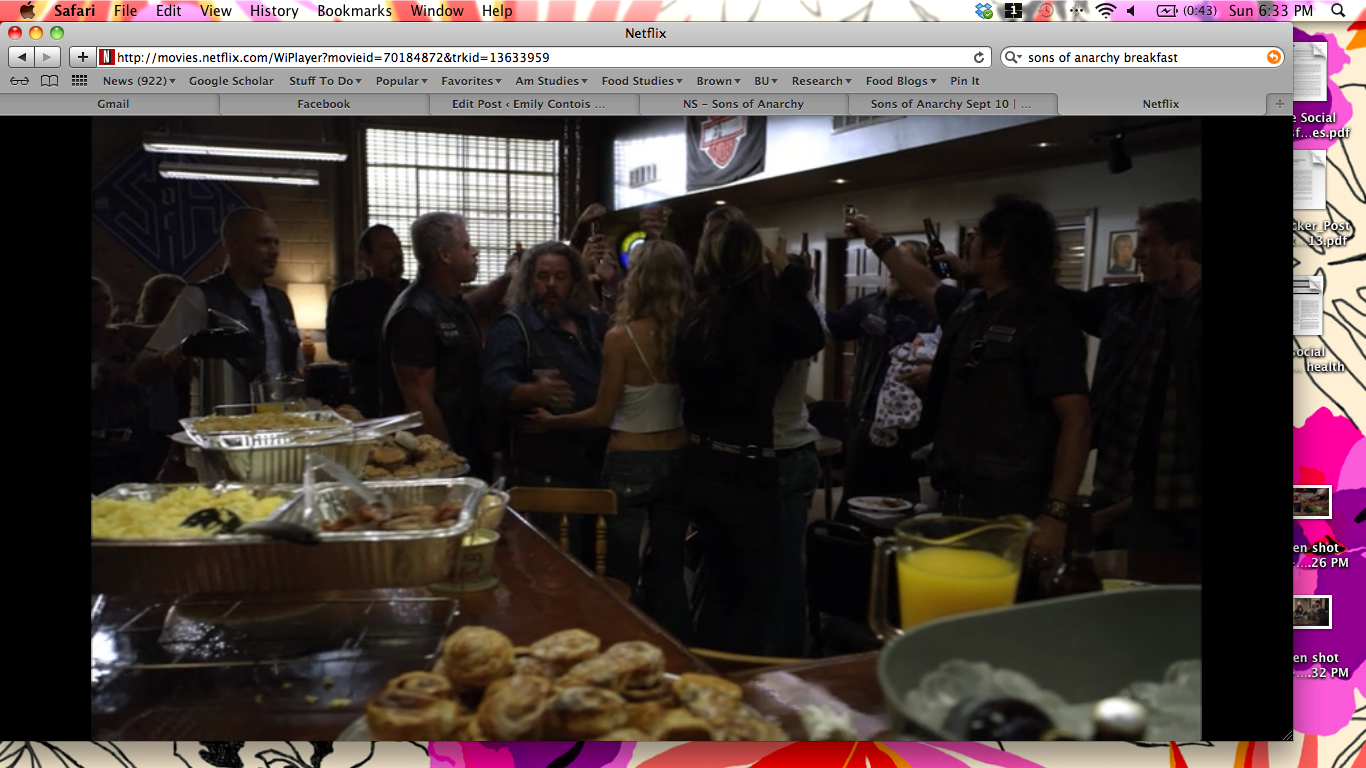
The finale of season 3, “NS,” opens with Gemma hosting a breakfast for the MC. The meal is preceded by a scene of her cooking in the early morning hours, stirring batter as Clay embraces her. Efforts of her domestic labors are evident: baked goods cover all of the kitchen’s counter space and baking sheets and tins are piled high in the sink. Notably, Gemma hosts this meal not at her home, but at the clubhouse, demonstrating her continued maternal offerings, but a lessening of the strength of her influence, as she does not bring the club into her home. Unlike the second family meal, this third meal is again joyous, as the club celebrates not only the return of Jax’s son, Abel, and Jax and Tara’s reuniting, but also the engagement of Opie (Ryan Hurst) and Lyla (Winter Ave Zoli).

The club toasts Opie and Lyla's engagement over the breakfast that Gemma prepared.

In season 3, the club toasts Opie and Lyla’s engagement over a breakfast that Gemma prepared.

While Gemma connives, plots, threatens, fights, and kills for the good of the Sons, some of her contributions to the club are heavily gendered, as she mothers the members and literally feeds the club through family meals in the first few seasons.

As the plot transforms, however, Gemma’s role as matriarch and its accompanying power and influence over Jax are increasingly threatened as Tara, who Jax loved when they were teenagers, returns to Charming and grows increasingly close to Jax. As Tara emerges as the leading lady in Jax’s life, Gemma not only struggles violently for her place, but also no longer feeds the club. While she is portrayed in other maternal and conventionally feminine settings—doting on her pet birds, tending to her plants and flowers, and caring for Jax and Tara’s young sons—she does not again gather the club around her table. She no longer feeds them, actions whose absence represent her waning power.

We’ll have to see what happens next for Gemma, since she is once again poised to resume her role as leading matriarch, as Tara fights criminal charges, which may take her away from Jax and her sons, leaving a vacant space for Gemma to fill.

The season six premiere of Sons of Anarchy airs tomorrow (Tuesday, September 10) on FX at 10 pm.

Labor Day Laments and the Masculine Glory of Groom’s Cakes

The groom's cake my husband would want had we had it to do over again; AT-AT cake by Cake Central member ChrisThe Cook

The groom’s cake my husband would likely want, if we had it to do over again. AT-AT cake by Cake Central member ChrisThe Cook

It’s Labor Day, which signals summer’s approaching end, as well as a seasonally-based, social ban on white clothing[Though really, when are white pants ever a good idea?] This holiday also tends to mark the end of the summer wedding season, but I’ve got weddings and cakes on the brain because I’m head-over-heels in love with Cherry Levin’s recent article, “He Can Have his Cake and We Will Eat It Too: The Role of the Groom’ Cake in Southeastern Louisiana Wedding Receptions,” in Digest: A Journal of Foodways and Culture

While I’m not sure the claim that the groom’s cake tradition is waining everywhere but in the south holds water, I greatly enjoyed the author’s analysis of the groom’s cake as a masculine detail within the otherwise ultra-feminine affair that is most big, white weddings.

Levin comments upon the “visual and symbolic relationship” between the wedding cake—or “bride’s cake” if you prefer—as its towering tiers and feminine, frosted details mirror the bride herself, adorned with lace, tulle, and beading. Furthermore, she contends that “celebratory cakes communicate important messages about gender, economic and social status.” In this way, the size, flavors, decoration, and theme of the groom’s cake takes on specific cultural meaning.

While the bride’s cake evokes the wedding day ideals of purity and beauty, Levin argues that “the southern groom’s cake openly affirms individual masculine characteristics and male personality in the otherwise controlled space of wedding ritual.” Interestingly enough, Levin points out that is often the bride who chooses and designs the groom’s cake, thus a symbol of masculinity crafted through a feminine lens. She further asserts, “When chosen by the bride, the groom’s cake may reflect and/or celebrate the groom’s successful performance of hegemonic masculinity or underscore notions of the groom’s virility by playfully critiquing aspects of his masculinity.”

Steel Magnolias inspired Armadillo Cake; Sandi Oh's Cupcakes, Edina, MN

Steel Magnolias inspired armadillo cake; Sandi Oh’s Cupcakes, Edina, MN

As Levin attended more than fifty southern weddings, researching the role and meaning of the grooms’ cake among other details, these desserts took on different masculine meanings, many of which may also resonate outside of the American south. She states that sports-themed cakes celebrated both hegemonic masculinity and regional identity; a beer-themed cake honored a groom as a “man’s man;” cakes that depicted hobbies, academic accomplishments, or careers each demonstrated a man’s special skills, mastery, and authority.

Near the end of the article, Levin discusses the armadillo groom’s cake made famous in Steel Magnolias as “an oikotype for what has become a groom’s cake trend at Louisiana wedding receptions.” Levin argues that the the red velvet, gray iced, armadillo-shaped cake—a confection in stark contrast to the extravagant and exceedingly pink wedding cake designed by the bride—communicates “encoded message about social, economic and class distinctions between the two merging families.” Despite these negative original connotations, the armadillo cake remains extremely popular and locally meaningful at Louisiana weddings.

The groom's cake at our wedding.

The groom’s cake at our wedding.

The armadillo cake also holds meaning outside of Louisiana, perhaps due to the wide release of the film version of Steel Magnolias. When I got married in Montana, my husband’s groom cake was a chocolate whale (an inside joke about the Carvel Fudgie the Whale cake) and the baker’s point of reference for my slightly unusual request was that she could carve it “like the armadillo cake,” a groom’s cake icon familiar to us both despite its southern origin, tradition, and character. From the lowlands of Louisiana to the mountains of Montana, the armadillo cake retains a sort of cultural currency.

Levin concludes, saying, “Groom’s cake not only demonstrates the bride’s vision of her groom’s masculine performance but also reveals her comprehension of his positioning within their social sphere.” While this is a fascinating finding that emerges from her copious wedding day observations and speaks to my own research on food and masculinity, my husband’s groom’s cake read, “Chris, You’re a whale of a husband!,” a predictive affirmation for the husband that he would be. I’m one lucky lady that this joking proclamation turned out to be wonderfully true.

Defining American Food in ‘The Saturday Evening Post All-American Cookbook’

If you ever want to strike up a passionate food debate, just toss out the the question, “What is American food?” While you’ll hear the unenlightened decree with disdain that the United States has no food culture, the answer is far more nuanced.

Like jazz and blues music, some argue that barbecue is a unique American cultural food product, one that loudly communicates a multiethnic history and both local and regional identity. Others will insist that the food traditions of New England form the culinary roots of American cuisine.[1] Others will point to McDonalds and other fast food joints known for selling burgers and fries as quintessentially American in taste, presentation, and capitalistic expansionism.[2] Still others will argue that the continually simmering melting pot[3] of American citizens ensures that all food served within U.S. borders in some way represents, absorbs, and communicates American food culture.

The Saturday Evening Post All-American CookbookThese disparate points of view are portrayed in different ways in The Saturday Evening Post All-American Cookbook.

Published in 1976, filled with reproductions of the Post’s covers and advertisements, and made up of 500 all-American recipes by food editor and author, Charlotte Turgeon, the cookbook commemorated not only the nation’s bicentennial, but also “every person who has played a part in the nation’s culinary heritage”  and country’s “magnificent” food (p. 6).

In his “Light-Hearted History of Eating in America,” which precedes the recipes, Frederic A. Birmingham, Managing Editor of The Saturday Evening Post, points to the innovation and flexibility of American cooks as they “adopted and adapted the traditional dishes of Europe to the miraculous plenty of their brave new world” (p. 7). In preparing and consuming this all-American food, Birmingham argues that American cuisine embodies the cultural value of freedom, unrestrained by “rigid traditionalism” and “rockbound food lore (p. 9), making space for uniquely American fare.

He also contends that “this country more than any other has been open and receptive to new knowledge in nutrition, diet, and, and scientific food preparation,” an inclination that he asserts “has contributed to our good health without decreasing our wealth of enjoyment at the dining table” (p. 9). Indeed, American openness to the certainty of science at the table, sometimes at the expense of tradition or art, has shaped the American diet and food culture.

Beyond scientific leanings, Birmingham promotes specific “American” ingredients as he boasts, “There is no steak like an American steak. We raise the best beef, cook it the best, and eat the most of it in many forms” (p. 11). While not at all his point, these seemingly contradictory sentiments reveal the underlying paradoxes and conflicts of eating in America: seemingly unrivaled plenty and abundance link arms with hearty appetites, rooted in the quest for freedom and innovation, only to butt up against nutrition, health, responsibility, and individualism.

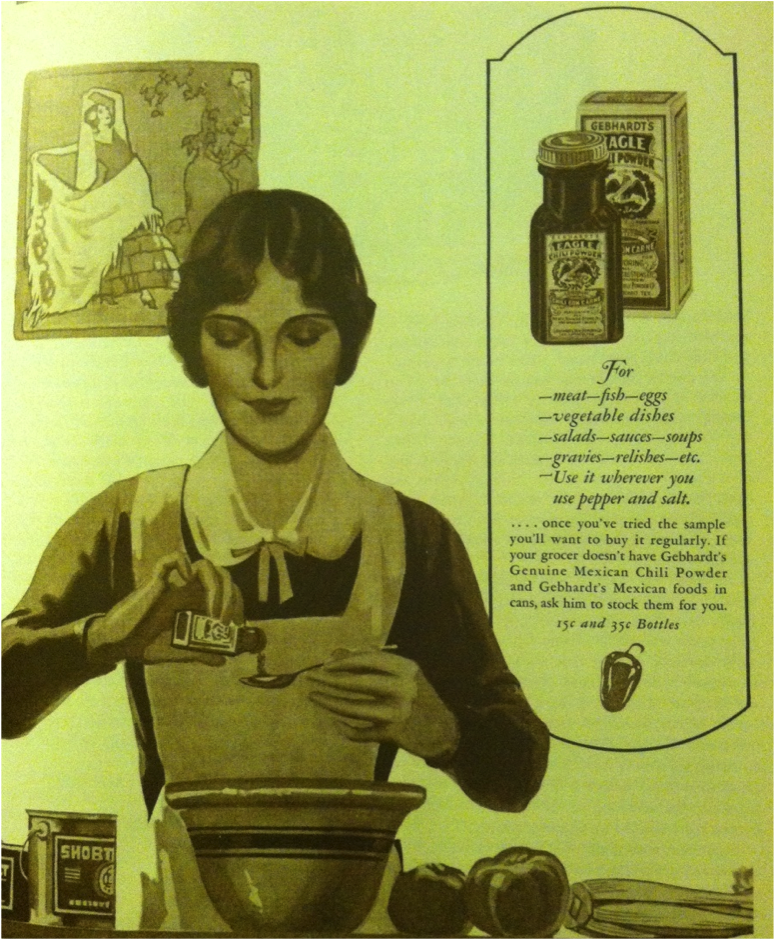
Gebhardt's chili powder advertisement from 'The Saturday Evening Post,' March 15, 1930

Gebhardt’s chili powder advertisement from ‘The Saturday Evening Post,’ March 15, 1930

While a typical “We are #1!” sentiment can be detected, the cookbook’s authors contend that they do not make Mark Twain’s claim that “the only good food in the world is American food” (p. 12). But they do say that Americans can hold their heads up high as our culinary creations are “based on the American theory that food should be delicious as well as nutritious, well seasoned while not exotic, well prepared but not complicated” (p. 12).

Beyond this definition of American food theory, Birmingham roots American food culture firmly within “The First Thanksgiving” myth. He posits that the great desires, needs, sacrifice, and suffering of the seventeenth century pilgrims is what causes plenty and abundance to resonate so deeply within all American citizens, past and present. Because the people of the United States began with and have known great want—as pilgrims, as immigrants, as refugees, as any who sought a new life on American shores—Americans powerfully embrace, value, and seek freedom from want. Notably, such an argument ignores the food cultures and significant agricultural expertise of Native Americans, as well as the violent histories of conquest that the Thanksgiving myth obscures.

Birmingham concludes his introductory comments with the words of Carlos Bulosan, which accompanied Norman Rockwell’s “Freedom from Want” when it first appeared in The Saturday Evening Post:

We are not really free unless we use what we produce. So long as the fruit of our labor is denied us, so long will want manifest itself in a world of slaves. It is only when we have plenty to eat—plenty of everything—that we begin to understand what freedom means. To us, freedom is not an intangible thing. When we have enough to eat, then we are healthy enough to enjoy what we eat. Then we are not merely living but also becoming a creative part of life. It is only then that we become a growing part of democracy” (p. 22).

Despite some of its shortcomings, this cookbook provides fertile source material for exploring the connections between American values and ideologies and the way that they inform how, why, and what Americans eat; as well as how they define what “American” food is.

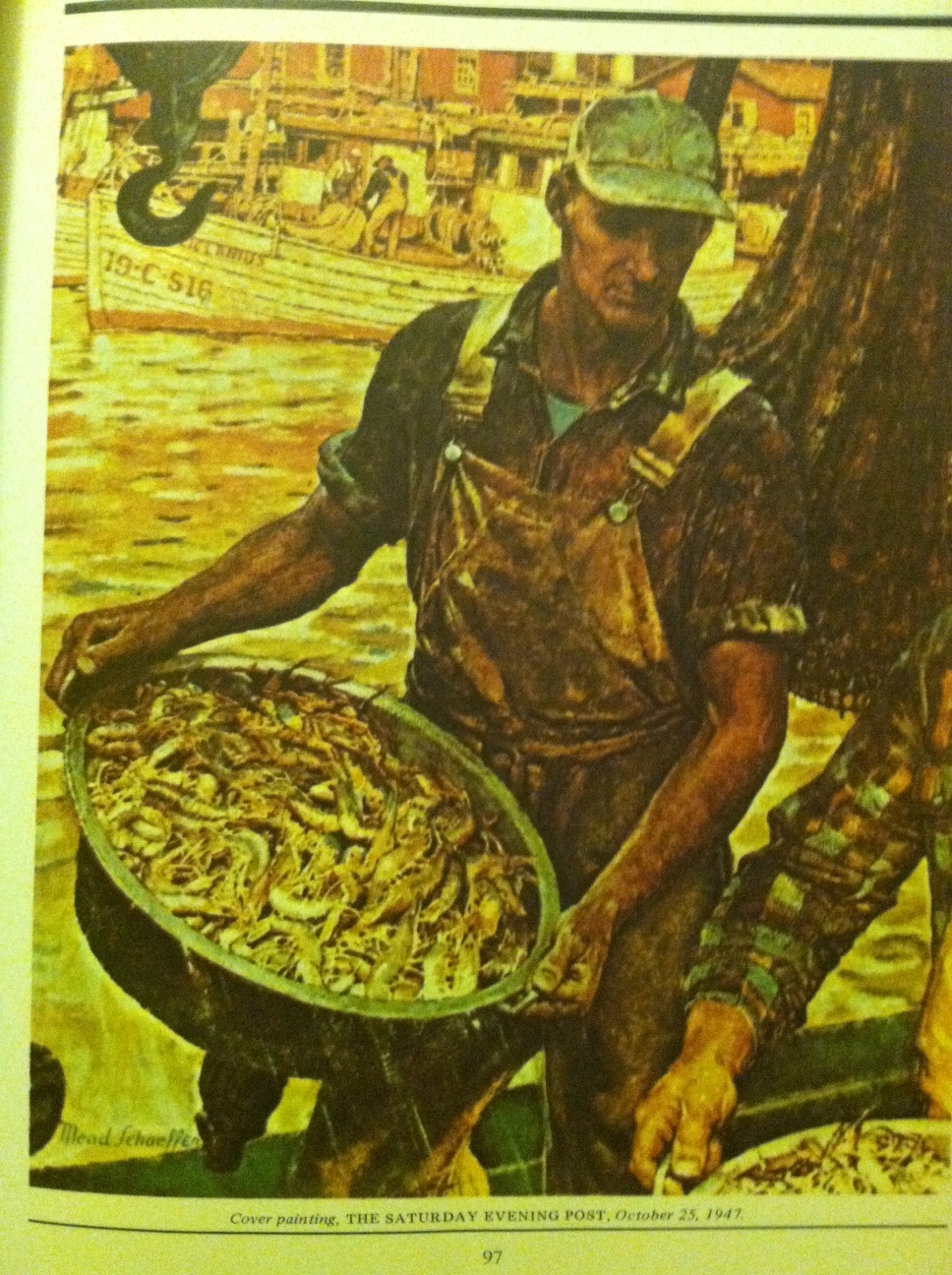
Cover painting, The Saturday Evening Post, October 25, 1947

Cover painting, The Saturday Evening Post, October 25, 1947

And last, but not least, sandwiched between reproductions of food-themed Post covers and period advertisements, among the cookbook’s 500 recipes are:

  • Sunday Roast Beef with Yorkshire Pudding: “a time honored custom”
  • Creamed Chipped Beef: a modern take on jerked beef, “a staple for pioneers”
  • Skillet Ham and Eggs: “pretty much a universal American dish”
  • Rabbit Fricassee: “popular with such connoisseurs as Thomas Jefferson”
  • Vichyssoise: “invented in the United States, albeit by a French chef”
  • Philadelphia Pepper Pot: a soup attributed to George Washington’s chef at Valley Forge, “confronted with starving troops and almost no rations”
  • Clam Chowder: “the delicious soup that Americans have eaten for centuries”
  • Brillat-Savarin’s Boston Fondue: While in exile in the US, Brillat-Savarin gave this dish to a Boston restaurant owner
  • Sautéed Eggplant: “part of the American cooking scene at least since the time of George Washington and probably several decades before that”
  • Real Apple Pie: “pie is America’s second most popular dessert and has been since the beginning of this country’s culinary history”

[1] For more, I recommend Stavely and Fitzgerald’s America’s Founding Food: The Story of New England Cooking.

[2] On this topic, I love Elizabeth Rozin’s The Primal Cheeseburger.

[3] Or ethnic stew or salad bowl if you prefer; for more, check out LeAna Gloor’s “From the Melting Pot to the Tossed Salad Metaphor: Why Coercive Assimilation Lacks the Flavors Americans Crave.”

Take Me Out to the Ballgame…and Eat 33,000 Hot Dogs

Classic baseball concessions

Classic baseball concessions

We all know how the 1908 song “Take Me Out to the Ball Game” goes, and if you care about food, the line “buy me some peanuts and cracker jack” will likely stand out.

I didn’t grow up a baseball fan (or football or basketball for that matter), as my Australian father instead schooled us on tennis, cycling, and Formula 1 racing. My husband, on the other hand, has loved the game of baseball all his life. And so this summer, on a road trip that covered a bit more than 5,000 miles, we stopped to see five ball games in five cities, meaning I consumed more baseball — and more ballpark concessions — than in my entire life up to this point.

Read More

Browsing the Grocery Store Butterscape: A Photo Essay

Mid-century butter boxes spotted during our recent road trip antiquing.

Mid-century butter boxes spotted during our recent road trip antiquing.

Unlike most foodies, I more often than not zoom through my trips at the grocery store like a crazed contestant on Supermarket Sweep. Last month in Montana, however, while spending a few relaxing days at home with my family, I allowed myself to get lost in the imagery of the butter aisle. [Imagine my husband’s embarrassed horror as I snapped all these photos. Perhaps it was a suitable and just revenge for taking me to Walmart.]

Bizarre iPhone photography sessions aside, butter bears a complicated identity in the grocery store. In her poetic ode to butter Margaret Visser (a Canadian Michael Pollan predecessor) explains the “butter mystique,” proclaiming it simple, rich, golden, and pure, as well as “irreproachable, unique, and irreplaceable” among both ancient and modern foodstuffs (chapter 3 in Much Depends on Dinner, 1986). While beyond reproach for some, heart health recommendations often shun butter for its saturated fat content, instead championing margarine, a food product with its own mixed identity, including everything from a healthy alternative to a butter impostor, a Frankenstein-esque food terror created in a lab to a cheaper spread. These layered food identities play out in the grocery store aisle, full of “real” butter, margarines, and butter-like concoctions, each exhibiting meaningful food packaging.

Read More

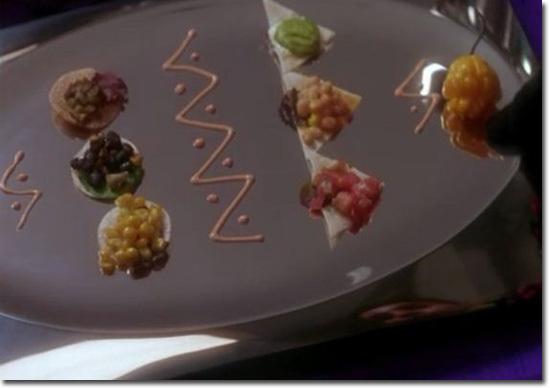
Haute Taco Bell & Underground Rat Burgers: Food as Political Metaphor in ‘Demolition Man’

Demolition Man (1993)

Demolition Man (1993)

When my husband and I moved into our new apartment in Providence one month ago, we split our time between building Ikea furniture during a minor heat wave (which was somewhat-less-than-delightful) and watching movies that ranged from beloved cult classic (Slap Shot with 1977 Paul Newman) to awesomely bad. It is from this latter set that today’s subject matter emerges: the sci-fi action flick, Demolition Man (1993).

In this film, directed by Marco Brambilla, hero John Spartan (Sylvester Stallone, ripped and a bit punch drunk as per usual) battles his violent nemesis, Simon Phoenix (Wesley Snipes, donning a startlingly blonde flat top). After Spartan’s attempt to arrest Phoenix goes wrong in 1996, both men are sentenced to be cryogenically frozen, which, yes, was somehow already a best practice in prisons before the end of the twentieth century. When Phoenix escapes at his parole hearing and starts a killing spree in the post-apocolyptic future of 2032, the current police force has no choice but to turn to Spartan for help.

Read More

Why Writing an Academic Blog Makes Me Feel Like Sally Field: 5 Things I’ve Learned in My First Year

In a post last year, the London School of Economics and Political Science’s Impact of Social Sciences blog argued that blogging is one of the best things that academics can do. As I celebrate my first year of blogging this month, I would have to agree. While I have a long way to go, here are five things I’ve learned while blogging on my thoughts and research in food studies, nutrition, and public health.

Read More

Graduate Food Studies Programs: A List

I began keeping this list of graduate food studies program after a fascinating roundtable discussion titled, “Masters Programs in Food Studies, Food Systems, and Food Policy,” at the 2013 joint meeting of the Association for the Study of Food and Society and the Agriculture, Food & Human Values Society at Michigan State University in East Lansing.

During this discussion, the directors of seven graduate food programs debated the key issues emerging in graduate food education. They were also asked by a session attendee to summarize each program’s distinguishing features, which I’ve summarized here in the hopes it might prove useful for any students currently weighing their options for graduate study in food.

Note: I’ve been keeping this list as current as possible. Last update: January 25, 2019

Boston University, MLA in Gastronomy 

  • Location: Boston, MA
  • Program Director: Megan Elias, Ph.D.
  • Program History: Co-founded in the 1990s by Julia Child & Jacques Pépin
  • Strengths / Specialities: Focus on the liberal arts; can include culinary arts & wine study; online, blended and in-person courses; in large, research university
  • Follow: Twitter (@GastronomyatBU); Facebook (BU Gastronomy); Blog (Gastronomy at BU)

Chatham University, MA in Food Studies

Drexel University, Master of Science in Culinary Arts and Science (MS CAS)

  • Location: Philadelphia, PA
  • Program Director: Rosemary Trout
  • Program History: Launched fall 2017
  • Specialties / Strengths: Program combines focus in culinary arts, food science, and gastronomy/food systems
  • Follow: Twiter (@DrexelHSM)

Green Mountain College, MS in Sustainable Food Systems– University to close in 2019 

Marylhurst University, MS in Food Systems & Society 

  • Location: Marylhurst, OR
  • Program Director: Patricia Allen, Ph.D.
  • Program History: Enrolled first cohort in 2014; program closing in 2018
  • Strengths / Specialities: Focus on social justice and change through food; “low-residency” program combines online learning with twice a year on campus intensives
  • Follow: Twitter (@marylhurstfood)

New York University, MA in Food Studies

  • Location: New York City, NY
  • Program Director: Jennifer Berg, Ph.D.
  • Program History: Program began in 1996
  • Strengths / Specialities: Focus on food and culture; can concentrate in food culture or food systems; specialized in urban food systems
  • Follow: Facebook

Syracuse University, MS in Food Studies

  • Location: Syracuse, NY
  • Program Director: Anne C. Bellows, Ph.D.
  • Program History: MS program was approved in 2015
  • Strengths / Specialities: Program provides a foundation in a political economy and human rights-based approach to food systems; program intersects with longstanding professional programs in nutrition and public health
  • Follow: Facebook (SUFoodStudies)

University of Adelaide, MA in Food Studies – Program closed November 27, 2013

  • Location: Adelaide, SA, Australia
  • Program Staff: Barbara Santich, Ph.D. and Rachel Ankeny, Ph.D.
  • Program History: In existence for more than 10 years, but recently changed
  • Strengths / Specialities: International focus; graduate certificate in food writing; online and in-person study options

University of the Pacific, MA in Food Studies – Program to close in 2020

  • Location: San Francisco, CA
  • Program Director: Polly Adema, Ph.D.
  • Program History: Enrolled first cohort in 2015
  • Strengths / Specialties: Food policy and politics, food history, food sociology, food business
  • Follow: Facebook

University of Vermont, MS in Food Systems

The Ins & Outs, Highs & Lows of Public Health Nutrition

A few weeks ago, I had a student email me to learn more about what it’s like to work in the field of public health nutrition. Since my last day with Kaiser Permanente is this Friday, I’ll soon be ending this stage of my professional public health career, moving toward a life in academia where I aspire to bridge the worlds of the liberal arts and public health. While my day-to-day life will focus less on applied public health practice, answering this student’s questions made me all the more proud of the work, perspective, and contributions of public health. 

What follows is some of our Q&A.

Read More

The Agony and the Ecstasy—of Eating

While we often think of eating as a supremely pleasurable experience, there are also times when eating brings pain, which can be wholly unwelcome or fully enjoyed. Rozin defines pain as “a negative experienced state that we avoid and that we try to reduce or eliminate” (1999: 5). And yet, there are numerous instances in which we do not avoid, reduce, or eliminate painful eating experiences. From late night, drive-through tacos that leave one’s stomach a bit unsettled to that ready-to-burst feeling that follows overeating at Thanksgiving dinner, we often fail to prevent moderately painful gastric distress. Pain can also find us by accident, as we cry out when a momentary mishap of the teeth causes us to bite down on our inner cheek or when we burn our tongues on a hot soup that we are too eager to try.

Specific foods, however, bring a pain that at least some of us welcome and seek on purpose. Spicy foods set our tongues and lips on fire. Pickled foods render the inside of our mouths raw. Sugary sour candies cause our teeth to ache. Where does the desire to repeatedly consume these pain-causing foods come from? Rozin posits a handful of mechanisms for what he refers to as hedonic reversal, the process by which painful eating experiences come to evoke pleasure. Whether a product of an addictive process, endorphin release, or benign masochism, not all eaters engage in this process and find this pleasure. How do we explain this difference?

Some eaters enjoy the pain of consuming hot chili peppers, while others do not.

Some eaters enjoy the pain of consuming hot chili peppers, while others do not.

At least with spicy foods, part of the difference may be cultural. For example, in Latin American, Asian, and Indian cultures, hot chili peppers are an integral part of cuisine. Children in these cultures thus grow up exposed to, eating, and enjoying spicy sensations as a normal part of everyday life. When hot chili peppers are consumed outside of this cultural context, however, how does this change the role, meaning, sensation, and experience of spiciness? Within a US context, spicy foods often become gendered and particularly for men have come to represent risk-taking, daring, and thrill seeking.

Beyond manly displays of palate prowess, it is argued that it was not only the cooking fire that made us human, but also our ability to put mind over body and enjoy the spicy heat on our tongues. From this point of view, man’s enjoyment of extreme spiciness is what sets us apart from the animals. The ability to mentally assure our tongues that they are not actually on fire demonstrates our higher brain functioning and perhaps also the separate and yet conjoined relationship between the immaterial mind and the physical body.

And finally, Rozin proposes three temporal frames of pleasure and pain: anticipation for the future, experience of the present, and memory of the past. While Proust shows us that the memory of past tastes powerfully shapes our present experience, so too do immediate pleasures and feared future pains. Eating reveals itself as a complex balance between pleasure and pain that is quite often renegotiated at every turn.

Food & Fat as Metaphor in ‘The Middlesteins’

When NPR included Jami Attenberg’s The Middlesteins as a foodie summer read, I had forgotten that it was on my request list at the library. When it came available with its fast food inspired red and yellow cover, I excitedly carried it home, ready to dig in.

Late last year, Hannah Rosefield wrote an incredibly insightful piece on the use of obesity as metaphor in not only The Middlesteins, but also in Michael Kimball’s Big Ray, Heft by Liz Moore, and Erin Lange’s young adult novel Butter. She argues:

An obese body is never, any longer, just an obese body, in life or in fiction, but an embodiment of an epidemic, an image of our society…It is true that although 70 percent of American adults are overweight or obese, a relatively small number is super obese. But these novels show Ray, Arthur, Butter, and Edie not at one end of a continuum, but as existing in a separate category, divided from their “normal” friends and family. We see the various societal factors that contribute to obesity, but by representing obesity as anomaly, Big Ray, Heft, Butter, and The Middlesteins shift the focus from society to the individual. Rather than ask how contemporary society enables obesity, these novels ask what is wrong with these particular individuals, why they and not others are victims of an obesity-enabling society. If the personal is political in these books, it is so only fleetingly.

The Middlesteins by Jami Attenberg

The Middlesteins by Jami Attenberg

I echo Rosefield’s sentiment that the treatment of the obese form in The Middlesteins reflects American culture, which champions the doctrine of personal responsibility, particularly for the way we eat and the weight we carry. Because of this, Edie (the novel’s obese protagonist) is blamed, ridiculed, and held in moral contempt for her fatness.

In a novel bursting with fat shaming, Attenberg mirrors society’s view of fatness, as Edie’s fat body is repeatedly vilified as a personal choice. In her summary of The Middlesteins, Jessica Soffer frames Edie’s eating as the central thread of the novel: “She eats and eats and eats, and we learn the ways in which her eating has damaged her daughter, her husband, and even her relationship with her grandchildren.” Edie’s eating, however, is not a simple, linear journey to self-destruction or an attempt to kill herself, as her family believes. Edie’s eating is a never-ending quest for comfort, love, and understanding—the things we all search for in this life.

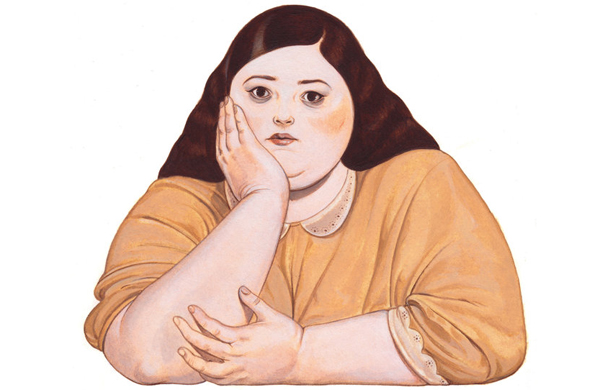
Image that accompanied the New York Times review of 'The Middlesteins'

Image that accompanied the New York Times review of ‘The Middlesteins’

Soffer continues, “Food runs and ruins the lives of everyone in this book.” And yet, Edie’s daughter’s vegetarianism and daughter-in-law’s obsessive calorie restriction are not painted in the same negative light as Edie’s overeating. Neither are her daughter’s excessive drinking nor her father’s smoking and death from lung cancer held up as potent symbols of dysfunction and destruction. Furthermore, Edie’s father also eats incessantly, trying to fill the void caused by going hungry on his journey to America:

At meals, he ate and ate; he was carnal, primal, about food. He staked out territory, leaning forward on the table, one arm resting around his plate, the other dishing the food into his mouth, not stopping to chew or breathe. But he never gained a pound. He had starved on his long journey from Ukraine to Chicago eight years before, and had never been able to fill himself up since” (p. 2).

Edie’s father remains thin and thus beyond reproach for his consumption. The painful and glaring spotlight placed on Edie’s eating is because of her resultant fat body, reflecting society’s conflicted ambivalence about eating and bodies, which takes the form of fat shaming, discrimination, and abhorrence.

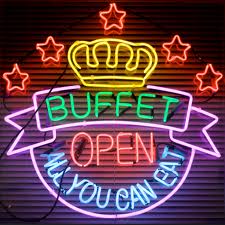
All you can eat buffetThis vehement reaction to Edie’s fatness, experienced by her family and readers alike, is rooted in our recognition of how universal Edie’s eating is and how closely related her body is to our own. While most of us do not eat to the extent Edie does or so often (in one scene, Edie orders and eats meals at McDonalds, Burger King, and a Chinese restaurant in rapid succession) most of us do over-indulge periodically. Such eating frenzies are engrained in American culture—from Thanksgiving Dinner to Super Bowl Sunday to All-You-Can Eat buffets—and are eating rituals that Americans experience and enjoy.

Edie is thus a symbol of the excess that lies in us all and that is so central to American mythology, rooted in the lore of abundance and plenty. This is articulated so well by guests at Edie’s grandchildren’s b’nai mitzvah, who eat and drink to excess at the party and admit: “There was nothing we could do for Edie that we did not already need to do for ourselves” (p. 238). Furthermore, at the end of the novel in a state of conflicted grief, Edie’s husband realizes: “It was then he thought he understood Edie, and why she ate like she had; constantly, ceaselessly, with no regard for taste or content…because food was a wonderful place to hide” (p. 263). We are all capable of recognizing what fuels Edie’s consumption and eating in a similar way.

In addition, Edie’s eating and fat body serve as metaphors for the dysfunction of her family and society more broadly in a material age. Within this text, food and eating are salient symbols, revealing the inner workings of each character—their hopes, their desires, their relationships to one another and the world around them. For example, Edie’s children are young (Robin in a high chair) when the Middlesteins first stop eating together as a family. The dissolution of commensality is a sign, symptomatic of the family’s growing estrangement and isolation, a process not rooted in but symbolized by Edie’s own eating.

Furthermore, Edie’s daughter-in-law’s disdainful concern for Edie’s weight, as well as her own restrictive eating habits and those she attempts to inflict upon her family, only embody her larger desire to exert control. Falling pregnant while in college, she views her children, her marriage, and the trajectory and contents of her entire adult life as a mistake, an uncontrolled course. Unable to redress her past, she attempts to firmly shape her future with an iron fist and raw vegetables: “Violent in her articulation” (p. 149), she “cut[s] her food into the tiniest of squares, which she would then chew thoughtfully and slowly, as if she were savoring every vitamin, as if she could feel each bite extending her life span” (p. 159).

Illustration of a classic comfort food, chicken noodle soup, by Holly Wales, which accompanied Attenberg's NYT article, "The Unlikely Chef"

Illustration of a classic comfort food, chicken noodle soup, by Holly Wales, which accompanied Attenberg’s NYT article, “The Unlikely Chef”

Edie’s overeating, her family’s isolated dining, and her daughter-in-law’s obsessive restriction are examples of problems that play out metaphorically through food. And this novel provides readers with a veritable feast of problems, including loveless marriages, the grief of losing one’s parents, a dissatisfying career, and a failing business to name but a few. It can be argued however that at the core of every problem, and at the root of every action in fiction or in life, lies the desire to love and be loved in return. When that love seems like it cannot be found in those around us, we seek it in other places. For some this can lead down a path of addiction, finding solace in drugs, alcohol, sex, theft, or food. Such instances warrant compassion and understanding, not disdain. While indicted for tearing her family apart by her eating, Edie does find love in the end, though time runs out all too quickly.

Because food plays myriad roles in our lives, it serves as a powerful symbol in literature, one to which we can relate effortlessly. From the opening pages, Attenberg writes, “Food was made of love, and love was made of food” (p. 6). Rooted in this sentiment, Attenberg’s opening line stands tall and meaningful among other literary beginnings: “How could she not feed her daughter?” (p. 1). In The Middlesteins, each character feeds his or her own problems, providing readers a painful but astute view into society’s ills and our collective potential for redemption, crafted through scenes of food, eating, and fat and thin bodies.

Toned Tummies & Bloated Bellies: Activia Yogurt & Gendered Digestion

In Experiencing Food and the Senses, one of the core courses in the MLA in Gastronomy program at BU, we shine a spotlight on all of the senses, especially those so often left out of scholarly inquiry. I continued my study of gender, coupling it with exploration of digestion as portrayed in advertising for Activia yogurt. Here is a taste from “Toned Tummies and Bloated Bellies: Activia Yogurt and Gendered Digestion.”

Close up of a 4-ounce Activia container, which advertises its trademark named bacterial strain, bfidius regularis. The container also includes the product’s health claim, “Helps regulate your digestive system.” The curving vertical lines mimic the female abdomen included in Activia television commercials.

Close up of a 4-ounce Activia container, which advertises its trademark named bacterial strain, bfidius regularis. The container also includes the product’s health claim, “Helps regulate your digestive system.” The curving vertical lines mimic the female abdomen included in Activia television commercials.

Often considered a taboo topic in the United States, the promotion and popularity of Activia, a probiotic yogurt launched in the U.S. in 2006, has in some ways opened a dialogue among American women on regularity, digestion, and constipation. In studies exploring gendered perceptions of food, yogurt is often considered a feminine comestible (Kiefer et al. 2005; Jensen & Holm 1999). Furthermore, Dannon states that they have only ever marketed their products to women (Sandler, 2008). As a functional food sold to appease digestive ills, the female-focused marketing of Activia provides a new and different opportunity to analyze gender in Dannon’s marketing tactics.

Activia’s probiotic market prowess takes place within a contemporary culture of constipation. Before Activia launched in the United States, Dannon hired the Opinion Research Corporation to survey more than 20,000 Americans for the Activia Most Irregular Cities Ranking. In this survey, irregularity was defined as “that miserable experience of not going to the bathroom for two or more days” (Dannon Press Release, 2006). Extrapolated survey results indicated that 26 million Americans had experienced irregularity at least once in the last three months (Dannon Press Release, 2006).

Digestive problems appear to be gendered. While it is unclear why, many functional gastrointestinal disorders, such as irritable bowel syndrome (IBS), occur significantly more often in women (Chang et al., 2006). Bringing unexpected and painful physical symptoms, IBS also results in emotional distress over one’s lack of control over bowel habits, which may affect women more than men (Chang et al., 2006). For example, women are taught that bodily functions are something to be kept private and secret as compared to men. In addition, bloating, as a physical condition that creates the appearance of fatness, is in conflict with the Thin Ideal which reigns in Western culture.

While the medical community recognizes these social implications, Walton (2002) argues that little scholarship explores “how bowel ‘regularity’ becomes one of the means by which women exercise ‘control’ in their daily lives” (p. 57). Vidali (2010) provides one such example as she explores the rhetorics of gastrointestinal (GI) disorders from a disability studies perspective.

Inner Hygiene: Constipation and the Pursuit of Health in Modern Society, Whorton (2000)

Inner Hygiene: Constipation and the Pursuit of Health in Modern Society, Whorton (2000)

A historical trajectory exists for the relationship between women and digestion. In Inner Hygiene: Constipation and the Pursuit of Health in Modern Society, Whorton (2000) chronicles the “culture of constipation” that emerged in the United States, England, and Europe in the nineteenth century. While a bodily issue with health implications, constipation was also viewed as linked to “spiritual, moral, and emotional well-being” (Walton, 2002). Most poignantly, Whorton argues that the nineteenth- and twentieth-century culture of constipation “conveys people’s ambivalence about modern life” (Verbrugge, 2002, p. 76). He argues that the forces of modernity that supposedly caused digestive distress (processed diets) also fueled its scientific and technological solutions.

In her feminist reading of Whorton’s text, Walton (2002) reveals the gendered perception and treatment of constipation in the nineteenth and twentieth centuries. In particular, she reveals how the “Lane colectomy,” a surgical procedure that was performed by British surgeon Sir Arbuthnot Lane (and later found to be ineffective and harmful), targeted nearly exclusively female subjects. Lane argued that poor digestive health rendered a woman ugly, undesirable, and unmarriageable, but as Whorton so poetically states, “surgery tamed the shrew” with Lane reporting that several of his female patients were married after receiving his operation (2000, p. 69). Walton argues:

As a result of the discourse of the colon throughout the late nineteenth and early twentieth centuries, we might, to follow Foucault’s lead, say that a new ‘species’ of individual was born: the ‘abdominal woman’ (2002, p. 64).

Based upon this historical medical preoccupation, Walton argues that women continued to be targeted by campaigns promoting internal cleansing and regularity.

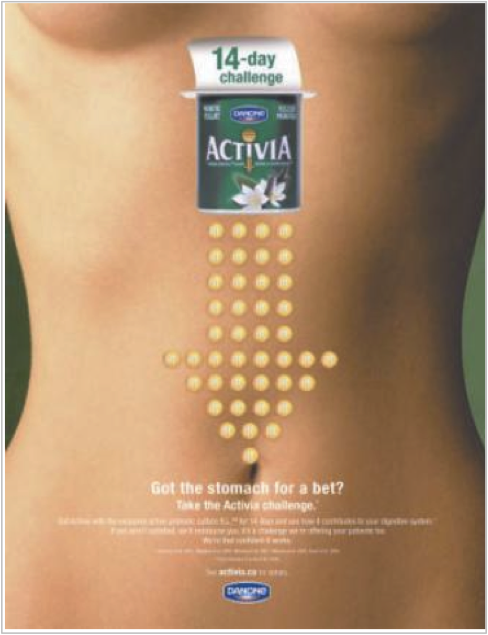
This sexualized image appeared in a Canadian Activia campaign. Like other advertisements, it features a woman’s flat abdomen. It also exposes the lower curve of her breasts.

This sexualized image appeared in a Canadian Activia campaign. Like other advertisements, it features a woman’s flat abdomen. It also extends upward farther than most U.S. advertisements, exposing the lower curve of her breasts.

The marketing of Activia yogurt reveals a modern adaptation of the historical abdominal woman, as the female target audience is quite literally reduced to a perfectly flat abdomen. In past Activia advertisements in the United States and abroad, the focus of the ad was a woman’s toned stomach and the animated bacteria that progress in the form of a superimposed yellow arrow through her digestive system intact and ready to promote regularity, health, and vitality. Notably all of these toned tummies were and continue to be light skinned. As Vidali reveals in her analysis of Activia advertisements, these flat bare bellies provide “gastrointestinal pornography” (Brown, 2007 quoted in Vidali, 2010), sexualizing women’s bodies within the more innocuous context of health. In this way, Activia advertising promotes a sexualized view of women, a subtext of weight loss, and idealized female body standards.

Notably, while the health benefit of Activia is directly communicated as regulation of the digestive system, the product’s subtext promotes something different and far more ephemeral—vitality, an active life, and a better self. Just as nineteenth-century campaigns against constipation were equally concerned for spiritual, moral, and emotional well being, twenty-first century interest in functional and medicinal foods expresses a culture’s current concerns and hopes for the future. In this way, the marketing of Activia, functional foods, and most “healthy” foods for that matter engage in a discourse about who consumers are, who they desire to be, and the exercise of control in this process. Furthermore, as women navigate culturally constructed ideals for female bodies and behaviors, Activia both reinforces these ideals and markets itself as a technological and medicinal solution for digestive distress and bloated bellies. In this way, any and every woman can become the perfect abdomen portrayed in Activia advertisements by following a fourteen-day regimen of yogurt consumption.

References

  • Chang, L., Toner, B., Fukudo, S., Guthrie, E., Locke, G. R., Norton, N., & Sperber, A. (2006). Gender, age, society, culture, and the patient’s perspective in the functional gastrointestinal eisorders. Gastroenterology, 130: 1435–1446.
  • Dannon Press Release. (2006, February 15). New survey shows Americans are backed up.
  • Jensen, K. O., & Holm L. (1999). Review preferences, quantities and concerns: socio-cultural perspectives on the gendered consumption of foods. European Journal of Clinical Nutrition, 53, 351-359.
  • Kiefer, I., Rathmanner, T., & Kunze, M. (2005). Eating and dieting differences in men and women. The Journal of Men’s Health & Gender, 2(2), 194-201.
  • Sandler, L. (2008, July 3). What health benefits, exactly, is Activia yogurt supposed to offer? Slate.
  • Verbrugge, M. H. (2002). Inner hygiene: Constipation and the pursuit of health in modern society (review). Bulletin of the History of Medicine, 76(1): 171-172.
  • Vidali, A. (2010). Out of control: The rhetoric of gastrointestinal disorders. Disability Studies Quarterly, 30(3/4): http://dsq-sds.org/article/view/1287/1313
  • Walton, J. (2002). Female peristalsis. differences: A Journal of Feminist Cultural Studies, 13(2): 57-89.
  • Whorton, J. C. (2000). Inner hygiene: Constipation and the pursuit of health in modern society. Oxford: Oxford UP.

Boston Strong: What’s Dunkin’ Donuts Got To Do With It?

When I blogged last week, I was obviously looking forward to the Boston Marathon—to the day when nearly the entire city hits the streets to cheer on the elite and the amateur, as we all celebrate Patriots’ Day on our feet. Instead, last week was a harrowing series of days for Bostonians, every one of us linked in someway to someone who was hurt or killed. As a city we mourned, but by Friday, as a city we celebrated—though those lost will never be forgotten.

During the manhunt that transpired on Friday, April 19, it was reported by BuzzFeed and The Huffington Post that Dunkin’ Donuts stores remained open during the city-wide lockdown to serve police officers and first responders. Having researched Dunkin’ Donuts coffee culture previously and powerfully aware of its meaning to Bostonians, I quickly wrote an essay on the open doors of Dunkin’ Donuts, serving as a caffeine and sugar-fueled heart of the city. I’m very excited that it was published this morning by The Inquisitive Eater, an online food journal published by The New School.

I invite you to read the short essay, “Dunkin’ Donuts Coffee: A Site and Source of Bostonian Identity Even During a Lockdown,” and to celebrate Boston with all of us (some of us newly) proud to call ourselves Bostonians.

The Week in Photos