Latest Posts

April Showers Bring May Flowers—and Thesis Due Dates

April showers have brought beautiful flowering trees in Boston this spring.

April showers have brought beautiful flowering trees in Boston this spring.

Spring has finally sprung in New England and tomorrow looks to be a great day for the Boston Marathon. Luckily, I’ll be able to take some time to enjoy Patriots’ Day because I’ve spent the last few weeks glued to my desk chair, pounding out the second draft of my thesis, which examines the marketing of weight loss programs to men.

Here’s a little taste…

Over the past decade, much has changed on the twenty-first century landscape of dieting, as the “low carb craze” of Atkins and South Beach made way for today’s Paleo Diet, evangelizing the diet of Stone Age hunter-gatherers and encouraging dieters to “eat like a caveman.” Perhaps no change is more notable, however, than the new target audience of weight loss programs—men.

Considered a masculine food in cultures the world over (Jensen and Holm 1999), the high intake of meat in low-carbohydrate diets made the Atkins and South Beach diets more popular among men than conventional low-fat diets. While men joined these diets in new numbers (Weinbraub 2004), Men’s Health Magazine was one of the first to develop a diet specifically for men in 2004, aptly named The Abs Diet.

Since then, the three giants of the diet industry—Weight Watchers, Nutrisystem, and Jenny Craig—have also set their sights on men. While the client makeup of these weight loss programs has historically been as high as 90 percent female (Advertising Age 2011), all three programs have in the last ten years begun targeting male clients directly. In 2005, the Nutrisystem for Men program began. Weight Watchers launched their men-only website in 2007, followed by a full-scale, $10 million campaign in April 2011. In February 2010, Jenny Craig launched their “Jenny Works for Men” campaign.

Jenny Craig for Men website homepage

Jenny Craig for Men website homepage

My thesis, advised by Warren Belasco, examines constructions of masculinity in an age of obesity by exploring the marketing of these weight loss programs directly to men in the twenty-first century. In this process, I identify the specific tactics employed by Weight Watchers, Nutrisystem, and Jenny Craig to de-feminize dieting and attract male clients.

While there may be trends toward inclusive masculinity in society generationally, the marketing of the three largest diet programs in the United States appears to reinforce the characteristics and values of hegemonic masculinity. Examples that are discussed in detail include the use of guy-to-guy language, alignment with sports, and the promotion of foods and ways of eating conventionally considered masculine.

After analyzing the key themes that appear in these marketing campaigns, I discuss how these themes inform the understanding of what defines a “real man” in today’s world and how notions of dieting, healthy eating, and health promotion are included or excluded in emerging definitions and understandings of masculinity. These issues are particularly timely as men continue to face significant health inequities, experiencing higher rates of disease and shorter lifetimes than women (Leone and Rovito 2013). Understanding the connections between men’s health, masculinity, and dieting can further inform campaigns, programs, and policies that address men’s health needs. In this way, a “real man” can be reframed as a healthy man.

Forecasting a Bright Future from the 2013 Future of Food and Nutrition Graduate Conference

Future of Food & Nutrition

This past Saturday, I had the pleasure of attending the 7th annual Future of Food and Nutrition Graduate Research Conference at the Friedman School of Nutrition Science and Policy at Tufts University. Organized and run by Friedman graduate students, the conference was as engaging and polished as any put on by a professional organization.

Graduate student research dealt with a host of topics both international and domestic, ranging from food access, food prices, and property values near grocery stores to behavior change and breastfeeding. Presentations that I attended also explored childhood obesity in Indonesia, regional U.S. food systems, and the latest in molecular nutrition. Students came from diverse backgrounds, including not only nutrition policy, biochemical and molecular nutrition, public health, and medicine, but also environmental science, agriculture, economics, urban and environmental planning; not to mention food studies and gastronomy as well. Collectively, presenters brought valuable multidisciplinary perspectives to the topics of food, nutrition, and food systems.

Beyond attending thought provoking panels, I participated in the poster presentation, giving two-minute power pitches on the paper I wrote in Ken Albala’s food history course, analyzing food safety messaging in refrigerator advertising during the Interwar Period from approximately 1920 to 1940. (On a side note, I was thrilled with the print job done by PhD Posters, which was quick, high quality, and a perfect fit for a grad student budget.)

Contois_36x42_Poster_Final

The poster I presented at the Future of Food and Nutrition Graduate Research Conference

While distilling a twenty-page paper into a poster was a challenge I had not previously encountered, poster presentations do have their advantages. As I have been counseled by my professors, presenting a poster rather than a panel talk does provide greater opportunity for conversation, feedback, and the sharing of ideas. I was pleasantly surprised and truly delighted by how receptive conference attendees where to tracing the historical narrative of consumer food safety messaging—a less traditional topic for a nutrition science and food systems conference.

These one-on-one and small group interactions reinforced the focus of the final expert panel (featuring Jason Reed of Hunger-Free Minnesota, James Harrison of The Food Project, and Emily Broad Leib of Harvard Law School Center for Health Law and Policy Innovation) and the overall theme of the conference—that the future of food and nutrition will be multidisciplinary and depend upon multi-sectorial collaboration.

Meat is Bad & The World is Flat: Thoughts from the Critical Nutrition Symposium

On March 8, 2013, I had the pleasure of attending the Critical Nutrition Symposium at UC Santa Cruz, organized by Julie Guthman, author of Weighing In. The event was spawned from a roundtable discussion at last year’s Association for the Study of Food and Society conference. The symposium brought together an interdisciplinary group of scholars to critically examine what is missing from conventional nutrition science research and practice, discuss why it matters, and brainstorm how to move forward in an informed and balanced way. What follows are a few of my favorite key ideas from the day’s discussions.

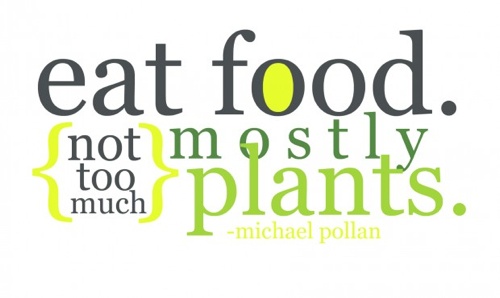
michael pollan

The seven word call to action that Pollan endorsed in “In Defense of Food.”

Adele Hite, a registered dietitian and public health advocate who is not afraid to ask big and delightfully confrontational questions regarding nutrition science, began the day by dissecting Michael Pollan’s now famous aphorism—Eat food. Not too much. Mostly plants. Step by step, she revealed the decades of revisionist myth and shaky science on which the diet most often considered healthy (one that is plant-based) is built. For example, she argued that the recommendation to eat like our grandparents is not particularly well founded, as nearly two-thirds of the average diet in 1955 came from foods that dietitians often encourage eaters to avoid, such as meat and full-fat dairy products. She claimed that these animal foods have been much maligned, but without significant scientific certainty of their harm. To illustrate her point, she cited the 2011 Cochrane Review, which she argues found no clear effect between dietary fat interventions compared to control diets on heart disease risk.

Among many other salient points, Hite stated that questioning the premise of energy balance elicits “a Galilean response” from nutrition scientists. Despite growing evidence that obesity is about far more than calories-in-and-calories-out, nutrition today continues to believe that the world is flat. To extend such metaphors, Hannah Landecker in her critical thoughts on nutrition science cited the anthropocentrism of the discipline, an orientation not unlike past beliefs that the earth was the center of the universe.

Landecker also made the interesting argument that nutrition is joyless as a science in that it typically views food and health in a narrow and restrictive way. Landecker finds joy in the study of metabolism, viewing it as an exciting and mind-bending exploration of the space between the food and the body. In such a way, it effectively studies the “how” of eating, while nutrition tends to remain focused on the “what.” In her comments, Nancy Chen agreed, describing nutrition as similar to economics; that is as a discipline focused on knowledge production. Grounded in her own anthropological perspective, Chen also noted the absence of cultural knowledge and frameworks in both nutrition and metabolic science.

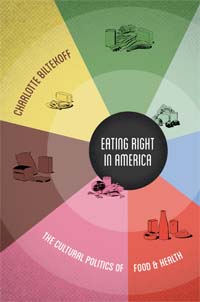
Eating Right in America

Forthcoming September 2013 from Duke University Press

In the next panel of speakers, Jessica Mudry, author of Measured Meals, argued that a “discourse of quantification” reigns supreme in nutrition, which privileges the formalized knowledge of nutrition over knowledge of the body itself. Within this frame, the conceptual calorie becomes the way in which we know food and how it communicates with and influences bodies. Extending notions of the calorie to dietary ideals more broadly, Charlotte Biltekoff argued that dietary advice embodies social and cultural values, as it constructs a moralized class hierarchy. Within this frame, ill health and poor eating habits carry increased moral and social significance. In her forthcoming book, Eating Right in America: The Cultural Politics of Food and Health, Biltekoff traces four movements—the domestic science movement, the WWII national nutrition program, the alternative food movement, and the anti-obesity movement—demonstrating how across more than a century, dietary advice has not only sought to reform diets, but also to craft ideal citizens.

Hidden Hunger by Aya Kimura

Hidden Hunger by Aya Kimura

In the final panel, Aya Kimura shared the findings presented in her book, Hidden Hunger: Gender and the Politics of Smarter Foods. She argued that “charismatic nutrients” capture attention and thus come to embody a particular food problem, providing a reductionist nutritional fix that ignores the social and cultural problems at the root of food issues. In this way, international food aid often bypasses the poor, particularly women, reducing food problems to nutrition problems. This reductionism misses many pieces of a more complex puzzle and promotes the power of industry and food scientists rather than local communities.

First published in 1970, "Our Bodies Ourselves" was a women's health and sexuality book, written by women for women.

“Our Bodies Ourselves” was a women’s health and sexuality book, written by women for women.

Jessica Hayes-Conroy also brought gender and power to the fore in her discussion of critical nutrition, arguing that the community-building and empowerment focus of protocol feminism, as put into action by Our Bodies Ourselves (1970), could be effectively applied to nutrition science.

As a “new” science, the story of nutrition is still being written, but much of the narrative is dominated by basic themes of human nature: the desires to create order from chaos and to seek the comfort of certainty. In this way, the first Dietary Guidelines for Americans in 1977 form the twentieth century legacy of nutrition science, which sought to assert authoritative knowledge even when it did not yet fully exist. While digging deeper quickly makes one very seriously confused on how best to eat and think about food, Hannah Landecker offers some ironic, but seemingly perfect advice:

Everything in moderation—and with a grain of salt.

Talk to Me Baby! Encouraging Dialogue between Nutrition Science and Food Studies

I’m very excited to be heading to UC Santa Cruz for Friday’s Critical Nutrition Symposium, an event that will address questions that I’ve also been pondering for a while, such as: 

  • What’s wrong or missing in conventional nutritional practice?
  • What are its effects in terms of human health and social justice?
  • What other approaches might work better?

What follows are some thoughts I have at this point on the current connections and future opportunities between nutrition and food studies, which I’m sure will be greatly expanded by the end of Friday’s discussions.

VegetablesUnlike other disciplines that inform food studies, generally heralding from the liberal arts and social sciences, nutrition science is just that – a science, thus coming from a divergent academic tradition that tends to favor statistics over narrative detail and quantitative methods over qualitative (Faltermaier 1997). In addition, nutrition and food studies contribute to one another’s fields in a more complex way because their area of focus overlaps — they both study food.

Up to our current point in history, each discipline has tended to study food in parallel, intersecting relatively rarely. Furthermore, the theoretical contribution of nutrition to food studies has been considered by some to be rather antagonistic. Michael Pollan is perhaps the loudest and most famous to attack nutrition science for encouraging individuals to conceptualize food and eating using a nutrient-by-nutrient frame, termed nutritionism by Gyorgy Scrinis, an Australian sociologist of science (Pollan 2008). Marion Nestle, a New York University professor, nutritionist, and author of Food Politics, also contends that breaking foods down into nutrients is a flawed approach as it “takes the nutrient out of the context of the food, the food out of the context of the diet, and the diet out of the context of the lifestyle” (quoted in Pollan 2008:62). From a food studies perspective, however, the “context of the lifestyle” is a multidisciplinary center containing a multitude of factors that impact food choice and eating patterns, factors coming from a variety of fields. Thus, there exists great potential for the fields of nutrition and food studies to enter into a deeper dialogue with one another.

There are also other instances where nutrition influences food studies. Whenever we employ a frame of health when considering food, we engage in a nutrition science discourse. Work in micro and macro food systems and societal perceptions of obesity are two other areas where considerable research has amassed. For example, in 2010, Food and Foodways presented a special issue on the topic “The Public Interest and the American Food Enterprise: Anthropological Policy Insights,” offering anthropological perspectives and analysis on issues such as food aid, world hunger, organic foods, food access, and food security – all topics traditionally considered within the purview of nutrition and public health.

Books and ApplesThere are also ways in which the field of food studies is influencing, and can continue to influence, nutrition and public health. Nutrition and public health approaches to preventing and managing obesity and disease have traditionally focused on individual education, skill building, and self-effacement, methods that have proved largely ineffective for understanding or influencing eating patterns toward a calorically prudent diet featuring more whole foods than processed. Especially as obesity rates continue to increase, nutrition and public health researchers and professionals are seeking new solutions. Some have turned to Gidden’s theories of “agency” and “social structure” to understand eating behavior, claiming that “public health lacks the theoretical frameworks to guide understanding of population eating patterns” (Delormier et al 2009). In fact, Schubert et al (2011) call for the creating of a division within nutrition science — social nutrition — that would acknowledge the role of social context, not as a mere contributor to understanding nutrition and eating, but as a central theme. More generally, researchers are more willing to entertain the theories and approaches of anthropology, sociology, ethnography, and other qualitative research methods.

We study food at an exciting time when much change is afoot. One such development is an open door for translational, interdisciplinary, and cooperative research between food studies and nutrition science.

Thoughts on Ph.D. Programs, the Arduous Task of Moving, and Food & the Senses

A seemingly-unimaginable-totally-wonderful-slightly-bewildering thing has happened to me—I’ve been offered admission to not one dream Ph.D. program, but several. While I’ll be making endless lists of pros and cons until April 15, one fact remains certain: my husband and I will indeed be moving again this summer, which brings up bitter-sweet memories.

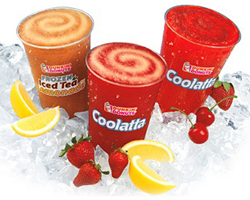
Dunkin' Donuts coolattas

Dunkin’ Donuts coolattas

On a hot and humid morning in July 2011, my husband and I moved everything we owned from a shipment container into a U-Haul truck and then into our new apartment in Brookline. After hours of traipsing up and down the stairs with arms full of far-too-heavy boxes, we returned the U-Haul truck to its lot. Without a car, we were about to begin the mile walk back to our new home, when we spotted a Dunkin’ Donuts across the street. Having never eaten there before and only newly aware of its ubiquity across New England (this was months before I first began my research on Dunkin’ Donuts coffee culture), we were beckoned forward, strangely drawn to the strawberry-vanilla Coolatta we had seen advertised on television and that appeared on large posters in the shop windows.

One of the required books for the course Food and the Senses, which debunks the Great Divide Theory that generally argues that sight champions over all other senses from the Enlightenment onward.

One of the required books for the course Food and the Senses, which debunks the Great Divide Theory that generally argues that sight champions over all other senses from the Enlightenment onward.

Segue with me for a moment: I am currently taking a course unique to the MLA in Gastronomy Program at Boston University—Food and the Senses. In this course, we have discussed the synesthesia of the human sensorial experience, the fascinating and growing field of neurogastronomy, the primal and powerful role of food memory, and the limited lexicon we possess to articulate sensory experiences. It’s here that my story of moving to Brookline nearly two years ago comes into play.

Dirty and sweaty from moving on that now distant July afternoon, my husband and I each ordered a strawberry-vanilla Coolatta, a semi-frozen, slushy sort of treat. Perfectly cold, I slurped the powerfully sweet, red, slightly frozen drink into my hot body, cooling down from the inside out. The semi-liquid, icy crystals made a soft whooshing sound as they traveled up the straw into my mouth and down my parched throat. Even though I was uncomfortably warm from the labors of moving, my hand soon grew painfully cold from holding the plastic cup. As we sat, resting at a small table, seated on metal frame chairs, beads of condensation formed on the outside of the cup, matching my own sweat. Tasting not of strawberries nor vanilla, the flavor dancing on my palate was simply of a sweetness so overpowering it wrapped itself around my tongue, forming a saccharine blanket. Though without any smell to speak of, the red drink quickly stained my lips and tongue a similar hue, lighter than blood, but deeper than any red fruit grown in nature.

While I’ve never had another Coolatta, it was the perfect sweaty slushy that day and forever a memory of moving, new beginnings, and Boston—and these paragraphs an attempt to describe it using our limited sensorial vocabulary.

Cooking Up a Storm at the 2013 Cookbook Conference

The Roger Smith Cookbook Conference in New York City drew an eclectic mix of culinary scholars; food studies academics; food writers and bloggers; food photographers and stylists; cookbook writers, editors and publishers; chefs; and those hoping to become any of the above.
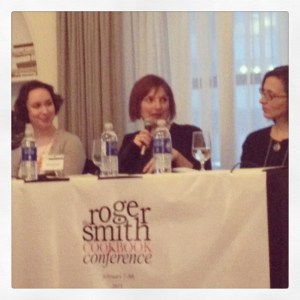
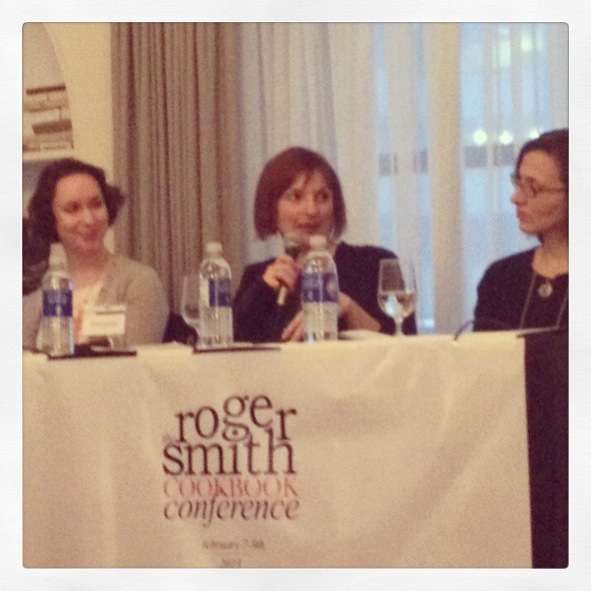
From left: Emily Contois, Anne McBride, Jane Black

From left: Emily Contois, Anne McBride, Jane Black; Photo by Tonya Hopkins

I participated in the panel, “Cookbooks as Works of Art and Status Objects,” which explored the slew of elaborate and expensive cookbooks that have come out recently that function as coffee table books more so than cookbooks. Examples include: The French Laundry Cookbook, The Big Fat Duck Cookbook, Alinea, Eleven Madison Park, NOMA, and Modernist Cuisine. The panel also featured Kim Beeman, Jane Black, Sarah Cohn, and Anne McBride, each of us bringing a different perspective to the nature and meaning of these cookbooks. I discussed these cookbooks as extensions of the trophy kitchen, given their ornamental nature and status-making potential.

I also attended several other panels, which I summarize in this post. I have captured what I found to be the most tantalizing sound bites from panelists, but I have by no means provided an adequate summary of their entire discussion.

For a full list of panel descriptions and panelist bios, please see the Cookbook Conference website. Panel videos and/or audio recordings are also available there. 

Kitchen Class Wars

The first panel that I attended on Friday morning dealt with a subject similar to the panel I was on—cookbooks and cooking as conspicuous consumption, particularly dependent upon conspicuous leisure. In his opening remarks, Michael Krondl emphasized that for much of history, cookbooks have been written for, and sold to, the middle class, the main group that rises and falls in the United States’ social hierarchy. As a result, cookbooks have long provided instruction for status climbing and served as manuals for, and symbols of, aspirational consumption. Katherine Alford argued that what aspiration is and what aspirational consumption means has totally changed—from Julia Child’s sharing of French cuisine and the elevation of a woman’s work in the kitchen to Paula Deen, a once welfare-recipient turned TV star. Based on Food Network trends, Alford shared that Italian food is no longer considered aspirational; rather, it represents idealized home cooking for cooks of many cultures. She also argued that Chopped is Food Network’s top show because it is not about “The Chef,” but about the American Dream, a story of rise and fall intricately linked to American social standing.

Providing a historical perspective, Cindy Lobel traced the roots of today’s comfort food trends to the antebellum period when prescriptive literature encouraged middle class homemakers to ensure the home was a comfortable space, in comparison to upper class homes, which were viewed as stuffy. Farha Ternikar shared results from her research, revealing that for middle and upper class Indian immigrants, European desserts are preferred and considered potent cultural capital over traditional Indian desserts, demonstrating how ethnicity intersects class in interesting ways at the dinner table.

Wartime Cookbooks: Artifacts of Home Front Culture, Tools of Social Engineering, Narratives of Survival
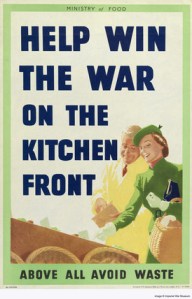
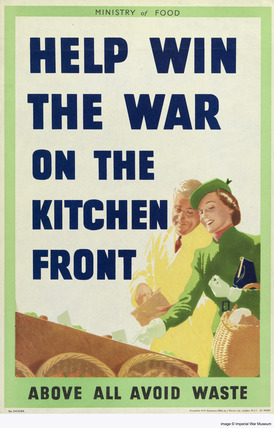
Kitchen Front

Wartime propaganda often targeted women on “the kitchen front,” fostering widespread patriotism for WWII’s total war of modernity.

This next panel revealed that during wartime the public and private worlds merged. The kitchen was its own war front, where women fought battles with spoons and knives, rather than guns. While our popular culture is full of examples of Americans going without and suffering on the home front, the truth is that in the United States and in Canada, most citizens had enough to eat. Furthermore, Ian Mosby demonstrated that while wartime rationing certainly impacted the middle and upper classes, it actually improved the diets of working class Canadians.

Rationing did change the make up of diets, however. Amy Bentley poignantly argued that wartime rationing, eating, and recipe writing served to preserve the overall grammar of eating (such as meals composed of meat and two vegetables), while rewriting the lexicon or vocabulary, by for example substituting corn for wheat and corn syrup for sugar. In altering a culture’s food vocabulary however, many bad, bizarre, and seemingly unpalatable recipes came about. For example, Barbara Rotger analyzed the recipe scrapbook of Isabella Ward, which contained many First World War recipes, including one for Boston Roast. The unsavory dish calls for a can of beans and a half cupful of cream, along with measures of cottage cheese, paprika, and tomato sauce. Ian Mosby argues that similarly dismal recipes appeared in Canadian newspapers to fill space left open due to writer shortages experienced during the war.

And finally, Diana Garvin discussed ricetarri (pamphlet cookbooks) in Fascist Italy. Featuring triumphant patriotic imagery on their covers, these pamphlets often included multiple versions of the same recipe—for example, oatmeal balls (the saddest substitute for gnocchi one can imagine) that differed only in size, from small to medium to large. Featuring recipes undesirable to eat and distributed to mostly illiterate Italian housewives, Diana argues that these Italian recipe pamphlets served as a “culinary Trojan horse” for the political ideals of Italian Fascism.

Notably, while in past wartimes Americans were encouraged to go without, the opposite has been recommended in recent years. Americans are currently encouraged to consume in order to support the war effort, to literally feed the economy.

In the Night Kitchen: Why Write Cookbooks for Kids?

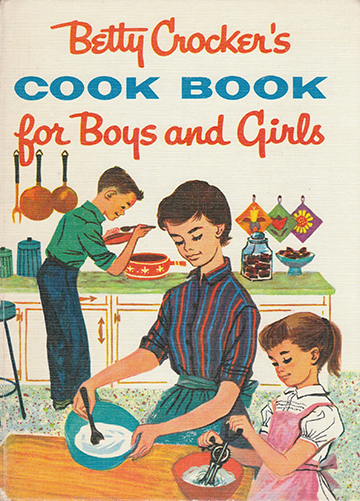
Betty Crocker's Cookbook for Boys and Girls (1957)

Betty Crocker’s Cookbook for Boys and Girls (1957)

The last panel that I attended on Friday discussed the topic of children’s cookbooks, coincidentally covered nicely in this New York Times article. In her opening comments, the entirely wonderful Laura Shapiro provided historical perspective on children’s cookery books, particularly in the twentieth century, quipping that Betty Crocker’s Cookbook for Boys and Girls turned an entire generation onto take out rather than promoting a life long interest in the culinary. Don Lindgren shared images and stories of cookbooks from bygone centuries, pointing to the nineteenth century Six Little Cooks as the first, true children’s cookbook.

Mollie Katzen spoke on her trilogy of children’s cookbooks, inspired by her experience as a mother. Using kid-friendly recipes that feature images instead of words, these cookbooks promote not only cooking skills, but also pre-reading skills, sensory learning, social cohesion, independence, and confidence among pre-school-aged children. She also commented that most kids rarely, if ever, see cooking as it happens because the endeavor takes place far above their eye level. She recommends that parents and caregivers engage children in cooking in a respectful way and bring the work and fun of cooking down to their child-height-eye level. Finally, Roxanne Gold shared her experience writing a children’s cookbook, long before she became a mother. She also shared her own personal revelation that she writes cookbooks not for her intended audience, but as self-expression. Her children’s cookbooks, however, are uniquely written for kids themselves.

Whose Food Is It Anyway?
Panelists drew heavily from Lisa Heldke's work, "Exotic Appetites: Ruminations of a Food Adventurer"

Panelists drew heavily from Lisa Heldke’s work, “Exotic Appetites: Ruminations of a Food Adventurer”

In the first panel that I attended on Saturday morning, three uniquely qualified panelists discussed the nature of authenticity and the appropriation and colonization of cuisine. Based on her extensive experience with Italian cuisine, Nancy Harmon Jenkins remarked that culinary authenticity is a constantly moving target and thus difficult to define. Conversely, Roberto Santibanez, famed Mexican chef and cookbook author, defines authentic Mexican cuisine as that which features the textures, flavors, and colors that Mexicans recognize as their own. Offering another perspective, Krishnendu Ray of NYU argued that authenticity is a question of “a true copy” that is largely dependent upon individual expectations. He also argues that it is perhaps more productive to identify modes of authentication than to argue about what foods or ingredients are authentic.

In the course of her remarks, Harmon Jenkins also posed an interesting question: “Does the insider or the outsider have a better approach to a cuisine?” Santibanez responded that in some ways a cuisine needs an outsider to observe and codify a cuisine, preparing it for exportation. He joked that his grandmother would teach Mexican dishes based upon her own embodied, sensory knowledge, saying of a dish, “Does it sound ready? The way it always has?” Ray echoed these thoughts, arguing that the most important parts of a culture are unarticulated and embodied. Because of this, Santibanez argued that the writings of white Americans with no claim to Mexican heritage are in some ways better equipped to translate the intricacies of Mexican cuisine for American audiences through cookbooks.

Another of Ray’s comments echoed the language-based metaphor that Amy Bentley used to explain wartime eating. Ray argued that in order to be understood by all, a language is shared; but despite this collective ownership, we each still have an individual voice. He argues that the same holds true for cuisine, privileging both the cuisine of the whole and the individual as equally meaningful, powerful, and right.

Culinary Politics: White House Cooking and Cookbooks

On the final panel that I attended, Cathy Kaufman began by providing foundational comments, discussing the role of politics, class, gender, and race in White House cooking. She argued that Teddy Roosevelt hosted the most controversial White House dinner when he invited Booker T. Washington in 1901.

Barbara Haber discussed the FDR White House and its reputation for universally bad food, as evidenced in the period quote, “If you’re invited to the White House for dinner, eat first.” White House dining was dismal because Eleanor Roosevelt—nothing if not loyal—hired the New York baker, Mrs. Henrietta Nesbitt, as the housekeeper of the White House. Cranky and a less than wonderful cook, Mrs. Nesbitt was largely responsible for the administration’s lowly food status. Her cooking was a frequent and impassioned complaint of FDR himself, though Haber postulates that Mrs. Nesbitt’s cooking was simply an easy target for his larger political frustration and anxiety.

Photograph by AP Photo; from Gourmet (2009)

Photograph by AP Photo; from Gourmet (2009)

Haber also debunked the rumor that the Roosevelts fed the king and queen of England hot dogs on their White House visit. In actuality, they were served a full State Dinner, after which they all escaped the press for Hyde Park, where they enjoyed an elaborate picnic that featured, yes, hot dogs, but also a robust spread of tasty and representatively “American foods,” such as a ham and cranberry sauce.

Linda Morgan discussed White House cooking during the Eisenhower administration, which reflected middle class eating habits, such as eating in front of the television, plenty of beef, and gelatin-based desserts. And finally, Judith Weinraub covered the “Golden Age of the White House pastry chef,” from Jimmy Carter to George H.W. Bush. Often without overtime pay, space to work, or part time staff, Roland Mesnier created beautiful, intricate, and delicious desserts for the presidential families and all of their guests.

In any era, White House dining both represents and leads American taste making. Especially as Michelle Obama has planted vegetables on the White House lawn and promoted healthy eating in an effort to combat childhood obesity, lessons from America’s presidential culinary past ring true.

Concluding Thoughts

The Cookbook Conference provided a little something for everyone—and pays homage to the role of cookbooks as meaningful primary sources for research, complex artifacts of the human experience, and an ever-evolving field in food media and publishing.


From Domestic Space to Status Symbol: A Kitchen History Photo Essay

Later this week, I’ll be discussing not only trophy kitchens, but also the phenomenon of ornamental trophy cookbooks at the Roger Smith Cookbook Conference. Just as I’ve explored the phenomenon of expensively outfitted kitchens that are then rarely used for cooking, the panel, “Cookbooks as Works of Art and Status Objects,” will explore cookbooks (such as Thomas Keller’s French Laundry Cookbook and Heston Blumenthal’s The Big Fat Duck Cookbook) that may find themselves more at home as coffee table art books than functional tools in the kitchen.

And so on that note, please enjoy this photo essay of the evolution of the twenty-first-century trophy kitchen. UPDATE: Some content from this post appears in my article, “Not Just for Cooking Anymore: Exploring the Twenty-First Century Trophy Kitchen,” published in the Graduate Journal of Food Studies, Winter 2014, pages 1-8!

Nancy Carlisle and Melinda Talbot Nasardinov straightforwardly define the kitchen in America’s Kitchens as:

the domestic space where food is prepared…primarily an indoor space, the place where people go to chop, mix, roast, boil, and bake.

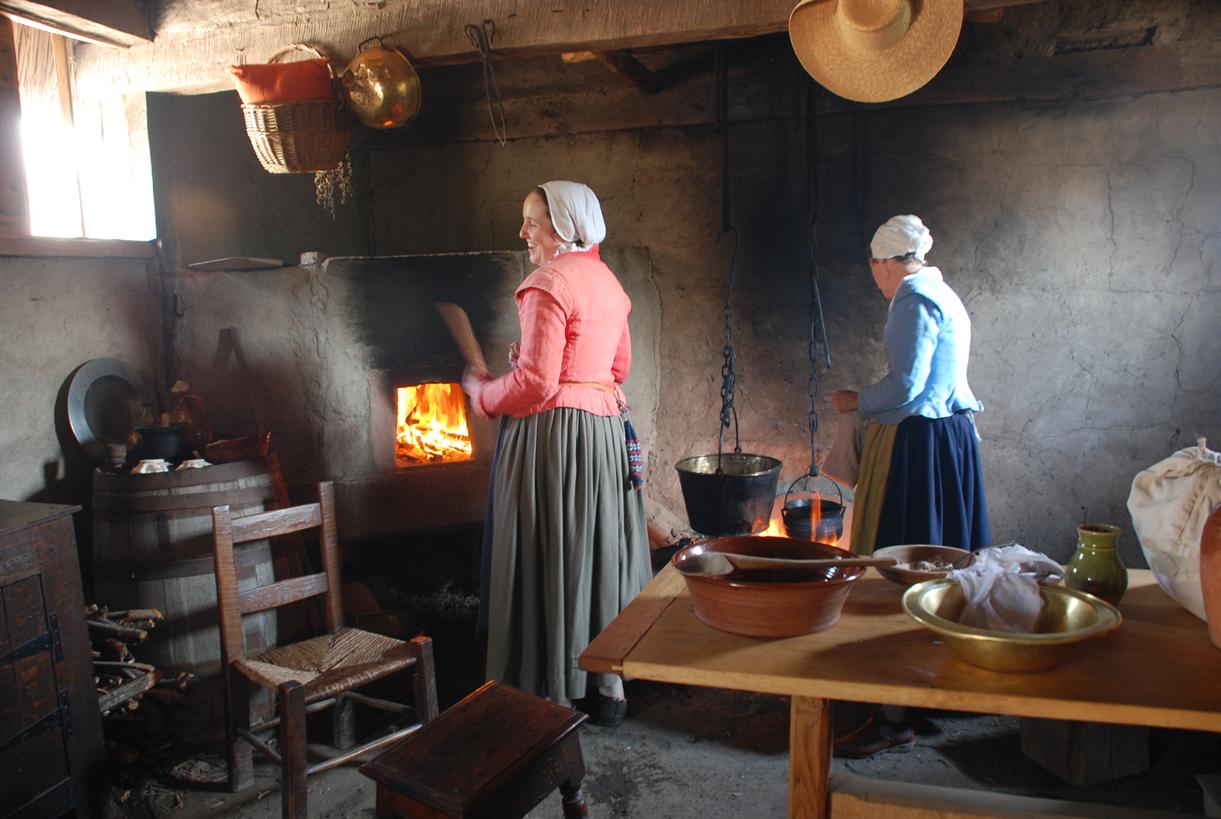
Indeed, for hundreds of years the American kitchen existed as a domestic space. In the colonial period it was a large room that hosted a variety of household duties.

Colonial Kitchen

Colonial kitchen, Plimoth Plantation

In the late eighteenth century, the kitchen became a room exclusively for cooking, often detached from the home and staffed by domestic servants.

Detached Kitchen

Home constructed 1790; the “old kitchen” was originally a detached kitchen

Technological innovations have greatly revolutionized the space, first with modern conveniences, such as running water and electricity, and then with an ever-growing army of appliances, gadgets, equipment, and specialized décor (Carlisle and Talbot Nasardinov 2008, Shove and Hand 2010, Plante 1995).

1924 Kitchen

1924 Model Kitchen, Library of Congress

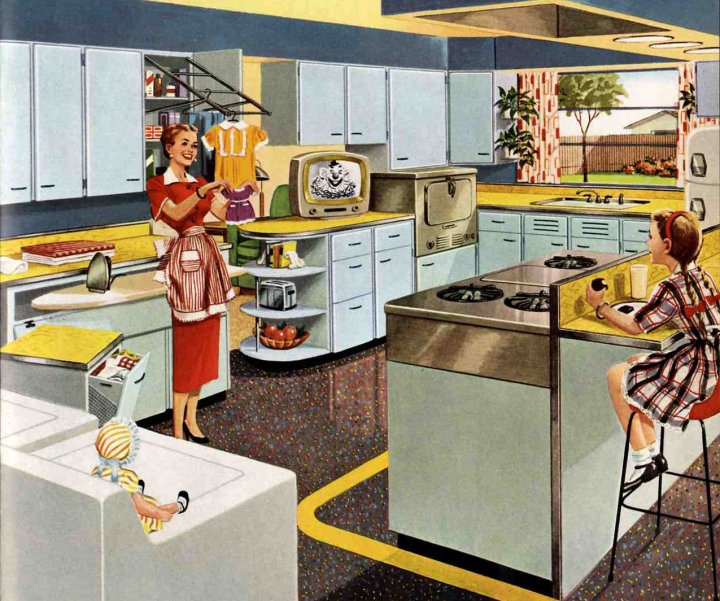
In the mid-twentieth century, the kitchen was reintegrated into the home, featuring the open floor plan familiar today.

1953-kitchenmaid-blue-kitchen-the-television-kitchen-cropped

1953 Model Kitchen

In opposition to how the kitchen has been historically positioned and understood within the home, the ideal twenty-first-century kitchen—often referred to as a trophy kitchen—is now considered the central “hub” of all activities, serving the combined purpose of multiple rooms—the dining room, living room, study, and kitchen—in one open and coordinated space (Carlisle and Talbot Nasardinov 2008, Shove and Hand 2010, Plante 1995). More than a domestic space for cooking, the trophy kitchen demonstrates status and expresses style.

Kitchen of the Year

House Beautiful Kitchen of the Year, 2012

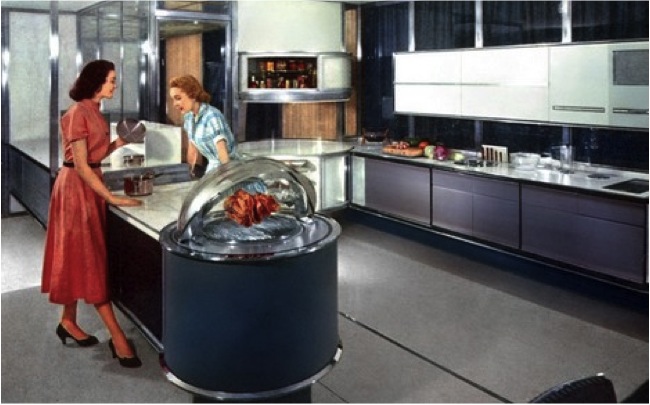
As kitchen scholars throughout time have imagined the kitchen of the future, more than one predicted that the kitchen would disappear. For example, turn-of-the-century feminists argued for kitchenless homes to free women from the burden of daily cooking (Hayden 1982). “Frigidaire’s Dream Kitchen of Tomorrow” featured at the 1957 Paris Exhibition of the Future included “an IBM punch card recipe file, automatic dispensing, and online TV ordering” (Alter 2008).

Frigidaire’s Dream Kitchen of Tomorrowfeatured at the 1957 Paris Exhibition of the Future

Frigidaire’s Dream Kitchen of Tomorrow featured at the 1957 Paris Exhibition of the Future

Molly Harrison predicted that the kitchen would take the form of a cylindrical station, including all appliances and equipment in a compact unit well suited for a spaceship (1977: 187).

The kitchen of the future as imagined in 1972 (Harrison, Molly. 1972. The Kitchen in History. New York: Charles Scribners Sons.)

The kitchen of the future as imagined in 1972

Instead, the kitchen has become the focal point of the home, not shrinking away, but overtaking the functions of other rooms within the home. The kitchen emerges victorious as a social space that communicates self-expression, style, taste, status, entertainment, and hopes for a better future.

References

Imagining the Dunkin’ Donuts Identity Outside of New England

Today I conclude my January 2013 blogging and this series of four posts, each covering sections from my paper, “Dunkin’ Donuts: A Site and Source of Bostonian Identity.” Here you can find posts onetwo, and three

In the global marketplace, Dunkin’ Donuts provides a unique case study of coffee consumption as an expression of identity, particularly in opposition to Starbucks, which has so powerfully shaped coffee culture worldwide. While the Dunkin’ Donuts coffee identity is uniquely salient in Boston and New England, the role and meaning of Dunkin’ Donuts also carries weight in other U.S. cities and in the international market, providing areas for further research.

Photo from bananacheesepie Tumblr

Photo from bananacheesepie Tumblr

For example, a study that identified devout Dunkin’ Donuts and Starbucks drinkers as “tribes” was conducted in cities outside of New England, in Phoenix, Chicago, and Charlotte. While the specific reasons for brand loyalty may vary in each city, Dunkin’ Donuts marketing strategies target some of the same cultural components that they do in New England. For example, the Dunkin’ Donuts brand is repeatedly linked to sports mania wherever possible, sponsoring the Chicago Bulls, Indiana Pacers, Washington Wizards, and Charlotte Bobcats (NY Sports Journalism 2010) and in 2009 Dunkin’ Donuts was named the official coffee of the Dallas Cowboys and Dallas Stadium. While the local meaning of Dunkin’ Donuts likely varies in the United States from place to place, it consistently asserts a specific identity in opposition to that of Starbucks and is worthy of additional study.

Just as the relationship between brand and consumer identity varies across the United States, Dunkin’ Donuts has created a different identity in the international marketplace as well. For example, Dunkin’ Donuts currently operates 900 shops in South Korea alone (Dunkin’ Donuts Press Kit, 2012), offering standard menu options, as well as specialized items, including soy donuts and 12-grain lattes made with barley and brown rice (Jargon & Park 2009).

http://cuteinkorea.com/dunkin-donuts-is-cute-in-korea/

Inside a Dunkin’ Donuts in Korea (Photo from Cute in Korea blog)

Different than stores and customer patterns across New England, Korean Dunkin’ Donuts shops feature lounges for lingering in, furnished with plush pink and orange chairs, Wi-Fi Internet access, and plasma-screen televisions. Just as Chinese populations have experienced McDonalds in culturally specific ways dramatically different from Americans (Yan 2008), Korean consumers view Dunkin’ Donuts as a hip place to dwell.

In such a way, Dunkin’ Donuts speaks to the globalization of food, revealing an example of a franchised global entity experienced as local practice that varies from place to place. What remains to be seen is if the local identity of Dunkin’ Donuts that resonates so powerfully in Boston can be transplanted and grown in new environments—or will it remain a New England phenomenon?

When Theory Actually Applies: Starbucks is to Bourdieu as Dunkin’ Donuts is to Foucault

Dedicated to joyous cups of joe in this (ever colder!) month of January, what follows is the third of four posts, which cover sections from my paper, “Dunkin’ Donuts: A Site and Source of Bostonian Identity.” Here you can find posts one and two

Coffee ScaleIn a Washington Post article comparing an existing Starbucks store to a newly opened Dunkin’ Donuts shop in the same area, the authors vividly reveal the opposing coffee cultures of each chain, saying, “Medium vs. grande. Good, quick and hot vs. Colombia Nariño Supremo. Metal frame chairs vs. comfy couches.” These catchy comparisons reveal the differing cultural frameworks of the two chains, which are I argue align with opposing theoretical frameworks.

Starbucks sells a culture of aesthetics and coffee as a lifestyle, which aligns with Pierre Bourdieu’s theory of social status and distinction. Bourdieu contends that members of higher social classes possess the resources and opportunities to secure greater economic, social, and cultural capital than the classes beneath them. This acquisition of capital thus informs their development of taste and preferences, as well as their desire to purchase objects that are rare, unique, and forms of self-expression. In applying Bourdieu’s work to coffee, some have argued that social class — or the desire to appear of a certain social status — influences coffee preferences and coffee’s associated meaning.

Dunkin v StarbucksIn earlier years, Starbucks sold itself well as a luxury, appealing to a higher income demographic (Simon 2008: 37). Being seen carrying a cup from Starbucks provided a certain amount of consumer distinction. Presently, however, the Starbucks customer base is theorized to be much broader, and Starbucks coffee has thus taken on a different meaning. In his research, Bryant Simon, author of Everything but the Coffee: Learning About America from Starbucks, revealed that many Starbucks customers view Starbucks coffee as an affordable luxury (2008: 123). Even as Starbucks has become an affordable luxury for a broader customer base, however, its brand still retains a note of distinction and individual expression.

Alternatively, Dunkin’ Donuts sells coffee not as a lifestyle, but as fuel, a theme clearly apparent in their most current advertising campaign, “America Runs on Dunkin’.” This is not to say that the Dunkin’ Donuts coffee culture does not provide a ritualistic pleasure, but the culture’s main objective is providing fuel in the form of caffeine for a target audience that relates to, aligns with, or desires to be connected to working and middle class experiences and values. For example, in 2004, Dunkin’ Donuts advertising took up the theme “Rituals that Revive” with the tagline “Bring Yourself Back.” Even when framed as a daily ritual, Dunkin’ Donuts coffee is not for relaxation or indulgence, but is a potent fuel that brings the consumer back to life. Patrick Reynolds, SVP Account Director at Hill Holliday, the firm responsible for Dunkin’ Donuts’ advertising, confirms this position, saying, “The reality is, few of us can take long, languid breaks to re-compose.”

Friends Don't Let Friends Drink StarbucksThe cultural framework of coffee as fuel aligns with Michel Foucault’s discussion of body discipline. He argues that discipline is widely used to control whole populations by modifying, regulating, and dividing the movements and operations of the body (Foucault 1977). By applying this principle to coffee consumption and the American worker, we see how caffeine regulates and modifies the body. Thus, coffee can be considered “an aid to successful body discipline” (Tucker 2011: 46). From the factory jobs of the nineteenth century to the tasks of the twenty-first century workforce, coffee provides fuel that allows the worker to modify his mind and body, à la Foucault’s body discipline, to suit the workday and its duties.

For a final dose of coffee chatter, join me next week when I ponder what the future holds for Dunkin’ Donuts coffee culture, particularly outside of New England where it is so dearly and fiercely loved.

The Dunkin’ Donuts Origin Story: A Meaningful Beginning

Dedicated to jolly cups of joe in the cold month of January, what follows is the second of four posts, each covering sections from my paper, “Dunkin’ Donuts: A Site and Source of Bostonian Identity.” Read the first post here

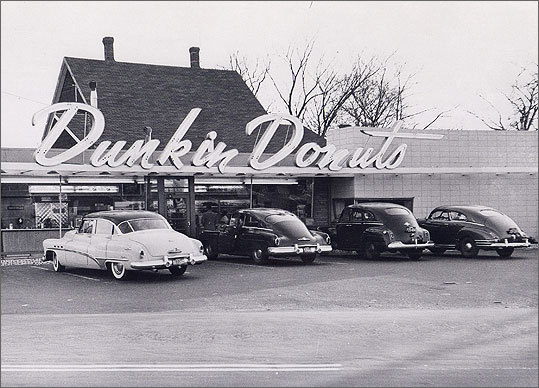
The role and meaning of Dunkin’ Donuts in New England eclipses its local origin story. After successfully operating the Industrial Luncheon Service, which served factory workers during World War II from mobile carts, William Rosenberg opened the first Dunkin’ Donuts store ten miles outside Boston in Quincy, Massachusetts in 1950. [If you’re not from New England, you might be as surprised as I was that this town is pronounced Quin-zzee.]

http://www.boston.com/business/gallery/dunkin_donuts_history/

The original Dunkin’ Donuts location (Photo from Boston Globe)

Dunkin’ Donuts’ origin story stands out in comparison to other large coffee chains. Starbucks, for example, emulates a European coffee experience, while Dunkin’ Donuts proudly promotes itself as American coffee, emphasizing the value of hard work. Furthermore, Starbucks is framed as a product of “posthippie capitalism” (Sanders quoted in Simon 2009: 29) and often critiqued in an elevated way as a “cultural institution” akin to higher art located within a “historical trajectory” of long standing tradition (Dickinson 2002: 17-18).

Conversely, Dunkin’ Donuts is a franchised chain built upon the American Dream story of William Rosenberg, a hardworking New Englander with an eighth-grade education who successfully built a coffee empire. From the start, Dunkin’ Donuts tells a specifically New England story, but the chain’s role as both a site and source of Bostonian and New England identity cannot be simply explained by the location of its first store.

http://www.boston.com/business/gallery/dunkin_donuts_history/

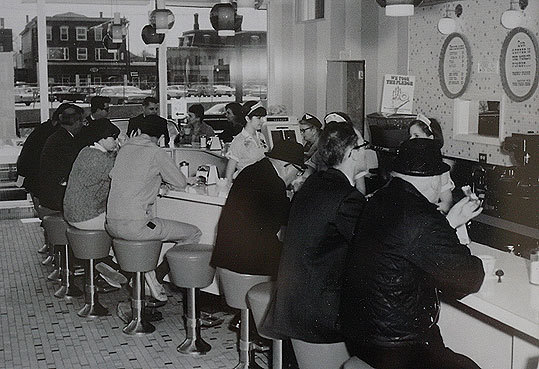
A look inside a 1970s Dunkin’ Donuts (Photo from Boston Globe)

Throughout decades of expansion, franchising, marketing, and repositioning, Dunkin’ Donuts emerged and remains a regional power brand, operating one store for every 5,000 to 6,000 people across New England (Rosenwald & Kirkham 2006) and outnumbering Starbucks ten to one (Carroll 2010).

http://www.boston.com/yourtown/massfacts/snapshot_dunkin_donuts_vs_starbucks_massachusetts/

Dunkin’ Donuts stores outnumber Starbucks 10 to 1 in Massachusetts.

Not only in New England but across the nation, Dunkin’ Donuts experiences strong customer loyalty, sweeping the coffee category in the Brand Keys Customer Loyalty Engagement Index for the past six years (Dunkin’ Donuts Press Release 2012). Despite the donuts in its name, the chain does 63 percent of its business in coffee (Hoy 2006), which embodies a specific identity for Dunkin’ Donuts coffee drinkers in Boston.

For more coffee chatter, join me next week when I’ll conduct a cultural coffee analysis, comparing Starbucks’ aspirational consumption to Dunkin’ Donuts’ functional fuel.

References

Dunkin’ Donuts Coffee: A Site and Source of Bostonian Identity

It’s January 7, which means that many folks must excitedly or begrudgingly head back to work after a wintery escape that began just before Christmas. This day requires a little extra courage and motivation, which might be found in a cup of coffee. If you’re like the 50 percent of Americans who buys coffee at work, I invite you to sip and enjoy this first section from my paper, “Dunkin’ Donuts: A Site and Source of Bostonian Identity.”

The landscape of New England is marked by not only world-famous fall foliage and monuments to America’s history, but also the abundant pink and orange signs of Dunkin’ Donuts, which despite being an international franchise, is a powerful symbol and source of regional pride and identity.

AmericanRunsonDunkin

Writing as a local, Mike Miliard links Dunkin’ Donuts with Bostonian identity in his Boston Phoenix article, “Choosing Our Religion: How One Little Post-War Doughnut Shop Became Synonymous with Boston’s Identity,” as he says, “It’s a lynchpin of our identity. It’s a religion. It’s a cult. People in these parts freaking love Dunkin’ Donuts.”

In fact, in 2005 Dunkin’ Donuts paid dozens of brand loyal customers in cities outside of New England (Phoenix, Chicago, and Charlotte) $100 to switch to Starbucks coffee for one week. They offered $100 to Starbucks customers for the opposite switch (Wall Street Journal, April 8, 2006). The results were staggering with coffee devotees from both camps so firmly committed to their brand that Dunkin’ Donuts researchers identified them as “tribes.” Particularly in Boston and greater New England, this tribal affinity eclipses the chain’s local origin story and goes beyond taste preference alone.

Dunkin' Donuts stores are as iconic in Boston as the New England Patriots and the T, which are all included in this photo taken during my many hours of participant observation studying Dunkin' Donuts coffee.

Dunkin’ Donuts stores are as iconic in Boston as the New England Patriots and the T, which are all included in this photo taken during my many hours of participant observation studying Dunkin’ Donuts coffee.

My recent research explores the Bostonian allegiance to Dunkin’ Donuts coffee, elucidating the chain’s unique coffee culture. I demonstrate how Dunkin’ Donuts coffee culture is both a site and source of Bostonian identity in three inter-related ways:

  1. It embodies the Bostonian character, physically, linguistically, and socially.
  2. It represents “the local,” both literally and symbolically.
  3. Dunkin’ Donuts endorses and practices values that Bostonians hold dear, including loyalty, which is related to regional sports fandom, and honor, which is linked to a proud, working class identity that is independent of actual social status or income.

This discussion reveals that Dunkin’ Donuts is a unique case study of coffee consumption as an expression and source of identity, particularly in opposition to Starbucks, that is experienced locally, even within a global context.

Ring in the New Year with Picasso and Dalí’s Food-Related Art

Whether you’re ringing in the New Year with a prominent party, a delightful dinner, or champagne in quantities worthy of a Gatsby gathering, I wish you a Happy Near Year—as, in this case, does the food-related art of Picasso and Dalí. A selection of works by these two artists uses food to provide intellectually elevated irony and humor, grounded in both linguistics and visual presentation.

Hey—if nothing else, this post can provide you with enviable fodder for cocktail conversation on this New Year’s Eve. 

Picasso linked food and linguistics in a playful, yet intellectual form of perceived realism. He repeatedly makes linguistic jokes through the purposeful and witty inclusion of textual ephemera in his collages. And yet, while he includes food advertisements and bottle labels in his pieces, he may be doing so without literal allusion to food, eating, drinking, or dining, but rather based on his personal adoration of typography.

Picasso's "Still Life with Chair Caning" (1912)

Picasso’s “Still Life with Chair Caning” (1912)

For example, in café scenes, Picasso repeats names and labels of dinner wines, brandies, and ales by pasting actual labels or newspaper advertisements onto the canvas or by writing the labels in his own hand. Rather than evoking sensory or gustatory qualities, Picasso mixes fact and fiction in the presentation of the bottles, creating jokes based on language, words, and letters (Rosenblum 55). Rosenblum summarizes this process well, stating that these language-based bottles “provide a permutation of verbal meanings that creates the exact linguistic counterpart of the Cubist visual legerdemain that questions the identity of objects through fragmentation and elision” (57). Rosenblum cites Picasso’s limitless interest in the typeface used in advertising that often trumps the foods and vessels in his still lifes. For example, in Still Life with Grapes and Pears (1914), the eye is more drawn to the dissected letters, “jo-ur-nal,” than the fruits.

Picasso's "Restaurant Still Life" (1912)

Picasso’s “Restaurant Still Life” (1912)

And in Restaurant Still Life (1912) Picasso places words related to dining throughout the work, creating a textual frame for the symbolic representations, rather than literal depictions, of foodstuffs and cutlery. Yet Rosenblum asks, “Are these Cubist still-life objects less real than the letters and numbers, which can suddenly seem so literal a record of prosaic visual truths?” (74-5). In such a way, Picasso encourages us to view text as image and image as text.

While Picasso linked food and linguistics in a playful, yet intellectual form of perceived realism, Dalí related foods and eating with the pursuit of knowledge, as well as shameful sex, through disturbing metaphors. From childhood, Dalí described his relationship with food as one characterized by “furtiveness, transgression, sensuality, and even sadism” (Irwin 104). Dalí manipulates qualities of foods in his paintings, such as softness or rottenness, rather than the foods themselves or their context. For example, rather than depicting Camembert cheese in The Persistence of Memory (1931), the physical qualities of cheese are personified and transformed into time itself, symbolized by the semi-sold state of the watches.

Dali's Persistence of Memory

Dalí’s “Persistence of Memory” (1931)

Notably, while the Impressionists depict commonplace objects, Picasso and Dalí also at times explore the commonplace, but as a function of the broader human experience. The Cubists fragment and deconstruct objects to view them differently and ponder their meaning in new ways. Dalí sees and uses foods as frightening symbols for the darkness of humanity.

Whether you see the dark or the light (or both!) in food, art, and life, may your New Year be bright.

References

  • Irwin, Robert. “The Disgusting Dinners of Salvador Dali,” in Food in the Arts. Proceedings of the Oxford Symposium on Food and Cookery 1998. Edited by Harlan Walker. Blackawton, Totnes, Devon: Prospect Books, 1999: 103-11.
  • Rosenblum, Robert. “Picasso and the Typography of Cubism.” In Picasso in Retrospect. Edited by John Golding and Sir Roland Penrose. New York: Praeger, 1973: 48-75; 266-68.

Family Dining on Christmas and in ‘Eat Drink Man Woman’

Between college, grad school, working, and grad school again, I’ve lived a thousand or more miles from my family for the last ten years. This means that for one reason or another, I haven’t been home for Thanksgiving or Christmas dinner in just about as long — and this year, that fact is making me even sadder than usual. Suffice it to say, I’ve got family and meals on the brain, which made me think of a favorite food film.

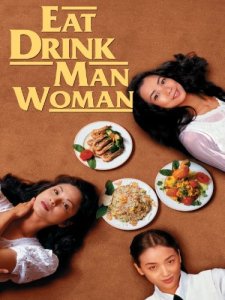
EatDrinkManWomanIn Eat Drink Man Woman (1994), director Ang Lee expertly tells the story of changing family dynamics in Taipei, Taiwan during a time of rapid modernization, employing a universal medium — food. Through Chef Chu who has lost his sense of taste and his three daughters, this film addresses many themes, including gender, family, and globalization.

Gender and authority come to the fore in this film, as they do in the public world of food where men in general are more likely to hold positions of power. Such is the case for Chef Chu. While he no longer works full time at The Grand Hotel, he acts with assured confidence when he is called in to help the all male staff to rectify a dish that is being served at an important dinner. The traditional, authoritative, masculine role of cook is complicated in the film, however, as Chef Chu’s authority is not well recognized by his daughters. In addition, his second daughter aspires to be a master chef like her father, a narrative point that emphasizes the film’s theme of transition and change.

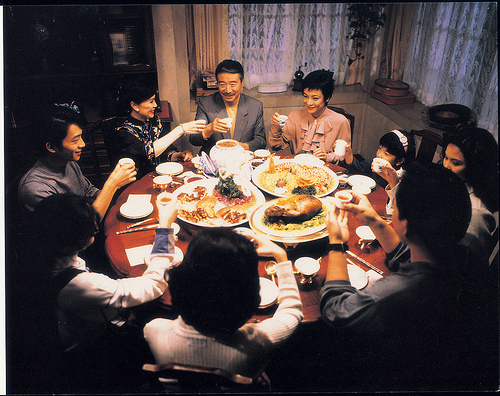
eat drink man woman

One of the family meals depicted in ‘Eat Drink Man Woman’

Eat Drink Man Woman also discusses family, again focusing on transition. Though he is unable for much of the film to communicate with his own daughters — through food or otherwise — Chef Chu prepares elaborate lunches for his (somewhat secret) fiancé’s daughter, an action that elevates her status at school and nourishes her both emotionally and physically. In this way, these special noon-time meals are similar to obento in that they aid a child to make a transition that could be difficult, not from the home to school, but from a single parent family to a new family.

While Eat Drink Man Woman discusses transitions in gender roles and family structure through food, the film’s overarching theme is not food itself, but rather the forces of modernization and globalization that bring on these changes. For example, Chef Chu’s elaborate traditional family meals, the luxurious cuisine of The Grand Hotel, and the fast food restaurant where his youngest daughter works all coexist, representing the contemporary state of globalized Taiwan. In this way, his second daughter most fully embodies the complexity and conflict of these transformations. Through her, Lee’s film portrays a character caught between tradition and modernization, family obligation and independence, who eventually finds balance and solace in food.

Myself, I hope for something simpler: to be home for the holidays at some point in the near future.

What’s Your Food Culture Type: June Cleaver or Hippie?

June Cleaver

The iconic American housewife of the 1950s, June Cleaver.

How Americans cook and eat is only in part about food. Much more of the story is told by the contextual details of the time. For example, the postwar era of the 1950s, crystalized in the pop culture image of June Cleaver, was characterized by marked changes in American life: more women entered the workforce; the middle class grew; car and home ownership increased; and the food industry, centralized by World War II, sought a civilian market for processed foods. Because of the amalgamative effect of these factors, packaged-food cuisine, such as the can-opener cooking proffered by Poppy Cannon, became popular.

Following this decade of rapid consumerism and processed foods, a subset of Americans in the 1960s and 1970s — hippies! — viewed food in a reactionary way to those who came before them. Opposed to the high-speed and time-obsessed American lifestyle — not to mention panicked by war, conflict, and imminent ecological demise — the counterculture expressed their worldviews, like the 1950s generation before them, through food, adopting a distinctly anti-modern perspective.

Hippie Eating

Hippies embraced their own food culture, the countercuisine, which embodied the principles and values of the movement.

Today’s food views build upon the undulating gastronomic torment of our past and again propose a vision for a bright and more prosperous future. As today’s American economy demands two income families to meet the pressures felt by a shrinking middle class with a limited social safety net, citizens again turn to food for answers. In today’s world, however, the trends of 1950s convenience and 1960s naturalness both exist as choices that woo consumers for different reasons. While neither option is more relevant than the other, they both provide options for American cooks and eaters. Furthermore, these ways of eating are not mutually exclusive nor are they chosen in a vacuum. The pressures of daily life may result in mostly convenience food products à la the 1950s, while the weekend may allow the slower pace to celebrate organic nature, from-scratch cooking, and gourmet gastronomic experiments.

Even in the young nation of the United States, today’s cooks and eaters draw from a diverse food history. Do women hate to cook? Should we grow our own food? Should we embrace brown foods and scorn white ones? Is home cooking important? These questions have resurfaced throughout history, and each time we must ponder their new meaning and form answers for our own time. The twentieth century legacies of both packaged-food cuisine and the countercuisine shape our current diets and will play a role in how we eat in the future.

Curating an Online Food Exhibit: “Making the Modern American Food System”

After studying the food views of second-wave feminists, the cuisines of the counterculture and the 1950s, and the foodways of turn-of-the century immigrants, Dr. Warren Belasco’s U.S. Food History course turned to specific histories of the industrial food system—from the Dust Bowl to the industrialization of milk production to the rise and triumph of refrigeration. At each stage, we pondered how these events, people, and institutions contributed to both America’s abundant, cheap food supply and the distancing of Americans from traditional food knowledge.

The course culminated in our final project assignment: creating an online food exhibit dedicated to the creation of the modern American food system.

And so I invite you to visit my online exhibit, “Making the Modern American Food System.”

Food System History