Latest Posts

Got Milk? Well, You Might Find 19th Century Politics in Your Glass

Marked with a logo depicting rolling green hills and blue skies, Garelick Farms dairy products are found in grocery stores across New England. Their “Dairy Pure” milk commercial often appears on television during the day while I work and study from my home in Brookline, Massachusetts. From its very name, Dairy Pure, this brand of milk promotes itself as a safe and perfect food. The commercial’s language and imagery are particularly interesting when analyzed alongside E. Melanie DuPuis’ Nature’s Perfect Food: How Milk Became America’s Drink. DuPuis tells the nineteenth-century story of how milk was transformed in the American conscious from a poison to a universally and naturally necessary, perfect food. The present day marketing for Dairy Pure milk also works to assuage fears about milk’s safety and promote milk’s place in the lives of mothers and children.

DuPuis describes the high infant mortality rates of mid-nineteenth century America, which stirred many milk reformers into action. Increasing urbanization had caused changes in societal expectations and cultural norms for middle class women, as well as increased the number of low-income women working outside the home. Both resulted in decreased breastfeeding, the biological phenomenon that puts milk and the feeding of children under intimately feminine control. With more infants and children consuming cow’s milk, the product’s safety, or lack thereof, was one factor that instigated political action surrounding milk.

Interestingly, Dairy Pure milk places purity under feminine control. The commercial stars Dairy Pure’s “Mom in Chief” who appears in each scene carrying the company’s “Five Point Purity Checklist,” ensuring perfection at every step in the chain of the modern food system with the tagline, “Starts pure, stays pure.” As a cheerful and motherly expert, the Mom in Chief first oversees an agrarian fantasyland, checking in on happy cows munching in green fields beneath a blue sky. Notably, the commercial skips from these happy grazing cows to the interior of a perfectly chilled refrigerated truck, which transports the milk to the orderly grocery store shelves consumers recognize. As Dupuis discusses, the vision of the milkmaid, or even the milking process, are absent from this perfect milk story.

It is in the grocery store aisle that control is transferred from Dairy Pure’s “Mom in Chief” to the consumer, also a mother, who purchases Dairy Pure milk for her adorable son, who, in the final scene, drinks a glass with a smile at their kitchen table. Ironically, the mother and her son are African American, an ethnic group of which as many as 75 percent are lactose-intolerant (Bittman 2012). If anything, this reveals DuPuis’ argument that milk is continually lobbied, marketed, and often generally believed to be the perfect food for all citizens to consume.

While Garelick Farms makes no claim that buying their Dairy Pure milk will save the world, it presents a story of progress, purity, and perfection, from the cow in the field to the healthy, happy child in your kitchen.

Curating the History of Freshness

In Fresh: A Perishable History, Susanne Freidberg chronicles the fascinating history of how refrigeration expanded the reach of the industrial food system, forever altering not only the world’s food supply, but also how consumers view freshness and conceptualize its meaning. She tells this story through a series of mini-histories focusing on specific foods: beef, eggs, fruit, vegetables, milk, and fish. In doing so, she reveals the many meanings of “fresh,” five of which are discussed in the following five images.

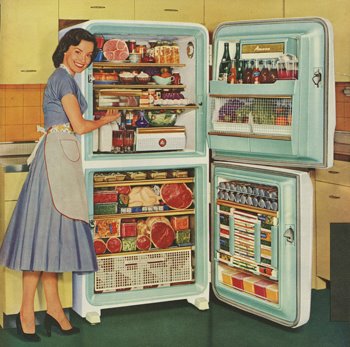
1. The Refrigerator

Consumers once got along without refrigeration, shopping frequently and preserving food by canning, drying, and pickling. In fact, consumers were at first wary of refrigeration, though World War I marked a turning point.

While meat and wheat were shipped to the warfront, American civilians were encouraged to consume fresh foods, unsuitable for shipment to soldiers. Consuming fresh produce, eggs, and dairy products were considered acts of both patriotism (as seen in this WWI food poster) and scientifically based health promotion, confirming the new place of these foods in the American diet and the role of the refrigerator to keep them fresh, safe, and tasty.

Refrigerators thus evolved to play a dual role: supplying nature (“the garden in a machine”) at a housewife’s fingertips, but also capable of defeating nature, providing technological protection from decay.

2. Fresh Eggs

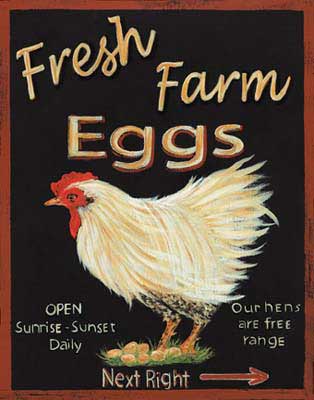
While consumers initially questioned the refrigerator itself, they questioned no refrigerated food product more than eggs. Always obscured by protective shells, consumers distrusted claims that refrigerated eggs were indeed fresh, a quality unobservable with the naked eye.

Refrigerated eggs also embodied the transformations occurring within an increasingly industrialized food system. Consumer distrust was rooted in more traditional views of freshness, views formed by consumers’ direct interactions with farmers. For example, this sign depicts “fresh farm eggs” available at the “next right,” implying the consumer’s journey to physically and personally visit the farmer and his or her hens.

Refrigeration dramatically rewrote this understanding of freshness, expanding it in new ways and largely disassociating it from the farmer and the land, and giving it a mechanical coldness. Interestingly, the bucolic imagery of early years would remain part of food packaging and advertising, tapping into a nostalgia for the natural that never went away.

3. Fresh Express Salad

In the early twentieth century, American views on health, physical beauty, and eating habits changed, a transformation told through a fresh vegetable — lettuce.

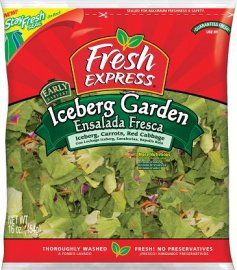
Then and now, consumers desire lettuce for a variety of reasons from its high nutrient density to its relatively convenient preparation. This consumer demand fueled the industrialization of of lettuce growing, picking, shipping, and packaging. (You can see modern day Ocean Mist Farms workers picking, shrink-wrapping, and sealing iceberg lettuce in this video.)

Starting in the mid-1930s, growers began pre-packaging produce, ushering in yet another definition of freshness that was clean, neat, and long lasting. Bagged lettuce remains popular today, from high status organic mesclun (AKA “yuppie chow”) to the comparatively nutritionally empty iceberg lettuce pictured here.

4. Fresh Fish

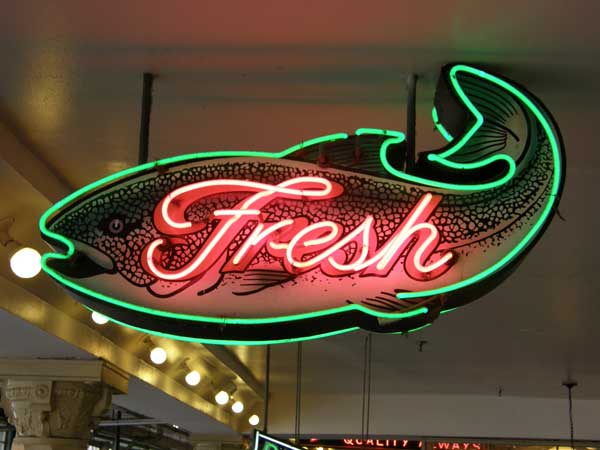
The story of fish provides yet another definition of freshness, one related to nature’s wild vitality, an ever diminishing resource. Fish has been preserved in a variety of ways, such as drying, salting, canning, or packing it in ice. Consumers have also desired fish that is fresh, wild, and just-caught, leading to high demands, overfishing, and fish farming.

While fruits and vegetables grow on farms, farmed fish draws an entirely different consumer reaction. Compared to the powerful, rustic vitality of wild fish, environmentalists, fisherman, an consumers alike view farmed fish as “toxic” and distasteful. The politics of the sea continue to write the next chapter in the freshness and wild nature of fish.

5. Buy Fresh Buy Local

As Friedberg so eloquently states in her history of freshness, “Consumers stopped expecting fresh food to be just-picked or just-caught or just-killed. Instead, they expected to find and keep it in the refrigerator.” The industrial food system that developed over the course of the twentieth century defied geography, defeated seasonality, and redefined freshness.

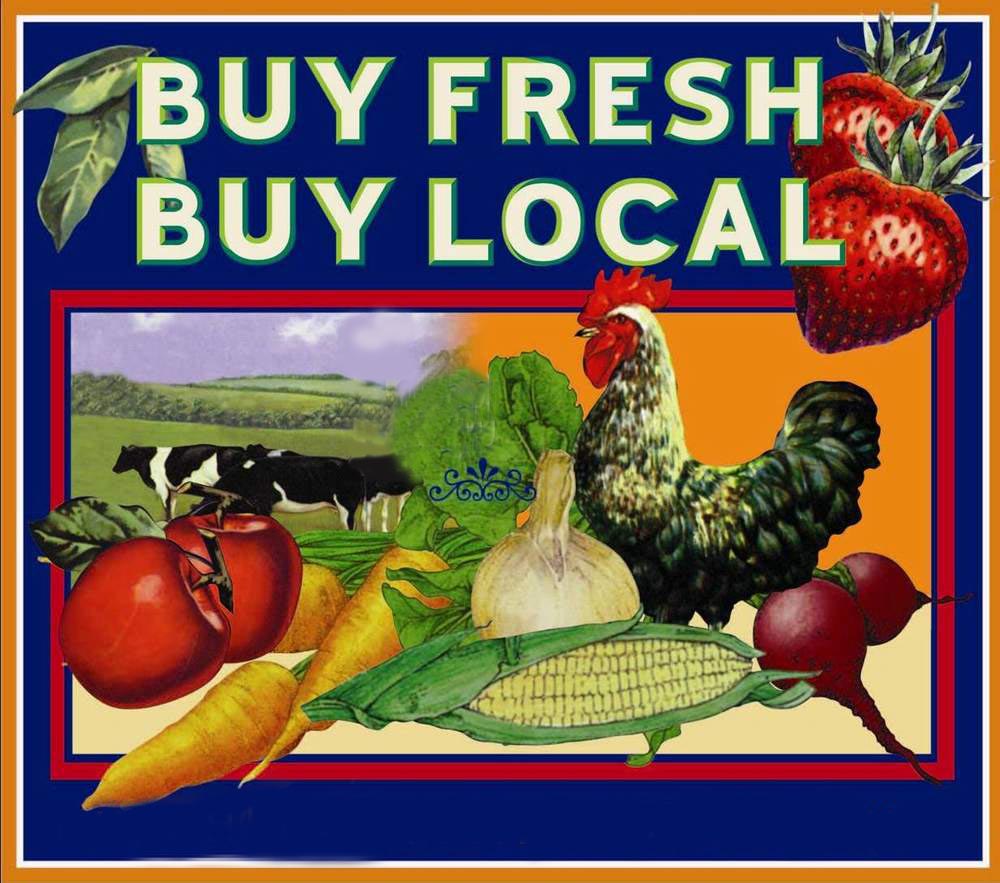
Consumers now resist the expectations formed by the industrial food system, as endorsed by Buy Fresh Buy Local campaigns, in effect redefining freshness, as more nostalgic and more local. These aims are reflected in the campaign logos, customized and localized to regions, states, and cities, depicting images in a style not unlike early twentieth century fruit and vegetable marketing, such as these produce crate labels.

Freshness has been defined differently throughout time, varying by product. What will “fresh” mean in the future?

The Dust Bowl Isn’t Over -OR- How the iPhone Could Save American Agriculture

Many Americans view the Dust Bowl of the 1930s as merely a historical event, a long ago environmental and agricultural trauma that, along with the Great Depression, stains our collective history, but will never occur again. Such a point of view, however, is not only revisionist, but highly inaccurate. The determinants of the Dust Bowl are not isolated to the 1930s, nor are its effects secluded to the American plains. In Dust Bowl: The Southern Plains in the 1930s (1979), Donald Worster posits that a combination of factors not only caused the Dust Bowl, but continue to derail agriculture worldwide: American values run amuck, capitalism ruling without restraint, farming taken over by business, and unstable agricultural policy hastily enacted.

Worster argues that the Dust Bowl, as well as subsequent agricultural issues, are rooted in American values and unrestrained capitalism. Fueled by the sprit of Manifest Destiny, the desire for endless opportunity, and the promise of plenty, farmers during the Dust Bowl era exploited the land to the fullest extent possible, employing every available technology to ensure high yields and high profits. As a result, factory-style farming of monocultures became a new norm; a way of farming that dissolves the traditional farming lifestyle and depletes the land.

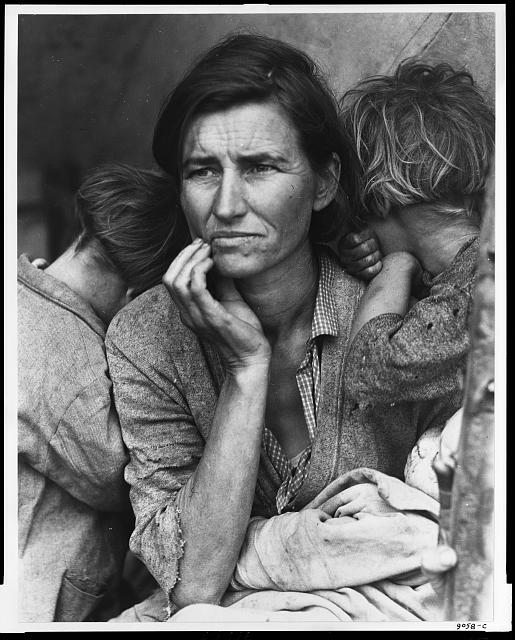
Destitute pea pickers in California… (Often referred to as “Migrant Mother”). 1936.
Photographer: Dorothea Lange

Such farming practices are nearly universal today. Worster’s Dust Bowl lessons not only inform our current agricultural practices, however, but also the broader environmental agenda of the United States. As Worster so expertly argues, the true meaning of the Dust Bowl reveals that not just wheat farmers on the plains, but all of America was sorely out of balance with nature. Furthermore, he argues that this distorted relationship is caused by the capitalist ethos that, “replaced man’s attachment to the earth…it replaced a rural economy aimed at sufficiency with one driving toward unlimited wealth.”

While no one is arguing for the United States to return to a rural economy, our relationship with the earth must be repaired. While it may not be feasible, or even possible, to restore our original balance, we must work toward a new balance between man and nature.

Farmer and sons…dust storm, Cimarron County, Oklahoma. 1936.
Photographer: Arthur Rothstein

This overarching issue affects not only our nation’s agricultural practices, but also our dependence upon fossil fuels, development of alternative energy sources, and commitment to green building practices, to name but a few. The Dust Bowl and Worster’s work ultimately reveal that man’s actions shape the earth. While Armageddon may not await us if we fail to proceed with humility and restraint to restore much needed balance to our systems, what is nearly guaranteed is that we shall be met again and again with natural disasters of our own making. From the Dust Bowl of the “dirty thirties” to the shorter and more severe “filthy fifties” to 2012’s hottest July on record to the droughts that decimated 2012 corn harvest yields, raising food prices across the board and around the world, we shall not escape this fate if we do not change our ways.

While core American values that lead to excess may have contributed to our current state of affairs, other values that Americans hold dear—innovation, creativity, and hard work—may be the key to our future. Political rhetoric repeatedly reinforces that it is the United States of America that creates the truly world-changing thinkers and entrepreneurs, from Google’s quirky innovation to Apple’s life-altering personal technologies. While the iPhone alone of course cannot save American agriculture, we can harness this same freethinking innovation and channel it into our relationship with the earth and her limited resources, ensuring our collective survival and success.

Literature: A Novel Foundation for Symmetrical Dialogue in the Successful Physician-Patient Relationship

“The Doctor and His Patient,” Jan Steen

While I most often blog about food, I’ve been thinking a lot about doctors lately for family reasons. Thus, the energy that I usually so easily channel into my professional and academic life is at the moment uncontrollably directed into worrying. I’ve been attempting to cope by watching way too much television on Netflix, which has likely exacerbated the situation.

In any event, the state of things has caused me to want to share with you a bit about a medical humanities course I once took as an undergraduate at the University of Oklahoma. The course, Literature and Medicine, was co-taught by English professor, Ronald Schleifer, and physician / Medical School professor, Jerry Vannatta, MD.

As Vannatta shares in a Sooner Magazine article (2005):

The course examines the relationship of the humanistic study of literature and language with the art and science of medicine through literary and non-literary descriptions and narratives and examines somatic, psychological, scientific and social conceptions of illness and health.

Here is where the double meaning of this post’s title comes in. Within the scope of this course, I explored the role of literature in creating symmetrical dialogue between physicians and patients, a role dependent upon novels (as in: an invented prose narrative that is usually long and complex and deals especially with human experience through a usually connected sequence of events) and a novel (as in: new and not resembling something formerly known or used) endeavor.

At the heart of medicine is the relationship between the physician and the patient. A successful physician-patient relationship is a healing partnership in which each individual accepts mutual responsibility in the care process and is, in turn, treated with dignity and respect. This relationship is manifested in the dialogue between physician and patient. If this conversation is unbalanced, the relationship suffers, and consequently, the patient may not receive the best medical treatment.

Despite the different roles, skills, knowledge, and resources of each party, the successful physician-patient relationship is one of essential equality based on the belief that we are all human and equal at a fundamental level. This belief in a common humanity fuels the respectful dialogue between physician and patient that yields the best possible care.

Furthermore, through exposure to literature, the physician’s ability to communicate and his capacity to understand his patient are enhanced to the degree that the inherent imbalance of power that may be present at the onset of the relationship, fades away. Literature is, in and of itself, a dialogue between the writer and reader that passes on dialogic knowledge and experience. Within the physician-patient relationship, literature has a transforming power by providing examples of poor relationships, warning of the harm they cause, and by providing examples of ideal relationships that teach and inspire.

For this reason, literature is a unique teaching tool for creating better physicians because it both is a dialogue and presents examples of dialogue. A trusting relationship is fostered between the physician and the patient through the enlightened dialogue represented in and stimulated by literature, which yields benefits for both parties.

Blogging for Food Day 2012 – “No Room for Debate: The World of Food is Full of Women”

Last week, I had the distinct pleasure to guest blog for Food Day 2012, a nationwide celebration and movement toward more healthy, affordable, and sustainable food, created by Center for Science in the Public Interest (CSPI). The post appears on Food Day 2012’s blog and is republished below… 

As the final Presidential debate concluded last week week, many issues occupied the minds of American voters, from the economy to foreign policy, education to job growth. Notably, women’s issues have been at the forefront throughout the campaign more than ever before. Most any reader of this post, however, likely works in a field in which women have long been a driving force—food.

In fact, the situation is quite the opposite. In food-related professions from dietetics (a career field made up of 97 percent women) to public health nutrition, food activism to food studies, women are powerfully represented. While representation may not directly translate into equitable power and pay, women consistently fight on the frontlines in the battle for healthy, affordable, and sustainable food for all. As food producers, consumers, and change-makers, women make their mark in the world of food.

There are a variety of explanations for women’s strong role in the study and work of food. For example, some point to women’s traditional responsibilities of child rearing and domestic labor, which make food women’s work. In addition, Warren Belasco contends that the study of food has long been held captive to the Victorian separation of male and female, public and private, again making food the work of women.

The assumption that food is women’s work has certainly led to conflict and dissatisfaction for some, but connection to food also affords a degree of matriarchal power, as women serve as gatekeepers of not only food consumption, but also family health. For this reason, public health interventions around the globe target women, promoting their good health and access to health care, as women are often in charge of monitoring and caring for family health needs.

While women play important roles in both the public and private worlds of food, Food Day effectively transcends gender and brings democratized attention to food issues. While the work and study of food may continue to be gendered, food is far more than a woman’s traditional labor. Rich in tradition and meaning, power and potential, food is a lens to study nearly every aspect of individual life and society, a vehicle for driving systemic and lasting change, and could very well be the key to a better, healthier, and more fulfilling life. As we bask in our post-Food Day glory, may our new knowledge, energy, and connections fuel us throughout the year to elevate the cause of food and all that it represents.

The Cheesecake Factory: America at Her Best—and Her Worst

With a castle-like façade, a phone-book-sized menu, and massive portions, The Cheesecake Factory aptly represents all-American abundance.

Beginning with its name, The Cheesecake Factory, this chain restaurant builds not upon a tradition of artisanal craft, but of mass production. The interior continues this theme. A mash-up of ancient Rome, Medieval England, and today’s Las Vegas, the restaurant interior features ridiculously high ceilings and nearly comedic interpretations of Corinthian columns, projecting an exaggerated view of middle class luxury.

Cheesecake Factory Interior

The spiral-bound laminated pages of the menu boast more than 200 selections, representing a variety of ethnic traditions from pasta marinara to miso salmon—not to mention chicken teriyaki, di pana, madiera, picatta, and marsala, to name but a few. Half the menu features this multitude of food options, while every other page features advertisements. With restaurants often located in or near shopping centers and malls, The Cheesecake Factory menu seamlessly links the dining experience to the consumerist activities outside the restaurant.

Cheesecake Factory Menu | Image from: http://blog.sfgate.com/culture/2010/11/08/tourist-trapped-the-cheesecake-factory/

The laminated and spiral-bound Cheesecake Factory menu features items alongside advertisements.

With heavily weighted cutlery, diners dig into meals served on boat-like plates, complemented by stein-like glasses better suited for mead than iced tea. The abundant choices and portion sizes match the number of calories in each entrée, as a single meal often exceeds an adult’s daily caloric needs. [In 2011, the Center for Science in the Public Interest gave The Cheesecake Factory items two of its eight Xtreme Eating Awards.]

Offering freedom of choice, abundant servings, and menu offerings representative of Americanized “melting-pot” cuisine, The Cheesecake Factory represents America at her best—and her worst.

Curating the History of American Convenience Cuisine

In the years following World War II, the United States took on a new shape and so did the way Americans ate. The 1950s witnessed the rise of “packaged-food cuisine,” a dietary change and gastronomic phenomenon that had as much to do with the postwar military industrial complex, women’s issues, and class-consciousness, as it did with food. This selection of five images explores these themes, using convenience food as a lens to explore the socio-cultural context of the 1950s.

1. The Evolution of Betty Crocker, 1921 – Present
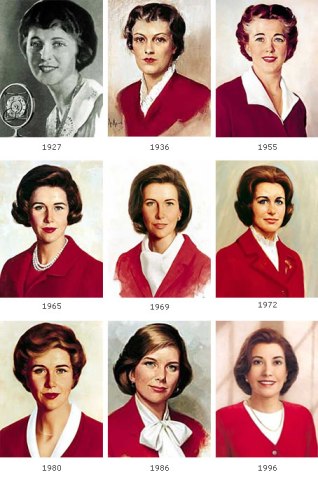
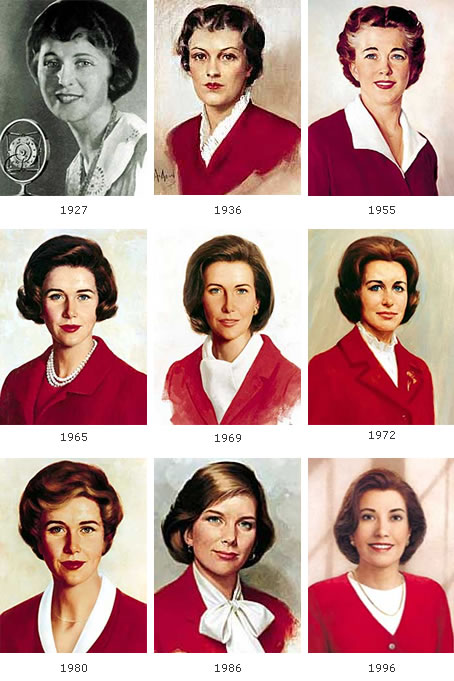
Created in 1921, the name and face of Betty Crocker has appeared in American grocery store aisles, pantries, and cookbooks for more than 90 years. Betty Crocker was developed as a “live trademark” by Marjorie Child Husted for Washburn Crosby, the company that made Gold Medal flour and would become General Mills. The Betty Crocker character formed bonds between customers and brands at a time when convenience cuisine was in its infancy, but primed to grow quickly.

A combination of fantasy and reality, Betty Crocker was an instructor of modern cuisine who offered tips, recipes, and packaged products to assist housewives to achieve success in the kitchen. Betty Crocker imparted advice in a way that valued a housewife’s efforts, respected her intellect, and instilled confidence. Betty Crocker assured even the most novice baker,

I guarantee a perfect cake every time you bake – cake after cake after cake.

Artist Neysa McMein painted Betty Crocker’s first official portrait in 1936, portraying an attractive yet stern countenance that exudes a calm confidence. Updated throughout the decades of the twentieth century, General Mills contends that Betty Crocker’s images reflect the look and character of the women who are her customers — at least the white ones anyway. Appearing in print and on food packaging, the radio, and for a short time even television, Betty Crocker is an icon of American packaged-food cuisine.

2. Pillsbury Cake Mix, 1949

Expressing love, requiring effort and skill, and demonstrating feminine mastery, cakes communicate potent symbolic meaning. A challenge for many a housewife to execute, cake mixes provide a prime example of an early convenience food product. First introduced in 1931, mixes simplified the cake baking process and promised a successful result, no matter the baker’s experience. As this advertisement demonstrates, a woman’s baking ability was also read as subtext for her ability to please her man and fulfill her feminine duties, inside the kitchen and out.

Food marketers also emphasized how convenience products made even complicated cooking, such as baking a cake, quick and easy. The white and chocolate fudge Pillsbury cake mixes featured in this advertisement required the cook to simply add milk to the mix. This approach did not thrill housewives, however, as cake mixes effectively engineered out the culinary labor that women felt was their moral, social, and emotional responsibility. Psychologist and marketing expert, Ernest Dichter, posited the “egg theory”—that allowing women to add eggs to the mix would ensure that they felt they had more fully fulfilled their cooking responsibilities.

Whether adding eggs satisfied housewives or fresh eggs were simply superior to the dried eggs found in complete mixes, this change thoroughly popularized cake mixes. By 1953, shoppers spent more than $150 million a year on these powdered products. A Pillsbury executive recalls the phenomenon saying,

Those were the days when cake mixes were miracles; when using them was like having the essence of the modern world in your own kitchen (Shapiro 2004: 73).

3. The Mixer, Hand Mixer and Blender Cookbook, 1955

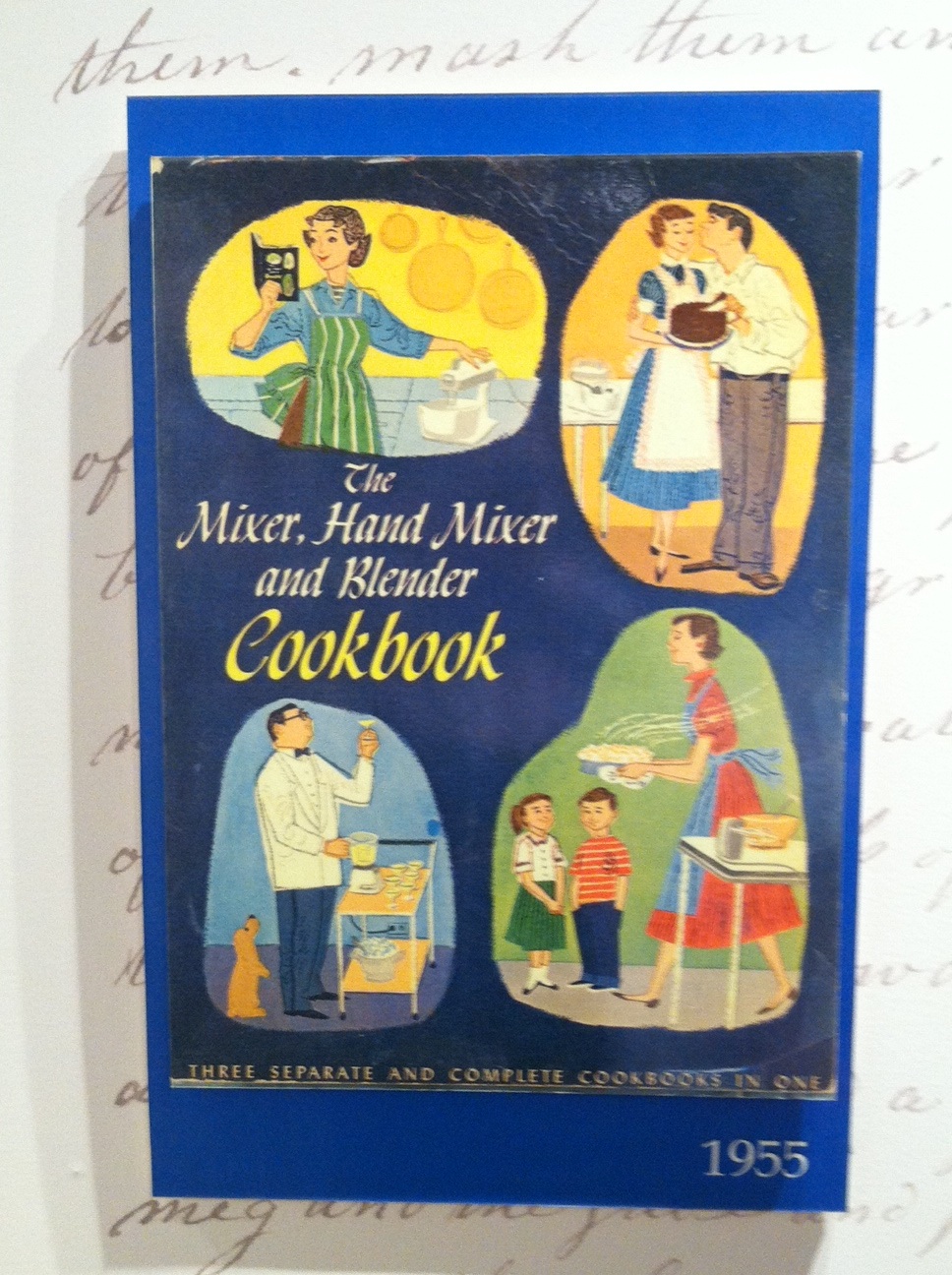
Photo taken by author at the Johnson & Wales Culinary Arts Museum

Kitchen technology ruled the 1950s domestic space, promising to make a housewife’s work quick and easy. While the decade’s fascination with technology resulted in many new, specialized kitchen gadgets, Ruth Schwartz Cowan asserts that such devices did not reduce the housewife’s labors, but rather elevated expectations for cleanliness and overall execution.

The Mixer, Hand Mixer and Blender Cookbook demonstrates the use of three kitchen gadgets that have earned a permanent place in many an American kitchen. The blender in particular won over gastronomes, including Julia Child and Alice Toklas.

The cover of this cookbook also communicates the binary gender stratification of cooking in the 1950s. As shown in the images on the right, women cooked out of a sense of responsibility and often as expected expressions of love for husbands and children. A subset of cookbooks targeted brides specifically, coaching young anxious women how to correctly fulfill housewifely duties. This cookbook cover also depicts the iconic American housewife of the 1950s: slim, coiffed, and nonplussed, she happily and effortlessly performs her domestic labors.

With such fantasies to live up to, it is no wonder that women of the time experienced identity anxiety, sought short cuts to cooking, and explored other venues in which to express themselves.

4. The Can-Opener Cookbook, Poppy Cannon, 1953
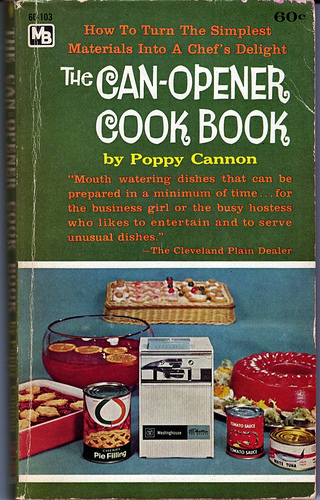
Among the many social changes of the 1950s, a growing number of women worked outside of the home. These workingwomen comprised Poppy Cannon’s target audience for sophisticated convenience food, recipes for which were immortalized in The Can-Opener Cook Book. While James Beard considered Poppy Cannon and her can-opener cooking the symbol of “everything that was wrong with American cooking in the postwar era” (Shapiro 2004: 5), Cannon’s food work tells a far more complex story about women and cooking in the 1950s.

While canned foods had been widely available across the United States since the nineteenth century, the 1950s packaged-food cuisine ushered in a time when complete meals were created by opening cans and mixing the contents. While modern diners may cringe at the recipes, wary to taste them, can-opener cooking demonstrates the concepts of “creativeness” and “glamorizing” (Shapiro 2004). Cooking with bland-tasting canned goods, housewives engaged their creativity to “doctor up” the contents, ensuring a tasty result. Furthermore, glamorizing ensured that sophisticated haute cuisine was within reach for every housewife, for aspirational recipes emphasizing presentation could be made from packaged ingredients.

The “original gourmet in a hurry,” Poppy Cannon popularized what she and her readers considered sophisticated convenience cooking, allowing particularly working women the flexibility and support to cook luxurious meals using shortcuts. Through the years, Cannon wrote for Mademoiselle, House Beautiful, and the Ladies Home Journal and published several cookbooks. Her cooking advice embodies the loaded food choices that women could make in the 1950s, perhaps none more important than: to cook or not to cook?

5. Model Kitchen, 1953
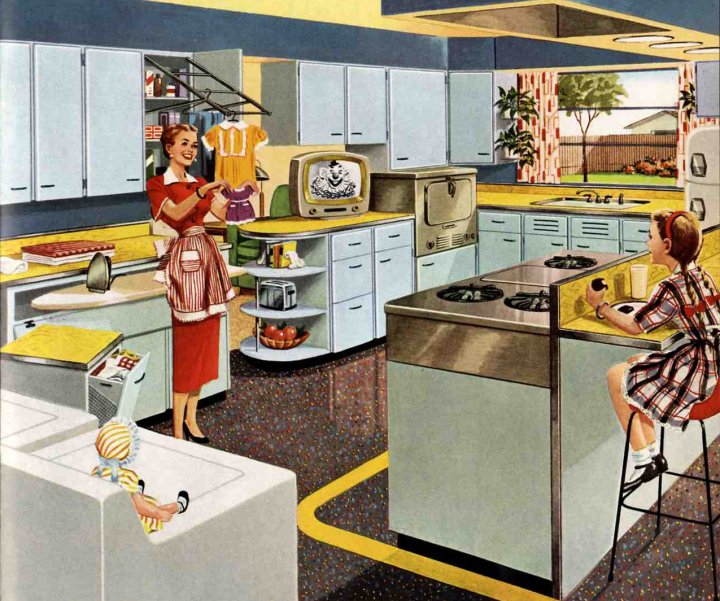
Kitchens are powerful sites of American mythmaking from dutiful, nonplussed housewives to well-behaved children and unified families. In the 1950s, the American landscape changed with the rise of suburbs and single-family homes. Subsequent changes in kitchen design resulted in larger kitchens with open floor plans, freeing women from a small, secluded room of servitude, and giving them a gadget savvy command center for the home.

As a locus of consumer desire and symbol of middle class comfort, the kitchens of the 1950s took on a more substantial role within the home. Kitchens also became spaces for fashion and feminine expression. As depicted in this image, model kitchens, and the salesman who retailed them, encouraged women to “dress” their kitchens in the latest fashions, as they did themselves. This particular image further feminizes the space, featuring a slim and attractive housewife, a cute and attentive daughter, and an alert baby doll on top of the washing machine.

In the 1950s, kitchens also came to symbolize prosperity and patriotism. For example, the 1957 Paris Exhibition of the Future featured “Frigidaire’s Dream Kitchen of Tomorrow.” Furthermore, the dream of the “American techno-kitchen,” immortalized in the 1959 “Kitchen Debate” between Vice President Richard Nixon and Prime Minister Nikita Khrushchev, stands out as a powerful example of the kitchen as a symbol of status and the success of consumer capitalism.

The American kitchen of the 1950s embodied the ideals of the decade—freedom, consumerism, and materialism—and laid the foundation for kitchens to follow and the women who cooked in them.


Any reader interested to learn more on this topic should read Laura Shapiro’s wonderful book, Something From the Oven: Reinventing Dinner in 1950s America.
These Are a Few of My Favorite Things…About Julia Child

Image from: http://www.radcliffe.harvard.edu/event/2012-siting-julia-symposium

Photo by Paul Child; Image from Schlesinger Library at the Radcliffe Institute for Advanced Study

Drawing record crowds, Siting Julia, a day-long symposium hosted by the Schlesinger Library at the Radcliffe Institute for Advanced Study at Harvard explored three sites of Julia’s life: Post–World War II Paris; Cambridge, Massachusetts; and national television.

Rather than regale you with a play-by-play of the day, I’ll instead share the four most wonderful things about Julia that I took from this symposium:

Her Personality 

Keynote speaker Laura Shapiro (author of Perfection SaladSomething from the Oven, and Julia Child) recounted what Paul Child called “Juliafication” — the phenomenon by which Julia’s warmth and attention lit up those around her. While many speakers discussed Julia’s caring, generosity, and sense of humor, Dana Polan (professor of Cinema Studies at NYU’s Tisch School of the Arts and author of Julia Child’s “The French Chef”) credits Julia’s personality for her success on television. And Lisa AbendTIME correspondent in Spain, argues that we have Julia to thank for transforming food into entertainment.

Her Love of Learning

Julia Child in her Cambridge home office, 1963; photo by Paul Child from the Schlesinger Library’s Julia Child Papers

Julia was the eternal student. Alex Prud’homme (Julia’s grandnephew and coauthor with her of My Life in France) spoke of how even at the age of 91, Julia was planning her next project — from learning to butcher in Chicago to teaching children to cook. He also discussed how seriously Julia approached recipe writing; each recipe is a short story full of comfort and wisdom.

Michela Larson, a longtime restaurateur in Cambridge and Boston, told of Julia counseling one of her cooks, saying one does not have to go to culinary school to learn about food. The experience of cooking, working with food and under noted chefs, carried just as much weight with her. Julia’s own commitment to learning influenced her belief that cooking can be taught, a tenet central to her books and television shows.

As a student in the MLA in Gastronomy Program, I am indebted to Julia’s lifelong love of learning as it helped to spawn the program in which I now study.

Her Moderate Approach to Food

While Julia is often heralded for her focus on fresh ingredients, her ideas on food were far ranging, often diverging from those currently endorsed by foodies and alternative food movement advocates. For example, she found organic food elitist, thought McDonald’s French fries and Burger King hamburgers were the best, argued we ought not to worry about GMOs, and supported MSG. One of her favorite snacks, Pepperidge Farm goldfish crackers, was served at the reception following the symposium. Julia did not see the point in vegetarianism, and according to Jane Thompson, who equipped Julia Child’s television kitchen and came to know her well, Julia once told her hair dresser,

I’m a card carrying carnivore. I eat anything and everything in moderation.

We would all do well to live by her mantra of moderation and openness to new experiences.

Her Contributions to Women’s Issues

Keynote speaker Laura Shapiro, argued that Julia Child taught Americans to not belittle women in their domestic roles, and that her legacy is how she created a new way to be a woman that included a kitchen. Dorothy Shore Zinberg, an astoundingly well-rounded academic who was one of Julia’s Cambridge friends and neighbors, also discussed Julia’s contributions to women’s issues. She contended that Cambridge was a ripe environment for Julia the person, Mastering the Art of French Cooking the book, and The French Chef the TV show because Cambridge was a town full of unemployed and underemployed women with PhDs who cooked and loved food as an intellectual outlet.

Julia Child began cooking on television the same year that Betty Friedan published The Feminine Mystique. Both women stand as key figures engaging in women’s issues, albeit in different ways. As artifacts of an amazing woman, Julia Child’s books, papers, and television shows now tell us the story of a woman who found her destiny and chose to fulfill it in the kitchen. So often credited with elevating food in America, Julia also elevated cooking and the women who do it.

– – – – – – – – – – – – – – – – – – – – – – – – – – – – –

Can’t get enough Julia? Here’s more:

  • The Boston University Metropolitan College Programs in Food, Wine & the Arts will celebrate Julia Child’s centenary over the course of two festive evenings – Tuesday, October 2 and Wednesday, November 7. Visit the program website for further details.

A Food News Round Up You Can ‘Smell’

Image from: http://www.xpress.com/Personals/wp-content/uploads/2012/04/Smell-Lemons.jpgI enjoy studying food, catching up on food-related news, and witticisms, which is likely a combination that some readers will enjoy and will leave others scratching their heads.

Fair warning, such may be the case for this edition of Food News Round Up, which covers:

  • Stanford’s recent study on organic food
  • McDonald’s menu labeling press coverage
  • Election 2012 and the role of food in politics
  • Latest food trends of the moment
  • Leftover food news

By the end, you’ll have engaged in a tasty selection of the last couple of week’s worth of food-related news — and what better way to engage all of the senses as you read the news than to spell out “smell” in the process?

Stanford’s Organic Food Study

I’d be remiss to not say something about the recent Stanford meta-analysis of 237 studies that concluded that eating organic offers few health benefits, so I’ll just go ahead and get that out of the way first:

Regardless of what you make of the evidence, if you want to buy organic when you can (and when it counts the most pesticide-wise) the Environmental Working Group’s shopper’s guides are great consumer resources.

McDonald’s Menu Labeling 

While calorie labeling on chain restaurant menus will be required as part of federal health care reform, McDonald’s recently announced that they’re making the change early and reaping a slew of press for it:

Election 2012, Food, and Politics

While Herbert Hoover apparently never promised “a chicken in every pot,” food continues to play a role in contemporary American politics:

  • NPR’s the Salt discusses how Yelp reviewers slice and dice the politics of pizza.
  • The LA Times chews on Obama’s pizza man, Romney’s doughnuts, and the politics of food.

Latest Food Trends

While the foodscape is continually changing, here are a few trends of the moment:

Leftover Food News

This happens every Food News Round Up: some nifty bits of food news don’t fit into a nice and neat category, and I can’t help but share them with you — and this time, we’ll finish spelling “smell” to boot.

Lobster Night at Boston University: Creating Community through Regional Foodways and Symbolic Consumption

It’s that time of year again for Boston University Lobster Night. Held annually in the dining halls, Lobster Night welcomes students to campus and a new school year, with a festive New England-themed dinner. This year’s event takes place this Thursday, on September 13 in the main dining halls across campus, and is open to students and the public.

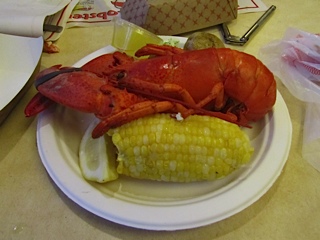
Lobster Night Meal

Lobster Night serves as both a community celebration of regional foodways and an academic indoctrination through food, teaching lessons that will aid students in the classroom and beyond. By sharing a locally sourced, celebratory meal together, students are transformed into a cohesive student body, grounded in the common culture of Boston University and the region of New England. Consuming lobster, an exotic other for many new students, and an iconic symbol of New England (Lewis 1998), is an intimate sensory experience that creates a lasting community memory that helps students to develop a spirit of exploration and openness.

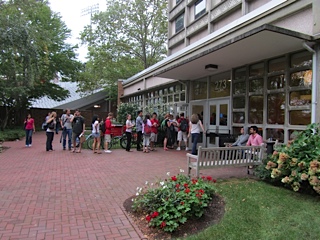
A line stretches outside the dining hall on Lobster Night, September 2011

Touted as the “Event of the Year” for Boston University Dining Services (BU Dining), Lobster Night began in 1985 and has grown to now serve approximately 8,000 lobsters at dining halls across campus (Fichera 2011). When I attended Lobster Night 2011, the dining hall was a frenzied environment, filled to capacity with lines stretching out the door. Once inside the dining hall, students attempted to form lines at several stations serving the lobster dinner; the lines oft converging into one dense crowd.

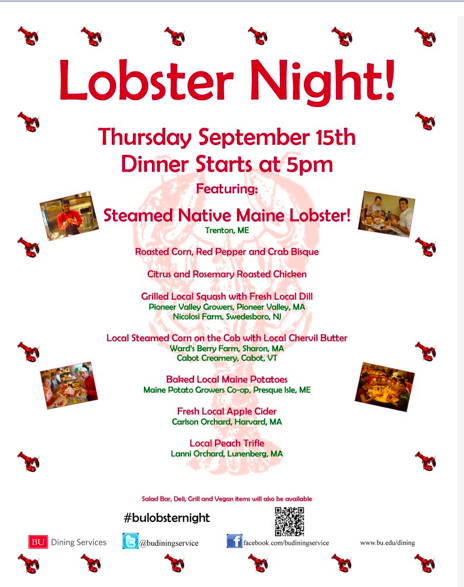
Once at the front of the line, each student exchanged a ticket for a thick paper plate of “Steamed Native Maine Lobster” from Trenton, Maine, accompanied by “Local Steamed Corn on the Cob with Local Chervil Butter” from Ward’s Berry Farm in Sharon, Massachusetts and Cabot Creamery in Cabot, Vermont, and “Baked Local Maine Potatoes” from the Maine Potato Growers Co-op in Presque Isle, Maine. Additional local items included “Grilled Local Squash and Fresh Local Dill,” “Fresh Local Apple Cider,” and “Local Peach Trifle.” The menu also featured a regionally iconic, but not locally sourced “Roasted Corn, Red Pepper and Crab Bisque.”

Lobster Night Menu

By featuring locally sourced, regional cuisine, Lobster Night fosters “local patriotism” (Tuan 1974: 101, quoted in Bell 1997: 149) among the students in attendance, which manifests in knowledge of New England foodways, a connection to the culture of the region, and a commitment to Boston University. Serving locally sourced items also places each food within the context of a distinct farm, city, state, and region. This literal connection to New England’s soil and water bodies connects the eater to not only the food item, but also to the region and its food culture. For a student new to Boston University and the region, the consumption of local foods of regional significance aids in creating a new sense of home and belonging.

Navigating the crowd grasping a plate piled high, students stake out places to sit like city drivers seeking available parking. Once seated, Lobster Night serves as both a rite of “conspicuous consumption” (Neustadt, 1992:151) and a “seasonal rite of passage” (145). While, at first glance, a jovial and messy dinner, Lobster Night is also a highly symbolic event. First, Lobster Night unifies both insiders and outsiders into a cohesive body. This unification process includes induction to not only eating lobster, but also to Boston University and New England. Second, through eating lobster, new students literally consume a symbol of New England, which makes them figurative citizens of a new region. In this case, consuming the exotic other, a lobster, is an intense sensory experience and a highly memorable undertaking.

For students, and all diners for that matter, eating lobster for the first time can be an intimidating experience requiring new knowledge, including the use of unfamiliar tools, and a willingness to look and feel a bit silly wearing a bib and eating messily. While some food festivals specifically target and welcome insiders — those with expertise or passion for the festival’s main foods — Lobster Night enthusiastically welcomes outsiders, particularly those who may have never before eaten lobster. Eating a lobster is tactically intimate. While students experience the crab in the bisque from a distance, separated from the seafood by the eating utensil, the spoon, this is not the case with the lobster.

Eating lobster requires an adventurous eater, open to new experiences, qualities that will also serve students well in their academic pursuits. The adventure begins by extracting meat from the shell, which requires firmly holding the lobster with one hand and pulling the lobster’s limbs from its body with the other hand. The eater then crushes, cracks, and literally imparts violence upon the crustacean, using the potent lobster cracker.

This tactile experience also lends itself to play. At Lobster Night, several students held up their lobsters, making them talk to one another like dolls, and many squealed and giggled in surprise and delight when juice squirted into the air as they dismembered their lobsters. By participating in the overtly sensory experience of eating a lobster, students fully partake in a regional ritual and actually ingest a symbol of regional identity. In doing so, students become unified as a group and linked to the university, and the region, in a memorable way.

In speeches and messages shared each fall, university leaders encourage students to be active and engaged citizens, to explore their city, and to be students of the world. Boston University also imparts this message for one evening through lobster, speaking to students through foodways, inviting them to feel at home within the Boston University family and in New England, and to lay down a solid foundation for their collective academic journey.

 References

  • Bell, David & Gill Valentine. (eds.). 1997. “Region” in Consuming Geographies: We Are Where We Eat. New York: Routledge: 145-162.
  • Fichera, John. 2011. “Lobster Anyone?” BU Today, September 15. Accessed September 15, 2011.
  • Johnston, Josée & Shyon Bauman. 2010. “The Culinary Other: Seeking Exoticism.” In Foodies: Democracy and Distinction in the Gourmet Foodscape. New York: Routledge.
  • Lewis, George. 1998. “The Maine Lobster as Regional Icon: Competing Images Over Time and Social Class.” In The Taste of American Place: A Reader on Regional and Ethnic Foods. Edited by Barbara Gimla Shortridge and James R. Shortridge. 65-84. Lanman: Rowman and Littlefield Publishers Inc.
  • Neustadt, Kathy, 1992. Clambake: A History and Celebration of an American Tradition. University of Massachusetts Press: Amherst.

Chewing on the ‘Last Supper’ in “Drive” -OR- Viewing Ryan Gosling Through a Food Studies Lens

Today is Labor Day, marking a transition in the year and the pace of my life. The fall semester starts tomorrow, which means I’m equally excited to start my study of Food Anthropology with Carole Counihan and US Food History with Warren Belasco — and fearful that I might be crushed beneath the weight of my academic course load, working full time, studying for the cursed GRE, and applying to PhD programs.

What this means for you is that I’ll happily continue blogging, but likely only once a week. So please do continue to visit me, but know I’ll only be posting new content on Mondays — like today! 

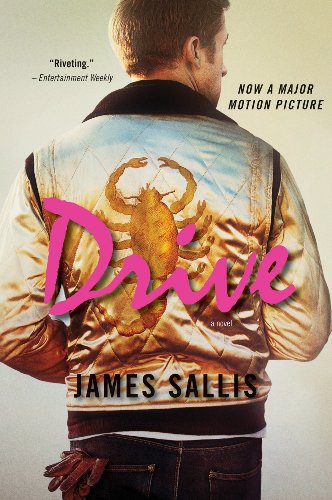
Image from: http://i-want-to-read-you.tumblr.com/post/26905245867/drive-james-sallis-much-later-as-he-sat-with

Drive (2011), directed by Nicolas Winding Refn, turned out to be a film that viewers either adored or loathed. My husband and I were in the adoring camp — and not just because we both have huge crushes on the Gosling.

After seeing the film, we read James Sallis’ novel by the same name on which the film is based. As is always the case, the novel provides far more context and depth to the character of Driver. The role of food in the final scene also struck me.

In the novel, after many deaths have occurred, Driver’s antagonist, Bernie Rose, invites him to dinner. They meet at Warszawa, a small 1920s Craftsman bungalow with hardwood floors, large, double-hung windows, French doors, and lace curtains converted into a Polish restaurant — an unexpected setting for a meeting between two violent men settling some very bloody business. [In all honesty, it sounds a lot like the restaurant where we had our wedding reception].

The irony does not end there. When Driver arrives, Rose has already started drinking wine, a Cabernet-Merlot blend, revealing himself as a bit of a wine connoisseur. As he pours a glass for Driver, he shares his wine knowledge, commenting on the current state of the wine industry and the new wines coming in from Chile, Australia, and the American northwest. Notably, the first words shared during this meal are not about the murders that have taken place or the uncertainty of these two men’s future, but about wine.

After introducing Driver to the wine, he starts with the menu, saying,

I can recommend the duck. Hell, I can recommend everything. Hunter’s stew with homemade sausage, red cabbage, onions, and beef. Pierogi, stuffed cabbage, beef roulades, potato pancakes. And the best borscht in town—served cold when it’s hot outside, hot when a chill comes on. But the duck’s to die for. (p. 153-54)

As occurs in many mafia movies, Rose is passionate about food, as we can see in how he describes a menu that he has enjoyed for nearly two decades. The phrase “to die for” seems a bit odd coming from a boss of organized crime, but perhaps it is meant to create trust, intimacy, and rapport with Driver?

They both end up ordering the duck, though Driver wonders if he has ever in his life eaten duck before. It is a new gastronomic experience for him, but one that he enjoys. As Driver meets with the man responsible for ordering multiple attempts on his life, Rose is also Driver’s Virgil on this journey in fine dining.

Over the course of the meal, these two men relax into an unexpected rhythm:

Working their way through a second bottle of Cabernet-Merlot and the second inning of this expansive meal, ordinary life going on about them, they’d landed for the moment on a kind of island where they might pretend to be a part of it. (p. 155)

Using the language of driving, which guides most of the narrative, Sallis describes their after dinner experience as “cruis[ing] into coffee and cognac” (p. 155). Following the meal, they leave the building and walk to their cars. But when they reach to shake hands, [SPOILER ALERT!] Rose holds a knife intent on killing Driver, but Driver is able to instead kill Rose.

This ‘last supper’ is not included in the film adaptation. Driver and Rose instead meet in a large and ornate Chinese restaurant with heavy red hues, where they do not eat or drink, and only discuss business.

The non-existent ‘last supper’ as it transpires in the film adaptation of “Drive.”

Let us ponder then, what this last supper means in the book:

  • What does it mean for these two grave enemies to share a meal together, discussing only pleasant, and often gastronomic, topics?
  • It is relevant that Rose invites Driver to a small, family-run restaurant at which he has dined himself many times. Is this a hospitable action? Is this a moment when a mature gangster shows a young buck one good meal before he plans to kill him? Is this meal a gift? A farewell? A long, slow warning?
  • A theme I’ve observed in other films, such as Pulp Fiction and A History of Violence (check out my blog post on food in A History of Violence here), is that food can serve as an “appetizer” of sorts for scenes of violence. Is this meal thus a sensory lead in for the violence that follows; a similar yet different engaging of the senses?

I’m obviously still chewing on the meaning of this ‘last supper,’ but you’re welcome to join in my ruminating — and to enjoy the film. If nothing else, you’ll get a delightful dose of Ryan Gosling through a food studies lens or otherwise.

Can Culinary Diplomacy Achieve World Peace? Maybe…

While I can’t agree with all governmental policy, I’m a huge fan of the U.S. Department of State’s new Diplomatic Culinary Partnership Initiative. Secretary of State, Hillary Rodham Clinton, explains:

Showcasing favorite cuisines, ceremonies and values is an often overlooked and powerful tool of diplomacy. The meals that I share with my counterparts at home and abroad cultivate a stronger cultural understanding between countries and offer a unique setting to enhance the formal diplomacy we conduct every day.

Image from: http://www.archives.gov/publications/prologue/2011/summer/whats-cooking.html

President Lyndon B. Johnson’s first state dinner, a Texas-style barbecue. Subsequent casual meals led to the term “barbecue diplomacy.” (Lyndon Baines Johnson Library)

As a food studies student, I couldn’t agree more that meals are rituals full of cultural meaning and unspoken dialogue, providing endless opportunities for developing understanding and connection. Every element speaks, such as: what foods are served; how the meals are prepared, plated, served, and introduced; who prepares the meals; and where the ingredients come from.

From the Kennedy’s Continental flair with French White House chef, René Verdon, to LBJ’s barbecue diplomacy — not to mention George W. Bush’s own version of barbecue diplomacy — culinary diplomacy has been informally utilized for decades. On September 7, 2012, however, the U.S. Department of State and the James Beard Foundation will formally announce their partnership and the launch of the Diplomatic Culinary Partnerships initiative, working to create global understanding through food.

Read More about the Diplomatic Culinary Partnerships Initiative

Which Came First: The Fear of Cholesterol or the Egg?

Image from: http://www.thereformedbroker.com/2012/08/06/chicken-or-the-egg-the-actively-managed-etf-problem/One of the reasons I went to public health school was because the public tends to think that eating well is a complicated endeavor from a nutrition perspective. If one allows herself to be buffeted by the waves of new research studies with their ever-conflicting results, then yes, eating well does become a daunting task.

New research on eggs has brought these thoughts to the forefront, yet again. Hence, I quip, which came first: the fear of cholesterol or the egg? If you’re not familiar with the flip-flopping advice to either abstain or enjoy eggs, here are a few (totally randomly selected) studies that demonstrate the ever-oscillating status of eggs in the American diet.

  • 1958: First published in 1928, Nutrition: In Health and Disease, a reference collectively written by Lenna Cooper, Edith Barber, Helen Mitchell, and Henderika Rynbergen—which I bought at a used bookstore in Duncan, Oklahoma—imposes no limits on egg consumption, rather recommending, “The ideal standard is 1 egg a day if possible.”
  • “Nutrition: In Health and Disease” (1958) pictured with one of my favorite antiques, an 1856 print titled “Winter Fashions”

    1999: The International Task Force for the Prevention of Coronary Heart Disease recommended limiting egg consumption to two eggs per week. You can read the full text article here. [If you’re anything like me, you get a bit of a thrill over FREE full text articles.]

  • 2001: A meta-analysis of 17 studies confirmed that dietary cholesterol increases the ratio of total to HDL cholesterol and came to the remarkably wishy-washy conclusion that “the advice to limit the consumption of eggs and other foods rich in dietary cholesterol may still be important in the prevention of coronary heart disease.” [Despite its frustrating conclusion, you can still read the FREE full text here.]
  • 2012: And then BAM! A new study released this month found that eating egg yolks regularly increases plaque buildup about two-thirds as much as smoking does.

So what’s an egg-loving girl to do? Unless you’re a bodybuilder (like my darling husband) and eat dozen-egg breakfasts during training, Cool Hand Luke betting you can eat 50 eggs in a single sitting, or Rocky drinking raw eggs upon waking, your egg consumption is likely a non-issue. Truthfully, there’s more compelling evidence for being concerned with eggs from a food safety perspective than for their cholesterol effects. [You can read up on egg food safety on Marion Nestle’s awesome blog, Food Politics.]

The key to a healthy diet consistently recommended throughout history, however, is moderation and balance. Love your eggs. Eat them. Just eat other things as well. A life of only omelets will grow boring. Your outlook and your cholesterol levels may both benefit from the spice of life—variety.

Eat Up: ‘A History of Violence’ Sandwich

While by no means a “food film,” food plays an interesting role in David Cronenberg’s A History of Violence (2005), a marvelous film — albeit as you can likely deduce from the title quite, ahem, violent. I’ll focus on two food-centric scenes, which sandwich much of the violent action of the film.

Image from: http://www.brego.net/viggo/movies/history-violence/?gallerycatId=41&galleryimageId=280

Stall’s Diner and Tom Stall, played by the always amazing, Viggo Mortensen

A man with a history of violence, Tom Stall, played by Viggo Mortensen, has a new family-centric, pie-serving, church-going, All-American life, which is astutely symbolized in the business he owns, Stall’s Diner. As discussed in the BBC News article, “Why the Diner is the Ultimate Symbol of America,” a diner proves to be the perfect food-centric foil to the violence of Tom’s past.

The freshly wiped-down surfaces, the democratic side-by-side seating at the counter, the ever-flowing coffee on the warmer, the simple “open” sign on the door, and the “friendly service” tagline on the sign that marks the storefront — all of these features clearly delineate the wholesome character of Tom, the loving Stall family, and the small, supportive community in which they live. The Main Street diner also serves as a poignant setting and a powerful polar opposite for the unexpected bloody acts that occur at the diner counter.

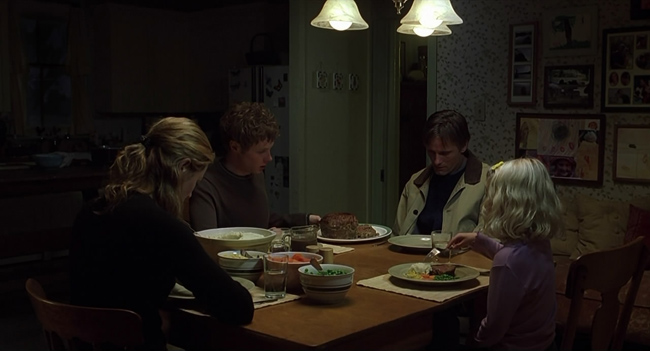
Another supremely wholesome food scene concludes the film. After the violence has concluded, Tom returns to his home, where his wife and two children are seated at the dining table for an All-American, comfort food meal of homemade meatloaf with mashed potatoes, corn, peas, and carrots. Serving these particular foods is meaningful. Imagine how the scene would read differently if the family ate McDonalds, TV dinners, or, say, an “ethnic” dish, such as enchiladas or lo mein. Just as the diner symbolizes a red-white-and-blue-America-on-Main-Street unity and prosperity, so does the homemade meatloaf.

Image from: http://febriblog.wordpress.com/2009/12/30/the-50-best-films-of-the-2000s/

The dinner scene that concludes ‘A History of Violence’

It is also through the language of food that Tom is welcomed back into his family. Rather than get up from the table and hug him, his daughter instead retrieves his place setting, welcoming him not only to the meal, but also back into the family. His son also engages in this unspoken dialogue, as he passes his father the meatloaf. We’re left with an element of painfully perfect ambiguity as the film cuts to black before Tom’s wife makes any meal-related gesture or before the family engages in the communal ritual of eating together.

While we are left to wonder exactly what will happen to the Stall family, the scenes in the diner and round the dinner table eloquently use food-centric devices to characterize this family and the intense, unexpected events that befall them.

Food News Round Up: On Obesity, Eating Rodents, & the Economy (Yes, in that order)

Image from: http://hardboiledpoker.blogspot.com/2011/12/break-in-brouhaha-and-beginning.htmlThe past couple of weeks have provided fecund fodder for the food news enthusiast.

Any fan of the CDC’s year-by-year ever-increasing obesity map will be intrigued that the 2011 data was released recently, alongside other obesity news. The news also turned up studies of disgust, which you can explore firsthand in articles on cooking up rat and squirrel. And finally, the struggling economy continues to affect life in the U.S. and abroad, especially dining trends.

So, dig in to this edition of Food News Round Up…

Food and Obesity

Obesity remains a key issue both culturally and politically, especially with the release of the CDC’s most recent obesity statistical analysis.

Food and Disgust

Disgust is an always interesting element of eating. Would you consider rat or squirrel?

Food and the Economy

As the ‘Great Recession’ continues to be felt by citizens across the globe, the restaurant industry also tightens its belt.

Delightful Leftovers

These tidbits of food news defy categorization this week, but should still satisfy.

This post was originally published as part of a recurring feature called ‘Food News Round Up’ on the Gastronomy at BU blog